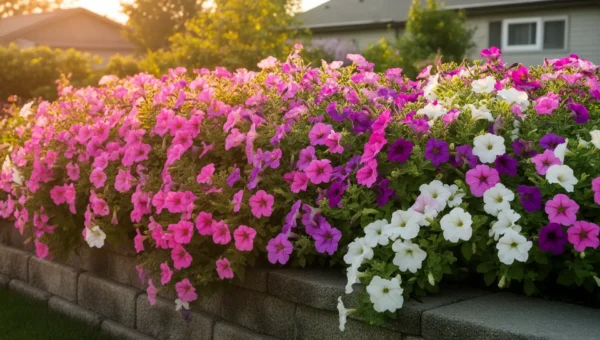
The Complete Petunia Care Guide: Watering, Feeding, and Deadheading for Non-Stop Summer Blooms

Most petunias stall by midsummer — here’s why, and the weekly schedule of watering, feeding, and deadheading that keeps them blooming through frost.
Petunias bloom hundreds of times over a season, yet midsummer collapse — leggy stems, fewer flowers, yellowing leaves — hits gardeners who followed every standard recommendation. The problem isn’t neglect; it’s that standard recommendations leave out the biology.
Three mechanisms explain most petunia behavior: ethylene signaling that stops blooming when spent flowers go unremoved, a soil pH threshold above which iron locks into unavailable forms, and fundamental differences between seed and vegetative petunia types that make identical care approaches produce very different results. This guide covers all three, alongside the practical schedules that keep petunias performing from late May through frost.
Petunia Types: Choosing the Right Plant for Your Conditions
The four main petunia groups have different heat tolerances, bloom sizes, and maintenance needs. Choosing the wrong type for your climate or container setup is the most common starting mistake.
| Type | Bloom size | Heat tolerance | Self-cleaning? | Best use |
|---|---|---|---|---|
| Grandiflora | 3–5 inches | Low | No | Cooler climates, zones 3–6 |
| Multiflora | 2–3 inches | Medium | No | Most climates, bedding |
| Milliflora | 1–1.5 inches | Medium | Yes | Containers, edging |
| Wave/Spreading | 2 inches | High | Yes | Hanging baskets, ground cover |
| Vegetative (Supertunia) | 2–3 inches | High | Yes | Containers, hot climates |
The most important distinction is between seed petunias and vegetative petunias. Grandifloras and most multifloras are grown from seed each year and require weekly deadheading to stay in bloom. Vegetative types — sold as branded names like Supertunia, Easy Wave, and other Proven Winners series — are propagated from cuttings and are genetically self-cleaning: they abort spent flowers before seeds develop, which sidesteps the ethylene mechanism that causes seed petunias to stall. If you’re growing a branded vegetative variety, you can skip weekly deadheading entirely and focus on the midsummer cut instead.

Three pre-planned garden beds, free
Stop staring at empty beds: printable plans with exact layouts, plant lists and planting calendars — yours free from the Garden Library.
Grandifloras produce the largest individual blooms but are the first to suffer in heat and humidity. Clemson Cooperative Extension notes they underperform in hot summers compared to multiflora and spreading types — zones 7–9 gardeners get more consistent results with Wave or vegetative types. Spreading Wave petunias extend 2–4 feet by midsummer, making them excellent for filling large containers and slopes but overwhelming in a 10-inch pot.
Petunias are closely related to calibrachoa, but the care requirements diverge more than the appearance suggests. See our petunia vs. calibrachoa comparison for a detailed breakdown.
Planting: Timing, Soil pH, and Spacing
Plant petunias once soil temperature reaches 60°F and your last frost date has passed. In zones 5–6, that usually means mid-May; in zones 7–9, late April is typically safe. Starting in cold, wet soil stalls establishment and invites root rot — a transplant set out at the right time will equal an early-planted one within two to three weeks.
Soil pH matters more for petunias than for most annuals. The commonly cited target of pH 6.0–7.0 is too broad: petunias specifically need a root zone pH of 5.5–6.2. South Dakota State University Extension classifies petunias as ‘iron-inefficient’ plants — at pH above 6.2, iron oxidizes into compounds roots cannot absorb regardless of how much iron is physically present in the soil. This single chemistry fact explains most recurring yellowing problems. If you’re in an alkaline region (much of the Midwest and Mountain West), test your soil pH before planting.
Prepare the planting bed by working 2–3 inches of compost or peat moss into the top 8–10 inches of soil. Apply a balanced granular fertilizer (8-8-8 or 10-10-10) at 2 pounds per 100 square feet, as recommended by University of Minnesota Extension. In established beds with reasonable fertility, skip the granular application and start liquid feeding after three to four weeks.
Space grandifloras and multifloras 12 inches apart, millifloras 4–6 inches, and spreading types 18 inches or more. Pinch the top inch off transplants at planting time to encourage branching from the base — this single step meaningfully increases bushiness. Skip pinching on millifloras and spreading types, which branch naturally.
Watering: In-Ground vs. Containers
The watering approach that sustains in-ground petunias actively harms container-grown ones, and vice versa.
In the ground, water deeply once per week, soaking the soil 6–8 inches deep. The goal is deep root establishment: roots that reach cool subsoil handle summer heat without visible stress. Shallow daily watering keeps roots confined to the top few inches where they’re exposed to temperature swings and drought. University of Minnesota Extension recommends a minimum of 1–2 inches per week delivered in one or two deep applications rather than daily light waterings.
In containers, daily watering is often necessary by midsummer. Test by pushing a finger into the soil to the first knuckle: if it’s dry, water thoroughly until water drains from the bottom of the pot. Hanging baskets in full sun during peak July and August heat may need watering morning and afternoon.
Avoid wetting flowers and foliage. Consistently wet petals in humid conditions invite petal blight, a fungal disease that browns blooms rapidly. Water at soil level where possible, and if you use overhead irrigation, time it so leaves dry before sunset.
Zone note: In zones 3–5, established in-ground plants typically need watering once weekly after June. In zones 7–9, check soil every two to three days during summer — heat and evaporation can exhaust soil moisture between standard weekly waterings.
Fertilizing: A Seasonal Schedule for Heavy Feeders
Petunias are among the heaviest-feeding annuals in common cultivation. They produce hundreds of flowers over a season and deplete available nutrients quickly, especially in containers where each thorough watering leaches soluble minerals from the pot. Underfeeding is the most common reason petunias slow down after a strong early-season start.
The seasonal schedule that keeps them producing:
- At planting: Balanced granular fertilizer (10-10-10 or 8-8-8) worked into the soil, or a controlled-release product like Osmocote at the manufacturer’s rate.
- May through early June: Begin water-soluble fertilizer every two weeks, applied in place of two regular waterings — not added on top of them.
- June through September: Increase to weekly liquid feeding. NC State Richmond County Extension recommends replacing one or two regular waterings per week with a dilute fertilizer solution as the most effective approach for sustained blooming.
- July (containers): Apply a second controlled-release dose, as the original application typically exhausts in 2–3 months. Proven Winners recommends this mid-season top-up for all container petunias.
One underappreciated caution: keep the phosphorus percentage (middle number on the fertilizer label) at 10 or below. Excess phosphorus binds to iron in the soil, rendering it unavailable to roots even when iron is present. A balanced 10-10-10 or a formula with lower phosphorus like 15-5-15 avoids this; a high-phosphorus bloom booster (15-30-15) can trigger the exact yellowing you’re trying to prevent. For a full overview of formulation choices, see our guide to liquid, granular, and slow-release fertilizers.
Stop missing your zone's planting windows.
Select your US zone and month — get a complete checklist of what to plant, prune, feed, and protect right now.
→ View My Garden CalendarDeadheading: Why It Actually Works
The instruction ‘remove spent flowers to encourage blooming’ appears in every petunia guide. What most guides don’t explain is the molecular mechanism behind it — and knowing the mechanism fixes the most common deadheading error.
When a petunia flower is pollinated, the stigma triggers ethylene production. Ethylene is the primary senescence hormone in petunias: it travels from the stigma through the style to the petals, where it activates programmed cell death. The cascade becomes autocatalytic — each ethylene molecule produced stimulates more ethylene production, rapidly accelerating petal collapse. Research from the National Institutes of Health documents this self-amplifying ethylene cascade as the mechanism driving pollination-induced senescence in ethylene-sensitive species like petunias. This is why a pollinated flower can fade visibly within 24–48 hours.
Deadheading interrupts this cascade by removing the ethylene source before it spreads. The critical mistake most gardeners make: removing only the petals. The seed pod — the small green swelling directly below the petals where the flower meets the stem — is where ongoing seed development and ethylene production occur. NC State Extension specifically instructs gardeners to remove ‘the small bud structure behind the flower,’ not just the flower itself. Snap or cut the stalk at its base, removing petals, calyx, and seed pod together.

Self-cleaning types — milliflora, Wave, Supertunia — abort flowers before seeds set, bypassing this cascade entirely. These types need no weekly deadheading. For a broader look at deadheading across garden plants, see our guide to deadheading flowers.
For seed petunias, deadhead once per week. Plants that fall two or more weeks behind will temporarily stall: deadhead everything, fertilize immediately, and normal blooming resumes within 7–10 days.
The Midsummer Recovery Cut
By mid-July, even well-maintained petunias often become leggy: long bare stems with blooms only at the tips. Terminal stem growth suppresses lateral branching as stems extend, so stretched-out plants produce less overall coverage over time. The fix is a hard cut followed immediately by feeding.
Trim back approximately 20% of the plant’s length in July. For most hanging baskets and containers, that means cutting trailing stems back 3–5 inches. For severely leggy plants with 12-inch bare stems, cut back more aggressively — to within a few inches of the base while retaining some foliage. Proven Winners recommends this 20% trim for Supertunia and similar vegetative types, followed by a water-soluble fertilizer application the same day to fuel the recovery.
Plants typically look sparse for 5–7 days before new lateral growth becomes visible. By 10–14 days after the cut, most petunias emerge noticeably fuller and resume regular blooming. Skipping the same-day fertilizer application after cutting delays recovery by a week or more. A second light trim in September encourages fall flowering as temperatures moderate.
Iron Deficiency: When Yellow Leaves Are a Soil Chemistry Problem
Interveinal chlorosis in the newest leaves — yellow tissue with green veins still visible — almost always signals iron deficiency in petunias. The cause is usually not absent iron but unavailable iron: a pH issue that locks soil iron into forms roots cannot absorb.

Petunias require a root zone pH of 5.5–6.2. South Dakota State University Extension identifies petunias and calibrachoa as particularly iron-inefficient — at pH above 6.2, iron oxidizes into insoluble compounds the plant cannot take up. The standard gardening advice of pH 6.0–7.0 places petunias at the upper edge of acceptable range or above it, which is why iron deficiency is more common in petunias than in most other annuals.
Three fixes in order of speed:
- Chelated iron drench: Apply a chelated iron product (such as Sprint 330) as a soil drench every 3–4 weeks. Chelated iron remains plant-available at higher pH than standard iron compounds. Rinse any product off flowers and leaves immediately — iron leaves brown stains on petals.
- Acidifying fertilizer: Switch to a high-ammoniacal-nitrogen fertilizer, which releases hydrogen ions as it breaks down and gradually lowers pH. This addresses the root cause rather than the symptom.
- Reduce phosphorus: If you’re using a high-phosphorus fertilizer, switch to a balanced or low-phosphorus formula — excess phosphorus binds iron regardless of pH.
In containers, soil pH can be measured and adjusted precisely. In-ground beds in alkaline regions (much of the Midwest, Mountain West, and Southwest) may need annual acidification with sulfur or acidifying fertilizer to maintain the 5.5–6.2 range petunias need.
Pests and Diseases
Two pests cause most petunia damage, but only one gets consistent attention in general gardening guides.
Tobacco budworm is the most destructive petunia-specific pest in North America. The adult is a small greenish-brown moth that deposits eggs directly on flower buds at dusk. Larvae bore into unopened buds and feed from inside, causing buds to fail to open or producing ragged, tattered flowers when they do. By the time damage is visible, the larvae are typically inside buds where contact pesticides cannot reach them. Washington State University Extension documents widespread resistance to many common garden insecticides in tobacco budworm populations.
Effective options: Bacillus thuringiensis (Bt) applied as a preventive before late June, targeting young larvae while they are still surface-feeding. Spinosad is more effective against established infestations but carries bee toxicity — apply only in the evening after pollinators have stopped foraging. Hand-removing visible caterpillars at dusk and dropping them in soapy water works well for light infestations.
Aphids cluster on stem tips and leaf undersides, leaving sticky honeydew that develops into sooty mold. More seriously, aphids vector mosaic viruses that can cause mottled, distorted growth with no cure. Insecticidal soap spray controls most aphid colonies — apply directly to colonies and repeat every 4–5 days. For identification and early detection guidance, see our aphid identification and treatment guide.
| Symptom | Cause | Fix |
|---|---|---|
| Buds fail to open; flowers ragged and tattered | Tobacco budworm larvae boring inside buds | Spinosad (evenings) or Bt before late June; hand-remove visible caterpillars |
| Sticky residue on leaves; black coating developing | Aphids + sooty mold | Insecticidal soap spray every 4–5 days directly on colonies |
| Irregular holes in leaves overnight; slime trails | Slugs or snails | Iron phosphate bait around plant bases; remove daytime hiding spots |
| Brown mushy petals during wet weather | Petal blight (Botrytis) | Improve air circulation; avoid wetting flowers; remove affected blooms immediately |
| Wilting despite moist soil; stem base blackening | Root rot (Pythium or Phytophthora) | Improve drainage; reduce watering frequency; replace plants with severe crown rot |
| New leaves yellow with green veins remaining | Iron deficiency (soil pH above 6.2) | Chelated iron drench; reduce phosphorus; acidify soil to pH 5.5–6.2 |
Seasonal Care Calendar
| Month | Key tasks |
|---|---|
| March–April | Start seeds indoors 10–12 weeks before last frost date; test soil pH; amend if needed |
| May | Plant out after last frost once soil reaches 60°F; pinch transplants; apply granular fertilizer at planting |
| June | Begin weekly liquid feeding; deadhead seed petunias every 7 days removing entire stalk |
| July | Perform 20% midsummer cut; fertilize same day; apply second controlled-release dose to containers; watch for budworm |
| August | Maintain weekly watering and feeding; deadhead seed petunias; scout for aphids and budworm |
| September–October | Light trim to encourage fall blooms; final liquid feeding; take 2–3 inch stem cuttings before frost to overwinter vegetative types indoors |
Frequently Asked Questions
How often should I water petunias in containers?
Check soil moisture daily in summer by pushing a finger 1 inch into the potting mix. If it’s dry, water thoroughly until it drains from the bottom. Hanging baskets in full sun during July and August often need morning and afternoon watering. In-ground petunias need 1–2 inches per week in deep, infrequent applications.
Why are my petunia leaves turning yellow?
Interveinal yellowing in new growth — green veins, yellow tissue — indicates iron deficiency caused by soil pH above 6.2. Apply chelated iron as a soil drench and switch to a low-phosphorus fertilizer. Uniform yellowing of older leaves typically indicates nitrogen deficiency; increase weekly feeding frequency.
Do all petunias need deadheading?
No. Self-cleaning types — milliflora, Wave/spreading, and vegetative brands like Supertunia — abort spent flowers before seeds set and don’t require weekly deadheading. Grandiflora and standard multiflora petunias need deadheading once per week, with the entire stalk including the seed pod removed at its base.
How do I revive leggy petunias?
Cut back approximately 20% of the plant’s length in July, then apply water-soluble fertilizer the same day. For severely leggy plants, cut back to within a few inches of the base while keeping some foliage. New lateral growth appears in 5–7 days; full recovery takes 10–14 days. A second light trim in September encourages fall re-flush.
Can petunias survive winter?
Petunias are perennials in USDA zones 10–11 but are grown as annuals in colder climates. Vegetative types (Supertunia, Wave) can be overwintered by taking 2–3 inch stem cuttings before the first frost, rooting them in water or moist potting mix, and growing them indoors in bright light until spring. Seed-grown grandiflora and multiflora types are not generally worth overwintering.
Sources
- University of Minnesota Extension — Growing Petunias
- Clemson Home & Garden Information Center — Petunia
- University of Florida IFAS Gardening Solutions — Petunias
- NC State Extension Gardener Plant Toolbox — Petunia x hybrida
- NC State Richmond County Extension — Secrets to Petunias Lasting All Season Long
- Proven Winners — Caring for Supertunias
- PMC / National Institutes of Health — Integrated Signaling in Flower Senescence: An Overview
- Washington State University Extension — Petunia: Tobacco Budworm
- South Dakota State University Extension — How to Prevent Iron Deficiency in Spring Greenhouse Plants