

ZZ Plant Care Guide: The Near-Indestructible Houseplant for Any Home

If you have ever killed a cactus, the ZZ plant may be the houseplant that finally changes your relationship with indoor gardening. Zamioculcas zamiifolia — universally known as the ZZ plant — is famous for surviving weeks without water, thriving in dim offices, and carrying on regardless of how neglected it becomes. Native to the drought-prone grasslands and forests of eastern Africa, this evergreen perennial has evolved a clever trick: fat underground rhizomes that store water like a built-in reservoir, letting it ride out long dry spells without a second thought.
The result is a plant that suits almost every home. It tolerates low light, irregular watering, and inconsistent humidity — conditions that would finish off most popular houseplants. It also looks genuinely handsome, with arching stems lined by pairs of thick, waxy, deep-green leaflets that catch the light beautifully.
One thing to be aware of before you bring a ZZ plant home: all parts of the plant contain calcium oxalate crystals, which are toxic to cats, dogs, and humans if ingested. The sap can also cause skin irritation. Always wear gloves when pruning or repotting, and keep the plant out of reach of curious pets and young children.
Quick Reference
| Feature | Detail |
|---|---|
| Latin name | Zamioculcas zamiifolia |
| Family | Araceae (Arum family) |
| Type | Evergreen perennial |
| Hardiness | USDA zones 9–10 outdoors; all zones as a houseplant |
| Height | 2–4 ft (60–120 cm) |
| Spread | 2–3 ft (60–90 cm) |
| Light | Low to bright indirect light |
| Watering | Every 2–4 weeks; very drought tolerant |
| Soil | Fast-draining mix (potting soil + perlite) |
| Temperature | 60–85°F (15–29°C) |
| Toxicity | Toxic to cats, dogs, and humans if ingested |
ZZ Plant Varieties
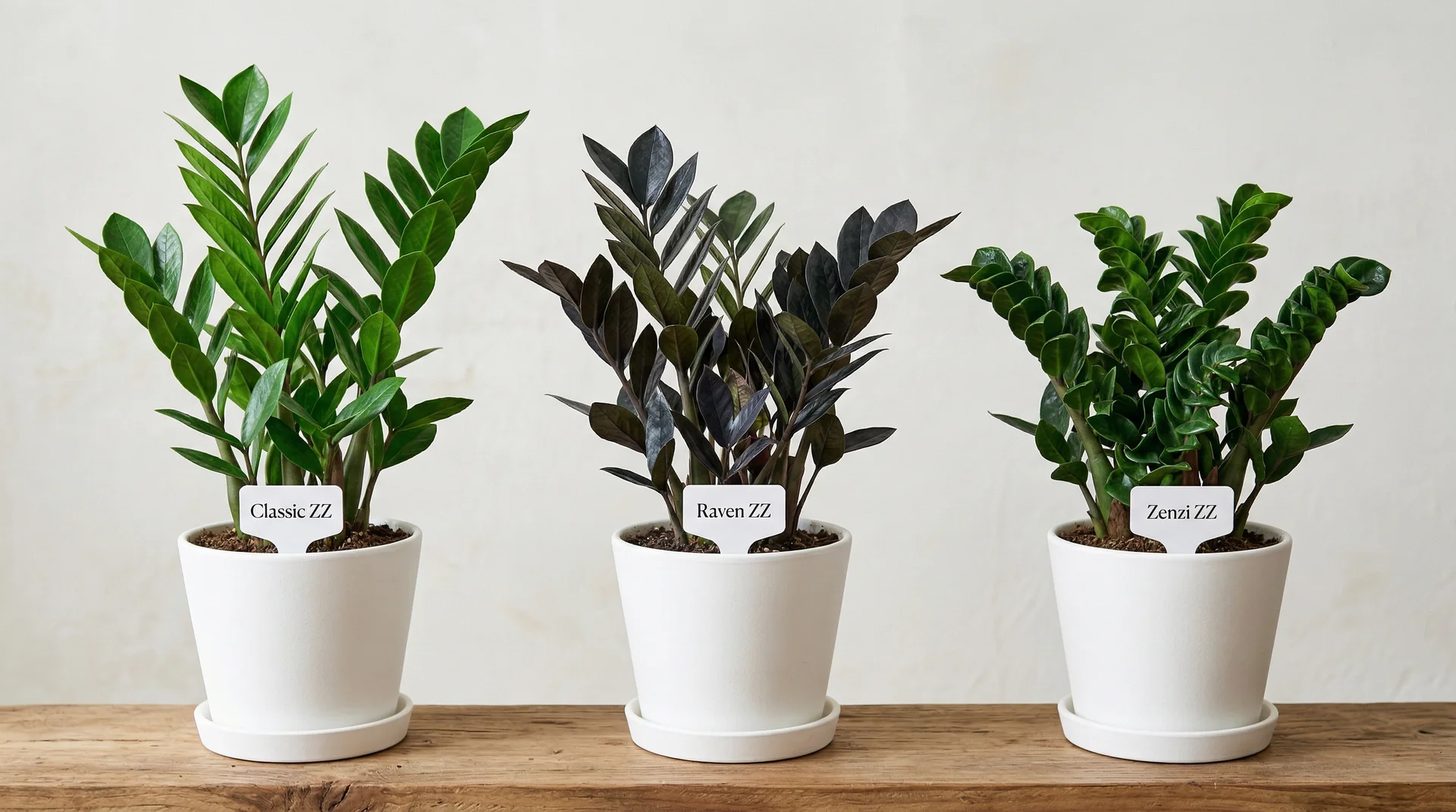
The ZZ plant has spawned a handful of popular cultivars, each with its own aesthetic twist on the classic look.

Three pre-planned garden beds, free
Stop staring at empty beds: printable plans with exact layouts, plant lists and planting calendars — yours free from the Garden Library.


Classic ZZ (Zamioculcas zamiifolia) — the original and most widely available variety, with dark, glossy green leaflets on gracefully arching stems. It is the largest of the common cultivars and the most forgiving grower, making it the default choice for beginners and offices alike.
Raven ZZ (Zamioculcas zamiifolia ‘Raven’) — a striking cultivar that has become hugely popular for its near-black foliage. New leaves emerge a vivid lime green, then gradually deepen to near-black over several weeks — a dramatic transition that makes every flush of growth an event. The contrast between new and mature leaves on the same plant is genuinely stunning.
Zenzi ZZ (Zamioculcas zamiifolia ‘Zenzi’) — a compact, slow-growing cultivar with shorter stems and leaflets that curl slightly inward, giving it a denser, more sculptural silhouette. Its small footprint makes it ideal for desks, shelves, and tight spaces where a full-sized ZZ would be too large.
Lucky Classic ZZ — similar to the standard variety but with slightly lighter, brighter green foliage. It shares the same easy-care profile and is often marketed as a good-luck plant in Asian cultural contexts.
Zamicro — a true dwarf form that stays compact even at maturity, typically reaching only 12–18 inches. It is perfect for terrariums, small pots, and collections where space is at a premium.
ZZ Plant Care
ZZ plant care is genuinely straightforward, but understanding the five core needs will help you get the best growth and avoid the handful of problems that do come up.

Light — the ZZ plant’s party trick is its light tolerance. It will survive in low-light corners that would defeat most houseplants, including fluorescent office lighting with no natural light at all. That said, it grows noticeably faster in medium to bright indirect light. Avoid direct sun, which scorches the waxy leaves. An east-facing windowsill or a spot a few feet back from a south- or west-facing window is ideal.
Watering — less is more. The ZZ’s rhizomes store a substantial amount of water, meaning the plant is far more likely to suffer from too much water than too little. Allow the soil to dry out completely between waterings — typically every two to four weeks in normal household conditions, and even less frequently in winter. Check by pushing your finger two inches into the soil; if it still feels damp, wait another week.
Soil — a fast-draining mix is non-negotiable. Standard potting compost retains too much moisture for ZZ plants. A 50:50 blend of potting soil and perlite works well. See the full guide to soil for ZZ plant for mix options and repotting advice.
Temperature — ZZ plants prefer temperatures between 60°F and 85°F (15–29°C). They do not tolerate frost. Keep them away from cold draughts, air conditioning vents, and windowsills that drop below 50°F (10°C) in winter.
Feeding — ZZ plants are light feeders. Apply a balanced liquid fertiliser (20-20-20 or similar) once a month during the growing season (spring and summer). Stop feeding entirely in autumn and winter when growth slows or stops. Over-fertilising causes salt build-up in the soil, which burns the roots and tips of leaves.
For planting dates in your area, check catalog california thistle.
Watering Guide
Overwatering is by far the most common reason ZZ plants decline, and it is worth understanding why so you never make the mistake. The ZZ’s plump rhizomes — potato-like structures that sit just below the soil surface — act as a water tank. Each time you water thoroughly, the rhizomes top up their reserves and the plant draws on them slowly between waterings. If you water again before those reserves are spent and the soil has dried out, the roots sit in wet compost for extended periods and begin to rot.

The right fertilizer schedule matters here — we explain why in catalog evergreen oak.
Stop killing plants with wrong watering.
Select your plant, pot size, and climate zone — get a precise watering schedule with amounts and timing.
→ Build Watering ScheduleThe safest approach is to water deeply and then wait. When the top two inches of soil are bone dry — and ideally when the pot feels noticeably lighter than it did after watering — it is time to water again. Soak the soil thoroughly until water drains freely from the bottom, then empty the saucer so the pot is not sitting in standing water.
In practice, most ZZ plants in average indoor conditions need watering every two to four weeks in summer and every four to six weeks in winter. Bright, warm conditions push you toward the shorter end; cool, dark conditions toward the longer. The key is never to water on a fixed schedule — always check the soil first.
Yellow leaves are the classic sign of overwatering. If you notice lower leaves yellowing, let the soil dry out fully before watering again. If multiple stems are yellowing and the soil smells musty, check the roots for rot. For a complete diagnosis of every cause of yellowing, read our dedicated guide: Why Is My ZZ Plant Turning Yellow? Every Cause Explained and Fixed.
The Best Soil for ZZ Plants
Standard all-purpose potting compost is designed to retain moisture — which is exactly what you do not want for a ZZ plant. A mix that holds water around the roots puts this drought-adapted plant at constant risk of root rot, even if you are careful with your watering.

The ideal ZZ plant soil does two things: it drains quickly so excess water moves through rather than pooling, and it remains loose and airy so the roots and rhizomes can breathe between waterings.
The simplest mix that achieves this is equal parts standard potting soil and perlite (50:50 by volume). The perlite opens up the structure and dramatically improves drainage without removing all moisture retention. For particularly wet climates or low-light positions where the soil dries slowly, you can push to a 40:60 potting soil to perlite ratio.
You can also add a small amount of coarse orchid bark or horticultural sand to improve drainage and aeration further. Avoid garden soil or heavy peat-based composts, which compact over time and hold far too much moisture.
Repot ZZ plants every two to three years, or when roots begin to circle the bottom of the pot or push out of the drainage holes. Always choose a pot with at least one drainage hole — never plant a ZZ in a pot without drainage. For a detailed breakdown of mix ratios and pot selection, see our full guide to soil for ZZ plant.
How to Propagate a ZZ Plant
ZZ plants can be propagated by three methods. Division is the fastest, leaf cuttings are the slowest but require the least material, and stem cuttings sit in the middle.

Division is the most reliable method and gives you a full-sized plant almost immediately. When repotting a mature ZZ, gently separate the root ball into two or more sections, each with a healthy rhizome and at least one stem. Pot each section in fresh well-draining mix and water lightly.
Stem cuttings involve cutting a healthy stem including several leaflets, allowing the cut end to dry for a few hours, then inserting it into moist perlite or a 50:50 perlite and potting mix. Roots and a small rhizome typically develop within a few months. Keep the mix barely moist and place in bright indirect light.
Leaf cuttings in water are the easiest method if you only have a single leaf to spare, though they are also the slowest — expect three to nine months before a tiny rhizome develops at the base of the leaf. Here is the step-by-step process:
- Choose a healthy, mature leaf (the thick, waxy kind — not a pale new one).
- Pull or cut the leaf cleanly from the stem, keeping as much of the petiole (leaf stalk) intact as possible.
- Place the base of the leaf in a small glass of water so only the bottom centimetre is submerged.
- Position in bright indirect light and top up the water as it evaporates, changing it entirely every two to three weeks to prevent stagnation.
- After one to three months you should see tiny white roots forming at the base. After three to nine months, a small green rhizome will appear among the roots.
- Once the rhizome reaches the size of a marble and has several roots of its own, pot it up in well-draining ZZ mix with the rhizome just below the surface.
Leaf cutting propagation is a slow process that requires patience, but it is a satisfying way to multiply your collection from nothing more than a single fallen leaf.
Common ZZ Plant Problems
Yellow leaves — the most common problem by far, and almost always caused by overwatering. Let the soil dry out completely and review your watering frequency. If the yellowing is widespread and accompanied by a musty smell, investigate for root rot. Rarely, yellowing can result from underwatering (the whole plant looks wilted and the soil is extremely dry), poor light, or a nutrient deficiency after years in the same soil. Full diagnosis in our yellow leaves guide.

Brown leaf tips — typically caused by low humidity or by fluoride and chlorine sensitivity in tap water. Try using filtered or rainwater, and mist the plant occasionally or run a nearby humidifier in dry winter months when indoor heating reduces humidity.
Drooping stems — if stems are flopping over, the most likely culprit is underwatering (check — is the soil bone dry and has it been very dry for weeks?). Bright direct sun can also cause wilting as the plant tries to reduce water loss. Less commonly, severe root rot collapses the rhizomes’ ability to support the plant. Give the soil a thorough soak if it is very dry and move the plant out of direct sun.
Watering mistakes cause more damage than most pests — veronicastrum virginicum ‘album’ (culver’s root) has the details.
No new growth — in winter, ZZ plants often slow to a standstill or stop growing entirely. This is normal dormancy behaviour and not a sign of a problem. If growth stalls during the growing season, the two most likely causes are insufficient light (move closer to a window) or a pot-bound root system (time to repot).
Root rot — caused by prolonged wet soil. Symptoms include soft, brown, mushy stems at the base, a foul smell from the soil, and widespread yellowing. To treat: remove the plant from its pot, cut away all affected roots and rhizomes with sterilised scissors, dust the cut surfaces with cinnamon or sulphur powder, and repot in fresh dry mix. Let the soil remain dry for a week before watering.
Nutrient needs change by season — allium mount everest ornamental onion has the timing.
ZZ Plant and Air Purification
The ZZ plant gained widespread attention after NASA’s Clean Air Study highlighted its ability to remove common volatile organic compounds (VOCs) from indoor air, including benzene, toluene, and xylene — chemicals that off-gas from paints, adhesives, and furniture. Research published in Journal of the American Society for Horticultural Science later supported its effectiveness against a range of airborne pollutants.

This has made it a popular choice for offices and bedrooms where air quality is a concern. In practical terms, the ZZ plant is a useful and easy-going addition to any room, but it is worth keeping expectations realistic: houseplants alone are not a substitute for good ventilation. The volume of plants required to make a meaningful difference to air quality in a real home is far greater than a single pot. Think of the ZZ’s air-cleaning ability as a modest bonus on top of its considerable aesthetic appeal — not a replacement for opening windows or running an air purifier.
Toxicity Warning
All parts of the ZZ plant — leaves, stems, roots, and rhizomes — contain calcium oxalate crystals. These microscopic needle-shaped crystals cause immediate irritation when they contact mucous membranes, making the ZZ plant toxic to cats, dogs, and humans if any part of the plant is chewed or swallowed.

In pets, symptoms of ingestion include drooling, pawing at the mouth, vomiting, and difficulty swallowing. In humans, ingestion causes a burning sensation in the mouth and throat, swelling, and gastrointestinal distress. If you suspect a pet or child has eaten part of a ZZ plant, contact a veterinarian or poison control centre immediately.
The sap also contains the same irritants and can cause mild skin irritation, redness, or a rash on contact — particularly for people with sensitive skin. Always wear gloves when pruning, repotting, or propagating ZZ plants, and wash your hands thoroughly afterwards. Avoid touching your eyes or face while handling the plant.
Despite the toxicity, the ZZ plant is perfectly safe to keep in homes with adults who handle it carefully. It simply requires sensible placement — out of reach of pets and small children — and basic precautions during handling.
Related Guides
Dive deeper into specific aspects of ZZ plant care with these dedicated guides:
- How to care for ZZ Plant? Home care and cultivation guide — a full deep-dive into every aspect of ZZ plant care including seasonal adjustments and common mistakes.
- Why Is My ZZ Plant Turning Yellow? Every Cause Explained and Fixed — a systematic guide to diagnosing and fixing every cause of yellowing leaves.
- Soil for ZZ plant – a practical guide for the breeder — the complete guide to mix ratios, pot selection, and repotting step-by-step.
- https://www.bloomingexpert.com/tips/zamioculcas-zz-plant/yellow-leaves-15/
- https://www.bloomingexpert.com/tips/zamioculcas-zz-plant/dropping-leaves-16/
- Why ZZ Plants Don't Flower Indoors – And the 6 Conditions That Actually Trigger Blooms
- https://www.bloomingexpert.com/tips/zamioculcas-zz-plant/drooping-15/
- https://www.bloomingexpert.com/tips/zamioculcas-zz-plant/brown-tips-18/
- https://www.bloomingexpert.com/tips/zamioculcas-zz-plant/root-rot-19/
- https://www.bloomingexpert.com/tips/zamioculcas-zz-plant/leggy-15/
- https://www.bloomingexpert.com/tips/zamioculcas-zz-plant/stunted-growth-18/
- https://www.bloomingexpert.com/tips/zamioculcas-zz-plant/curling-leaves-19/
- ZZ Plant Brown Spots: 6 Causes Ranked by Damage Speed
Sources
- Wolverton, B.C., Johnson, A., Bounds, K. Interior Landscape Plants for Indoor Air Pollution Abatement. NASA Technical Report, 1989.
- Sriprapat, W., Suksabye, P., Areephak, S., Klantup, P., Waraha, A., Sawattan, A., Thiravetyan, P. Uptake of toluene and ethylbenzene by plants: Removal of volatile indoor air contaminants. Ecotoxicology and Environmental Safety, 2014.


