

Asparagus Beetles: Identify the 2 Species and Eliminate Them Before They Damage Your Crop

Identify both asparagus beetle species, know the treatment thresholds, and choose what actually works — including which organic spray to skip.
Every asparagus bed gets beetles. The common and spotted asparagus beetle both arrive each spring, and in most gardens they were there last year too. What separates a productive patch from a disappointing one isn’t whether beetles show up — it’s what happens after harvest ends.
When beetle larvae strip your ferns in July, the plant goes into fall with depleted carbohydrate reserves. Those reserves fuel next April’s spear production. Fewer stored carbohydrates mean thinner, scarcer spears — or spears that emerge weeks later than they should. Michigan State Extension frames it well: this year’s beetles come from last year’s fern. Protecting the canopy after the last spear is harvested is as important as what you do in spring.

This guide covers both species, how to read the damage correctly, and how to match your response to the scale of the problem. Most home gardens don’t need insecticides if you catch infestations early and clean up reliably each fall. When you do need to spray, the product that works best may not be the one on most recommended lists — we’ll cover that too.
The Two Asparagus Beetle Species
Common Asparagus Beetle (Crioceris asparagi)
About 1/4 inch long with an elongated, slightly oval body. The wing covers are bluish-black with a metallic sheen, marked with three cream-yellow square spots on each side — six spots total. The thorax (the segment between head and wings) is reddish-orange. Adults emerge first in the season, by early May, and are the primary cause of spear damage during harvest.

Larvae are plump, humpbacked, pale gray to dark gray, with a black head and legs. They grow to about 3/8 inch when fully mature and develop through four instars over 10–14 days [2].
Spotted Asparagus Beetle (Crioceris duodecimpunctata)
Slightly larger than the common species — up to 3/8 inch — and uniformly reddish-orange rather than metallic blue-black. It has six black spots on each wing cover, twelve total, which is the source of its species name. The spotted beetle is regularly confused with ladybugs. Two features reliably distinguish them: the spotted asparagus beetle has a noticeably elongated body (not dome-shaped) and long, thread-like antennae roughly as long as its body. Ladybugs have very short, clubbed antennae and a rounded silhouette. The spotted beetle’s larvae are orange; common beetle larvae are gray.
The spotted species also targets different resources: it feeds primarily on asparagus berries and fern foliage rather than spears. This means its damage is mostly a fern-season problem, and it tends to appear 2–3 weeks after the common species [1].
Identifying Eggs
Both species lay tiny, dark brown to black, bullet-shaped eggs about 1/16 inch long, attached upright at one end to the asparagus surface. In rows, they look like a line of tiny black staples. The common beetle lays them in aligned rows of 3–10 on spear surfaces; the spotted beetle lays them singly on ferns and flower buds.
Manual removal is harder than it looks. Research published in the Journal of Integrated Pest Management measured the adhesive bond at more than 8,600 times the egg’s own weight [3]. A soft-bristled toothbrush dislodges them more efficiently than fingernails.
When both species share a bed, the common beetle typically dominates, outnumbering the spotted at roughly a 13:1 ratio [3]. If you’re seeing beetles but struggling to identify both species, the common asparagus beetle is almost certainly the primary culprit.
Life Cycle and Seasonal Timing
Adults of both species overwinter in plant debris at the base of asparagus plants and in nearby garden material. The common asparagus beetle is the earlier riser, emerging in early May as spears break ground. The spotted species follows 2–3 weeks later, typically mid-to-late May [1].

Females begin laying eggs almost immediately after emergence. Eggs hatch in 3–8 days depending on temperature — development stalls below 50°F (10°C) [3]. The larvae feed for 10–14 days, progressing through four growth stages, then drop to the soil to pupate in silken cocoons. New adults emerge roughly a week after pupation. A full generation takes 3–4 weeks in warm summer conditions, extending to about 8 weeks in the cooler temperatures of early spring or fall [2].
Most US gardens see 2–3 generations per season. Warmer climates such as North Carolina can see up to 5 [2]. The first generation causes the most significant spear damage; later generations focus on the ferns.

Recognizing Asparagus Beetle Damage
Harvest Season (Spring)
During spear season, look for four signs of beetle activity:


- Brown scars and pitting on the surface of emerging spears — adult feeding damage running lengthwise along the spear
- Egg rows visible as aligned black capsules attached to the spear surface; they don’t injure the spear directly but affect marketability
- Hooked spear tips — heavy adult feeding causes the growing tip to curl downward as tissue is eaten unevenly
- Dark staining on spear surfaces, left by larval secretions [2]
Fern Season (Summer) — The Hidden Consequence
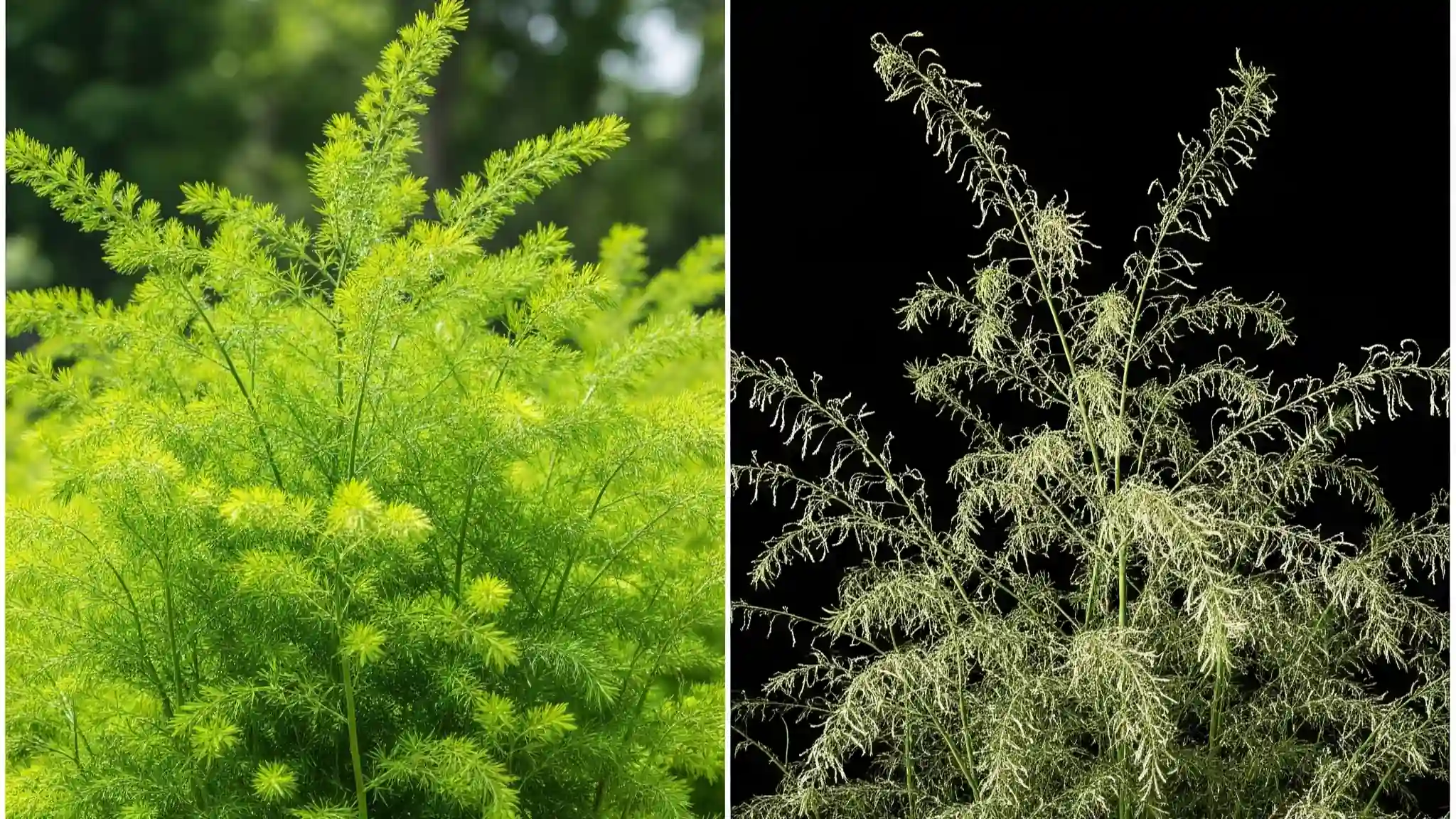
Summer damage is subtler but has longer-lasting consequences. Larvae strip or skeletonize fern foliage, leaving a brown, thinned canopy. When larval feeding completely removes bark from around a stem’s circumference, it girdles the tissue above — the section above the feeding point turns yellow-brown and dies back [7].
The spotted beetle’s larvae focus mainly on asparagus berries rather than foliage, so their damage looks different: shriveled or missing berries rather than defoliated stems. The effect on plant vigor is real but works through a different pathway.
The mechanism that connects summer damage to spring harvest: asparagus ferns photosynthesize throughout summer and channel those sugars into the crown for winter storage. The crown draws on those carbohydrate reserves to produce spears the following spring. Defoliated ferns store less energy. The result shows up the following April — fewer spears, thinner than usual, or slower to emerge. This is why experienced asparagus growers monitor for beetles through late summer, not just during the harvest window [5].
When to Treat: Thresholds for Home Gardens
A few beetles on a healthy stand is normal and doesn’t require action. Small populations are unlikely to affect yield — the plants can sustain minor feeding without consequence [7]. The following thresholds, drawn from university extension research, give you a practical framework for deciding when to intervene [1, 3]:

| Season | What to look for | Treat when |
|---|---|---|
| Harvest (spring) | Adults on spears | 5–10% of plants infested |
| Harvest (spring) | Egg clusters on spears | 2% or more of spears have eggs |
| Fern (summer) | Adult beetles | 10% of plants infested |
| Fern (summer) | Larval feeding damage | 50–75% of plants affected |
For a typical home bed of 10–15 plants, this translates to: treat during harvest when you find beetles on 1–2 plants, or egg rows on more than 1 in every 50 spears you pick. During fern season, act when roughly half your ferns show active feeding damage.
Two signs that natural control may be handling the population without your help:
- Tiny metallic green wasps hovering at fern level — these are Tetrastichus coeruleus, a parasitic wasp specific to asparagus beetles. It parasitizes eggs and continues feeding on the larvae after they hatch, with field suppression rates up to 71% [3]. If these wasps are active, broad-spectrum sprays will kill them along with the beetles.
- Lady beetles feeding at the fern base — they consume both eggs and larvae and are a reliable indicator of active biological control.
If either natural enemy is present and infestation is at the lower end of the threshold range, wait 7–10 days before treating. In many home gardens, the natural control resolves the situation without any input from you.
How to Control Asparagus Beetles
Cultural and Physical Controls
Harvest frequency is the most effective and most underused tool during spear season. Asparagus beetle eggs hatch in 3–8 days — harvesting spears every 1–2 days removes them before larvae can emerge [1]. No product, no pre-harvest interval considerations, no residue risk. This works better than most sprays during the spear window and has no downsides for the garden.

Hand-picking works well for beds of 20 plants or fewer. Drop adults and larvae into a bucket of soapy water — once submerged they can’t escape. Use a soft-bristled toothbrush to dislodge egg clusters from spear surfaces, working in sideways strokes along the row.
Row covers applied in late April, before beetle emergence, prevent the first colonization wave. Remove them once ferns begin developing to avoid humidity build-up and to allow access for beneficial insects. Row covers also help with early-season asparagus fern problems — see our guide on preventing asparagus fern rust and rot for combined fern management strategies.
Stop missing your zone's planting windows.
Select your US zone and month — get a complete checklist of what to plant, prune, feed, and protect right now.
→ View My Garden CalendarA less-known technique worth trying: leave one unharvested spear section at the end of the bed as a trap zone. Beetles concentrate there for mating and egg-laying. Treat that area specifically rather than the whole bed, which reduces overall pesticide exposure and spares beneficial insects elsewhere.
Biological Controls
Protecting Tetrastichus coeruleus wasps means avoiding broad-spectrum sprays when populations are within manageable range. These wasps are present in most established asparagus beds — watch for them hovering at fern level during warm afternoons. Avoiding sprays when infestation is below threshold gives them room to work.
For pupae already in the soil during fern season, beneficial nematodes have genuine research backing. Steinernema feltiae achieved up to 96% larval mortality in greenhouse trials [3]. The RHS recommends Steinernema carpocapsae for garden use [7]. Water nematodes into the soil at the plant base during fern season, in the evening or on an overcast day — they need consistent moisture to move through the soil and reach their targets.
Encouraging birds near the asparagus bed is a low-effort supplement. Wrens and sparrows are effective predators of larvae, particularly during the vulnerable window when pupating larvae drop from plants to the soil surface.
Organic Insecticides
Pyrethrin-based products (e.g., Pyganic) reduce egg numbers on spears but show only moderate efficacy against adult beetles. Pre-harvest intervals are typically one day, making them practical during spear season. Reapply after rain — pyrethrin breaks down quickly in sunlight and loses potency within a day or two. Neem oil is most effective against larvae and less so against adults; apply weekly during active infestations, coating spear surfaces thoroughly.
A caution on spinosad (sold as Entrust): it appears on most asparagus beetle recommended lists, but Michigan State University field trials found no significant reduction in beetle numbers or egg counts compared to untreated controls [5]. If you’ve been using it without results, that’s why. Spinosad has proven efficacy against other garden pests — the evidence simply doesn’t support it here.
Chemical Controls
When organic options aren’t sufficient, three active ingredients have demonstrated efficacy:
- Carbaryl (Sevin): the established standard for commercial growers. One-day pre-harvest interval; up to 3 applications per harvest season with a 3-day retreatment interval. No resistance detected in recent Michigan field trials [5].
- Acetamiprid (Assail): matches carbaryl’s efficacy and acts through a different mechanism — use it as a rotation partner to reduce long-term resistance risk. Also a one-day pre-harvest interval.
- Malathion: effective; pre-harvest interval varies by formulation, so read the label carefully before applying.
Application tip from MSU Extension: spray on warm, sunny afternoons when adults are most active and concentrate at spear tips for mating. Targeting the top 6 inches of emerging spears is sufficient — full canopy coverage isn’t needed and spares beneficial insects lower in the bed [5].
Prevention: Breaking the Overwintering Cycle
The most effective single prevention step is fall debris removal. After the fern canopy fully browns following the first hard frost, cut everything to ground level and remove it from the bed. Adult beetles overwinter in that plant material; remove it and you eliminate their primary shelter [1, 4]. If your bed had heavy infestation during the season, bag and dispose of the debris rather than composting it — beetles can survive a mild compost winter.

The second critical window is fern-season monitoring. Most gardeners treat hard in spring, then ignore the bed through summer. Beetles that survive into fall become the founding population for the following year. A single targeted treatment in August or September, when larvae are actively feeding and the fern canopy is still green, directly reduces the count that overwinters [5]. Pair this with fall cleanup and you’re addressing two chokepoints in the beetle’s cycle instead of one.
Companion planting is often suggested — parsley, marigolds, and petunias around the bed perimeter are commonly cited as deterrents. The supporting evidence is largely anecdotal; no controlled trials have confirmed efficacy for asparagus beetles specifically. It won’t harm the bed to plant them at the margins, but treat it as a supplementary measure alongside methods with stronger evidence.
Asparagus plants can thrive for 15–20 years when crown health is maintained, but repeated beetle defoliation shortens that productive lifespan year by year. Sound foundational care — planting depth, fertilization timing, bed drainage — is itself a form of pest prevention. Our complete asparagus planting guide covers the practices that build the long-term crown health that keeps this pest manageable. For other pests that may appear alongside beetles in the vegetable garden, the garden pest identification guide covers the most common culprits.

Frequently Asked Questions
Can asparagus beetles spread to other vegetables?
No. Both species are host-specific to cultivated asparagus (Asparagus officinalis) in North America. They won’t colonize tomatoes, squash, or other garden beds regardless of how large the population grows in your asparagus patch [3].
How do I tell the spotted asparagus beetle from a ladybug?
Three reliable differences: ladybugs have a round, dome-shaped body; spotted asparagus beetles are elongated. Ladybug antennae are very short and clubbed; asparagus beetle antennae are long and thread-like. Ladybug undersides are black; spotted asparagus beetles are orange underneath. When in doubt in the field, check the antennae first — it’s the fastest distinguishing feature.
Why do I get beetles every year even though I spray in spring?
Spring treatment controls current-season spear damage but doesn’t reduce the population that overwinters if beetles survive fern season untreated. The adults that emerge next spring come from last fall’s survivors. Combining harvest-season control with fall debris removal and fern-season monitoring breaks the cycle far more effectively than spring spraying alone.
Are asparagus beetles harmful if accidentally eaten on spears?
No. Rinse spears as usual. The beetles, eggs, and larvae present no health risk to humans.
When is it safe to stop monitoring for the season?
Once ferns fully brown after the first hard frost, beetles have entered dormancy. Cut the foliage to ground level, remove it from the bed, and you’ve completed the key prevention work until spears emerge the following spring.
Sources
- Asparagus Beetles — University of Minnesota Extension [1]
- Insect and Related Pests of Vegetables: Pests of Asparagus — NC State Extension [2]
- Common Asparagus Beetle and Spotted Asparagus Beetle: Identification, Ecology, and Management — Journal of Integrated Pest Management, Oxford Academic [3]
- Asparagus Beetle — University of Wisconsin Extension [4]
- Controlling Common Asparagus Beetle During Harvest Season — Michigan State University Extension [5] [linked above]
- Asparagus Beetles — Virginia Tech Extension [6]
- Asparagus Beetle — Royal Horticultural Society [7] [linked above]


