

Liquid, Granular, Slow-Release, or Spikes: Which Fertilizer Form Actually Works Best for Your Plants?

Fertilizer forms explained — how liquid, granular, slow-release, and spike fertilizers actually work, and a decision table to choose the right one every time.
The Form Matters More Than You Think
Most gardeners choose fertilizer by NPK ratio — the three numbers on the bag. That’s the right question to ask second. The first question is: what form is this fertilizer in, and how does that form affect when and how your plants actually get fed?
Two products with identical 10-10-10 labels can behave completely differently in your garden. One delivers nutrients within hours; another takes weeks to begin releasing; a third might never reach the roots you’re trying to feed. The difference isn’t chemistry — it’s delivery mechanism.
There are four main fertilizer forms available to home gardeners: liquid, granular, slow-release (including controlled-release), and spikes. Each works through a fundamentally different process. Understanding those processes — not just the marketing claims — lets you match the right form to the right situation, avoid wasted fertilizer, and protect your plants from common application mistakes like fertilizer burn.
How Each Fertilizer Form Delivers Nutrients: A Quick Reference
| Form | Delivery mechanism | Time to availability | Application frequency | Best situation |
|---|---|---|---|---|
| Liquid | Pre-dissolved; absorbed via roots or leaf surface | Hours | Every 1–2 weeks | Fast fix, new transplants, containers |
| Granular (quick-release) | Dissolves in soil moisture; roots absorb from solution | Days (water-dependent) | Every 4–6 weeks | Lawns, large beds, pre-plant |
| Slow-release / CRF | Osmotic diffusion through polymer coating | Weeks (lag period first) | Once per season | Established plants, low-maintenance |
| Spikes | Same as slow-release; localized to spike placement | Weeks | Twice yearly | Containers, individual houseplants |
Liquid Fertilizers: Nutrients in Hours, Not Weeks
Liquid fertilizers skip the breakdown step that every other form requires. The nutrients are already dissolved, so roots can begin absorbing them as soon as the solution contacts the root zone — typically within a few hours for potassium and urea forms of nitrogen. That speed is liquid’s defining advantage, and it’s why liquids are the right tool for any situation where you need results quickly.

Three pre-planned garden beds, free
Stop staring at empty beds: printable plans with exact layouts, plant lists and planting calendars — yours free from the Garden Library.
There are two routes liquid fertilizer can take into a plant: through the roots and through the leaves. Soil application — watering with diluted liquid — feeds via the root system, which is the standard pathway. Foliar application, spraying directly onto leaf surfaces, is faster still. Research from Michigan State University found that nutrients move through plant tissue at roughly one foot per hour once absorbed, meaning a foliar spray can reach growing tips within a day.

Foliar feeding has a critical limitation most articles skip: it works well for micronutrients — particularly iron, manganese, and zinc — but cannot practically supply macronutrients like nitrogen, phosphorus, or potassium in adequate amounts. The concentration of nutrients that leaves can absorb is simply too low to meet a plant’s bulk nitrogen demand. University of Connecticut’s Soil Nutrient Analysis Laboratory is direct on this: foliar application is a supplement for micronutrient deficiencies, not a replacement for soil feeding of macronutrients.
The faster something works, the faster it also leaves. Liquid fertilizers don’t persist in soil. In outdoor beds with regular rain or irrigation, they can be largely depleted within one to two weeks, which means consistent feeding requires consistent application — typically every seven to fourteen days during the growing season.
Burn risk is real with liquids. When concentrated liquid nitrogen contacts leaf tissue, the salt solution draws moisture out of cells by osmosis — the same process that makes salt wilt lettuce. Michigan State University Extension notes that any liquid nitrogen applied as a concentrated spray can cause this dehydration injury. Apply at moderate temperatures (below 85°F), avoid midday application when foliage is hottest, and always follow dilution instructions on the label.
One underappreciated advantage: every drop of liquid fertilizer contains the same ratio of nutrients, according to Michigan State University Extension research. Unlike granular blends — where different granules may carry different nutrients — liquid formulations give each plant uniform dosing.
Liquid fertilizer is best for: correcting a visible deficiency quickly, feeding new transplants during the first two to three weeks, feeding container plants between slow-release applications, and foliar correction of iron chlorosis. For deeper reading, see our guide to granular vs. liquid fertilizer.
Granular Fertilizers: Reliable, Cheap, and Soil-Dependent
Standard granular fertilizers are the most widely sold form, and for good reason: they’re inexpensive, easy to store, and familiar. The mechanism is straightforward — granules dissolve in soil moisture, releasing ions into the soil solution, which roots absorb as water moves through them. The granules themselves never enter the plant.
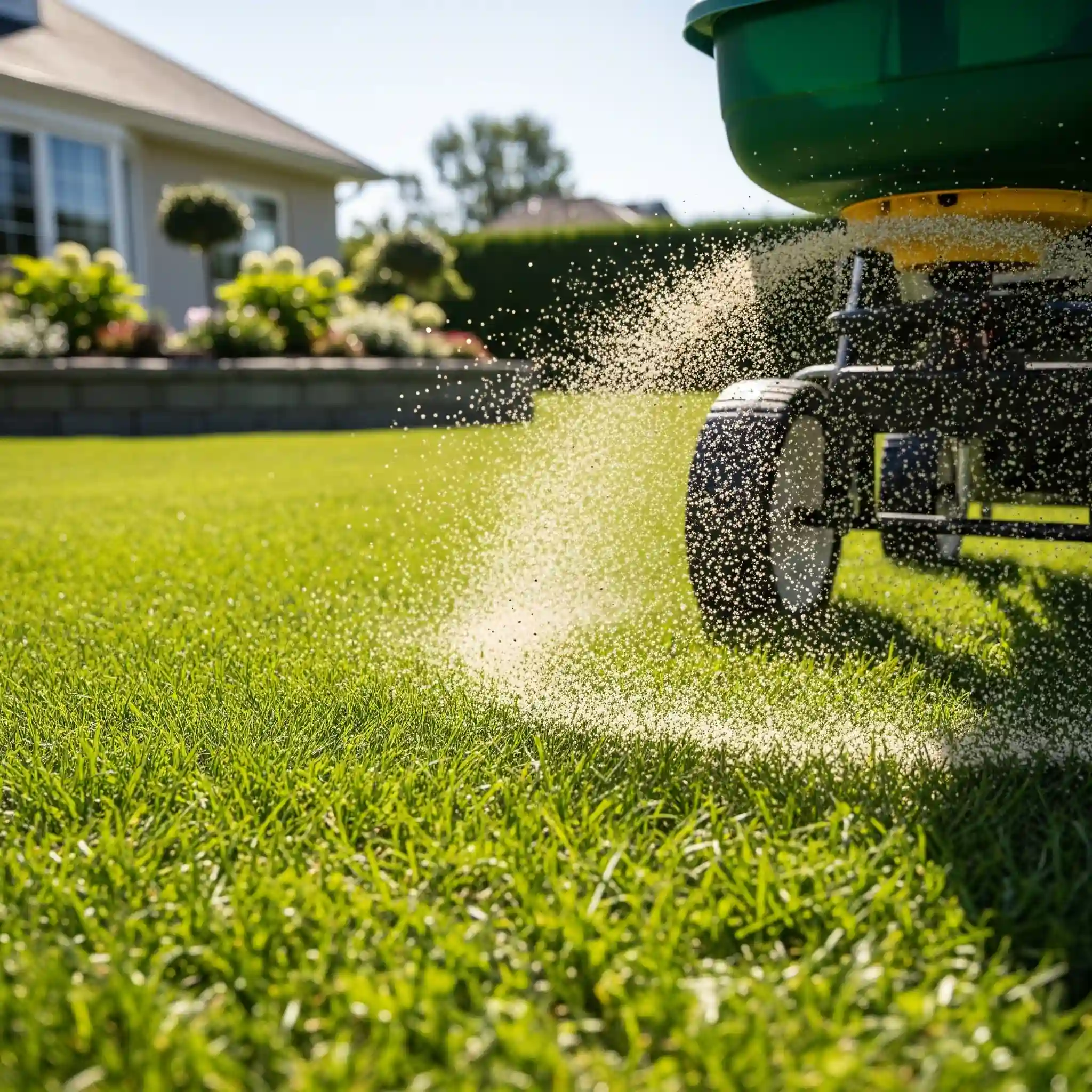
That soil-dependency is granular’s biggest constraint. Below 50°F soil temperature, microbial activity collapses, and the nitrogen transformations that make nutrients plant-available slow dramatically. The biological process called nitrification — which converts ammonium to plant-available nitrate — slows sharply below 50°F and essentially halts at 32°F. Applying granular nitrogen in cold soil means you’re largely paying for fertilizer that sits unused until temperatures climb. This is why experienced gardeners switch to liquid fertilizer in early spring before soils have warmed sufficiently.
The burn risk with granulars works differently from liquids. Quick-release granular nitrogen compounds — urea, ammonium nitrate, ammonium sulfate — have high salt indexes, meaning they draw moisture aggressively from plant tissues on contact. Michigan State University Extension confirms that slow-release nitrogen fertilizers carry significantly lower burn risk than quick-release forms — the key difference is salt index, which determines how aggressively the compound draws moisture from plant tissues. The fix is straightforward: apply granulars to the soil surface, not foliage, and water them in immediately. Granules sitting on wet leaves can etch and discolor tissue.
Granular fertilizers need reapplication every four to six weeks during the growing season, since nitrogen leaches readily from soil with rain and irrigation. NC State Cooperative Extension notes that common granular formulations like 10-10-10 dissolve and deplete much like liquids — the granule is simply a delivery vehicle, not a slow-release mechanism. For a large vegetable garden or lawn, a six-week cycle is manageable. For mixed borders with dozens of different plants, it becomes tedious — which is where slow-release forms earn their price premium.
Slow-Release Fertilizers: The Science Behind the Marketing
Slow-release is the most technically complex fertilizer form — and the one most misrepresented on product labels. Understanding how it actually works changes how you apply it.
The term “slow-release” covers two distinct technologies that behave very differently:
- Controlled-release fertilizers (CRFs) — granules coated with a polymer membrane (like Osmocote). Release is driven by osmotic pressure, not biology.
- Slow-release fertilizers (SRFs) — compounds like urea-formaldehyde or sulfur-coated urea. Release depends on soil microbial breakdown, so it tracks with temperature and moisture.
How polymer-coated CRFs work: Water vapor diffuses through the polymer shell and dissolves the fertilizer inside. The resulting concentrated solution creates osmotic pressure that drives nutrient ions out through the membrane — a continuous, steady diffusion. A PMC review of controlled-release fertilizer coatings describes three stages: a brief lag period while water penetrates the coating; a linear release phase where osmotic pressure builds and steady diffusion begins; and a decay phase as the concentration gradient falls. Well-engineered products produce a sigmoidal (S-shaped) release curve that roughly tracks a plant’s growing-season demand.
The surface application problem — what the label doesn’t tell you: A peer-reviewed study published in PLOS ONE tested polymer-coated urea products labeled as 45-day, 75-day, and 120-day release materials under real field conditions. When incorporated into soil, the products released nutrients reasonably close to their labeled timelines. But when surface-applied, all three products released more than 80% of their nitrogen within 35 days, regardless of the label.
Stop missing your zone's planting windows.
Select your US zone and month — get a complete checklist of what to plant, prune, feed, and protect right now.
→ View My Garden CalendarThe reason: polymer coating permeability responds to temperature. Lab release rates are determined at around 68°F (20°C). Soil surface temperatures in summer routinely exceed 122°F (50°C). At those temperatures, the coating releases far faster than the manufacturer calculated. The practical implication: if you’re using slow-release granules on a lawn or mulched bed where they sit on the surface, plan for multiple applications — the four-month label claim likely doesn’t apply. The same study found that sulfur-coated urea — the older slow-release technology — performed even worse, releasing over 80% of its nitrogen by the first sampling point regardless of placement.
What you pay for the slow-release benefit is real. UF/IFAS reports that environmentally smart nitrogen (ESN, a polymer-coated product) costs approximately 35% more than conventional urea. Some Osmocote-type formulations cost significantly more per pound of nitrogen than standard soluble granulars. The tradeoff: one spring application instead of monthly reapplications, reduced leaching, and lower burn risk. For established shrubs, trees, and perennials, the economics often justify the premium.
Fertilizer Spikes: When They Work and When They Don’t
Fertilizer spikes are slow-release fertilizer in compressed rod form. The nutrient chemistry is the same — it’s the geometry that creates both their appeal and their main limitation.
The appeal is convenience. Drive a spike into the soil near a plant’s root zone, and nutrients slowly diffuse outward over several months. No measuring, no dissolving, no risk of over-applying. Jobe’s Company recommends placing spikes two feet from the plant base at the dripline, with three feet of spacing between spikes for trees and shrubs.
The limitation is coverage. Nutrients diffuse outward only a few inches from the spike. For a houseplant in a six-inch pot, the root zone and the spike’s effective radius overlap completely — spikes work well here. For a mature shrub with roots spanning six feet in every direction, or a tree with a ten-foot root radius, a spike at the trunk feeds a tiny fraction of the roots actually doing the work. UF/IFAS Extension makes this point directly: broadcast fertilizers feed the whole root area; spikes only reach roots immediately surrounding the point of insertion.
The crumble workaround: If you have spikes on hand and want to use them for trees or large shrubs, UF/IFAS recommends crumbling them and distributing the material evenly across the entire canopy area (from dripline to trunk). This delivers the same nutrients with far better coverage than inserting the spike whole — effectively converting a spike into a granular broadcast application.
Spikes are also not the right tool for lawns or large garden beds. The localized release means you’d need dozens of spikes to achieve even distribution, eliminating the cost and convenience advantage.
For container plants and individual houseplants — which is where spikes genuinely shine — see our comprehensive container fertilizing guide.
Choosing the Right Form: Situation-by-Situation Guide
| Situation | Best form | Why |
|---|---|---|
| Visible yellowing or deficiency right now | Liquid (foliar for micronutrients) | Fastest uptake — results in days not weeks |
| Transplanting seedlings or new plants | Diluted liquid for first 2–3 weeks | Gentle, consistent delivery during root establishment |
| Established lawn, spring application | Slow-release incorporated into soil | One application covers the season; lower leaching |
| Large garden bed, seasonal feed | Slow-release granules worked into top inch | Set-it-and-forget-it; even coverage over a season |
| Container plants and houseplants | Spikes or biweekly diluted liquid | Spikes match the root zone; liquid gives more control |
| Soil temperature below 50°F | Liquid only | Granulars and organic SRFs won’t activate in cold soil |
| Mid-season correction (specific plant) | Liquid | Targeted application; results visible within 1–2 weeks |
| Drought conditions (no irrigation) | Slow-release or liquid | Granulars need moisture to dissolve and won’t work in dry soil |
| Tree or large shrub, annual feeding | Granular broadcast at dripline | Covers the full root zone; spikes do not |
| Iron deficiency (interveinal chlorosis) | Liquid foliar spray with chelated iron | Soil pH corrections take months; foliar works in days |
Before choosing any fertilizer form, it helps to understand what the NPK numbers on your fertilizer label actually mean — form and ratio work together.
Using Multiple Forms Together: The Combination Approach
Professional gardeners and horticulturists rarely commit to a single fertilizer form for a season. The most effective approach combines slow-release granules or CRFs for baseline nutrition with liquid feeding for targeted corrections. UF/IFAS Gardening Solutions notes that many successful gardeners use granular products for baseline nutrients and liquids for targeted boosts — treating the two as complementary rather than competing.
A practical example for a perennial border: apply slow-release granules in early spring once soil temperature exceeds 55°F, worked lightly into the top inch of soil. This provides background nutrition through summer. If a specific plant shows iron chlorosis in July — yellowing between the veins while veins stay green — a targeted foliar spray with chelated iron corrects the deficiency in days without disturbing the entire bed’s feeding schedule.
The main risk when combining forms: double-dosing nitrogen. If you’ve applied a slow-release product with a four-month release window, don’t add a granular nitrogen top-dress four weeks later without checking the release schedule. Accumulating nitrogen from two sources can push application rates beyond what plants can absorb, increasing leaching and burn risk. The standard baseline for most home lawns and garden settings is one pound of nitrogen per 1,000 square feet per application. Understanding how to read micronutrient and secondary nutrient labels helps when dialing in a combination approach.
Frequently Asked Questions
Which fertilizer form works fastest?
Liquid fertilizer, applied either to the root zone or as a foliar spray, delivers nutrients fastest. Foliar-applied micronutrients are detectable in plant tissue within hours, with movement throughout the plant measurable within a day. Granular quick-release fertilizers take days to dissolve and become available. Slow-release and spike forms have a lag period of days to weeks before meaningful nutrient release begins.
Can I use liquid and granular fertilizer at the same time?
Yes, but track your total nitrogen rate carefully. If you apply a quick-release granular at the label rate, adding a full-strength liquid feed in the same week risks exceeding the plant’s uptake capacity and can cause burn or leaching. A diluted liquid foliar spray for micronutrients alongside granular macros is a complementary combination — the two forms supply different nutrients with no overlap risk.
Are fertilizer spikes worth it?
For containers and small houseplants, yes — the root zone matches the spike’s effective delivery radius, and the low-maintenance format suits indoor plants well. For trees, large shrubs, or garden beds, no — the localized nutrient concentration fails to reach most of the plant’s roots. UF/IFAS Extension recommends crumbling spikes and broadcasting the material under the canopy if you want to use spike fertilizer for larger plants.
Does slow-release fertilizer work in cold soil?
Polymer-coated controlled-release fertilizers slow significantly in cold conditions because membrane permeability decreases with temperature. Organic slow-release materials — urea-formaldehyde, feather meal — depend on soil microbes, which largely shut down below 50°F. Neither form works as a primary fertilizer strategy when soils are cold. Switch to liquid fertilizer in early spring before soils warm above 55°F, where both microbial activity and polymer diffusion resume.
What’s the difference between slow-release and controlled-release fertilizer?
The distinction matters for planning. Controlled-release fertilizers (CRFs) use polymer coatings to regulate nutrient diffusion — the release rate is predictable and determined by coating thickness and temperature. Slow-release fertilizers (SRFs) rely on microbial decomposition or chemical hydrolysis — the rate is variable and depends on soil temperature, moisture, and microbial populations. UF/IFAS is direct on this point: the rate, pattern, and duration of release are not controlled for true SRFs. When you see “slow-release” on a label without mention of polymer coating, the timing is less predictable than a coated CRF.
Sources
- Controlled-Release and Slow-Release Fertilizers as Nutrient Management Tools — UF/IFAS Extension
- Pros and Cons of Granular and Liquid Fertilizers — Michigan State University Extension
- Controlled Release Fertilizers: A Review on Coating Materials and Mechanism of Release — PMC/National Institutes of Health
- Types of Fertilizer — UF/IFAS Gardening Solutions
- Foliar Fertilization — University of Connecticut Soil Nutrient Analysis Laboratory
- Nitrogen Release Rates from Slow- and Controlled-Release Fertilizers Influenced by Placement and Temperature — PLOS ONE / PMC
- Should I Use Fertilizer Spikes or Granular? — UF/IFAS Extension Nassau County
- Which Fertilizer Is Best? — NC State Cooperative Extension (2024)
- Benefits of Using Lawn Fertilizers Containing Slow-Release Nitrogen — Michigan State University Extension


