

Aphid Warning: Spot the Infestation in 60 Seconds and Treat It Before It Spreads

Spot an aphid infestation in under 60 seconds, learn which of the 6 species is attacking your plants, and choose the right treatment for each situation.
A single aphid that goes unnoticed in spring can produce a colony numbering in the thousands before summer. That is not an exaggeration — it is biology. Aphids reproduce through a process called parthenogenesis, where females skip mating entirely and give birth to live young all season long. The offspring are already pregnant when they are born. By the time you notice distorted leaves or a sticky film on your car hood beneath the garden, the infestation may be weeks old.
This guide gives you a systematic 60-second inspection protocol to catch infestations before they escalate, a diagnostic table for the six species most likely to be on your plants, and a tiered treatment framework with the mechanism behind each option — so you understand not just what to use, but why it works and when to leave the spray bottle in the shed entirely.
What Are Aphids? The Two-Tail-Pipe Rule
You can definitively identify an aphid using a single anatomical feature: two small tube-shaped protrusions called cornicles that project from the rear of the abdomen. Every aphid has them; no other common garden insect does. Once you know to look for them, misidentification becomes rare — most people confuse aphids with whitefly nymphs or mites, neither of which have cornicles.
Beyond the cornicles, aphids share a consistent body plan: pear-shaped, soft-bodied, and between 1/16 and 1/8 inch long — roughly the size of a pinhead to a sesame seed, according to the University of Minnesota Extension. They come in green, black, yellow, red, brown, and a waxy white depending on species.

Three pre-planned garden beds, free
Stop staring at empty beds: printable plans with exact layouts, plant lists and planting calendars — yours free from the Garden Library.
One other feature worth knowing: winged aphids. Most of the time, the aphids feeding on your plants are wingless females. When a colony becomes overcrowded, the next generation includes winged adults that fly to new plants and start fresh colonies. That is when an isolated problem becomes a garden-wide one.

The 6 Most Common Garden Aphid Species
Knowing which aphid you are dealing with matters for treatment. Woolly aphids need a completely different approach from green peach aphids — the waxy filaments covering their bodies physically block contact pesticides from reaching the exoskeleton.
| Plant(s) | Species | Appearance | Key Treatment Note |
|---|---|---|---|
| Vegetables, roses, ornamentals (500+ hosts) | Myzus persicae — Green peach aphid | Yellowish-green or reddish; three dark lines on back | Most common; responds to all standard treatments |
| Broccoli, cabbage, kale, Brussels sprouts | Brevicoryne brassicae — Cabbage aphid | Powdery gray-green from waxy coat; clusters densely on leaf undersides | Host-limited to brassicas; standard controls effective |
| Roses | Macrosiphum rosae — Rose aphid | Light green to pink with black legs | Host-limited; monitor from early spring when buds break |
| Cucumber, melons, squash, peppers (700+ hosts) | Aphis gossypii — Melon/cotton aphid | Dark green to near-black; small cornicles | Major virus vector; prioritize early control |
| Milkweed | Aphis nerii — Oleander aphid | Bright yellow with black legs; unmistakable | Rarely causes serious damage; often leave untreated |
| Apple trees (bark and roots) | Eriosoma lanigerum — Woolly apple aphid | White fluffy/cottony filaments; causes galls on stems | Soaps and oils ineffective; systemic insecticides required |
The University of Wisconsin Extension notes that the green peach aphid alone has over 500 host plant species — which is why it appears on almost every crop and ornamental in temperate gardens and why it is the species most frequently behind early-season infestations.
Why 10 Aphids Become 10,000 in Two Weeks
Most pest guides tell you aphids reproduce quickly. Few explain why, and understanding the mechanism changes how urgently you respond.
Aphids use two strategies simultaneously that no other common garden pest employs. The first is parthenogenesis: all-female reproduction throughout the growing season. There are no males in the summer colony, no time spent mating, and no energy diverted to fertilization. Every individual is a reproductive female from birth.
The second strategy is more remarkable: viviparity, meaning live birth rather than eggs. Skip the egg stage and development time compresses dramatically. But what makes aphids unique even among viviparous insects is what researchers call the telescoping of generations. A female aphid carries developing daughters inside her. Those daughters already contain developing granddaughters. The grandmother is, in biological terms, pregnant with her grandchildren simultaneously.
A peer-reviewed study in Frontiers in Zoology confirmed this nesting-doll reproductive structure and noted it explains much of why aphids have diversified into approximately 5,000 species — roughly 30 times more than their non-viviparous relatives. The practical result for your garden: a typical aphid species completes 10 to 30 generations in a single season. Some cabbage aphid populations have been documented at 41 generations per year. A single surviving founder from spring can theoretically produce billions of descendants if conditions stay favorable.
I tracked a colony on a climbing rose in zone 6 — 20 aphids at the end of April, unmanageable within 10 days. The plants were flushing new growth after a warm spell, which is exactly the tender, nitrogen-rich tissue aphids target. If you had asked me on day five whether I needed to act, the answer would have been no. By day ten, the answer was emphatically yes.
The 60-Second Inspection Protocol
This is not about spending an hour scrutinizing every leaf. It is a systematic scan that catches infestations before they establish. Run it once a week during spring flush, when new growth is tender and aphid populations are building fastest.
Step 1 — Check new growth tips first. Aphids target the softest, most nitrogen-rich tissue on the plant. Before looking anywhere else, examine the growing tips and the newest, smallest leaves at the ends of shoots.
Step 2 — Flip young leaves. Aphids on exposed upper leaf surfaces are the exception. They colonize leaf undersides where they are sheltered from rain and predators. Flip the newest leaves and examine the undersides — a hand lens helps but is not required.
Step 3 — Look for two tail pipes. If you find small clustered insects, confirm cornicles before acting. This separates aphids from spider mites (which leave webbing), whitefly nymphs (which are flat and scale-like), and thrips (which are elongated and leave silver streaking).
Step 4 — Feel for honeydew. Run a finger across upper leaf surfaces, particularly older leaves below new growth. Aphids feed above and excrete downward. A sticky film on leaves that otherwise look clean is a reliable early warning sign, often detectable days before you can see the insects themselves.
Step 5 — Watch for ants on stems. Ants farm aphids for honeydew — they protect them from predators and relocate them to fresh plant tissue. A column of ants marching up a stem is one of the most reliable early-warning signals in the garden. Follow the ants and you will find the colony.
Stop missing your zone's planting windows.
Select your US zone and month — get a complete checklist of what to plant, prune, feed, and protect right now.
→ View My Garden CalendarStep 6 — Check for distorted leaves. Aphid saliva contains compounds that disrupt normal plant cell development. New leaves that emerge cupped, crinkled, or twisted have almost certainly had aphids feeding on them while still in bud. The distortion is permanent — the leaf will not unfurl — which is why catching infestations before this stage matters.
6 Signs of Aphid Damage — What Each One Tells You
The type of damage tells you how long the infestation has been running and how urgently you need to respond.
| Symptom | Cause | Severity | Response |
|---|---|---|---|
| Sticky residue on leaves or surfaces below plant | Honeydew excretion from feeding aphids above | Early | Inspect immediately; colony is active |
| Black sooty coating on leaves | Sooty mold fungus growing on honeydew; blocks photosynthesis | Moderate | Treat pest source; mold weathers away naturally once honeydew stops |
| Cupped or crinkled new leaves | Saliva toxins injected during bud-stage feeding; tissue distortion | Moderate | Affected leaves will not recover; stop further spread |
| Yellow or pale patches on leaves | Chlorophyll extraction through sap removal | Moderate | Confirm with cornicle check; many other causes possible |
| Stunted or twisted shoot tips | Heavy colony feeding on meristematic tissue | Severe | Begin treatment immediately; growth point is compromised |
| Mosaic or mottled leaf pattern | Virus transmission (CMV, potato virus Y) during aphid probing | Severe | No cure; remove severely infected plants; focus on vector control |
Sooty mold deserves a brief explanation. According to NC State Extension, the fungus is not parasitic — it has no way to penetrate healthy plant tissue. It grows entirely on aphid honeydew as its food source. Remove the aphids and the honeydew supply stops; the existing mold gradually weathers away. Trying to clean sooty mold without addressing the aphids is a temporary fix.
The virus transmission point is underemphasized in most aphid guides. Aphids are vectors for over 150 plant viruses, including cucumber mosaic virus (CMV) and potato virus Y (PVY). What makes this particularly dangerous is that transmission can occur during probing behavior alone — University of Wisconsin entomologists note that “the virus is transmitted when aphids probe the leaf surface with their mouthparts, even if the aphid then decides it is looking for a different host and flies away.” You cannot eliminate virus risk by killing only the aphids already established in your garden.
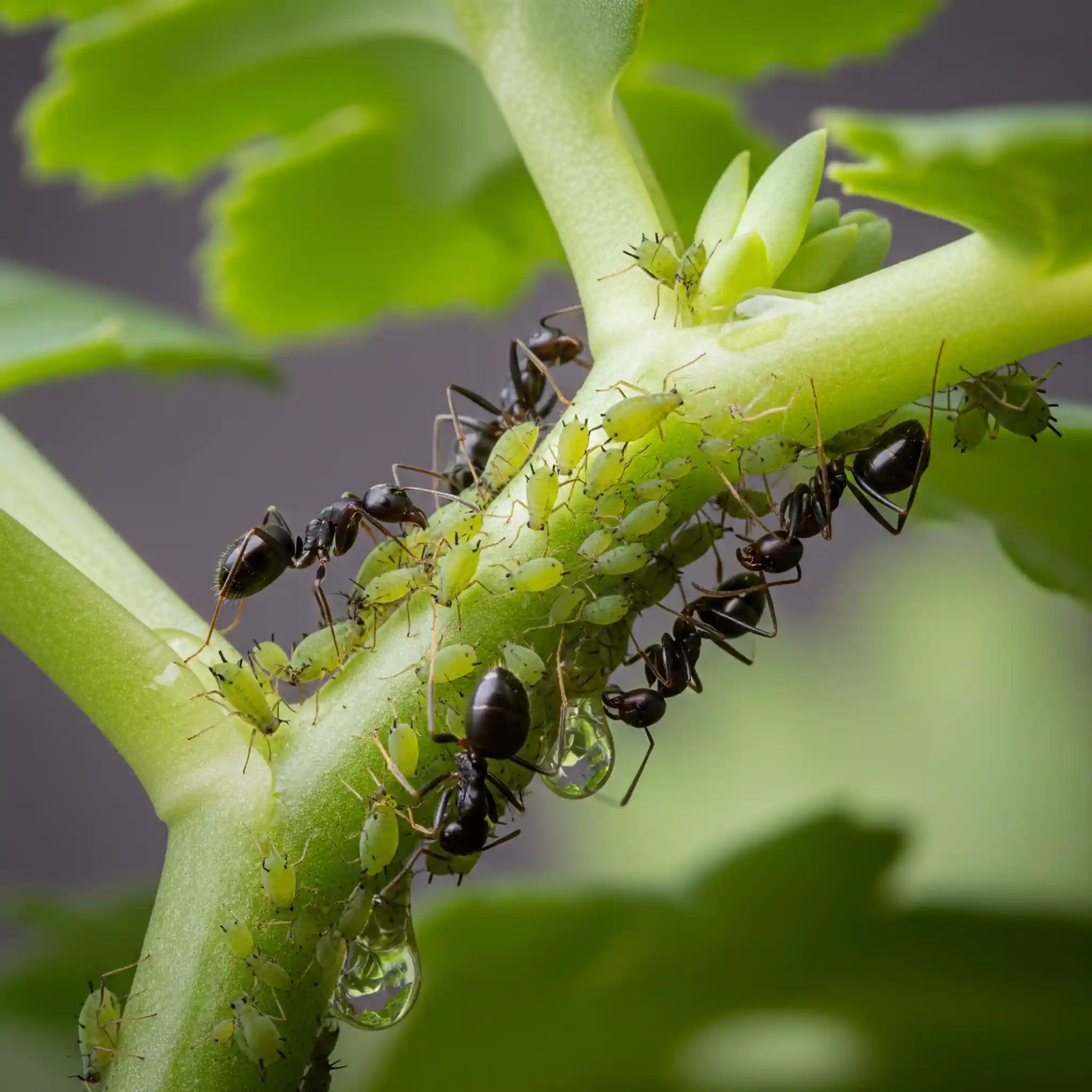
The ant-aphid relationship deserves its own note. Ants not only harvest honeydew — they actively defend aphid colonies, chasing off or killing lady beetles and lacewing larvae that would otherwise reduce the population. Persistent aphid infestations that resist natural control are often being protected by ants. Managing the ant trail (a ring of sticky barrier tape around the stem works) can shift the balance back toward natural predators.
Treatment: Match the Method to the Infestation
The right treatment depends on infestation severity, location on the plant, and whether beneficial insects are already present. Always start with the lowest-impact option that fits the situation.
Tier 1 — Water jet (mild or early infestations)
A strong stream of water from a dial nozzle set to jet or shower setting physically removes aphids from the plant. According to Clemson Extension, once dislodged, aphids cannot climb back up and will typically starve to death. This is the correct first response for small colonies on outdoor plants. Never use a pressure washer — it damages plant tissue. Repeat every 2-3 days for two weeks to knock back each new generation before it reproduces.
Tier 2 — Insecticidal soap (moderate infestations)
Insecticidal soap works by coating the aphid’s exoskeleton and causing it to suffocate. There is no residual activity, which is an advantage: late-arriving pollinators are not harmed by dried soap. It must make direct contact with the aphid to work, so thorough coverage of leaf undersides is essential. Apply late in the day to protect foraging beneficial insects. Reapply every 5-7 days for 2-3 treatments. See our guide on insecticidal soap formulations and how to use them correctly.
Tier 2 (alternative) — Neem oil
Neem oil contains azadirachtin, which interferes with aphid molting — it prevents them from shedding their exoskeleton as they grow, disrupting development rather than killing on contact. This makes it slower-acting than soap but means resistance is less likely to develop over repeated applications. For full guidance on mixing ratios and timing, see our neem oil application guide.
Tier 3 — Pyrethrins (heavy established infestations)
Pyrethrins are plant-derived (from chrysanthemum flowers) and offer quick knockdown for severe cases. They are harmful to beneficial insects and toxic to aquatic life, so apply only when necessary and choose morning or evening application to minimize contact with pollinators.
Tier 4 — Systemic insecticides (last resort)
Products containing imidacloprid or dinotefuran are absorbed through the plant and kill aphids through sap feeding. They take 2-4 weeks to become fully effective and are highly toxic to pollinators — never apply to plants in bloom or anywhere bees actively forage. On edible crops, observe label pre-harvest intervals strictly.
Woolly aphid exception
Insecticidal soaps and horticultural oils cannot penetrate the waxy filaments of woolly apple aphids. Systemic insecticides are the only reliable option, with the same pollinator precautions applied above.
When NOT to Treat — Let Nature Do the Work
This section is absent from most aphid guides, and it is where many gardeners cause more harm than the aphids would have.
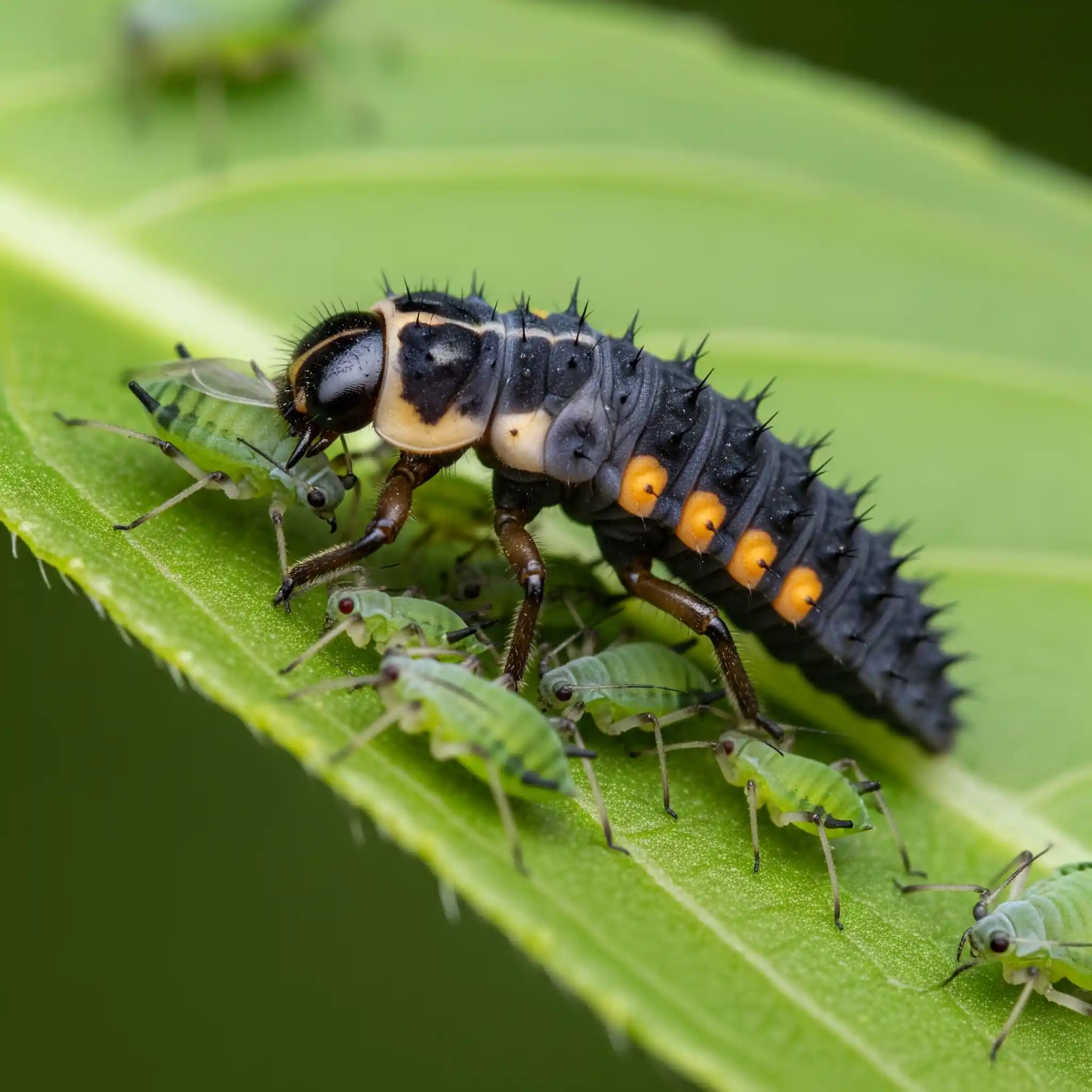
Leave the colony alone if lady beetles or lacewing larvae are feeding on it. Both are voracious aphid predators at the larval stage — a single lacewing larva consumes hundreds of aphids during development. Research has shown natural enemies can reduce aphid populations by up to 80% when present early in the season. Spraying now eliminates the predators that would otherwise do the work for you.
Leave the colony alone if you see parasitized mummy aphids. Parasitic wasps in the Aphidius genus inject their eggs into living aphids. The aphid continues feeding while the wasp larva develops inside, then dies as the adult wasp emerges. Parasitized aphids are easy to spot: they turn bronze or golden, swell slightly, and have a small exit hole in the abdomen. Finding even a few mummies in a colony means wasps are actively working through it — give them 5-7 days before intervening. As Clemson Extension notes, Aphidius wasps “impregnate aphids with eggs, killing and mummifying” the host.
Leave small colonies on healthy plants alone. The University of Minnesota Extension emphasizes that most aphid infestations cause minimal long-term plant harm, and treatment is frequently unnecessary. A cluster of 30-40 aphids on one shoot of an established plant will likely be regulated by natural enemies before it causes significant damage.
One prevention note that is often overlooked: high-nitrogen fertilization drives rapid, succulent new growth — exactly the soft tissue aphids prefer. If you are fertilizing heavily and seeing recurring infestations, reducing nitrogen input is often more effective than repeated spraying. For a comprehensive, low-intervention approach, see our overview of integrated pest management (IPM).
Prevention: Make Your Garden Less Hospitable
Once you have cleared an infestation, the goal is reducing the conditions that made it possible.
Companion planting. Sage, garlic, and nasturtiums deter aphids physically and through volatile compounds. Sunflowers and clover attract lady beetles and lacewings and serve as buffer hosts that draw aphids away from ornamentals and vegetables. For a full breakdown by species, see our guide on companion plants that repel aphids.
Reflective mulch. Silver or aluminum reflective mulch beneath plants disrupts the flight orientation of winged aphids — they navigate partly by light patterns and avoid highly reflective surfaces. Clemson Extension recommends this particularly in vegetable beds vulnerable to early-season colonization.
Nitrogen management. Avoid heavy fertilization, especially with high-nitrogen formulas in spring when new growth is flushing. Succulent, nitrogen-rich tissue is not just preferred by aphids — it allows faster development and higher reproduction rates compared to feeding on tougher, more mature growth.
Preserve your predator community. Resident populations of lady beetles, lacewings, and parasitic wasps build at the same time aphid populations are rising in spring. Early-season pyrethrin or systemic applications kill both. Maintain the predator community and you often avoid the need for treatment entirely. For a broader overview of low-intervention options, see our natural pest control guide.
Frequently Asked Questions
Do aphids spread between plants? Yes — when colonies become overcrowded, winged forms develop and fly to new hosts. A contained infestation that goes untreated will expand within 2-3 weeks as winged adults emerge and disperse.
How do I treat aphids on indoor plants? Water spray in the sink is the safest first step. Follow with insecticidal soap applied to all leaf surfaces and allow to air dry. Avoid systemic insecticides indoors. Repeat every 5-7 days for three weeks.
Can aphids kill plants? Severe, sustained infestations can cause significant damage, particularly in combination with virus transmission. However, most aphid infestations on healthy, established plants cause cosmetic damage rather than plant death. Young seedlings and transplants are at higher risk.
Do aphids bite humans? No. Aphid mouthparts are specialized stylets designed exclusively for penetrating plant tissue and extracting sap. They have no mechanism for biting humans or animals.
What time of year are aphids worst? Spring is the primary peak — new growth is tender and predator populations have not yet built up. A second smaller surge is possible in early fall as temperatures moderate. Midsummer populations often crash naturally as predator pressure increases and plant tissue hardens.
Sources
- Clemson Home & Garden Information Center. "Integrated Pest Management (I.P.M.) for Aphids." https://hgic.clemson.edu/factsheet/integrated-pest-management-i-p-m-for-aphids/
- University of Minnesota Extension. "Aphids in home yards and gardens." https://extension.umn.edu/yard-and-garden-insects/aphids
- University of Wisconsin Horticulture Extension. "Aphids, in-depth." https://hort.extension.wisc.edu/articles/aphids-2/
- Brisson JA et al. "Aphid polyphenisms: trans-generational developmental regulation through viviparity." Frontiers in Zoology. PMC3900772. https://pmc.ncbi.nlm.nih.gov/articles/PMC3900772/
- University of Wisconsin Vegetable Entomology. "Insect-Vectored Plant Pathogens." https://vegento.russell.wisc.edu/pests/plant-pathogens/
- NC State Extension Publications. "Sooty Molds." https://content.ces.ncsu.edu/sooty-molds


