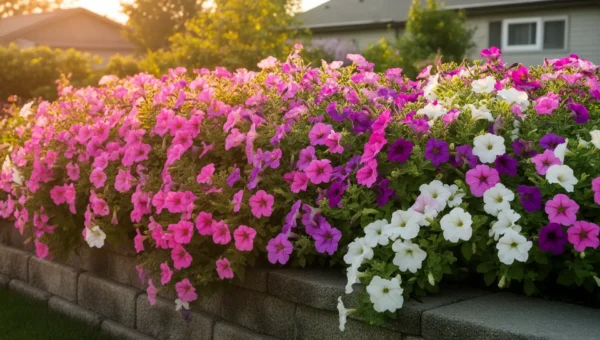
Petunia Companion Planting: 8 Annuals and Vegetables That Thrive in the Same Container

Petunias are one of the hardest-working plants in British and European gardens — prolific flowerers, long-season performers, and available in every colour from pure white to near-black. But a pot or border of petunias alone rarely looks as good as petunias surrounded by the right companions. The right partner plants fill textural gaps, extend colour range, disguise leggy stems mid-season, and share the same care routine, making maintenance simpler rather than more complex.
This guide covers the best petunia companions for containers and borders alike, with practical planting recipes, colour combinations, and a care-compatibility breakdown so every plant in your scheme thrives together.
Why Companion Planting Matters for Petunias
Petunias are vigorous but have one structural weakness: they become leggy and bare-stemmed by mid-July without regular deadheading and feeding. A well-chosen companion conceals this mid-season lull, fills the lower tier while petunias arch overhead, or provides contrasting texture that makes the petunia blooms stand out more clearly.
The golden rule for petunia companions is care compatibility. Petunias need:

Three pre-planned garden beds, free
Stop staring at empty beds: printable plans with exact layouts, plant lists and planting calendars — yours free from the Garden Library.
- Full sun — minimum six hours direct sun daily
- Regular feeding — high-potash liquid feed every 7–14 days once in bud
- Good drainage — waterlogged roots cause root rot rapidly
- Deadheading or shearing — every 3–4 weeks to prevent exhaustion
Any companion that shares all four requirements will integrate cleanly into the same maintenance routine. Partners that need shade, constant moisture, or no feeding will constantly underperform or require separate attention — defeating the purpose.
You might also find sunflower companion plants helpful here.
The Thriller–Filler–Spiller Framework
Container designers use the thriller–filler–spiller formula to build pots with visual structure at every level. Petunias are naturally flexible and can play any of the three roles depending on variety.

- Thriller (height, focal point): Upright salvia, ornamental grass, tall petunia varieties such as Sophistica or Amore series
- Filler (mid-level, mass): Standard or mounding petunias, calibrachoa, geraniums, bacopa, helichrysum foliage
- Spiller (trailing, over the rim): Wave petunias, calibrachoa, lobelia, trailing verbena, sweet potato vine, bacopa
A useful baseline for a 30–40 cm pot: one thriller, two to three fillers, and two spillers. Increase quantities proportionally for window boxes or half-barrels. For detailed container technique and compost selection, see the container gardening guide.
Best Petunia Companions for Containers
1. Calibrachoa (Million Bells)
Calibrachoa is the closest thing to a petunia’s twin. The flowers are identical in form but smaller — typically 2–3 cm across — giving the impression of thousands of miniature petunias spilling over the pot edge. Care requirements are virtually identical: full sun, high-potash feed every 10–14 days, and good drainage. Unlike standard petunias, calibrachoa is self-cleaning, meaning spent flowers drop without deadheading. This makes the pairing particularly low-maintenance.

Calibrachoa pairs best with trailing petunia varieties rather than upright ones, as both plants cascade to a similar length (40–50 cm). Use contrasting colours — a pure white petunia with deep violet calibrachoa, or a coral petunia with yellow-orange calibrachoa — for the greatest visual impact. Proven Winners’ Superbells range offers consistent performance across the season.
| Petunia colour | Calibrachoa colour | Effect |
|---|---|---|
| White (e.g. Supertunia White) | Deep violet/navy | Classic high-contrast |
| Hot pink | Lemon yellow | Bold, tropical |
| Soft lavender | Rose pink | Pastel harmony |
| Coral/salmon | Bronze/copper | Warm autumnal |
2. Lobelia
Lobelia erinus is one of the most versatile petunia companions for both containers and window boxes. The trailing forms (such as Cascade or Regatta series) spill 30–40 cm over the pot edge, providing a cascading blue or white skirt beneath bolder petunia blooms. The upright compact forms work as mid-level fillers between taller plants.
Blue lobelia with pink or white petunias is a classic British bedding combination precisely because the colour contrast is so clean — blue and pink sit opposite each other on a warm/cool axis. Lobelia prefers slightly cooler, moister conditions than petunias, so in very hot, dry summers it may slow down or go to seed mid-season. Combat this by keeping it in a slightly larger pot that retains moisture longer, or interplanting where the petunia canopy provides afternoon shade to the lobelia at root level.
3. Trailing Verbena
Verbena is an underused petunia companion that punches well above its height (10–20 cm trailing stems extend 30–50 cm). It flowers in clustered flat heads rather than the trumpet shape of petunias, providing genuine textural contrast. Verbena is fully drought-tolerant once established and shares petunias’ need for high-potash feeding and full sun.
The most useful colour mixing role for verbena is to bridge two colours in a scheme. A pot using magenta petunia and orange calibrachoa, for example, benefits from a red-purple verbena to smooth the transition. Verbena bonariensis, the tall airy variety, is too large for containers but superb in mixed borders as a vertical element woven between petunias.
4. Sweet Potato Vine (Ipomoea batatas)
Sweet potato vine is the boldest foliage plant in the summer container palette. Chartreuse forms (‘Marguerite’, ‘Lime Light’) make vivid purple or hot pink petunias pop with an almost electric contrast. Near-black or deep burgundy forms (‘Blackie’, ‘Sweet Caroline Sweetheart Purple’) create a moody, contemporary scheme when paired with white or pale yellow petunias.
Growth rate is the main management consideration: sweet potato vine can cover 60–90 cm in a single season and will overwhelm small containers or smaller companions if not pinched back monthly. In a large patio pot or half-barrel, this vigour is an asset — it fills space rapidly and suppresses weeds. Sweet potato vine needs the same full sun and regular feeding as petunias and is highly heat-tolerant, making it an excellent choice for south-facing walls.
5. Bacopa (Sutera cordata)
Bacopa produces tiny five-petalled flowers — typically white or pale lilac — on self-branching trailing stems 20–30 cm long. It is the quintessential white filler/spiller for mixed pots: light enough not to compete with bold petunia blooms, airy enough to separate colours that might otherwise clash, and continuous enough to maintain coverage from May to first frost.
Bacopa prefers slightly cooler and moister conditions than petunias and will pause flowering in heat above 28°C, resuming when temperatures fall. In the UK climate this rarely causes more than a brief pause in July. The Snowstorm series from Ball Horticultural remains the most reliable performer, maintaining flower production through periods of heat and drought better than older selections.
Stop missing your zone's planting windows.
Select your US zone and month — get a complete checklist of what to plant, prune, feed, and protect right now.
→ View My Garden Calendar6. Helichrysum / Silver Bush (Helichrysum petiolare)
Helichrysum petiolare contributes silver-grey felted foliage rather than flowers. This single quality makes it disproportionately valuable in mixed containers: silver foliage reflects and intensifies every colour placed near it, while providing textural contrast that flowers alone cannot achieve. It pairs particularly well with mauve, purple, and deep pink petunias, and is equally effective beside white petunias in all-silver-and-white schemes.
Growth is moderate — trailing stems reach 40–60 cm — and helichrysum tolerates drought well once established. It requires little feeding compared to flowering companions; include it in the same high-potash programme and it will grow steadily without becoming dominant. Pinch stem tips monthly to maintain a bushy habit rather than allowing it to sprawl over neighbouring plants.
Best Petunia Companions for Borders
Alyssum (Lobularia maritima) — Low Edging
Sweet alyssum forms dense 10–15 cm mounds along the front of borders, releasing honey fragrance throughout summer. As a petunia companion it serves as a living edge: low enough not to obscure petunias planted immediately behind, fragrant enough to add a sensory dimension that petunias lack, and available in white, pink, and purple to coordinate with any colour scheme.

Alyssum requires minimal deadheading — it self-cleans reasonably well — and shares petunias’ preference for full sun and well-drained soil. It also acts as a low-level nectar source, attracting hoverflies that control aphids. In a border context, a 20 cm-wide alyssum edge followed by 25–30 cm petunias creates a two-tier front margin that holds definition throughout the season.
Marigold (Tagetes) — Hot Colour Pairing
Marigolds and petunias are the two workhorses of the summer border, and they combine naturally because their cultural requirements are nearly identical: full sun, moderate water, high-potash feed, and regular deadheading. French marigolds (Tagetes patula, 20–30 cm) fit between petunias as mid-level fillers; African marigolds (Tagetes erecta, 40–60 cm) work as background uprights behind trailing or mounding petunia varieties.
The colour combination most garden designers reach for is orange marigold with purple or violet petunia — these are complementary colours (opposite on the colour wheel), creating maximum visual energy. For a more sophisticated palette, bronze or mahogany marigolds with apricot or peachy-pink petunias produce a warm, autumnal border scheme that ages well into September. For full marigold growing detail, see the marigold care guide.
Salvia — Upright Contrast
Annual salvias (Salvia splendens, S. viridis, S. horminum) provide a vertical spike form that petunias entirely lack. Salvia splendens in red behind white or purple petunias is a formal bedding classic; the more recent coral, salmon, and purple-leaved Salvia splendens cultivars (Vista, Sizzler, Clown series) work in less traditional schemes. Salvia farinacea ‘Victoria Blue’ (40–50 cm) is particularly effective as a cool-toned spike behind hot-pink trailing petunias.
Salvias need full sun and good drainage but are more drought-tolerant than petunias once established. In a mixed border they benefit from the same weekly or fortnightly feeding schedule, so no separate programme is required.
Zinnia — Cut Flower Bonus
Zinnias and petunias share identical requirements — full sun, warm conditions, regular feeding — and together produce a border with enormous colour range. The practical bonus of adding zinnias is that their flowers are cut-flower quality: long-stemmed, long-vase-life, and available in colours petunias cannot match, including lime green and antique salmon. Cutting zinnia stems also stimulates branching, effectively doubling the flower production.
Plant tall zinnia varieties (60–90 cm: Giant Cactus, Queen Lime series) as backdrop; mid-height varieties (30–45 cm: Zahara, Profusion series) as companions at the same level as mounding petunias. Both plants require similar spacing (25–30 cm) and both benefit from deadheading at the same session, making combined maintenance efficient.
Geranium / Pelargonium — Classic Bedding Combination
Zonal pelargoniums are petunias’ oldest bedding companion. The pairing works because they fill different roles in the same space: pelargoniums provide rounded, structured foliage and upright flower heads; petunias provide loose, trumpet-shaped flowers in greater volume and a wider colour range. Together they produce the classic British municipal bedding scheme — red pelargonium, white alyssum, blue lobelia — which endures because it works.
Pelargoniums prefer slightly drier conditions than petunias, so in wet summers they may develop leaf spot if constantly damp. In containers, ensure excellent drainage. In borders, plant on slightly raised ground. Both need deadheading to maintain production, and both respond to the same high-potash feed programme.
Colour Scheme Combinations
Cool Pastels: Petunia + Lobelia + Bacopa
The most reliably elegant scheme for shaded patios and north-facing walls where colours read clearly without direct sunlight. Use soft lilac or lavender petunias (Supertunia Vista Silverberry or Blushing Princess) with trailing blue lobelia (Regatta Sky Blue) and white bacopa. Ratio for a 40 cm pot: two petunias, two trailing lobelia, two bacopa. The bacopa threads between the other plants, preventing heavy patches of any single colour.

Hot Summer: Petunia + Marigold + Zinnia
Maximum energy — best for south-facing spaces needing bold impact from a distance. Choose magenta or hot orange petunia, French marigold in orange-red, and zinnia in yellow. This is a triadic colour scheme (three colours equally spaced on the colour wheel) that maintains visual tension without looking accidental. Underplant with bronze sweet potato vine to anchor the scheme with a warm foliage tone.
Modern: Petunia + Ornamental Grass + Sweet Potato Vine
Contemporary container design moves away from traditional bedding density toward textural contrast between flowers, fine foliage, and bold foliage. A tall ornamental grass such as Pennisetum setaceum ‘Rubrum’ (purple fountain grass, 60–90 cm) as the thriller, surrounded by white or deep purple petunias as filler, with chartreuse sweet potato vine spilling over the edge, creates a scheme that reads as designed rather than planted. This combination tolerates heat exceptionally well and requires less deadheading than a traditional petunia-only container.
Height and Habit Matching Guide
| Companion plant | Height | Habit | Best petunia pairing |
|---|---|---|---|
| Calibrachoa | 15–20 cm / trailing 40–50 cm | Trailing/cascading | Trailing Wave or Supertunia types |
| Lobelia (trailing) | 10–15 cm / trailing 30–40 cm | Cascading | Mounding or standard upright |
| Bacopa | 10 cm / trailing 20–30 cm | Spreading/trailing | Any — best as filler/spiller |
| Helichrysum | 20–30 cm / trailing 40–60 cm | Spreading foliage | Mounding or upright |
| Sweet potato vine | 15–20 cm / trailing 60–90 cm | Vigorous trailing | Large containers; upright petunia |
| Trailing verbena | 10–20 cm / trailing 30–50 cm | Sprawling/trailing | Upright mounding petunia |
| Alyssum | 10–15 cm | Compact mound | Border edging below all petunia types |
| French marigold | 20–30 cm | Upright bushy | Mid-border beside mounding petunia |
| African marigold | 40–60 cm | Upright tall | Behind trailing or mounding petunia |
| Salvia splendens | 25–45 cm | Upright spike | Behind or beside any petunia type |
| Zinnia (mid) | 30–45 cm | Upright branching | Beside mounding petunia |
| Pelargonium (zonal) | 30–45 cm | Upright rounded | Beside or behind any petunia type |
Care Compatibility at a Glance
All recommended companions share the core petunia care requirements: full sun, good drainage, and regular high-potash feeding. Minor variations to note:
- Lobelia and bacopa prefer slightly more moisture — pair with petunias in larger pots that dry out more slowly, or use water-retaining gel in compost.
- Sweet potato vine is more drought-tolerant and grows more vigorously than companions — pinch monthly and increase pot size.
- Pelargoniums prefer drier conditions — avoid overwatering when combining in pots; terracotta pots help regulate moisture.
- Helichrysum needs less feed than flowering companions — it will still grow well on the petunia programme without becoming dominant.
- All companions benefit from the same fortnightly liquid tomato feed (high potash) that petunias require.
Hanging Basket Recipes
Recipe 1: Classic British Basket
For a 35 cm wicker or wire basket. Plant list: 3 × trailing petunia (pink or red), 3 × trailing lobelia (blue), 2 × white bacopa. Place bacopa around the outer rim as primary spiller; plant lobelia and petunias alternating through the mid-zone and top. Feed every 10 days with tomato feed; water daily in warm weather. This basket will reach full coverage in 6–8 weeks from a May planting.

Recipe 2: Tropical Drama Basket
For a 40 cm solid basket. Plant list: 2 × magenta trailing petunia, 2 × orange calibrachoa, 1 × chartreuse sweet potato vine (centre-planted and allowed to trail). The sweet potato vine handles drought gaps better than lobelia, making this an excellent choice for gardeners who travel in summer. Feed weekly; water every 1–2 days in July–August.
Recipe 3: Silver and White Elegance
For a 35 cm basket. Plant list: 3 × white trailing petunia, 2 × helichrysum petiolare ‘Silver’, 2 × white bacopa. All-white with silver foliage reads as refined and suits formal entrances, painted walls, or gardens where a clean palette is preferred. The silver helichrysum amplifies the white flowers, making the basket appear brighter than a pure white scheme.
Frequently Asked Questions
What should you not plant next to petunias?
Avoid planting petunias with shade-lovers (impatiens, begonias) or bog plants (astilbe, ligularia) in the same container. These companions need conditions opposite to petunias — shade and constant moisture — so one group will always struggle. In borders, avoid planting petunias immediately next to large shrubs or perennials that cast shade by July, as leggy, flowering-reduced petunias result.
Can petunias and marigolds be planted together?
Yes — petunias and marigolds are one of the most compatible bedding combinations available. Both need full sun, well-drained soil, high-potash feed, and regular deadheading. Marigolds also produce a natural root exudate that suppresses soil nematodes, which can benefit nearby plants including petunias. The colour combination of orange marigold with purple petunia is a high-contrast complementary pairing that provides maximum visual impact in sunny borders.
Do petunias grow well with lobelia?
Petunias and lobelia combine well in containers and window boxes, with one caveat: lobelia prefers slightly cooler, moister conditions. In a British spring (May–June) and autumn (September–October) the pairing is excellent. In a heatwave July, lobelia may stop flowering temporarily while petunias continue. Use trailing lobelia in larger containers where compost retains moisture longer, and the combination will perform well for the full season.
How many plants should go in a petunia container?
For a 30 cm pot: 1 petunia + 2 companion plants. For a 40 cm pot: 2 petunias + 3–4 companions. For a 50–60 cm pot or half-barrel: 3–4 petunias + 5–6 companions. Resist the temptation to overcrowd early in the season — plants need airflow to prevent botrytis. Gaps fill naturally within four to six weeks of a May planting.
What companions work in partial shade?
Petunias perform best in full sun, but tolerate up to four hours of partial shade with reduced flowering. In part-shade conditions, shift companion plants toward impatiens, fuchsia, or busy lizzies rather than the full-sun companions listed in this guide. For full-sun petunia schemes, the companions above will outperform shade-tolerant alternatives significantly.
Sources
- RHS — Petunia Growing Guide (rhs.org.uk)
- Proven Winners — Companion Planting with Annuals (provenwinners.com)