

Lumpy, Twisted Zucchini? 6 Causes and How to Fix Each

Bent or bumpy zucchini isn’t random — each shape tells you which of 6 problems caused it. Here’s how to diagnose and fix the right one.
Is Your Zucchini Trying to Tell You Something?
You pull a zucchini from the vine and it bends at a 45-degree angle. Another has skin like rough cork — bumpy and mottled — while everything else in the same bed looks fine. A third is hollow when you slice it open.
Before you blame cross-pollination from a neighbor’s squash, stop — that was my first instinct too, and it cost me two full seasons of misdirected troubleshooting. Pollen from another plant does not change the shape of your current-season fruit. That is one of the most persistent misconceptions in vegetable gardening, and chasing it wastes diagnostic time. What actually causes lumpy, misshapen, or deformed zucchini is one of six distinct problems, each with a different visual signature and a different fix.
The diagnostic table below will get you to the right section fast. Some causes are easy to correct mid-season. Others — viral infections especially — require harder decisions. Knowing which you are dealing with is what matters most.
Quick Diagnostic: What Does the Deformity Look Like?
| What You See | Most Likely Cause |
|---|---|
| Bent, curved, or tapered to one side; skin is smooth | Cause 1: Incomplete pollination |
| General misshaping during a heat wave; very few fruits setting | Cause 2: Heat stress above 90°F |
| Warty or knobby bumps on the skin; mottled, mosaic leaves; distorted leaf shape | Cause 3: Virus infection |
| Corky or rough skin texture; hollow or spongy inside when cut | Cause 4: Boron or calcium deficiency |
| Fruit shape mostly normal but pinched or tapered at the stem end | Cause 5: Potassium deficiency |
| Completely wrong shape or color — unlike the rest of this season’s crop | Cause 6: Saved seed or volunteer plant |
Cause 1: Incomplete Pollination
This is the cause behind the majority of misshapen zucchini in home gardens, and understanding the mechanism tells you exactly why the shape goes wrong.

Three pre-planned garden beds, free
Stop staring at empty beds: printable plans with exact layouts, plant lists and planting calendars — yours free from the Garden Library.
Zucchini is monoecious — it grows separate male and female flowers on the same plant. The female flower has a tiny proto-fruit at its base; the male grows on a slender stem without one. When a bee moves from a male flower to an open female, it deposits pollen on the stigma. Each pollen grain travels down the style to fertilize one potential seed inside the ovary. Here is the key: each fertilized seed sends a hormonal signal to the surrounding wall tissue to expand and fill out. Sections of the ovary wall next to fertilized seeds swell. Sections with unfertilized ovules beside them barely grow, or stay narrow.
When only some of the ovules get fertilized, one side or one end of the developing fruit pushes out while the other lags behind. The result is a banana-curved fruit, a fruit that swells on one side only, or a fruit with a full blossom end and a thin, tapered stem end. A fully pollinated zucchini grows straight because seeds are evenly distributed along its entire length, creating even pressure on all sides.
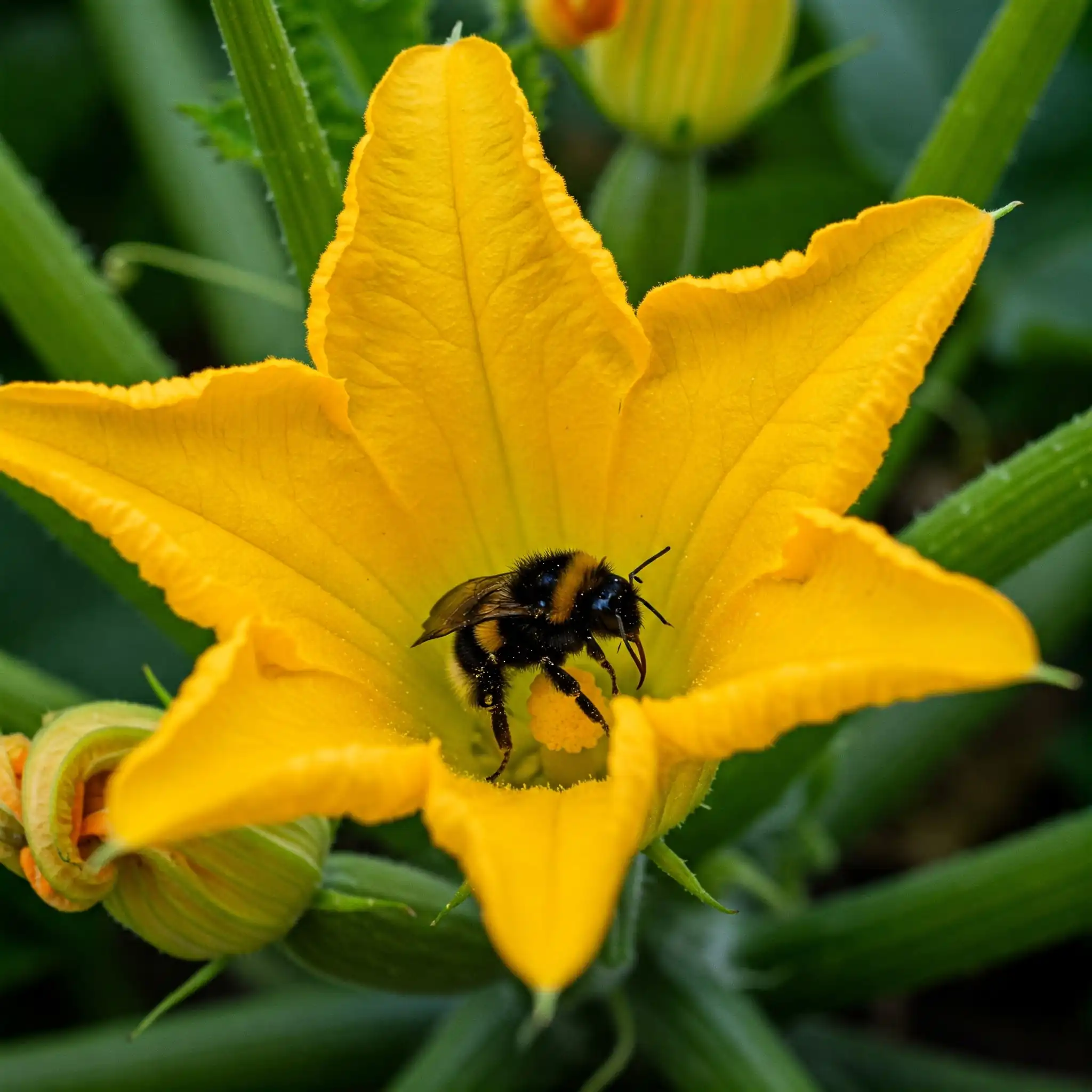
Why pollination fails: Bees fly most actively between 60°F and 90°F and stay grounded during cold snaps, heavy rain, and sustained wind. Early in the season, male and female flowers sometimes open on different days, leaving females with no available pollen. Overhead watering in the morning washes pollen off anthers before bees arrive. Pesticide applications during flowering hours reduce pollinator activity directly.
What it looks like: Fruit bent or curved to one side; one end fat and the other pointed; a single bulge along the length; narrow blossom end with a swollen middle. The skin is smooth — this is an important diagnostic detail, because warty, bumpy skin points to a different cause entirely.
Fix: The fastest correction is hand-pollination. Pick a fully open male flower early in the morning, peel back the petals, and press the pollen-covered anther directly against the stigma in the center of an open female flower. Do this before 10 a.m. when both flowers are fully receptive. One male flower can typically pollinate two or three females.
For ongoing improvement, switch watering to late afternoon so morning pollen remains dry during peak bee hours. Plant borage, phacelia, or nasturtium within 10 feet of your zucchini bed to attract pollinators. If poor pollination is a recurring problem, our complete guide to hand-pollinating zucchini and attracting bees covers the full technique, and our article on getting more fruits from poor pollination conditions covers broader strategies.
Cause 2: Heat Stress Above 90°F
When daytime temperatures push above 90°F — and especially when nights stay above 70°F — three separate problems hit your zucchini plants at once.
Pollen sterility. Pollen viability drops sharply in sustained heat. Even if a bee visits and transfers pollen, that pollen may no longer be capable of fertilizing seeds. The result is the same as incomplete pollination: uneven seed development and uneven fruit shape.
Male flower dominance. Zucchini shifts its flower production under heat stress, producing more male flowers and far fewer female flowers. You may see a plant flowering vigorously — but almost entirely male flowers. No female flowers means no new fruits. The few females that do open under these conditions are more likely to set poorly.
Reduced bee activity. The optimal foraging range for many bee species is 60°F to 90°F. Above 90°F, bees slow down and reduce pollination activity. This happens at exactly the temperature that also disrupts your pollen — a compounding failure.
What it looks like: Misshapen fruits appearing across multiple plants simultaneously; very few new fruits setting during an extended heat spell; male flowers abundant, female flowers rare. When heat is the driver, the problem tends to appear garden-wide rather than on a single plant.
Fix: In the short term, 30% to 50% shade cloth stretched over plants from 10 a.m. to 2 p.m. reduces canopy temperature during peak heat hours. Consistent soil moisture reduces the compounding stress of heat plus drought. For succession planting, schedule one planting in early spring before peak heat and a second in midsummer for fall harvest, timing both to avoid the hottest weeks in your zone.
If heat-related poor fruit set is a recurring problem, parthenocarpic varieties remove the pollination bottleneck entirely. These produce fruit without any pollinators: Golden Glory (yellow), Nocha (dark green), and Dunja (dark green, nearly spineless) are all documented performers. Parthenon and Sure Thing are additional widely available options. Our guide to selecting the right zucchini variety covers parthenocarpic and heat-tolerant options in detail.
Cause 3: Mosaic Virus Infection
Viral infection produces a distinctly different type of deformity — and the difference matters because there is no midseason cure once a plant is infected.
Stop missing your zone's planting windows.
Select your US zone and month — get a complete checklist of what to plant, prune, feed, and protect right now.
→ View My Garden CalendarFour viruses commonly infect zucchini in North America: Zucchini Yellow Mosaic Virus (ZYMV), Watermelon Mosaic Virus (WMV), Cucumber Mosaic Virus (CMV), and Papaya Ringspot Virus (PRSV). All four are transmitted primarily by aphids, which pick up the virus from infected weeds or plants and carry it to your zucchini during feeding. Once inside a plant, the virus spreads systemically through the vascular tissue. No foliar spray removes it.
What it looks like on fruit: ZYMV is the most damaging — infected fruit stays small, becomes heavily malformed, and develops green mottling and rings where the skin should be uniform. WMV causes fruit distortion and color breaks, especially visible on yellow-fruited varieties. PRSV produces fruit with knobby overgrowths and color breaks. CMV causes mottling and color variation across the skin surface.
The key visual distinction from causes 1 and 2: Virus-caused deformities produce warty, knobby bumps. The skin looks diseased, not just unevenly shaped. Check the leaves: mosaic or mottled patterns (yellow patches mixed with dark and light green), leaf wrinkling, puckering, and distorted ‘fern-like’ leaf shapes alongside deformed fruit is a strong indicator of viral infection. Pollination and heat problems do not produce leaf symptoms.
Diagnosis: University of Minnesota Extension notes that virus infections cannot be definitively confirmed without a laboratory test. If you want certainty before pulling a productive plant, contact your state plant disease diagnostic clinic — most university extension programs offer this service.
Fix: There is no midseason treatment. If a plant shows strong virus symptoms, remove it promptly to slow aphid transmission to healthy neighbors. Insecticide applications are not effective for preventing aphid-transmitted mosaic viruses — aphids transmit the virus during a brief probing phase before any insecticide has time to act. Reflective silver mulch laid at the base of plants reduces aphid landing rates and is worth applying preventively.
For next season: plant earlier in the season, before aphid populations peak in midsummer. Resistant varieties exist for ZYMV, WMV, and CMV in commercial zucchini and yellow squash lines — check seed catalog resistance codes when purchasing.
Cause 4: Boron or Calcium Deficiency
Boron deficiency has a visual signature distinct from both pollination problems and viral infection: a corky, rough, or bumpy skin texture, and a hollow or spongy interior when you cut the fruit open.
Boron is essential for cell wall formation, pollen grain germination, and fruit tissue development. Michigan State University Extension identifies it as critical to ‘protein synthesis; seed and cell wall formation; pollen grain germination’ — basic functions that run throughout the developing fruit. When boron is deficient, cell division in developing tissue becomes disrupted in patches. Normal tissue grows around the arrested areas, leaving a bumpy exterior. Internally, those arrested zones produce hollow cavities. Boron and calcium deficiency together specifically increase hollowness in summer squash, according to University of Delaware Cooperative Extension research.
What it looks like: Rough, corky skin with a texture unlike normal zucchini; fruit that feels lighter than expected; hollow center or spongy texture when you slice it open. The skin deformity is surface-level and distributed — not the discrete warty bumps of viral infection.
Which gardens are at risk: Sandy soils lose boron quickly through leaching. Soil analysis below 0.7 ppm indicates low availability. High pH soils (above 7.0) lock up boron even when it is physically present. Extended drought reduces boron movement to roots — the nutrient travels through soil water, so in dry conditions it does not reach the plant even from adequate reserves.
Fix: Soil test before treating. Boron has a narrow margin between deficiency and toxicity, and over-application harms plants. If a test confirms deficiency, a small borax application — roughly 1 tablespoon worked into 100 square feet of soil before planting — corrects it for the season. Consistent watering immediately restores boron uptake in drought-restricted soils. Adding compost or organic matter to sandy beds reduces long-term leaching.
Cause 5: Potassium Deficiency
Potassium deficiency creates a more specific deformity than boron: the fruit pinches or tapers at the stem end, while the rest of the fruit may look relatively normal.
Potassium drives cell expansion and osmotic regulation throughout the plant. In a developing zucchini, cells near the stem attachment point expand as water is drawn in through potassium-powered osmosis. When potassium is insufficient, that expansion is impaired at the stem end while the rest of the fruit continues developing normally. University of Delaware Cooperative Extension specifically identifies potassium deficiency as a cause of pinching at the stem end in summer squash — a distinct visual pattern that separates it from other deficiencies.
What it looks like: A zucchini that appears mostly normal in shape but tapers noticeably where it attaches to the stem — sometimes a gentle taper, sometimes a dramatically pointed constriction. No bumps, no mottling, no hollowness.
Conditions that cause it: Heavy rainfall leaches potassium from sandy soils. Nitrogen-heavy fertilizer applications without balancing potassium create a relative deficiency — nitrogen drives rapid foliage growth that outpaces the available potassium supply.
Fix: Soil test to confirm. If deficient, potassium sulfate is the preferred amendment for vegetable gardens (potassium chloride raises soil salinity and can stress plants at higher rates). Avoid mid-season applications of nitrogen-heavy fertilizers if stem-end pinching appears.
Cause 6: Saved Seeds or Volunteer Plants
This cause produces some of the most dramatic fruit deformities — unexpected shapes, unusual colors, fruits that look like a completely different variety. It also comes with one of the most persistent misconceptions in vegetable growing, worth clearing up directly.
The misconception: Many gardeners blame current-season cross-pollination — a bee carrying pollen from a neighbor’s squash to their zucchini — for their weird-looking fruit. This is not how it works. When a bee deposits pollen from another plant on your zucchini’s stigma, the pollen affects only the seeds forming inside the fruit. The fruit’s exterior shape and skin characteristics are determined entirely by the mother plant’s genetics. This season’s cross-pollination cannot change this season’s fruit.
What it changes is next year. Save seeds from a cross-pollinated fruit, plant them next season, and the offspring carry mixed genetics — expressing variable, often unpredictable shapes, colors, and textures. Nebraska Extension is unambiguous: ‘The pollen source does not, no matter if the plant is self- or cross-pollinated, affect the look or flavor of a new fruit.’ Iowa State University Extension confirms the same: effects only show when saved seeds are planted in subsequent generations.
What actually causes this year’s genetic deformities:
- Saved F1 hybrid seeds. Hybrid zucchini (labeled ‘F1’) are bred for consistent traits in the first generation only. If you saved seeds from an F1 variety last season and planted them this year, the offspring express variable genetics from both parent lines. The resulting fruit may look nothing like the parent plant.
- Volunteer plants. A zucchini left on the vine until it rotted, or a fruit that ended up in the compost pile and sprouted, grows into a volunteer plant the following season. That plant grew from seeds that were cross-pollinated in the previous year, and it produces variable, often unexpected fruit shapes.
Zucchini belongs to the species Cucurbita pepo, which includes acorn squash, crookneck and straightneck squash, pattypan squash, delicata squash, spaghetti squash, and ornamental gourds. All of these cross-pollinate freely with zucchini — meaning a garden that grows several C. pepo varieties produces saved seeds with especially unpredictable offspring characteristics.
Fix: Buy certified fresh seed each season from a reputable supplier. Remove volunteer plants as soon as you spot them in spring, before they flower — they may also carry disease from overwintered plant debris.
Are Deformed Zucchini Safe to Eat?
In most cases, yes. Zucchini deformed by incomplete pollination, heat stress, or nutrient deficiency is safe to eat. The shape and texture may be off, but the flesh is nutritious and cooks normally.
Virus-infected zucchini — identifiable by the combination of warty skin and mottled leaves — are also technically safe to eat, since plant viruses cannot infect humans. Quality is usually poor, though: bitter, tough-skinned, and with poor texture.
The one exception to watch for: Bitter zucchini should not be eaten. Bitterness in cucurbits signals elevated cucurbitacins — naturally occurring compounds that zucchini produces at very low levels, but which concentrate under extreme stress. Before cooking any deformed zucchini, nibble a small piece from the stem end. If it tastes sharply bitter, discard the fruit. High cucurbitacin levels cause significant gastrointestinal distress and are not reduced by cooking.
A hollow interior from boron deficiency is safe to eat. The texture is poor but the flesh itself is not harmful.
Preventing Deformed Zucchini
Most causes have practical prevention steps that pay off season after season.
Protect pollinators. Plant borage, phacelia, or marigolds within 10 feet of your zucchini before the plants start flowering. Stop pesticide applications during flowering — if spraying is necessary, do it after 7 p.m. when bees have returned to their colonies. Switch from overhead morning watering to drip irrigation or late-afternoon watering to keep pollen dry during peak bee hours. Our zucchini watering guide covers the timing and technique for both approaches.
Soil test before planting. A basic panel from your state extension service (typically $15 to $30) flags boron, potassium, and calcium deficiencies before they show up in your fruit. Test every two to three years, or the season after any significant fertility problem.
Choose appropriate varieties for your conditions. In zones where summers regularly push above 90°F for extended periods, parthenocarpic varieties remove the pollination bottleneck entirely. Golden Glory, Nocha, Dunja, Parthenon, and Sure Thing are all documented performers that set fruit without pollinators.
Use certified fresh seed annually. Do not save seeds from F1 hybrid zucchini. Remove volunteer plants in spring before they flower. For a complete guide to growing zucchini from planting through harvest, including variety selection and soil preparation, see our Zucchini Plant Care Guide.
Frequently Asked Questions
Can I eat misshapen or lumpy zucchini?
Yes, in most cases. Deformities caused by incomplete pollination, heat stress, or nutrient deficiency produce perfectly safe, edible fruit. The exception is any zucchini that tastes bitter — bitter flesh indicates high cucurbitacin levels that cause gastrointestinal upset, so discard those regardless of shape.
Will cross-pollination from a neighboring squash make my zucchini look weird this year?
No. Cross-pollination happening this season affects only the seeds inside your current fruit, not the fruit’s exterior shape, color, or skin. Effects only appear the following year, if you save and replant those seeds. The current season’s fruit shape is determined entirely by your plant’s own genetics.
How do I tell the difference between a pollination problem and a virus?
Look at the leaves. Incomplete pollination and heat stress produce misshapen fruits with completely healthy, normal-looking leaves. Viral infections almost always come with leaf symptoms: a mottled or mosaic pattern, leaf wrinkling, or distorted fern-like foliage. Warty, knobby skin on fruit alongside distorted leaves is a strong indicator of viral infection. Smoothly bent or curved fruit with healthy leaves points to pollination or heat.
Sources
- University of Minnesota Extension — Deformed Fruit (Summer Squash)
- University of Delaware Cooperative Extension — Fruit and Fruiting Disorders in Summer Squash
- University of Minnesota Extension — Heatwave Makes Vegetables Misbehave
- Alabama Cooperative Extension System — Mosaic Virus Diseases of Squash
- Cornell Vegetables — Virus Diseases of Cucurbits
- University of Minnesota Extension — Cucurbit Viruses
- Michigan State University Extension — Boron in Vegetables: Not Too Little, Not Too Much
- University of Maryland Extension — Pollination of Vegetable Crops in a Changing Climate
- Iowa State University Extension — Cross-Pollination Between Vine Crops
- Nebraska Extension (Lancaster County) — Weird Squash: Pollination Gone Wrong?
- Clemson Home and Garden Information Center — Give Parthenocarpic Squash a Try Next Year


