

15 Zucchini Plant Problems (And Exactly What to Do About Each)

Diagnose 15 common zucchini problems — powdery mildew, squash vine borers, blossom end rot, mosaic virus — with exact fixes backed by extension research.
Zucchini earns its beginner-friendly reputation right up until the first problem appears — and then another follows. A wilting plant at breakfast, stippled leaves by lunch, and fruit rotting before it is three inches long. Most problems are fixable, but only if you catch them early and identify the right cause. Treating bacterial wilt as a watering problem, or spraying natural leaf variegation as powdery mildew, wastes weeks you do not have.
This guide covers the 15 most common problems with garden-grown zucchini: the actual cause of each one, why it happens at a biological level, and exactly what to do — or when to cut losses and replant. Research draws from Clemson Cooperative Extension, Penn State Extension, Iowa State Extension, University of Minnesota Extension, and Cornell University’s Vegetable Disease Program. For a full growing foundation, see our complete zucchini care guide.
Quick Diagnostic Table
| What You See | Most Likely Cause | Urgency | First Action |
|---|---|---|---|
| White dusty powder on leaves | Powdery mildew (two fungal species) | Medium | Baking soda spray; improve airflow |
| Flowers but no fruit forming | Only male flowers; poor pollination | Low — wait 2 weeks | Check for female flowers; hand-pollinate |
| Flowers drop before opening | Male drop (normal) or heat/cold stress | Low if male; medium if female | Identify flower type; shade in heat waves |
| Dark rot at fruit tip | Blossom end rot (calcium uptake) | Medium | Water consistently; mulch; cut nitrogen |
| Yellow leaves | Nitrogen deficiency, overwatering, or virus | Medium | Check soil moisture; fertilize if needed |
| Plant wilts suddenly; orange frass at stem base | Squash vine borer | High — act same day | Find entry hole; surgically remove larva |
| Stippled leaves; bronze egg clusters under leaves | Squash bugs | High — act within days | Remove egg clusters; crush nymphs |
| Plant wilts and never recovers; thread-like ooze when stem cut | Bacterial wilt via cucumber beetles | High — plant cannot be saved | Remove plant; control beetle population |
| Leaf colonies; curled foliage; sticky residue | Aphids | Medium | Blast with water; insecticidal soap |
| Fine stippling; webbing under leaves in hot weather | Spider mites | High in heat — spreads fast | Two insecticidal soap apps, 5 days apart |
| Jagged holes in leaves and flowers | Cucumber beetles or squash bugs | Medium | Identify pest; row cover or trap |
| Yellow mosaic patterning; distorted leaves | ZYMV or CMV virus | High — remove plant | Pull infected plant; control aphid vectors |
| Split stems with brown gummy ooze | Gummy stem blight (fungal) | Medium-High | Remove affected stems; rotate crops 2+ years |
| Seedlings collapse at soil level | Damping off (Pythium/Rhizoctonia) | High — resow | Improve drainage; reduce moisture; resow |
| Lumpy, deformed, or curved fruit | Incomplete pollination or mosaic virus | Low-Medium | Hand-pollinate; check for leaf mosaic symptoms |
1. Powdery Mildew
That white dusty coating on zucchini leaves is powdery mildew, caused by two fungal species: Podosphaera xanthii and Erysiphe cichoracearum, according to Clemson Cooperative Extension. Unlike most fungal diseases, these pathogens thrive in both dry and humid conditions — spores travel on dry air currents, then germinate rapidly when humidity rises. The fungus colonizes leaf tissue and pulls nutrients directly from plant cells, causing infected leaves to yellow and die from the margins inward.
Before reaching for the spray bottle, make one important distinction. Silvery-white angular blotches that feel smooth to the touch are natural genetic variegation present in many modern zucchini cultivars — not a disease. University of Maryland Extension specifically flags this because gardeners routinely treat healthy variegated leaves unnecessarily. Powdery mildew always has a dusty texture and wipes off on your finger; variegation does not.

Three pre-planned garden beds, free
Stop staring at empty beds: printable plans with exact layouts, plant lists and planting calendars — yours free from the Garden Library.
Fix: Apply 1 tablespoon baking soda mixed with half a teaspoon of liquid soap per gallon of water, weekly at first signs. Remove heavily infected leaves. Space plants at least 36 inches apart and maximize airflow between plants. Clemson Cooperative Extension confirms that resistant varieties are available for most cucurbits — prioritize these if mildew recurs every season. See our full guide on white spots on zucchini leaves.

2. Poor Pollination and No Fruit Set
Zucchini is monoecious — it produces separate male and female flowers on the same plant. Iowa State Extension confirms that the first flowers to appear are predominantly male, often for the first two weeks of flowering. Female flowers are identifiable by the small immature fruit (the ovary) sitting at the base of the bloom; male flowers attach to a plain stem. If you see flowers but no fruit forming in the first few weeks, females likely have not appeared yet — patience is the correct response.
When females do appear and still fail to set fruit, insufficient pollination is the cause. Bee activity drops sharply in cool, rainy, and very hot weather above 95°F (35°C). Broad-spectrum insecticide use near flowering plants eliminates the pollinators you need. In all three scenarios, hand-pollination bridges the gap.
Fix: Hand-pollinate by transferring pollen from a freshly open male flower to the center of a female with a small paintbrush or cotton swab — do this before 10 a.m. when flowers are at peak fertility. Our step-by-step guide on hand-pollinating zucchini and attracting bees covers the full technique. For persistent fruit-set failure, see our guide on improving pollination.
3. Blossom Drop
Male blossom drop is normal and requires no action. Once a male flower has shed its pollen, the plant drops it — this is expected biology, not a problem. Seeing 10 or more male flowers fall in a single morning is completely normal, especially early in the season before females have appeared. A healthy plant typically produces 4 to 5 male flowers for every 2 to 3 females.
Female blossom drop is the concern. Females abort without setting fruit when temperatures exceed 95°F (35°C) or fall below 50°F (10°C) — at those extremes, pollen loses viability and fertilization fails. Drought stress and excess nitrogen fertilization both divert the plant’s resources away from fruit development.
Fix: Temperature-triggered blossom drop cannot be reversed after it happens. During heat waves above 95°F, use 30% shade cloth over plants during peak afternoon hours to protect pollen viability. If plants produce abundant foliage but drop all their flowers, reduce or eliminate high-nitrogen fertilizer — the plant is prioritizing leaf growth over reproduction.
4. Blossom End Rot
Blossom end rot appears as a dark, sunken, leathery patch at the tip of developing fruit — the end opposite the stem. It looks like a disease but is actually a physiological disorder caused by insufficient calcium reaching the rapidly expanding fruit tissue.
The mechanism is transport, not supply. Calcium moves through plants via the xylem, carried by water. When soil moisture is inconsistent — wet periods followed by dry spells — calcium uptake stalls, and fast-growing fruit cells at the tip die. Iowa State Extension confirms that soil calcium is almost never the actual deficit. Erratic irrigation is the culprit in the vast majority of cases. Excess nitrogen worsens this by driving aggressive vegetative growth that competes with developing fruit for the limited calcium supply.
Fix: Water consistently, delivering about 1 inch per week during dry weather. Mulch 3 inches deep around the plant base to buffer soil moisture between waterings. Reduce or eliminate high-nitrogen fertilizers once fruit is actively setting. Calcium foliar sprays exist but are secondary — fix the watering schedule first. See our zucchini watering guide for timing specifics by region.
5. Yellow Leaves
Yellow leaves on zucchini have five distinct causes, each requiring a different response. Getting the diagnosis right matters far more than applying a generic fix:
- Nitrogen deficiency: Uniform yellowing starting on the oldest lower leaves, moving upward as the deficiency progresses. Apply a balanced fertilizer or side-dress with compost.
- Overwatering: Yellowing combined with wilting and soft, dark-smelling soil. Improve drainage and reduce watering frequency before fertilizing.
- Iron or magnesium deficiency: Interveinal chlorosis — yellowing between leaf veins while veins stay green. More common on new leaves than old. Amend with a complete micronutrient product.
- Squash bug feeding: Yellow-green stippling (individual puncture marks from piercing damage), not uniform yellowing. Inspect leaf undersides for insects and eggs.
- Mosaic virus: Irregular yellow mottling accompanied by leaf distortion and curling. Cannot be treated — see Problem 12.
Our in-depth guide on why zucchini leaves turn yellow covers each cause with comparison photos.

6. Squash Vine Borers
Squash vine borers are the most destructive single pest for zucchini, capable of killing an entire plant within 48 hours of larval entry. The adult is a day-flying moth that mimics a wasp — metallic greenish-black body, orange abdomen with black spots, about half an inch long. Females lay flat, reddish-brown, coin-shaped eggs at the base of stems. The larvae bore directly into the main stem, tunnel through the pith, and physically block water transport. Sudden daytime wilting of an apparently healthy plant, accompanied by orange-brown frass (sawdust-like excrement) at a small hole near the soil line, is the diagnostic sign.
Penn State Extension notes that moths emerge in early summer and target the squash family. In northern zones 4 to 6, peak egg-laying falls in mid-to-late June; two generations occur in the South, with a second emergence in late summer.
Stop missing your zone's planting windows.
Select your US zone and month — get a complete checklist of what to plant, prune, feed, and protect right now.
→ View My Garden CalendarFix — active infestation: Locate the frass entry hole. Slit the stem lengthwise with a clean knife at the entry point, remove the larva, bury the cut section under 2 inches of soil, and water deeply — stems can re-root above the damage zone. Fix — prevention: Cover plants with floating row covers from transplanting until first female flowers open, then remove for pollination. A second planting started in early July after the main egg-laying window closes is the most reliable long-term strategy. See our squash vine borer identification and control guide.
7. Squash Bugs
Squash bugs (Anasa tristis) are shield-shaped, brownish-gray insects that overwinter under garden debris and emerge in spring. The key to control is catching them early — once you have a full adult population in August, chemical and mechanical control both become difficult. Penn State Extension documents the development: eggs hatch in 1 to 2 weeks, and nymphs develop through five growth stages over 4 to 6 weeks before reaching adulthood. Adults are hardy and capable of surviving cold temperatures; nymphs in their first two stages are the most vulnerable window.
Feeding damage shows as small yellow-green stippling where insects have pierced the leaf and extracted plant sap. Heavily infested leaves yellow, brown, and die as populations build. The egg clusters are your most reliable early warning: shiny, elliptical, bronze-to-red eggs arranged in precise geometric rows on leaf undersides, often in groups of 15 to 40 eggs.
Fix: Remove egg clusters by hand the moment you find them — scrape directly into soapy water. Crush small nymphs in their first and second stages before they develop the waxy coating that protects older nymphs. For adults, lay cardboard boards under plants overnight and collect those sheltering there at dawn. See our comprehensive squash bug control guide.

8. Cucumber Beetles and Bacterial Wilt
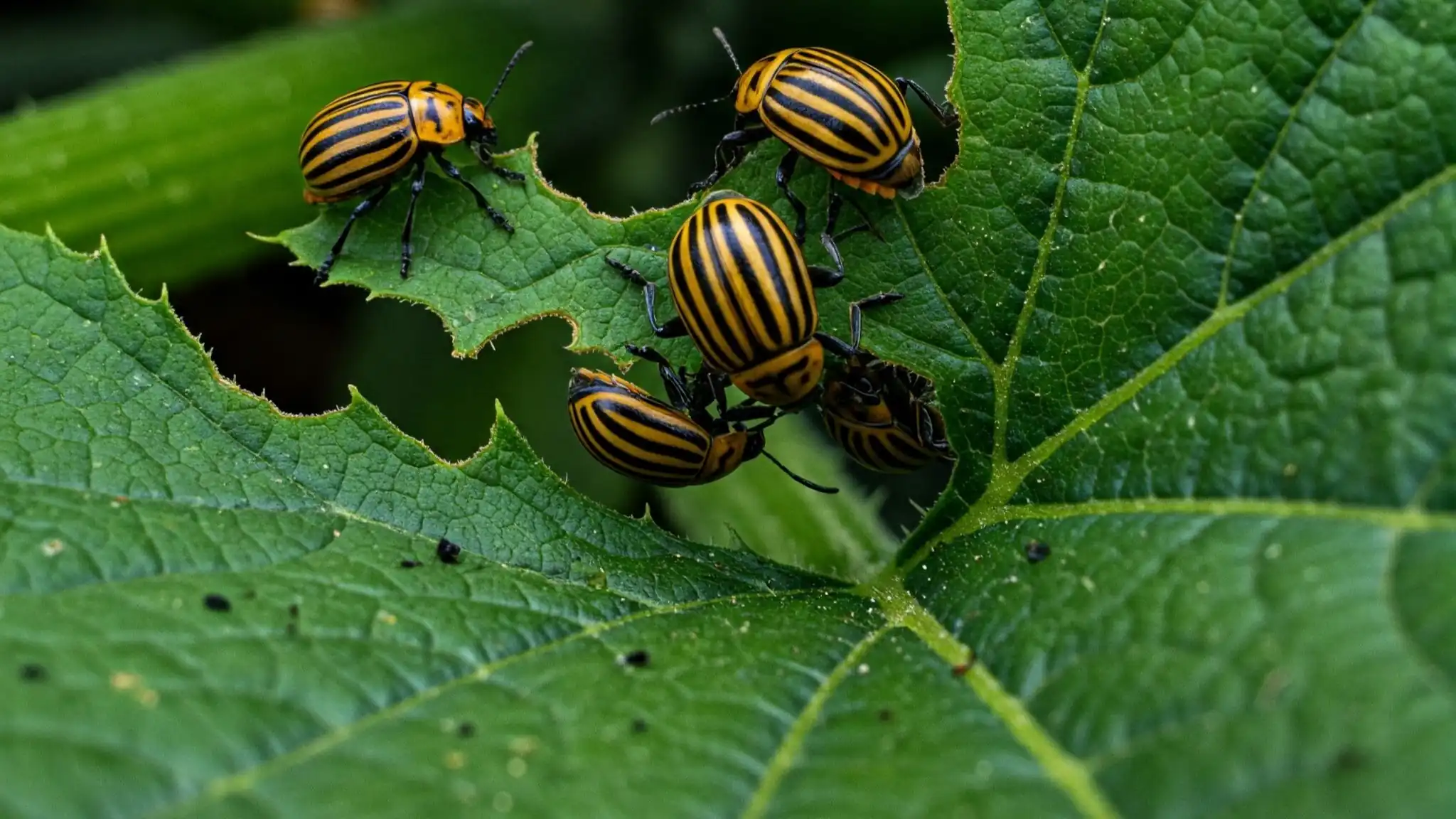
Two cucumber beetle species attack zucchini: the spotted cucumber beetle (quarter-inch, yellowish-green with 12 black spots) and the striped cucumber beetle (same size, three black stripes along the back). Both feed on leaves and fruit, but University of Maryland Extension notes that striped beetles are more likely to carry bacterial wilt bacteria — making identification relevant to your risk assessment.
The real danger is Erwinia tracheiphila, the bacterium that causes bacterial wilt. University of Minnesota Extension explains the mechanism: this pathogen overwinters in the beetles’ digestive systems. When beetles feed on a healthy plant, they transfer bacteria through feeding wounds, where the bacteria multiply rapidly and plug the vascular tissue, blocking water transport entirely. The plant wilts during the day and initially recovers at night; within days to weeks, it dies completely.
To confirm bacterial wilt rather than drought stress: cut the vine near the crown, slowly pull the cut surfaces apart, and watch for thread-like strands of bacterial ooze stretching between the cut ends. This is the diagnostic sign. In my experience the strands are more visible than you’d expect — if you hold the cut ends about an inch apart in good light, a genuine wilt infection produces clear, thread-like filaments that are hard to miss.
Fix: No pesticide cures bacterial wilt once infection takes hold. Remove infected plants immediately and dispose of them away from the compost. For prevention, use floating row covers until first bloom. University of Minnesota Extension recommends treating when 2 or more beetles appear per plant on seedlings, or when 25% of leaves are defoliated on established plants. See our cucumber beetle identification guide.
9. Aphids
Melon aphids (Aphis gossypii) are the dominant aphid species on zucchini, ranging from light yellow to deep green or near-black — color identification alone is unreliable. Clemson Cooperative Extension confirms they transmit Cucumber Mosaic Virus, meaning an aphid infestation is not just a direct feeding problem but a virus delivery system. Colonies form on leaf undersides and at growing tips; infested plants show curled, cupped leaves, sticky honeydew residue on surfaces below the colony, and sooty mold growing wherever honeydew accumulates.
Fix: A strong jet of water directed at leaf undersides knocks aphids off, and many do not survive the fall — this is effective for early-stage colonies. For persistent populations, apply insecticidal soap directly to leaf undersides, ensuring full coverage of the colony. Avoid broad-spectrum insecticides, which kill parasitic wasps and ladybugs that provide more sustained long-term aphid control than chemical treatments. Our organic pest control guide covers the full integrated approach.
10. Spider Mites
Spider mites thrive in the exact conditions that stress zucchini: hot, dry weather above 85°F (29°C). A single generation can complete in under a week in peak summer heat, making this one of the fastest-spreading zucchini problems. The first sign is fine stippling on leaf surfaces — individual cells drained of content, leaving pale pinprick marks. This initially resembles squash bug feeding damage. The distinction is webbing: flip a leaf and look for thin silk webbing on the underside with tiny, barely visible moving dots.
Fix: Clemson Cooperative Extension recommends two applications of insecticidal soap spaced exactly 5 days apart — the first kills active mites, and the second targets eggs that hatch in the interval. Neem oil is an effective alternative that also disrupts the mite reproductive cycle. Keep plants well-watered during hot spells: drought-stressed plants are significantly more susceptible to mite damage and less capable of recovering from it.
11. Holes in Leaves
Three pests create distinct hole patterns, and the distinction matters for choosing your response:
- Cucumber beetles: Irregular, jagged holes at leaf margins and in flower petals. High-risk because beetles transmit bacterial wilt — see Problem 8.
- Squash beetles: Surface feeding between leaf veins creating a ‘windowpane’ effect where the lower leaf epidermis remains intact but the interior is consumed. Clemson HGIC describes this species as an orange beetle with seven large black spots per wing cover, resembling a large ladybug.
- Squash bugs in heavy infestations: What starts as stippling progresses to dead, papery brown patches that resemble large ragged holes as the tissue collapses.
University of Maryland Extension notes that striped cucumber beetles carry bacterial wilt at higher rates than spotted beetles — jagged holes combined with any nearby wilting should immediately raise your alert level. Our guide to holes in zucchini leaves covers identification photos for all three pests.
12. Zucchini Yellow Mosaic and Cucumber Mosaic Virus
Zucchini Yellow Mosaic Virus (ZYMV) and Cucumber Mosaic Virus (CMV) are the two most damaging viruses affecting garden zucchini. Cornell University’s Vegetable Disease Program notes that ZYMV was first identified in Europe in 1981 and reached New York by 1983; it is now distributed throughout the United States.
Both viruses spread via aphids in a non-persistent manner: the aphid acquires the virus within 30 seconds of probing an infected plant and transfers it to the next plant it probes. This speed is why controlling aphids after a virus is circulating in a planting does not stop the spread — the virus moves faster than you can reduce the aphid population.
ZYMV produces prominent yellow mosaic patterning on leaves, severe distortion and stunting, and small malformed fruit with green mottling and knobby protrusions across the entire surface. CMV causes severe downward cupping along the leaf midvein on summer squash, along with fruit deformity. Cornell confirms resistant varieties of zucchini are available for both viruses.
Fix: No treatment exists for either virus. Remove infected plants immediately and dispose of them away from the compost pile. For future seasons: choose resistant varieties, manage aphid populations aggressively from the start of the season, and control perennial weeds around the garden that serve as virus reservoirs over winter.
13. Gummy Stem Blight
Gummy stem blight, caused by the fungus Didymella bryoniae, produces split stems with a distinctive brown, sticky, gummy ooze. This distinguishes it clearly from squash vine borer damage (which shows frass-filled entry holes at the base) and from root rot (which starts below the soil line). Leaf spots are brown or tan with water-soaked margins. The pathogen overwinters in infected seeds and plant debris, and spreads readily via overhead irrigation that splashes spores from soil to stem.
Fix: Remove affected stems immediately. Switch entirely to base-level irrigation — overhead watering accelerates this disease more than almost any other factor. Clemson Cooperative Extension recommends rotating cucurbit crops with non-host plants for at least 2 consecutive years to break the disease cycle in soil. Purchase only certified disease-free seed. Preventive fungicide applications can slow spread in severe outbreaks, but cultural controls provide the primary long-term solution.
14. Damping Off
Damping off kills seedlings in two phases: pre-emergence (seeds rot before sprouting, leaving bare spots in the seed tray) and post-emergence (seedlings emerge but their stems pinch to a thread at soil level and topple). The cause is soil-dwelling fungi — primarily Pythium and Rhizoctonia species — that proliferate in cold, wet, poorly aerated conditions. Sowing too deep, overwatering, using unsterilized garden soil instead of seed-starting mix, and starting seeds in a cold location below 65°F are the most common triggers.
Fix: Sow in sterile, well-draining seed-starting mix — never garden soil. Keep the germination medium at 70°F or above. Water from below when possible and let the surface dry between waterings. Ensure air circulation from day one with a small fan on low speed. Once damping off appears, resow in fresh, dry mix in clean containers. Seedlings affected by damping off do not recover — do not try to rehabilitate them.
15. Deformed or Lumpy Fruit
Lumpy, curved, or misshapen zucchini has two primary causes that require opposite responses — distinguishing between them matters before you act:
Incomplete pollination: Iowa State Extension explains the mechanism directly — the ovary wall enlarges more adjacent to fertilized seeds. When only part of the flower received adequate pollen transfer, seeds form unevenly, and the fruit bulges at the well-pollinated end while tapering or pinching elsewhere. The plant and its leaves appear completely healthy. Fix: hand-pollinate while female flowers are fresh and open in the morning.
Viral infection (ZYMV or CMV): Small, severely malformed fruit with green mottling and knobby protrusions across the entire surface, accompanied by mosaic patterning and distortion on the leaves. Fix: remove the plant immediately. It is an active virus source infecting every aphid that feeds on it. See Problem 12.
Our guide on lumpy and deformed zucchini fruit covers both causes with identification photos.
When NOT to Treat
Several common zucchini ‘problems’ are normal plant behavior or benign conditions requiring no intervention:
Male flower drop. A healthy plant drops every male flower once it has shed pollen. Seeing 10 or more male flowers fall in a single morning is completely normal, especially early in the season before females have appeared.
Silver or gray angular leaf patches. Many modern zucchini cultivars carry natural genetic leaf variegation — smooth, angular silver-white blotches on the leaf surface. University of Maryland Extension specifically documents this because it is routinely mistaken for powdery mildew and sprayed unnecessarily. The tactile test is reliable: variegation is smooth and does not wipe off; mildew is dusty and does.
Lowest-leaf yellowing at mid-to-late season. As zucchini plants mature, the oldest lower leaves undergo natural senescence. Yellowing starting on the bottom 2 to 3 leaves that does not spread rapidly upward, occurring in mid-to-late summer, is aging — not disease or deficiency. Remove the leaves and continue.
Oversize fruit turning yellow. A zucchini left too long on the plant eventually turns yellow-orange. This is maturity, not disease. Harvest it immediately — leaving oversized fruit in place signals the plant to slow production, and regular harvesting keeps output high through the season.
Building a Problem-Resistant Zucchini Patch
Most of the 15 problems above are easier to prevent than treat. Five practices address the root causes of the majority:
- Space plants 36 inches apart. Crowding drives powdery mildew, reduces airflow for pest inspection, and makes early diagnosis harder when plants overlap.
- Use floating row covers from transplanting until first female flowers open. This single intervention blocks squash vine borers, squash bugs, cucumber beetles, and aphids during the highest-risk establishment period.
- Water at soil level, never overhead. Wet leaves accelerate every fungal disease covered here: powdery mildew, gummy stem blight, and damping off all require wet foliage to spread at full speed.
- Rotate cucurbit crops to a different bed each year. Squash vine borers overwinter in soil near the previous season’s plants; cucumber beetles build up in the same beds year over year. Moving the planting breaks both cycles.
- Remove infected plants immediately and completely. Bacterial wilt, mosaic viruses, and gummy stem blight all spread from infected material left in the garden. Hesitating to pull a declining plant costs neighboring plants.
For year-round growing strategies, our how to grow zucchini anywhere guide covers full-season setup from soil preparation to final harvest.
Frequently Asked Questions
Why does my zucchini have lots of flowers but no fruit after three weeks?
Iowa State Extension confirms that the first flowers on zucchini are predominantly male. Female flowers — identifiable by the small fruit at their base — appear a week or two later. If females are present and still not setting fruit, hand-pollinate each morning before 10 a.m. and check whether bees are actively visiting. See our hand-pollination guide for technique.
Can I eat zucchini that has blossom end rot?
Yes. Cut the affected end off, removing at least an inch beyond the dark tissue, and cook the rest normally. Blossom end rot is a physiological calcium transport disorder — not a disease or pathogen — and does not contaminate the healthy flesh above the affected tissue.
My zucchini plant was healthy and then collapsed overnight — what happened?
Sudden complete collapse almost always means squash vine borers or bacterial wilt. Check the stem base: if you see orange sawdust-like frass and a small entry hole, vine borers are present — surgical removal is possible. If the stem looks intact but a cross-section produces visible thread-like ooze when the cut surfaces are slowly pulled apart, bacterial wilt has blocked the vascular system. That plant cannot be saved; remove it to protect neighboring plants from beetle-spread infection.
Sources
- Penn State Extension — Insect Pests Affecting Squash Plants
- Clemson Cooperative Extension — Cucumber, Squash, Melon and Other Cucurbit Diseases
- Iowa State University Extension — Why Are My Zucchini Fruit Rotting Before Harvest?
- University of Minnesota Extension — Bacterial Wilt of Cucurbits
- Clemson Cooperative Extension — Cucumber, Squash, Melon and Other Cucurbit Insect Pests
- Cornell University Vegetable Program — Virus Diseases of Cucurbits
- Iowa State University Extension — Solving Common Problems with Summer Squash
- University of Maryland Extension — Key to Common Problems of Squash


