

How to Diagnose and Treat the 7 Most Common Plant Diseases Before They Spread

Spot, diagnose, and treat powdery mildew, black spot, root rot, and 4 more common plant diseases with a master diagnostic table and mechanism-based guide — before they spread.
The first sign of trouble is easy to miss — a faint white powder on your zucchini leaves, a cluster of brown spots spreading across your rose foliage, or a tomato plant that wilts by noon despite moist soil. Most gardeners reach for the nearest spray bottle. But treating before you know what you have often makes things worse: fungicides do nothing against bacterial diseases, and no spray on earth can reverse a viral infection.
Around 85% of plant diseases are caused by fungal or fungal-like organisms, according to Michigan State University Extension — but the remaining 15% require completely different responses. The fastest path to a healthy garden isn’t a stronger spray; it’s an accurate diagnosis.
This guide covers the 7 most common plant diseases in home gardens: powdery mildew, black spot, gray mold, root rot, rust, fusarium wilt, and bacterial leaf spot. For each one, you’ll find the exact visual signs to look for, the biology behind why it develops, and the most effective treatment steps. A master diagnostic table gives you a 60-second identification shortcut before you read the full profiles.
Start with the type framework below — knowing whether you’re dealing with a fungal, bacterial, or viral problem narrows your options immediately and saves you from the most common treatment mistakes. If you’re not sure whether you have a disease or a pest problem, our guide to distinguishing plant pests from diseases will help you rule out insects first. Or use the plant problem diagnosis guide to work through all three categories — pest, disease, and care — in one place.

Three pre-planned garden beds, free
Stop staring at empty beds: printable plans with exact layouts, plant lists and planting calendars — yours free from the Garden Library.
Understand the Disease Type Before You Treat
Before identifying the specific disease, narrow it down to a category. The visual signs of each type are distinct enough that you can usually make this call in under a minute.
Fungal diseases — the most common category, responsible for about 85% of plant disease — show visible pathogen growth: white powder, gray fuzz, orange pustules, or black spots with ring patterns. Fungi spread through airborne or water-splashed spores and need specific humidity and temperature conditions to establish. Most respond to fungicides and cultural changes.
Bacterial diseases look wetter and more angular. The spots tend to be water-soaked (translucent when held to light), have straight or angular edges where they’re bounded by leaf veins, and may show a yellow halo around dark tissue. Bacteria enter through wounds and natural leaf openings and spread rapidly in warm, wet conditions — Penn State Extension notes that bacteria can double their population in under 10 minutes under favorable conditions. Standard fungicides don’t work; copper-based products are the main option.
Viral diseases show no physical signs of the pathogen at all — only plant symptoms: mosaic or mottled coloring on leaves, distorted new growth, or stunted plants. Viruses force the plant’s own cells to produce more virus particles. There’s no treatment; infected plants must be removed. For the full identification guide — including how to tell mosaic, leaf curl, and ringspot apart, and why insecticides backfire on aphid-vectored viruses — see plant viruses: mosaic, leaf curl, and ringspot.
Abiotic disorders aren’t caused by pathogens at all. Nutrient deficiencies, drought stress, and temperature damage can all mimic disease symptoms. If yellowing appears uniformly across the whole plant rather than starting at a localized point, suspect an environmental cause — check soil pH and drainage — before assuming disease.
Quick Reference: Identify Your Plant Disease in 60 Seconds
Use this table for a rapid first-pass identification, then read the full disease profile below for treatment details.
| Disease | Type | Where It Appears | Key Visual Sign | Treatable? |
|---|---|---|---|---|
| Powdery Mildew | Fungal | Leaves, stem tips | White powdery coating on upper leaf surface | Yes |
| Black Spot | Fungal | Rose leaves | Circular black spots with fringed edges; yellowing | Manageable |
| Gray Mold (Botrytis) | Fungal | Flowers, stems, dead tissue | Dusty gray-brown fuzz on dying tissue | Yes |
| Root Rot | Oomycete | Roots, crown | Soft dark roots; wilting despite moist soil | Partial |
| Rust | Fungal | Leaves | Orange spots above; raised pustules on underside | Yes |
| Fusarium Wilt | Fungal | Whole plant, vascular tissue | Asymmetric yellowing; brown vascular tissue | No |
| Bacterial Leaf Spot | Bacterial | Leaves | Angular water-soaked spots; yellow halos | Partial |
Disease 1 — Powdery Mildew
Powdery mildew is the most widely distributed fungal disease in home gardens, affecting cucurbits, roses, phlox, bee balm, and hundreds of other plants. It’s also one of the most counterintuitive: unlike most fungal diseases, it doesn’t need free water to spread. Liquid water on leaves actually inhibits spore germination, according to Penn State Extension. Powdery mildew thrives on warm days (70–80°F) followed by cool, humid nights — the classic late-summer conditions across most US climate zones.
The biology explains its persistence. The fungus grows on the leaf surface but sends fine threads called haustoria into the epidermal cells to extract nutrients. From the moment a spore lands on a leaf to the production of a new generation of spores takes just 48 hours — meaning a small patch can cover an entire plant within days under the right conditions.
Identify it: A white or grayish powdery coating on upper leaf surfaces, most prominent on younger leaves and stem tips. Affected tissue may yellow, wilt, or distort as infection progresses. Unlike downy mildew, the growth appears on the top of the leaf, not the underside. If you need to tell them apart, our guide to powdery mildew vs downy mildew explains the one visual test and why the two diseases require opposite treatments.
Treat it: Improve air circulation through pruning and better spacing. Wetting the leaves during low-humidity afternoons inhibits spore spread on already-infected plants. Apply a sulfur-based fungicide, potassium bicarbonate, or neem oil at first signs, repeating every 7–10 days. For tomatoes specifically, see our guide to handling powdery mildew on tomatoes. For a broader look at fungal disease control options, see preventing and treating fungal infections. Dense planting and excess nitrogen fertilizer — which promotes the lush, soft growth that powdery mildew colonizes most easily — are the two main cultural drivers to address. If you’re not sure whether the white marks on your leaves are powdery mildew, spider mite stippling, or hard-water deposits, the white spots on plant leaves guide walks you through a one-minute wipe test that separates all three.
Disease 2 — Black Spot
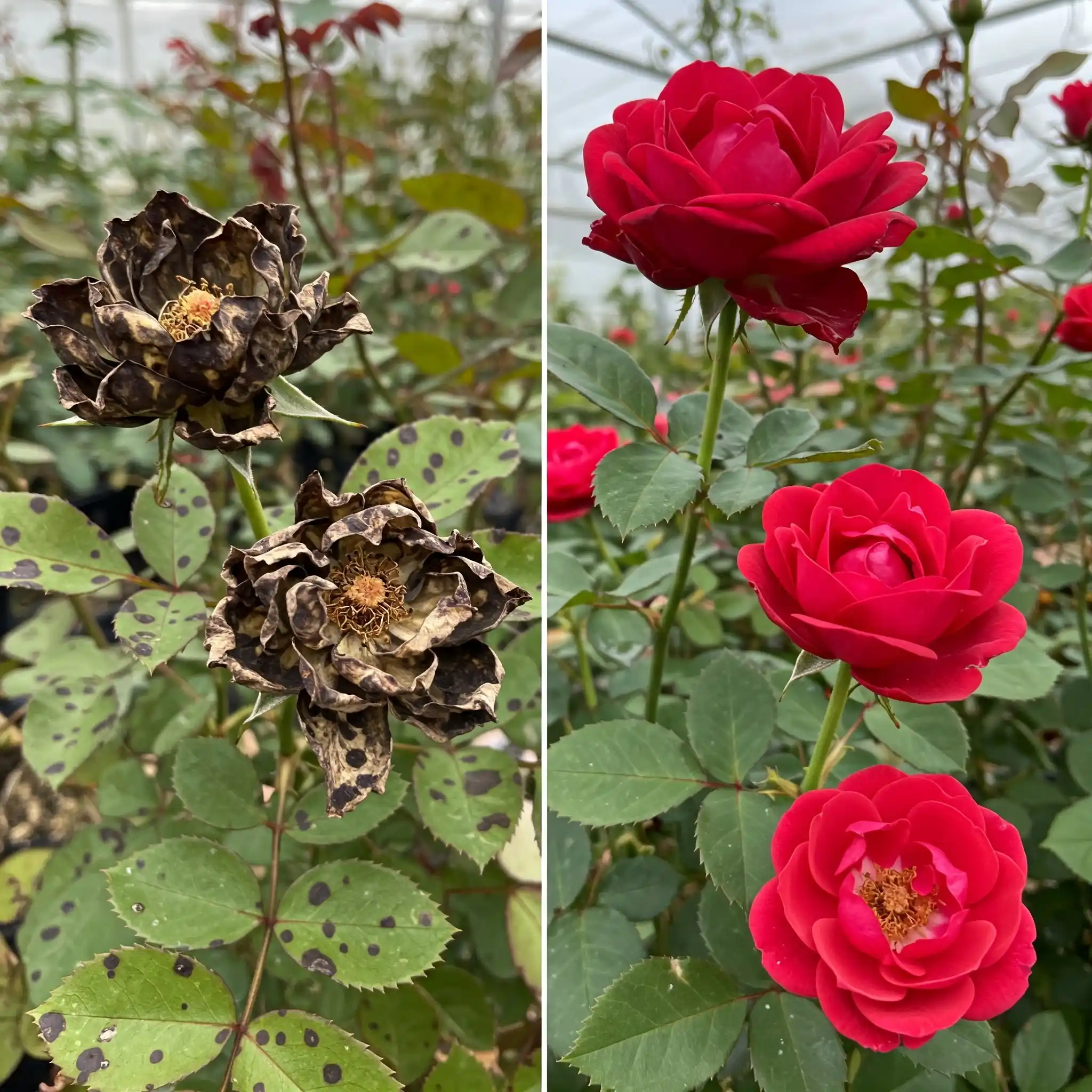
Black spot is caused by Diplocarpon rosae, described by University of Maryland Extension as “the most significant rose disease globally.” It’s host-specific to roses, but within a rose garden it spreads aggressively through water splash and infected debris.
The fungus overwinters in fallen leaves and stem lesions, not in soil — it can’t survive in the ground for more than about a month. Come spring, rain or irrigation splashes spores onto young leaves, which are the most vulnerable. Young leaves need only a few hours of surface moisture for infection to establish, and symptoms appear 3–16 days later. The spots are circular to irregular with distinctive fringed, feathery edges — this visual detail separates black spot from the angular edges of bacterial disease.
Identify it: Circular black spots on leaves, starting on lower foliage and progressing upward. Infected leaves turn yellow and drop early, leaving bare canes by midsummer in severe cases. Stems develop dark blotches that eventually blister.
Treat it: Remove and dispose of (don’t compost) all fallen leaves and infected canes in fall and before spring bud break — this is the highest-leverage step because it eliminates the primary overwintering reservoir. Avoid overhead irrigation, or water early morning so leaves dry quickly. Apply fungicide (chlorothalonil, copper sulfate, or myclobutanil) every 7–14 days from spring through fall, timing applications before forecast rain. Resistant rose cultivars, particularly modern landscape roses, are the most effective long-term solution for gardens with a history of black spot. For a full visual diagnostic guide covering both fungal and bacterial black spots across all plants, see black spots on plant leaves.
Stop missing your zone's planting windows.
Select your US zone and month — get a complete checklist of what to plant, prune, feed, and protect right now.
→ View My Garden CalendarDisease 3 — Gray Mold (Botrytis Blight)
Botrytis cinerea is an opportunist. The gray mold fungus cannot invade healthy tissue directly — it needs a nutrient source first, which it finds in dying flower petals, old pruning stubs, and injured leaves, according to Penn State Extension. Once established on dead tissue, it moves aggressively into living cells.
What makes Botrytis particularly alarming is its reproductive capacity: a piece of infected tissue the size of a small fingernail can produce over 60,000 spores. A single spore is enough to start an infection. Even turning on an irrigation system is enough to release a cloud of spores from nearby infected plant material.
Identify it: A dusty, grayish-brown fuzz on fading flowers, damaged stems, or dead tissue left on the plant. The fuzzy coating is the fungus itself — thousands of spore-bearing stalks. Affected tissue collapses into a dark, water-soaked rot. Botrytis is especially common in cool, wet springs and in enclosed spaces like greenhouses or dense plantings where air barely moves.
Treat it: Sanitation is the primary defense. Remove dead flowers, petals, and any dying tissue promptly — don’t let organic debris accumulate at the plant crown or on the soil surface. Improve air circulation through proper spacing and judicious pruning. Reduce overhead watering and ventilate enclosed spaces in the mornings, when humidity is highest. If fungicide is needed, rotate chemical classes — Botrytis develops resistance rapidly and is already resistant to benzimidazole and dicarboximide products. Penn State Extension recommends selecting fungicide classes with no known resistance issues and following resistance management guidelines strictly.
For a complete guide to botrytis identification, the sclerotia overwintering cycle behind its annual return, and specific fungicide resistance guidance, read our full article on botrytis gray mold.
Disease 4 — Root Rot (Phytophthora and Pythium)
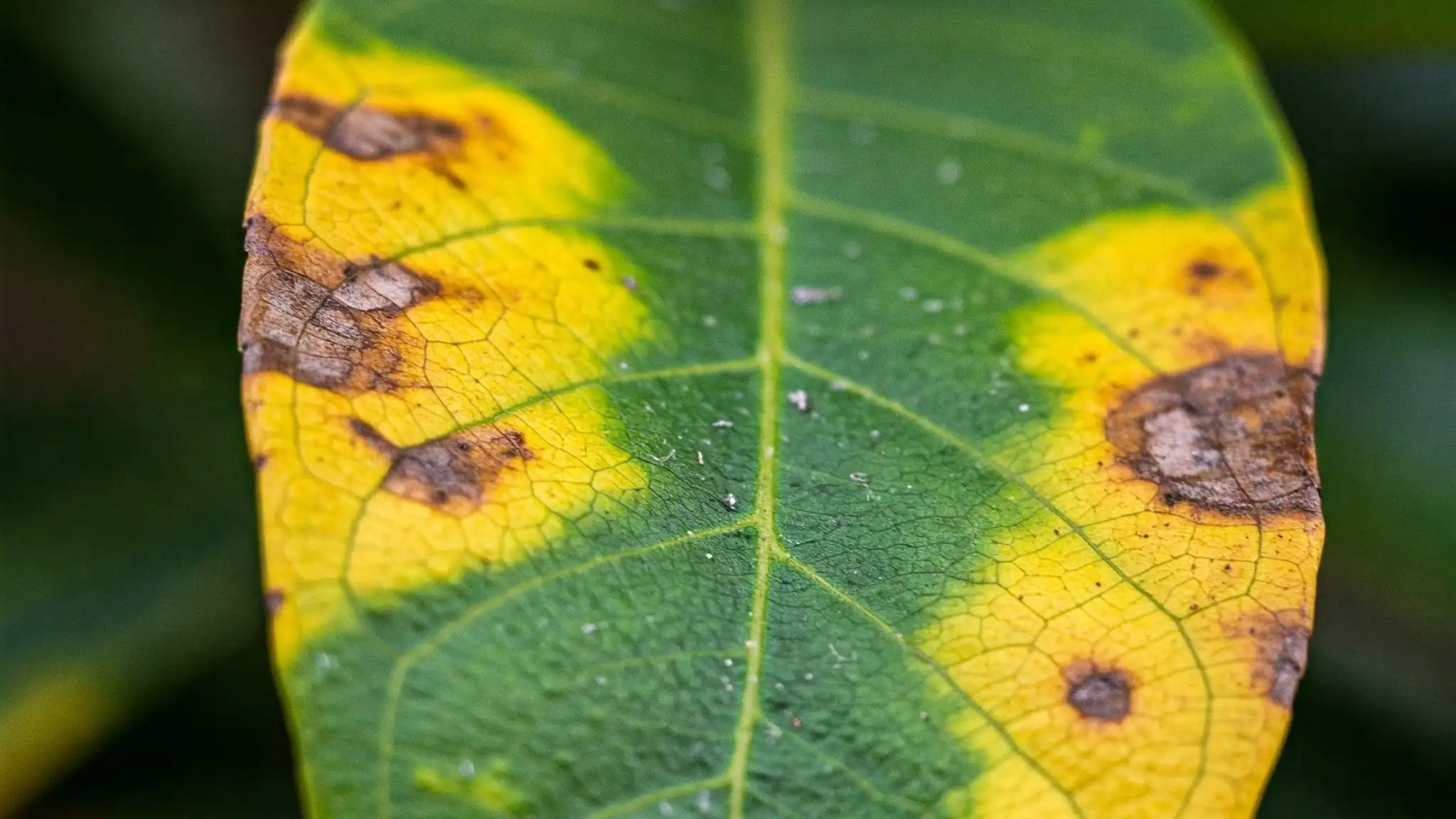
Root rot is the disease most often misdiagnosed as drought stress — both cause wilting and yellowing above ground. The critical diagnostic clue: root rot causes wilting even when the soil is moist. If a plant looks drought-stressed but the soil is wet, dig up a root and examine it before reaching for the watering can.
The main culprits, Phytophthora and Pythium, aren’t true fungi despite behaving like them. They’re oomycetes — water molds — according to NC State Extension, and they’re uniquely adapted to saturated soil. They can persist in soil for years and produce mobile zoospores that swim through water films to reach roots. The more waterlogged the soil, the more actively these pathogens spread.
Identify it: Wilting and yellowing that doesn’t resolve after watering. If you dig up the plant, the roots are soft, brown or black, and may smell foul — healthy roots should be firm and white or tan. At the soil line, look for dark, girdling lesions where the stem meets the soil.
Treat it: Improving drainage is the primary management strategy, per NC State Extension. Amend heavy clay soils with organic matter, raise planting beds, and avoid overwatering. If root rot is caught early, repot container plants in fresh sterile mix after trimming away rotted roots with sterilized scissors. In the landscape, severely infected plants are typically beyond saving — remove them to prevent spread. For houseplant-specific treatment steps, including which root damage is recoverable, see our root rot treatment guide.
Note that a related oomycete species, Phytophthora infestans, causes late blight — one of the fastest-moving foliar diseases in the vegetable garden, and distinct from the soil-borne root rot described above. If you grow tomatoes or potatoes, see our comparison of early blight vs late blight to learn which visual clues tell them apart and which fungicides actually stop each.
The same Pythium species that cause root rot in established plants also attack seedlings at the soil line — a condition called damping off that can collapse an entire tray overnight. If you start seeds indoors, see our guide to diagnosing and preventing damping off in seedlings for the full 5-pillar prevention protocol.
Disease 5 — Rust
Rust diseases are caused by fungi in the order Uredinales and are among the most visually distinctive garden diseases to identify. Some are so host-specific they infect only a single genus. Others — like cedar apple rust — require two completely different host plants to complete their life cycle, spending part of the season on junipers and part on apple or crabapple trees, according to University of Minnesota Extension. This is why rust can appear in your apple trees when cedars grow nearby, even with no obvious source of infection on the apple itself.
All rust fungi share one requirement: leaves must be wet for 2–4 hours for spores to germinate and infect. This makes rust a disease of wet springs and humid climates, though late-season outbreaks occur when fall dew periods lengthen.
Identify it: Yellow or orange chlorotic spots on the upper leaf surface, with corresponding raised, powdery orange or rust-colored pustules on the underside. As infection progresses, spots turn brown or black and leaves drop. Rust is the only common garden disease that produces pustules primarily on the lower leaf surface — that underside location is the fastest way to confirm it when you’re not sure.
Treat it: Remove infected leaves promptly, but don’t take more than one-third of the plant’s foliage at once — aggressive defoliation stresses the plant further. Improve air circulation and switch to drip irrigation to keep foliage dry. For chemical control, myclobutanil and azoxystrobin are the most effective fungicides per UMN Extension, and should be applied to healthy tissue early in the season — they’re protectants, not cures, and won’t reverse active infection.
For a complete breakdown of rust species, the alternate-host lifecycle that explains why sprays often fail, and a full organic vs. fungicidal treatment comparison, see our in-depth guide: rust on plants — identification, lifecycle, and treatment.
Disease 6 — Fusarium Wilt
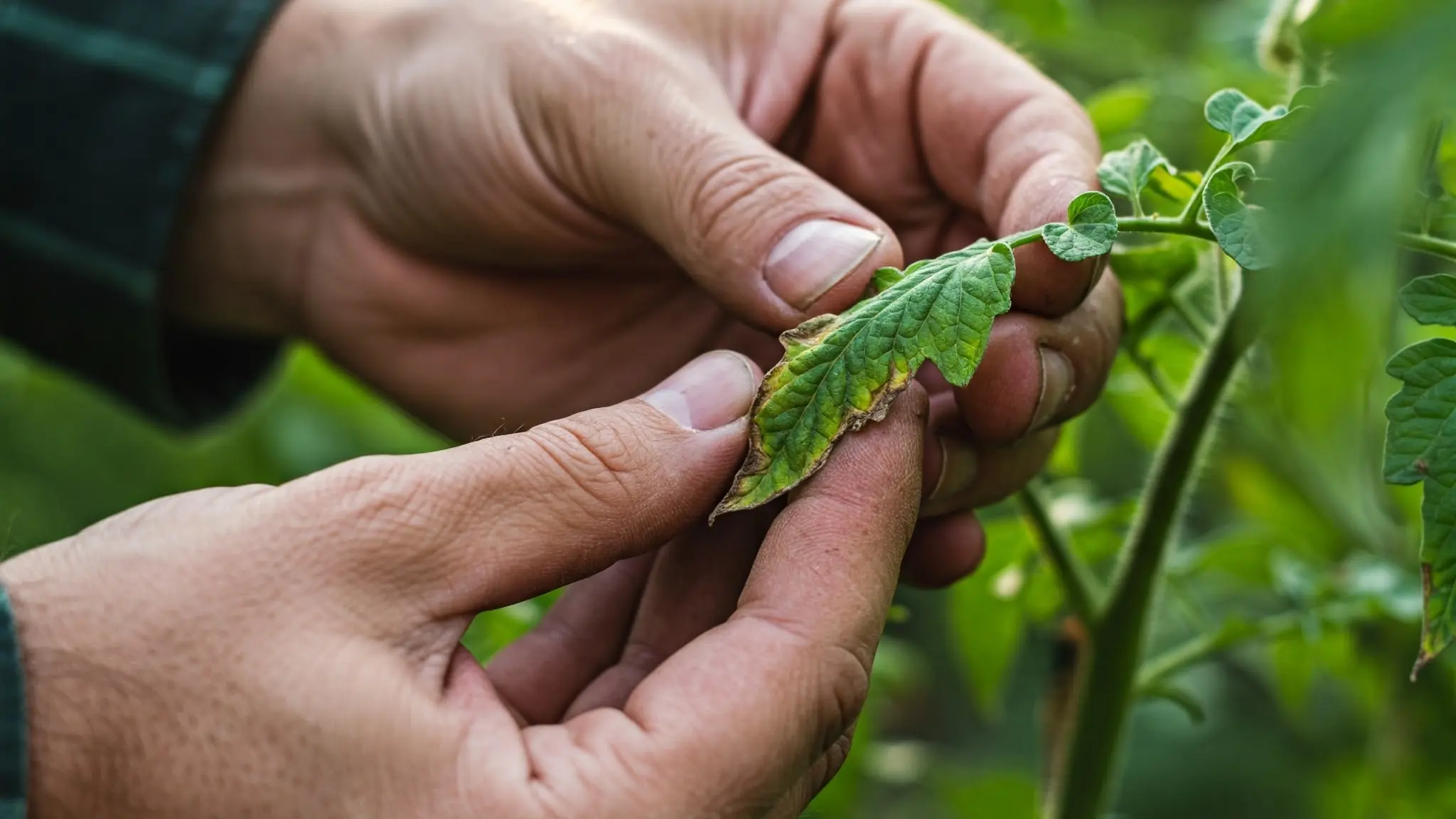
Fusarium wilt is in a different category from the diseases above: it’s incurable once established. Fusarium oxysporum moves through the plant’s vascular system — the same vessels that carry water and nutrients from roots to leaves — blocking transport and causing the plant to collapse from the inside out. By the time visible symptoms appear above ground, the pathogen has already spread systemically through the stem.
The fungus thrives in warm, acidic soil, with an optimal soil temperature of 82°F, according to University of Minnesota Extension. Primary hosts are tomatoes, eggplant, and peppers, though the pathogen also survives on common garden weeds including pigweed, mallow, and crabgrass. To confirm the diagnosis, peel away a strip of stem near the soil line: healthy vascular tissue is cream or white; fusarium-infected tissue is dark reddish-brown.
Identify it: Initial wilting during the hottest part of the day with partial recovery at night. Yellowing that’s asymmetric — affecting one branch or even one side of a single leaf while the other stays green. Permanent wilting follows as the infection progresses. This asymmetry is the single most reliable visual clue that separates fusarium wilt from root rot, which causes more uniform decline across the whole plant.
Treat it: There is no effective chemical treatment for fusarium wilt. Remove infected plants immediately, bag them, and dispose of them away from the garden. Fusarium chlamydospores — resting structures — can survive in soil for many years, so rotate susceptible crops for at least 3–5 seasons. Plant tomatoes labeled VFN (Verticillium, Fusarium, Nematode resistant). Raising soil pH toward neutral limits the fungus’s preferred acidic conditions and reduces — though doesn’t eliminate — risk. Fusarium and Verticillium wilt share enough symptoms that even experienced gardeners confuse them; our guide to Fusarium vs. Verticillium wilt explains how to distinguish them with a 30-second stem test and why the rotation rules differ.
Disease 7 — Bacterial Leaf Spot
Bacterial diseases are the ones gardeners most often treat incorrectly, because they look superficially similar to fungal leaf spots at first glance. The key differences: bacterial spots are water-soaked at first and angular in shape — bounded by the straight veins of the leaf rather than the circular or irregular shapes typical of fungal lesions. A yellow halo around a dark center is another strong indicator. During wet weather, infected tissue may exude a sticky bacterial residue, a sign Michigan State University Extension calls bacterial “ooze” — visible as a sticky film or streaming from cut stems.
Unlike fungi, bacteria enter plants through wounds or natural leaf openings (stomata), not through direct penetration of the waxy cuticle. This means injuries from pruning, hail, or insect feeding directly open the door to bacterial infection. Once inside, bacteria spread through water splash, contaminated tools, and insect movement between plants.
Identify it: Small water-soaked spots that darken to brown or black, often with a yellow halo around a dark center. Spots are angular rather than circular, following the lines of leaf veins. Hold the leaf up to light — under moist conditions, spots look translucent. Clemson HGIC notes that in prolonged wet weather, lesions can coalesce and kill large portions of leaves.
Treat it: Remove and destroy infected foliage. Avoid overhead irrigation and crowded planting. Sterilize pruning tools between cuts with a 10% bleach solution or 70% isopropyl alcohol — tool transmission is a primary spread route for bacterial pathogens. Copper-based fungicides (copper soap, copper octanoate) are preventive rather than curative; apply before infection takes hold, especially ahead of wet weather. The biological control Bacillus amyloliquefaciens also shows efficacy as a preventive spray, per Clemson HGIC.
For a complete visual guide to telling fungal from bacterial leaf spots — including the concentric ring vs. yellow halo diagnostic and exactly how each type spreads — see our in-depth article: Fungal vs. Bacterial Leaf Spot: How to Tell the Difference and Fix Both.
When Treatment Won’t Help: Viral Diseases
If you’ve worked through all seven disease profiles and your plant shows none of those patterns — instead displaying mosaic or mottled yellow-and-green coloring on leaves, distorted or curled new growth, or flower color breaking into streaks — suspect a viral disease. Cucumber mosaic virus, tomato spotted wilt virus, and rose rosette virus are among the most common in US home gardens.
Viruses cannot be treated. They’re transmitted by insects (especially aphids and thrips), by propagating cuttings from infected plants, or by contaminated tools. The only management options: remove and destroy infected plants immediately to stop further spread via insect vectors, control the insect populations carrying the virus, and in future seasons select virus-resistant varieties. No spray — fungicide, copper, neem, or otherwise — has any effect on a plant virus. Applying treatments to a virus-infected plant delays removal and gives vectors more time to move the pathogen to neighboring plants.
5 Prevention Practices That Stop Disease Before It Starts
Treating diseases after they appear is always harder than preventing them. These five practices, applied consistently, dramatically reduce your garden’s disease pressure.
1. Choose resistant varieties. This is the single highest-leverage decision you make. Selecting rose cultivars with natural black spot resistance, tomatoes with VFN labeling, or squash types bred for powdery mildew tolerance eliminates the disease pressure before you plant. Our guide to growing disease-resistant plants provides cultivar-by-cultivar recommendations across common garden plants.
2. Water at soil level, in the morning. Most fungal and bacterial diseases need moisture on leaf surfaces to infect. Drip irrigation and soaker hoses keep foliage dry. Morning watering lets any unavoidable leaf moisture dry before evening, when fungal spore activity is highest and humidity most favors infection.
3. Space plants for air movement. Crowded plants trap humidity around leaves and stems. Follow spacing recommendations on plant tags — or go wider when disease pressure is a known issue in your garden. Consistent airflow through the canopy is one of the cheapest and most effective disease suppressants available.
4. Practice rigorous sanitation. Clear fallen leaves, spent flowers, and dead stems promptly. Many pathogens — including black spot, botrytis, and rust — overwinter in garden debris and reinfect plants the following spring. This single habit eliminates the most common inoculum reservoir in the home garden.
5. Sterilize tools between plants. Bacterial diseases and some fungal pathogens spread readily on pruning blades. A quick wipe with 70% isopropyl alcohol or a 10% bleach solution between cuts takes seconds and prevents weeks of systemic spread through your beds.
Frequently Asked Questions
Can plant diseases spread from plant to plant?
Yes — most fungal and bacterial diseases spread readily through water splash, wind-blown spores, insects, and contaminated tools. Viral diseases spread primarily through insects and infected propagation material. Remove diseased plant material quickly to limit spread to neighboring plants.
Will neem oil treat all plant diseases?
Neem oil has some efficacy against early-stage fungal diseases like powdery mildew but is not effective against bacterial diseases, viral diseases, or fusarium wilt. For a comparison of treatment options and active ingredients, see our guide to neem oil versus insecticidal soap.
Can a diseased plant recover?
Many can, with prompt intervention. Surface fungal diseases — powdery mildew, rust, and black spot — are generally manageable with treatment and sanitation. Root rots and vascular wilts are far harder to reverse, and viral infections are permanent. As a rough guide, the disease severity hierarchy from most to least recoverable runs: leaf spots, then cankers, then root and crown rot, then vascular wilts, per NC State Extension. The earlier you catch a problem, the better the odds of saving the plant.
Another fungal disease worth knowing is anthracnose — it produces sunken dark lesions on tomatoes, strawberries, and shade trees through the same rain-splash cycle as other fungal diseases, but requires a specific 8-hour wetness window to establish infection. Catching it before symptoms appear is the only effective approach.
Sources
- NC State Extension — Diseases and Disorders (Extension Gardener Handbook, Chapter 5)
- Penn State Extension — Plant Disease Basics and Diagnosis
- Penn State Extension — Powdery Mildew
- Penn State Extension — Botrytis or Gray Mold
- Michigan State University Extension — Signs and Symptoms of Plant Disease: Is It Fungal, Viral or Bacterial?
- Clemson HGIC — Houseplant Diseases and Disorders
- University of Maryland Extension — Black Spot Disease of Roses
- University of Minnesota Extension — Fusarium Wilt
- University of Minnesota Extension — Rust in the Flower Garden
- NC State Extension — Phytophthora Root and Crown Rot in the Landscape


