

5 Pests That Chew Holes in Zucchini Leaves — How to Identify and Treat Each One

5 pests chew holes in zucchini leaves, and the fix depends on which one. Use 3 ID clues and extension-sourced thresholds to confirm before you treat.
You walk out to the garden and find holes scattered across your zucchini leaves. The instinct is to grab a spray bottle — but applying the wrong product wastes money, kills the beneficial insects that suppress these pests naturally, and often leaves the actual culprit untouched.
The hole pattern is diagnostic. A flea beetle infestation looks completely different from a slug problem, and each pest needs a different response. Five insects and mollusks routinely chew holes in zucchini leaves. I’ve identified each one below with three confirmation clues, treatment thresholds from university extension research, and a section on the pests that don’t make holes but often get blamed — a common misidentification that sends gardeners down the wrong path entirely.
Quick Diagnosis: What Kind of Holes?
Use this table to narrow down the culprit before spending time on a detailed inspection.
| Hole appearance | When active | Likely pest | Confirm by |
|---|---|---|---|
| Tiny (<1/8"), round, scattered — ‘shothole’ pattern | Spring and early fall; seedlings most vulnerable | Flea beetles | Shake the plant — tiny beetles jump away from disturbed foliage |
| Irregular, jagged holes 1/4"–1" across, often brownish at edges | June onward; heaviest in midsummer | Cucumber beetles | Look for yellow beetles with 3 black stripes or 12 black spots on leaf undersides |
| Large ragged holes 1/2"+; leaf veins often left intact | Midsummer onward; older leaves hit hardest | Caterpillars | Find green larvae with white side stripes on leaf undersides; look for frass (small droppings) below |
| Irregular holes in leaves + seedling stem severed at soil level | Spring; attacks young transplants and seedlings | Cutworms | Dig 1″ into soil at the plant base in the morning — find a fat gray caterpillar curled in a C-shape |
| Ragged holes with soft, irregular edges; dried silvery slime trails on leaves or soil | Cool, wet nights; spring through first frost | Slugs or snails | Inspect at night with a flashlight; check for silvery slime trails at dawn |
Cucumber Beetles: Irregular Holes and a Hidden Disease Risk
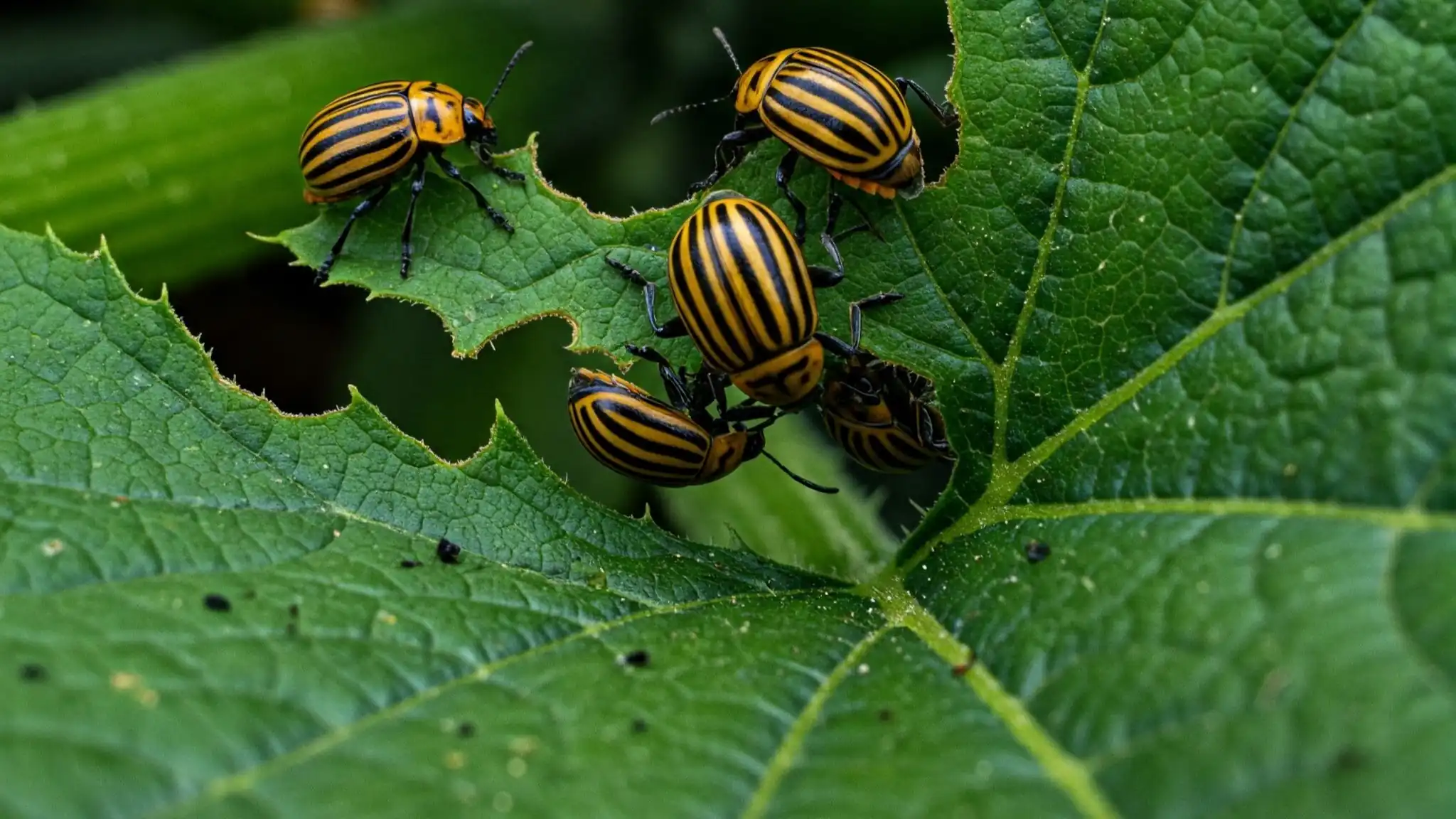
Two species attack zucchini — the striped cucumber beetle (Acalymma vittatum) and the spotted cucumber beetle (Diabrotica undecimpunctata howardi) — and both leave similar feeding damage: irregular, jagged holes in leaves, sometimes browning at the edges, concentrated on the shaded undersides where beetles congregate to avoid the midday heat.

Three pre-planned garden beds, free
Stop staring at empty beds: printable plans with exact layouts, plant lists and planting calendars — yours free from the Garden Library.
According to the University of Minnesota Extension, striped cucumber beetles are about 1/5 inch long with yellow bodies and three vertical black stripes. Spotted beetles are similar in size but display 12 black spots on yellow-green wing covers. Both are roughly the size of a watermelon seed. The easiest time to find them is in the morning, when they’re less active — check leaf undersides and the junction where leaf meets stem.
Young plants face the greatest risk. UMN Extension research states that striped cucumber beetles ‘can totally defoliate small plants.’ Once a zucchini develops four or more true leaves, it tolerates beetle feeding much better — but the greater danger is what cucumber beetles carry. The striped species transmits the bacterium Erwinia tracheiphila, which causes cucurbit bacterial wilt. When an infected beetle feeds, it deposits bacteria directly into the wound; the bacterium then multiplies inside the plant’s vascular vessels and blocks water transport, causing the whole plant to collapse suddenly within a week. The University of Maryland Extension notes that bacterial wilt primarily kills cucumbers and muskmelons but ‘also’ affects summer squash. There’s no cure once a plant is infected — pull and dispose of it immediately to prevent further beetle feeding and spread.
A practical timing strategy from UMD Extension: plant susceptible crops around June 15, after overwintering adult beetles have already emerged and dispersed. This window shifts your planting past peak pressure without any chemicals. In Zones 3–5 where the season is shorter, that’s not always practical — use row covers instead.
Three ID clues for cucumber beetles:
- Yellow body, about 1/4 inch long, with either 3 black stripes or 12 black spots — visible on leaf undersides during the day
- Irregular holes 1/4 to 1 inch across with slightly browned, chewed edges; worst on young plants with fewer than 4 true leaves
- Damage concentrated on shaded leaf surfaces and stem junctions rather than distributed evenly across the plant
Treatment: Float row covers over transplants at planting and keep them on until flowers open — at that point they must come off for bee pollination. For uncovered plants, UMN Extension sets the spray threshold at 0.5 to 1 beetle per seedling, or when 25% of leaf area is lost. Below that threshold, a healthy mature plant outgrows the damage. Trap crops — blue Hubbard squash planted 1 to 2 weeks earlier than your zucchini — concentrate beetles in one spot for hand-removal before the main planting is established. Kaolin clay applied to leaf surfaces creates a particle barrier that deters feeding without harming bees.
Flea Beetles: The Tiny Holes You Might Overlook
Flea beetles create a damage pattern called ‘shothole’ injury — dozens of small, round holes less than 1/8 inch across scattered across the leaf. No other zucchini pest creates this specific look. The holes are uniform in size (not ragged), densely scattered, and appear on both young and mature leaves, though seedlings suffer the most.
According to University of Minnesota Extension, flea beetles measure 1/16 to 1/8 inch long — smaller than a sesame seed — with colors ranging from black to bronze, metallic blue, or brown. Their oversized hind legs allow them to jump like fleas when disturbed, which is the simplest confirmation: shake a zucchini leaf and watch for tiny insects springing away in multiple directions.
Adults overwinter in leaf litter and become active in early spring. On a mature zucchini plant, a moderate flea beetle population causes cosmetic damage and rarely threatens yield — the plant grows faster than the beetles eat. On a seedling, the same population can stunt or kill by reducing photosynthetic leaf area before the root system is fully established. UMN Extension recommends treating only when more than five beetles per plant are present on seedlings. Below that threshold, the plant outgrows the damage. The species completes one to two generations per year.
Three ID clues for flea beetles:
- Round holes less than 1/8 inch — uniform in size, scattered across the leaf surface rather than localized
- Tiny jumping insects visible when the plant is disturbed (harder to spot when they’re motionless)
- Damage concentrated on young leaves and seedlings; on mature plants, the plant continues growing despite the holes
Treatment: Row covers applied at transplanting completely block flea beetles — remove only when flowers open for bee pollination. For uncovered plants, set trap crops (radish and mustard greens are strong attractants) 7 to 14 days before your main planting to pull flea beetles away from zucchini seedlings. If the threshold of five beetles per seedling is exceeded, spinosad- or pyrethrin-based sprays applied in the evening target adults effectively. Kaolin clay works as a preventive barrier in areas with chronic pressure. Once the plant has four or more true leaves, treatment is rarely necessary.
Caterpillars: Large Ragged Holes With the Veins Intact
When holes are larger — a half inch or more — with ragged or slightly clean-cut edges that trace around the tougher leaf veins, caterpillars are the most likely cause. Caterpillars avoid the fibrous major veins because they’re harder to chew, leaving a ‘window pane’ or skeletonized look in severe cases. Three species commonly target zucchini in the US.
The cabbage looper (Trichoplusia ni) is a pale green caterpillar, roughly 1 inch long, with white lateral stripes running the length of its body. It moves by drawing its hind end toward its front and arching the middle section into a loop — a distinctive gait. According to Illinois Extension, cabbage loopers ‘create big holes on leaf surfaces’ and cannot survive Midwest winters, migrating north each season from the South. Eggs are dome-shaped, individually laid on leaf undersides.
The corn earworm (Helicoverpa zea) is larger — up to 1 3/4 inches — and hairy, with cream or yellowish-green coloring in early instars that shifts to green, reddish, or brown with pale stripes as it matures. NC State Extension identifies this as a late-season pest on zucchini that ‘devours flowers and scars or even bores into fruits’ in addition to feeding on leaves.
The beet armyworm (Spodoptera exigua) is light-green to black with fine white wavy lines along its back and a distinctive dark spot on each side of the second body segment behind the head — the most reliable visual marker for identification. It has five pairs of abdominal prolegs.
Stop missing your zone's planting windows.
Select your US zone and month — get a complete checklist of what to plant, prune, feed, and protect right now.
→ View My Garden CalendarThree ID clues for caterpillars:
- Large holes (1/2 inch or more) with relatively smooth to slightly ragged edges; tougher leaf veins often left intact, creating a ‘skeletonized’ look in heavy infestations
- Green or patterned caterpillar visible on leaf undersides, especially during morning and evening hours
- Small, dark, round droppings (frass) on and below damaged leaves — a reliable sign even when the caterpillar isn’t visible
Treatment: Bacillus thuringiensis (Bt) is the most effective and pollinator-safe caterpillar control available to home gardeners. Bt is a naturally occurring soil bacterium that produces proteins that paralyse caterpillar gut cells within hours of ingestion but have no effect on beetles, flies, or bees. Apply when caterpillars are small and freshly hatched — larger larvae are significantly harder to kill. Spray in the evening when caterpillars are actively feeding. Hand-pick any visible larvae and destroy egg masses found on leaf undersides before they hatch.
Cutworms: Holes in Leaves and a Severed Stem
Cutworms are ground-level caterpillars, and the combination of leaf holes plus a seedling stem cut clean through at the soil surface overnight is their signature pattern. If you find just a stump where a young zucchini plant stood, with the upper part dragged into the soil or simply gone, a cutworm did it while you slept.
These are larvae of several moth species in the family Noctuidae, but their behavior sets them apart from the leaf-feeding caterpillars above. Cutworms feed after dark and retreat into the top 1 to 2 inches of soil during daylight hours. To confirm, dig carefully around the base of a damaged plant in the morning; you’ll find a smooth, fat, grayish or brownish caterpillar, 1 to 2 inches long, curled in a tight C-shape.
Cutworm pressure is highest in spring, particularly on soil that was recently grassy or weedy — female moths lay eggs in vegetation, and larvae emerge ready to feed on nearby plants. Once a zucchini stem thickens past a pencil diameter, the plant moves largely past the most vulnerable stage. Transplants and young seedlings are the primary target.
Three ID clues for cutworms:
- Seedling cut off cleanly at or just below the soil surface overnight — often no upper plant found nearby
- Irregular holes in the lower leaves closest to the soil, sometimes alongside the stem cut
- Fat, smooth gray or brown caterpillar (1–2 inches) found curled in a C-shape in the soil within 2 inches of the damaged plant base
Treatment: Physical collars are the most reliable seedling protection — a toilet paper roll or a strip of cardboard pushed 1 inch into the soil around each transplant creates a barrier cutworms won’t cross. For established infestations, Bt kurstaki (Bt var. kurstaki) products applied to the soil surface around transplants target larvae as they emerge. Beneficial nematodes (Steinernema carpocapsae) worked into moist soil before planting attack cutworm larvae underground and provide season-long biological control in gardens with consistent soil moisture.
Slugs and Snails: Nocturnal Holes With a Slime Trail
Slugs and snails leave two signs no insect does: ragged holes with soft, torn edges — quite different from the cleaner chewing of beetles — and the dried silvery slime trail they leave wherever they crawl. If you’re finding new damage every morning but the plant looks undisturbed during the day, slugs or snails are the most likely explanation. They feed after dark and shelter under mulch, debris, and moist soil during daylight.
According to Washington State University Cooperative Extension, slug damage is heaviest during cool, moist weather — common in spring and early summer across most US growing regions — and decreases during hot, dry periods. WSU notes that young plants and seedlings can be completely consumed when slug populations are high. Clemson HGIC confirms that activity runs ‘from spring through the first frost’ and that ‘moisture is required for their survival,’ which is why damage spikes after rain or overhead irrigation.
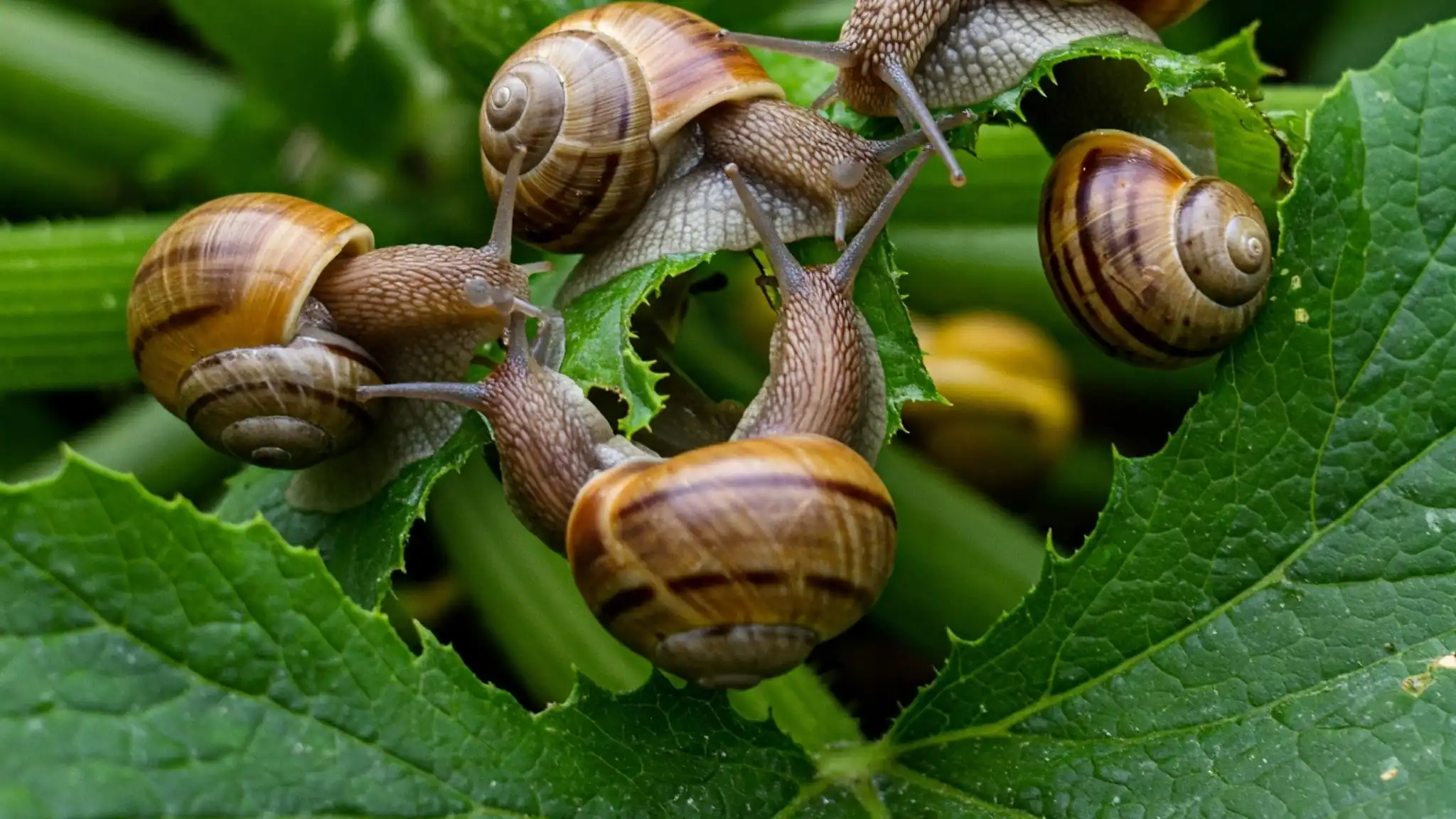
Slugs and snails use a rasping, file-like structure called the radula to scrape plant tissue, which is why their holes have soft, irregular edges rather than the clean-cut look of beetle chewing. The hole edges sometimes appear almost as if the leaf was torn rather than bitten. The dried slime trail is silvery and visible on leaf surfaces, stems, and the surrounding soil at dawn — it’s the most reliable confirmation even when the slug itself is long gone.
Three ID clues for slugs and snails:
- Ragged holes with soft, torn edges on leaves, especially on younger, more tender foliage and growing points
- Dried silvery slime trail visible on leaf surfaces and nearby soil at dawn — persists for several hours after feeding
- Damage appears or worsens overnight, particularly after rain or evening irrigation; no insects found during daytime inspections
Treatment: Beer traps are a reliable mechanical control: set shallow containers level with the soil surface, fill with an inch of stale beer, and slugs are attracted to the yeast and drown. Replace every two to three days. Diatomaceous earth (food-grade) sprinkled around the base of plants scratches a slug’s soft body on contact, causing rapid dehydration — effective in dry conditions but needs reapplying after rain. For heavy infestations, iron phosphate baits (sold as Sluggo, Escar-Go!, and Bonide Slug Magic) are the most effective treatment and are safe around pets, wildlife, and beneficial insects. Apply to the soil around plants, not on leaves. Switch from evening to morning irrigation to let the soil surface dry before nightfall — slugs are most active in the cool, moist window from dusk to 2 a.m.
For application rates and timing for diatomaceous earth across zucchini pests, see our guide on using diatomaceous earth for zucchini pests.
These Pests Do NOT Make Holes: Common Misidentifications
Two of the most frequently blamed zucchini pests — squash bugs and spider mites — do not chew holes in leaves. Treating them as if they do means applying the wrong product while the actual hole-maker continues feeding. A third pest, the squash vine borer, makes holes — but in the stem, not the leaves.
Squash bugs (Anasa tristis) use piercing-sucking mouthparts to extract sap from leaf cells rather than chewing tissue out. University of Minnesota Extension research is explicit: squash bug feeding creates ‘yellow spots that eventually turn brown’ — not holes. In heavy infestations, leaves wilt, curl, and die, which can look hole-like from a distance — but close inspection shows the tissue is dead and discolored in place, not physically removed. The most reliable confirmation for squash bugs is checking leaf undersides for shiny bronze oval eggs arranged in neat clusters. Squash bugs also transmit yellow vine decline disease. If you’re dealing with squash bugs, our squash bug prevention and control guide covers identification, egg removal timing, and treatment options.
Spider mites cause stippling — hundreds of tiny pale dots on the upper leaf surface created by mites piercing individual cells and emptying their contents. In heavy infestations, the whole leaf takes on a bronze or silver sheen. You’ll find fine webbing on leaf undersides and, under a hand lens, can see the mites themselves: eight-legged, tiny, usually yellow-brown. Clemson HGIC describes spider mite damage as ‘pale yellow and reddish-brown spots’ forming ‘large whitish, stippled areas.’ Spider mite damage never removes tissue — it discolors it. Two applications of insecticidal soap or neem oil, five days apart, effectively knock back populations.
Squash vine borers (Melittia cucurbitae) do make holes — but entry holes in the main stem, not in the leaves. The first sign is usually sudden wilting of a vine, with a small hole near the soil line surrounded by green, sawdust-like frass (larval droppings). There are no leaf holes. For identification and the surgical removal technique that can save the plant, see our squash vine borer guide.
Prevention: Stop Pest Damage Before It Starts
Most of the five hole-making pests above can be substantially reduced — or excluded entirely — using the same set of cultural practices. These approaches work because they address the biology: removing overwintering habitat, blocking access at the vulnerable seedling stage, and making the garden less hospitable to pests that depend on moist, sheltered conditions.
Row covers at planting are the single highest-impact intervention. A floating row cover applied immediately after transplanting physically blocks cucumber beetles, flea beetles, and caterpillar moths from reaching the plant. Remove the cover only when flowers open, which is when bees are needed for pollination. This one action eliminates feeding access during the most critical seedling stage, when plants are smallest and most easily defoliated.
Crop rotation prevents soil pest populations from building up year over year. Cucumber beetle adults overwinter in leaf litter and nearby soil, emerging close to the same location each spring. Moving your zucchini to a new bed each season disrupts their emergence next to the host plant. A minimum two-year rotation out of all cucurbits (zucchini, cucumber, squash, pumpkin) is recommended.
Debris removal in fall eliminates the overwintering habitat for cucumber beetles, flea beetles, and cutworm moths. Remove spent vines and nearby weeds after the first frost. Tilling the top 2 to 3 inches of soil in late fall exposes pupating insects and eggs to cold temperatures and bird predation.
Watering timing is the simplest slug and snail control available. Switch from evening irrigation to morning watering, which lets the soil surface dry before nightfall — the active window for slugs. Drip irrigation or soaker hoses that keep the soil surface drier than overhead watering reduce slug activity consistently.
Trap crops concentrate beetles where you can deal with them. Blue Hubbard squash planted 1 to 2 weeks before your zucchini is the most effective cucumber beetle trap crop; treat or hand-remove beetles from the trap planting before your main crop establishes. Radishes and mustard greens planted nearby pull flea beetles away from zucchini seedlings during the most vulnerable early weeks.
For a full overview of organic pest management options for zucchini, including companion planting combinations that support beneficial insects, see our organic pest control guide for zucchini. For a broader look at what can go wrong with zucchini plants — diseases, nutrient deficiencies, and pollination failures alongside pests — our 15 common zucchini problems guide covers the full picture.
Frequently Asked Questions
Why do my zucchini leaves have holes but I can’t find any insects?
Slugs and snails feed at night and shelter in soil or under mulch during the day, making them invisible in daytime inspections. Check for dried silvery slime trails on leaf surfaces and nearby soil — these persist well into the morning. Cutworms also feed nocturnally and hide 1 to 2 inches underground during daylight. Caterpillars often rest motionless on leaf undersides and are easy to miss unless you flip the leaves. Inspect at dusk or with a flashlight at night for the most reliable sighting.
Can holes in zucchini leaves kill the plant?
For established plants with four or more true leaves, minor to moderate leaf damage is usually cosmetic. A zucchini losing 20 to 30% of leaf area to flea beetles or caterpillars continues producing fruit. The situations that genuinely threaten the plant are: a seedling being defoliated by cucumber beetles before it has four true leaves, a cutworm severing the stem before it hardens, or cucumber beetle feeding that introduces bacterial wilt — which causes irreversible whole-plant collapse with no cure once established. Act quickly on seedlings; on mature plants, confirm the pest and check thresholds before treating.
What makes holes in zucchini leaves at night?
Slugs and snails are the primary nocturnal hole-makers. Cutworms also feed after dark, though their most distinctive damage is the severed seedling stem rather than leaf holes. Some caterpillar species feed primarily at night, particularly in warm weather. Confirm slugs by inspecting after dark with a flashlight, or by checking for slime trails at dawn. If you find no slime trails, look for a curled gray caterpillar in the soil at the plant base — that confirms a cutworm.
Should I treat every time I see holes in my zucchini leaves?
No. This is where most gardeners over-treat and harm the beneficial insect populations that suppress these pests naturally. Flea beetles on a mature plant at five or fewer beetles per leaf, minor caterpillar damage with no larvae currently present, or a single night of slug feeding on well-established plants generally doesn’t require treatment. Treat when you have confirmed the pest is present (not assumed), when threshold numbers are met, and when seedlings or bacterial wilt risk is involved. Over-applying pesticides kills ground beetles, parasitic wasps, and predatory mites — the insects that eat the larvae and eggs of every pest on this list.
Sources
- University of Minnesota Extension — Cucumber Beetles
- University of Maryland Extension — Cucumber Beetles: Spotted or Striped on Vegetables
- University of Minnesota Extension — Flea Beetles
- Clemson HGIC — Cucumber, Squash, Melon and Other Cucurbit Insect Pests
- NC State Extension — Pests of Cucurbits
- University of Minnesota Extension — Squash Bugs
- Washington State University Hortsense — Slugs on Cucumber, Pumpkin, and Squash
- Clemson HGIC — Snails and Slugs in the Home Garden
- Illinois Extension — Cabbage Looper


