

Why Zucchini Flowers Drop Without Setting Fruit — and 2 Ways to Fix It This Weekend

Zucchini flowers dropping without fruit? Learn the 6 AM morning window, the squash-bee secret, and 2 proven fixes: hand pollination and companion planting.
Zucchini plants are famously productive — yet plenty of gardeners spend early summer watching yellow flowers open and drop with no fruit forming at all. The plants look healthy. There are plenty of blooms. Nothing is obviously wrong. But by mid-morning the flowers have closed, and by the next day they are gone.
The fix is usually simple once you understand what the plant is asking for. Every zucchini fruit starts as a female flower that must receive pollen from a male flower — and that transfer has to happen within a few hours in the morning. Miss the window, or miss the pollen, and the flower aborts.
This guide covers both solutions: how to hand-pollinate zucchini when bees are not doing the job, and how to build the right garden conditions to attract squash bees and other pollinators so you need to hand-pollinate far less often. The two approaches work together — hand pollination gives you fruit this week, while habitat changes pay off for the rest of the season and into next year.
The Biology Behind Zucchini Flowering
Zucchini is a monoecious plant — it produces separate male and female flowers on the same plant rather than having both reproductive organs in a single flower. For fruit to form, pollen must travel from a male flower to a female flower. Without that transfer, the small zucchini behind the female flower shrivels within 24 to 48 hours of opening and drops from the plant.

Three pre-planned garden beds, free
Stop staring at empty beds: printable plans with exact layouts, plant lists and planting calendars — yours free from the Garden Library.
Male flowers grow on straight, thin stems with no swelling at the base. Inside the petals, they carry a single stamen coated in powdery yellow pollen. Touch the anther gently — yellow powder should come off on your fingertip. If it does not, the flower is not yet ready or has already shed its pollen for the day.
Female flowers grow on slightly thicker stems and have a swollen ovary at the base that looks exactly like a miniature zucchini — typically 1 to 2 inches long. Inside the petals, you will find a branched, multi-lobed stigma that looks like a small ridged star or crown, rather than a single stamen. The stigma is the structure that must receive pollen for fertilization to occur.
The timing problem: Both flower types are only open for a few hours in the morning — typically from around 6 AM until roughly noon, depending on temperature. According to University of Florida IFAS Extension research on cucurbit pollination, flowers typically remain open only until around midday. In summer heat, they close even earlier. A female flower that has closed by 10 AM is no longer receptive to pollen. This is why attempting to hand-pollinate in the afternoon produces no results — the stigma has already shut down for the day.
The early-season imbalance: Zucchini plants almost always produce male flowers first, typically one to two weeks before female flowers appear. According to UNH Extension, this is completely normal — the plant is establishing its pollen supply before committing energy to fruit development. If you are seeing only male flowers in the first few weeks of flowering, wait. Female flowers will follow.
I have consistently seen gardeners pull up a zucchini plant in frustration because it ‘only produces male flowers’ — when the plant was three weeks into the season and female flowers were just days from appearing. Early patience saves a lot of unnecessary replanting.
5 Reasons Your Zucchini Is Not Setting Fruit
The symptom that sends you looking for answers — flowers dropping without fruit — has several different causes. Identifying the right one changes what you do about it.
| Symptom | Most Likely Cause | Fix |
|---|---|---|
| Only male flowers for first 2 to 4 weeks | Normal early-season pattern | Wait — female flowers follow within one to two weeks |
| Both flower types open but no fruit forms | Low bee activity or bees not visiting flowers | Hand-pollinate; add companion pollinator plants nearby |
| Small zucchini forms then shrivels and drops within 3 days | Incomplete pollen transfer to the stigma | Hand-pollinate, making sure to cover all stigma lobes |
| Deformed or lumpy mature zucchini | Partial pollination causing uneven seed development | More thorough hand pollination on next female flower |
| No flowers at all | Plant stress, excess nitrogen, or overcrowding | Check watering, spacing, and fertilizer — reduce nitrogen |
| Flowers open, bees active, still no fruit | Pollen sterility from heat above 90°F | Use 30% shade cloth; try parthenocarpic varieties |
The most important distinction in this table: deformed or lumpy mature zucchini and a shriveled miniature zucchini have the same root cause — insufficient pollen — but look completely different at harvest. Deformed fruit is not a disease. It is a pollination shortfall. The female stigma has multiple lobes, and each lobe connects to a different section of the ovary. If only some lobes received pollen, seeds develop in those sections only. The sections without seeds get no developmental signal, so those cells stop dividing — leaving flat or undeveloped areas on the fruit. University of Maryland Extension confirms that twisted or deformed squash is a direct result of insufficient pollination.
How to Hand-Pollinate Zucchini — Step by Step
Hand pollination is the guaranteed backup when bees are not doing the job — whether that is because of poor pollinator habitat in an urban garden, cool or wet weather keeping bees inactive, a recent insecticide application, or a heat wave suppressing foraging. It takes about two minutes per flower and works reliably when done at the right time of day.
Timing is everything: Pollinate between 6 AM and 10 AM. Female flowers close by noon and their stigmas stop being receptive after that. Early morning also produces the most viable pollen in male flowers — the anther is fresh and powdery when the flower first opens, and pollen viability declines as the day heats up.
Step 1 — Confirm Both Flowers Are Fresh and Open
Look for flowers that opened that morning: petals fully spread, the stamen or stigma clearly visible and well-formed. Yesterday’s flowers may still be technically open but pollen viability declines sharply after the first morning window. Fresh flowers have bright yellow petals with good color saturation. Flowers from the day before look slightly limp even when still open — skip them and check back the next morning.
Step 2 — Test the Male Flower for Pollen
Touch the stamen gently with your fingertip. If fine yellow powder transfers, the flower is ready. If the stamen looks dry or powderless, move to another male flower. Plants at peak production typically carry three to five open male flowers for every female — you will have options most mornings.
Step 3 — Choose Your Technique
Technique A — Paintbrush or cotton swab: Dab the tip into the male flower’s anther until you have visible yellow pollen coating it. Immediately transfer to the female flower’s stigma, dabbing all lobes of the branched structure at the flower’s center. This method works well when you have multiple female flowers to service from one male, or when flowers are positioned awkwardly on the plant.
Technique B — Direct flower transfer: Remove the male flower by snapping it off at its stem base. Peel back the petals to expose the anther fully. Gently press and rotate the anther against all lobes of the female stigma for five to ten seconds. This approach transfers more pollen per contact and is faster — one male flower can service up to three female flowers in a single morning before its pollen is spent.
Step 4 — Check Back in 48 Hours
A successfully pollinated female zucchini will begin visibly swelling at the base within 24 to 48 hours. If the small fruit yellows and drops within that window, either the pollination failed — try again on the next open female — or pollen viability was compromised, most often by temperatures above 90°F on the day of pollination.
Stop guessing if your garden pays.
Log what you grow and harvest — see total yield weight, estimated retail value, and season-on-season progress in one place.
→ Track My HarvestThe detail most guides overlook: because each stigma lobe connects to a different section of the ovary, coating only some lobes produces uneven seed development — and the sections without seeds do not grow to match the rest. This is the direct mechanism behind lumpy, deformed zucchini. Cover every lobe completely when pollinating by hand, and the fruit will develop straight and uniform.
For a more detailed diagnosis of why your crop is underperforming across the season, see our article on getting more zucchini fruits by fixing poor pollination.
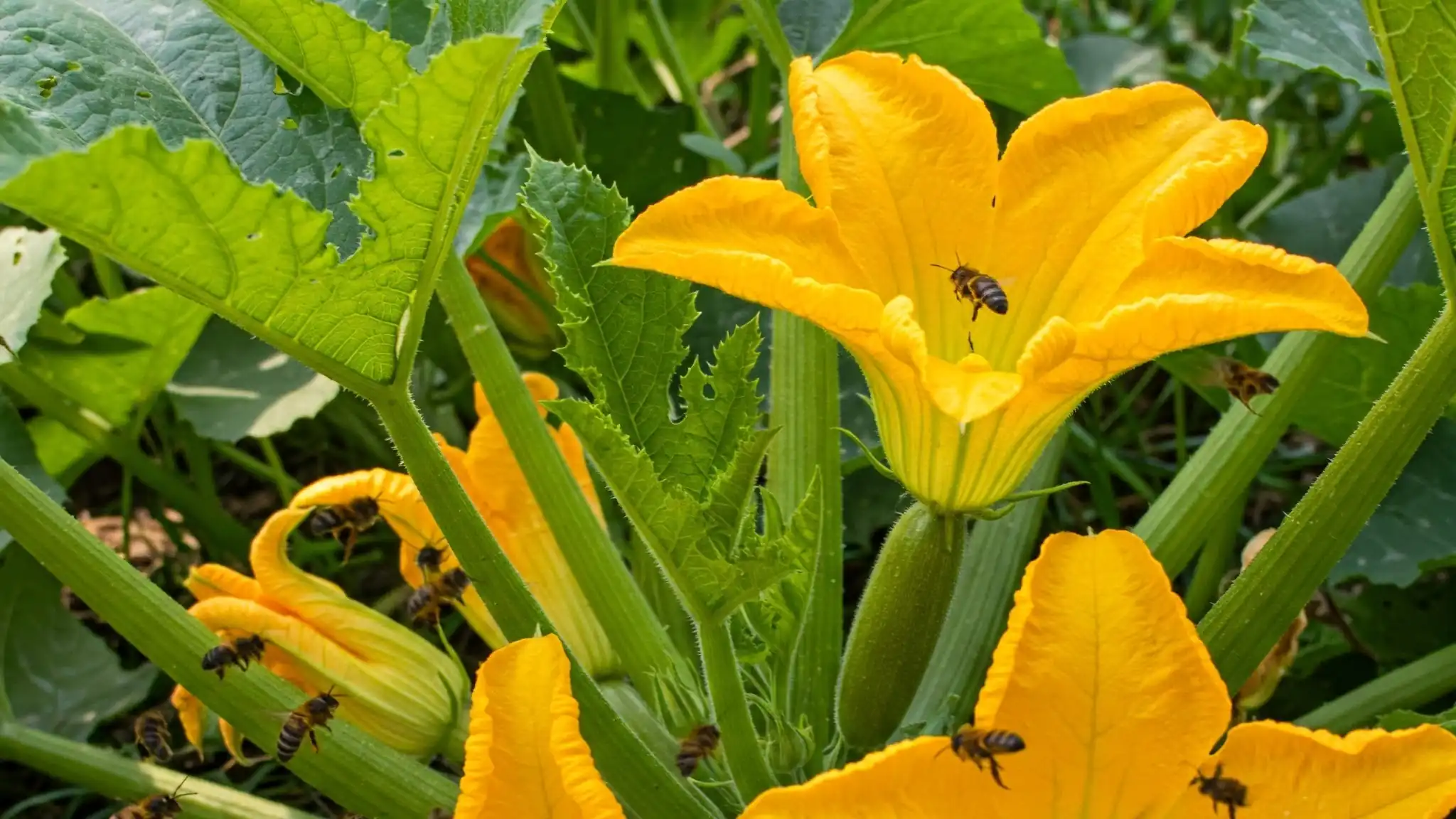
Building a Bee-Friendly Zucchini Garden
Hand pollination solves this week’s problem. A garden designed for pollinators solves every week after it.
The Squash Bee — the Specialist Already in Your Garden
There is a native North American bee that evolved alongside squash-family plants and collects pollen from almost nothing else. Peponapis pruinosa — the squash bee — is not something you need to order from a supplier or attract from a distance. If you have grown zucchini, pumpkins, or any Cucurbita crop for more than a season or two, there is a good chance squash bees are already nesting in your soil right now.
What makes squash bees worth understanding:
They start before other bees. Squash bees begin foraging at sunrise — 30 to 60 minutes before honey bees become active. According to both NC State Extension and University of Delaware Extension, squash bees often complete most of a garden’s morning pollination before other bee species have started their day. By the time a honey bee arrives at your zucchini patch, the squash bees may be almost done.
They are far more efficient per visit. Research from UF/IFAS Extension found that honey bees deposit roughly four times less pollen per flower visit compared to specialist squash bees. NC State Extension documents that it takes only 6 to 10 squash bee visits to fully pollinate a single female flower — and that squash bees pollinate an estimated two-thirds of all commercially grown squash in the United States, not honey bees.
Squash bees nest in the soil, typically 6 to 12 inches underground, often directly beneath the squash plants they are pollinating or at bare soil patches along the edges of the planting bed. University of Delaware Extension places typical nest cells at just 6 to 7 inches below the surface. You have almost certainly walked past their nests without knowing they were there.
Protecting Squash Bees From the Two Biggest Threats
Most gardeners accidentally damage squash bee populations without realizing it. The two main threats:
1. Tilling. Research consistently finds three times more squash bees on no-till farms compared to tilled farms. Deep rototilling — especially below 6 inches — destroys the underground nest cells where larvae are developing through the off-season. If you rototill your zucchini bed each spring, you are resetting the local squash bee population to near zero every year. Switch to shallow hand cultivation only where needed and leave the planting area undisturbed between seasons.
2. Systemic insecticides. NC State Extension documents that applying imidacloprid as a soil drench caused an 89% reduction in squash bee reproductive success. The chemical moves into pollen and nectar — exactly what squash bees collect all day. Soil-drench products marketed for aphid and cucumber beetle control frequently contain imidacloprid or similar neonicotinoids. If these are used near squash, expect the local squash bee population to decline sharply within one to two seasons.
If you must apply any insecticide — including organic options such as pyrethrin — do it after noon, when squash flowers have closed and squash bees have stopped foraging. University of Delaware Extension is explicit on this timing: apply only after cucurbit flowers have closed, usually after 12 PM. Anything applied before noon hits active foragers directly.
Companion Plants That Recruit More Pollinators
Beyond protecting the squash bees already in your soil, you can recruit bumble bees, sweat bees, and honey bees with companion plantings. Bumble bees are documented by University of Georgia research as the second most effective squash pollinators — worth attracting even in a garden already hosting a healthy squash bee population.
The best annual companions for a zucchini bed, per Ohio State University Extension:
- Zinnias — bloom all season from June through hard frost; choose single-flowered varieties, which attract bees far better than tightly packed doubles
- Borage — blue star-shaped flowers that bees consistently prioritize; also reportedly deters aphids from nearby plants
- Cosmos — tall and airy, they will not crowd zucchini and bloom prolifically with minimal care through the summer
- Sunflowers — position these at the north or east edge of the bed so they do not shade the zucchini during peak afternoon hours
- Herbs in flower — basil, dill, and fennel allowed to bolt and flower attract a wide range of native bee species; do not cut them back once they begin to bloom
Plant companions in clusters of at least five to seven plants per variety — bees forage more efficiently in patches than across isolated individual plants. Start companion plantings two to three weeks before transplanting your zucchini so flowers are already open when the first male zucchini flowers appear.
When Heat Kills Zucchini Pollination
Temperature affects pollination more than most gardeners expect. Above 90°F, zucchini pollen becomes sterile — it will not germinate on the stigma even when transferred correctly, whether by squash bees or by hand. University of Georgia botanical research confirms pollen sterility at this threshold. When daytime highs reach the 90s and night temperatures stay above 75°F, expect poor fruit set regardless of bee activity or hand-pollination technique, as documented by University of Maryland Extension.
The mechanism: high temperatures disrupt pollen tube formation. After a pollen grain lands on the stigma, it must extend a microscopic tube through the style to reach the egg inside the ovary. This process is temperature-sensitive. Above critical thresholds, the tube fails to form or collapses before reaching the egg. Fertilization does not complete. The fruit aborts. University of Maryland Extension found that night temperatures are the primary driver of this failure — warm nights that prevent the plant from recovering are more damaging than peak daytime heat alone. Even a few hours of very high temperatures during the pollination window can cause widespread fruit drop across the planting.
Heat also pushes zucchini plants toward producing more male flowers and fewer females — an imbalance that corrects itself when temperatures drop. Do not remove plants during a prolonged heat spell.
Three practical adaptations for hot summers:
- Water in the late afternoon or evening, not morning. Morning irrigation wets flowers and foliage exactly when bees are most active — wet surfaces deter bee foraging. See our zucchini watering guide for timing and method details that also reduce foliar disease pressure.
- Use 30% shade cloth during heat waves lasting four or more consecutive days. This reduces flower temperature enough to preserve some pollen viability without blocking the full sun zucchini needs for productive growth — a strategy recommended by University of Maryland Extension.
- Plant parthenocarpic varieties if you garden in a hot climate or use a greenhouse. Varieties such as Dunja, Sure Thing, Cavili, Parthenon, and Costata Romanesco set fruit without any pollination — the ovary develops without fertilization, so pollen viability is irrelevant. Fruit quality and flavor are identical to standard varieties; seeds simply do not develop inside. For a full comparison of heat tolerance and other performance traits, see our zucchini variety selection guide.
Frequently Asked Questions
Can I store male flower pollen to use the next morning?
Pollen viability drops significantly within a few hours of a flower opening. You can try storing it in a dry sealed container in the refrigerator for one to two days, but germination rates decline sharply even under ideal storage conditions. Fresh same-morning pollen is always the more reliable choice for guaranteed fruit set.
My zucchini grows to 2 to 3 inches then turns yellow. Is this a pollination problem?
Almost always, yes. An incompletely pollinated ovary receives weak developmental signals — cell division slows or stops in the sections without seeds, the fruit stalls, yellows, and eventually drops. The fix is thorough hand pollination on the next open female flower, covering all lobes of the stigma. Consistent yellowing of small fruits suggests either no bee activity reaching the flowers or regular attempts to pollinate at the wrong time of day.
How many zucchini plants do I need for reliable pollination?
Two or more plants dramatically increases the chance of having open male and female flowers simultaneously on the same morning. One plant can be enough with consistent hand pollination, but a single plant often runs long stretches producing only male flowers early in the season. For reliable natural pollination without intervention, two plants of the same variety is the practical minimum.
Does hand pollination affect fruit flavor or size?
No. Properly hand-pollinated zucchini is identical in flavor and texture to bee-pollinated fruit. Size is determined by how long you leave the fruit on the vine and the plant’s overall nutrition — not the pollination method. Parthenocarpic varieties also produce fruit indistinguishable in flavor from seed-bearing zucchini.
Which zucchini varieties set fruit without any pollination?
Parthenocarpic varieties including Dunja, Sure Thing, Cavili, Parthenon, and Costata Romanesco set fruit without pollination. They are suited to greenhouses, urban balconies, and regions where summer heat regularly exceeds 90°F and compromises pollen viability. For a comparison of these alongside standard varieties, see our zucchini variety selection guide.
Sources
- UNH Extension — Zucchini Plants Flowering But Not Producing Fruit
- University of Maryland Extension — Pollination Problems of Vegetables
- NC State Extension — Squash Bees in the Home Garden
- Maryland Grows / UMD Extension — Pollination of Vegetable Crops in a Warming Climate
- University of Delaware Extension — Squash Bees: Specialist Pollinators of Cucurbit Plants
- UF/IFAS Extension — Pollination of Cucurbita spp. Crops in Florida
- Ohio State University Extension — Attracting Pollinators to the Garden
- Coastal Georgia Botanical Gardens / University of Georgia — The Plight of Poorly Pollinated Squash


