

How Often to Water Petunias: Up to Daily in a Basket, Weekly in a Bed, and Why Wave Types Are the Exception

Water petunias up to daily in baskets, weekly in beds, more for Wave types. Five finger tests compared, RHS trial volumes, and how to tell wilt from root rot.
In short
- How often to water petunias: up to daily in a hanging basket, a deep soak about weekly in the ground, more often for spreading Wave types (UMN Extension).
- Doubling the water gave only 8-15% more flowers in an RHS basket trial.
- Checked against: University of Minnesota, Iowa State, Kansas State, Illinois and Penn State Extension, and the RHS.
When the Royal Horticultural Society doubled the water applied to manually watered petunia hanging baskets, it got only 8-15% more flowers, and twice as much water was wasted. So the useful question is not how many times a week, but how fast your planting dries out. That runs from as often as daily for a hanging basket in summer to about once a week for petunias in the ground, with spreading Wave types the exception that needs more.
This guide sets out the figures each extension source gives for baskets, patio pots and ground beds, shows why the container sets the schedule, compares the five different finger-test depths that extension and plant-brand pages recommend, and separates wilt from root rot and wet-foliage botrytis. Feeding, deadheading and light are in our petunia care guide; the geometry of why a basket dries faster than a pot has its own article, hanging basket vs. patio pot watering.
How often to water petunias: the answer by planting type
A petunia in a hanging basket may need water as often as daily in summer, a petunia in a ground bed needs a thorough soak about once a week, and a patio pot depends on its size and volume of soil (UMN). The table gives each extension source’s own figure first, then the weather adjustments; where no source gives a number, the cell says “our estimate”.

Three pre-planned garden beds, free
Stop staring at empty beds: printable plans with exact layouts, plant lists and planting calendars — yours free from the Garden Library.
| Planting | What the sources say | Hot and sunny | Cool or overcast | Windy |
|---|---|---|---|---|
| Hanging basket | Water when the surface is dry to the touch (Iowa State); “perhaps as often as daily” (UMN) | May need water once a day (Iowa State); Proven Winners suggests checking for rootbound plants if a container needs water several times a day | Test first and water only if dry at test depth; every 2-3 days is our estimate, no source gives a number | No source gives a figure for baskets; K-State lists wind as a factor, so check twice a day (our judgment) |
| Patio pot, 12 in. or more across | Containers need frequent watering, daily watering “is necessary” (Illinois); dry at least 3 inches down before watering (K-State) | Daily may be needed (Illinois, UMN) | Every 3-4 days (our estimate) | Check daily (our judgment) |
| Ground bed, upright petunias (grandiflora, multiflora) | Thorough soak about once a week, 6-8 inches deep (UMN); about 1 inch of rain a week is generally adequate (Penn State) | Still weekly “in all but the worst weather” (UMN) | A 1-inch rain covers the week (Penn State’s per-week figure) | Raised beds in full sun and exposed to high wind may need more frequent watering (K-State); no figure for ordinary beds |
| Ground bed, Wave and other spreading types | “Require frequent watering” (UMN, no number) | More often than weekly (UMN); a Lowe’s Wave care sheet says ample water 2-3 times a week | Between the weekly bed rule and the container rule; no source gives a number | No source gives a figure |
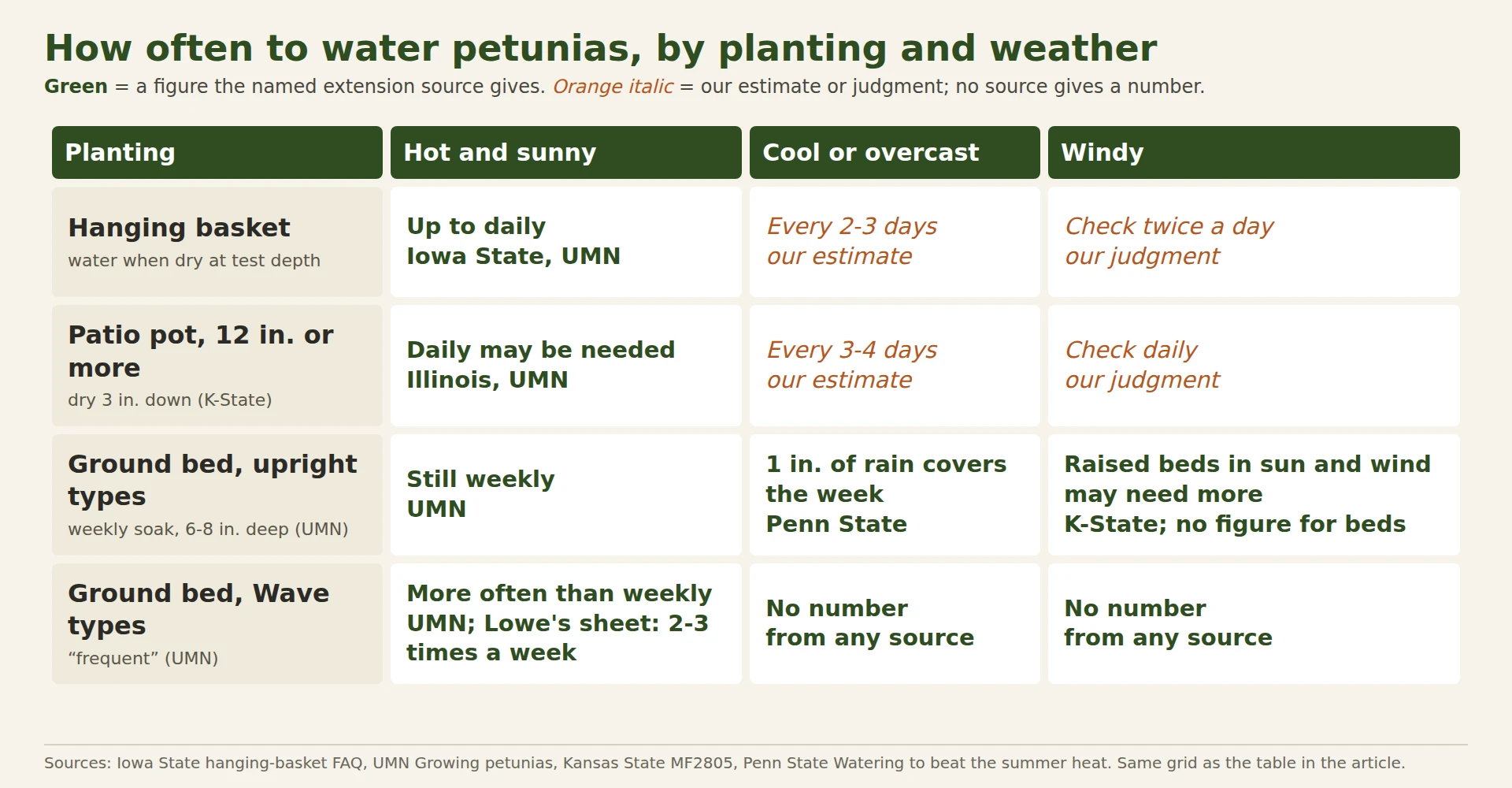
The sources agree that containers need water more often than beds; none ranks a basket against a pot, and the numbers differ. We found no trial that waters baskets, pots and beds of the same petunia side by side, which is why Illinois Extension says there are “no hard and fast rules” and sends you to the soil.
Why the container, not the plant, sets the schedule
A small volume of light potting mix dries faster than the same plant in garden soil. Iowa State says basket potting mixes are light, well-drained and dry out quickly, and a basket may hold several plants. Kansas State lists what moves the interval: the container’s shape, size and material, sun and wind exposure, and the density and maturity of the plants in it. Penn State, writing about vegetables and herbs, singles out pots smaller than 10 inches in diameter as the thirstiest.
The geometry is simple. For a straight-sided pot, the area of the soil surface divided by the volume of mix is 1 divided by the depth (our arithmetic). A basket 6 inches deep therefore exposes twice as much soil surface per cubic inch as a pot 12 inches deep, before counting the leaves above it and, for a lined basket, the sides. A basket also hangs in open air, which maximises the sun and wind exposure K-State lists. The full surface-to-volume comparison, with a UK trial, is in our basket vs. patio pot article.
Petunias themselves are thirsty. In the Reading study behind the RHS container work, petunias needed on average 30% more water than impatiens when each was given everything it lost in the previous 24 hours. But two petunias in the same 2-litre container needed only about 10% more water than one, so in that test a second plant did not double the demand.
How much water a petunia actually uses
The RHS gives the only measured volumes we found. In its Reading experiments, it took 160 ml of water a day to saturate the compost supporting each petunia, but only 80 ml to grow a good plant. In the Wisley basket trial, which ran 9 weeks through the hottest July day on record (36.7 °C, about 98 °F) at that garden, every basket used less than 25 litres in total, an average of 142 to 380 ml a day (roughly 5 to 13 fluid ounces). A 5-litre basket held 3.4 litres of water at the start of the trial, and soil moisture in every basket dipped below 20% by volume at some point, which the RHS says probably affected flower production.
8-15% more flowers when the RHS doubled the water given to manually watered petunia baskets, with twice as much water wasted.
Source: Royal Horticultural Society, Research shows the best way to water hanging baskets
Can you cut the water back? Three sources, three answers
Cutting back is cheaper than it sounds, but not free. The RHS bedding project reports that “acceptable” container displays were possible with irrigation 67% below optimum. The peer-reviewed paper from the same group is less cheerful: at 25% of the water lost, petunia flower number fell by half (from an average of 71 to 33 per plant), height by a third and flower size by 13%. A trial at a German horticultural institute, run with a breeder, found three petunia cultivars (NightSky, Famous Laser Pink and Royal Sky) rated good to very good on 50% of the water, while saying other petunias would pass only if buyers accept poor-looking plants in a heat spell. “Acceptable” is a judgment call, and none was ordinary garden watering: the Reading experiments were run in glasshouses and the German one used drip-irrigated window boxes. Treat the 80 ml and 160 ml figures as a floor and a ceiling, not a schedule.
Wind, heat and pot material: what changes the interval
Heat and sun shorten the interval, and the pot decides how much. Proven Winners, a plant brand rather than a university, notes that unglazed terra cotta dries out faster than glazed ceramic, plastic holds water better, and dark or thin-walled plastic can heat the soil enough to stress roots. Kansas State adds that the soil in exposed containers often gets too hot for roots, and that a midday watering that merely moistens the plants and the soil surface with cool water can lower the temperature. If a basket needs water several times a day, Proven Winners suggests checking whether the plants have become rootbound, and moving to a roomier container if so.
Wind is the gap. K-State lists wind as a factor for containers and says a raised bed in full sun and exposed to high wind may need watering more often, but none of the sources we read gives a figure for how much faster wind dries a basket. Test, don’t guess.
Timing matters too. Penn State advises watering containers at around the same time each day: a plant watered in the morning one day and the evening the next goes through two full days of sun and heat on one watering. For ground beds, Penn State’s 1 inch per week includes rainfall, and a rain gauge is the way to know whether the last shower counted.
The finger test: five sources, five depths
Every source says to feel the soil, and the depths they give range from the surface to 3 inches. The table lists the depth each gives; none was tested on petunias in particular.
| Source | Test depth before watering | Written about |
|---|---|---|
| Iowa State Extension | Soil surface dry to the touch | Hanging baskets |
| Illinois Extension | First inch or so is dry | Containers in general |
| Penn State Extension | Finger to the first knuckle | Containers (vegetables and herbs) |
| Proven Winners | Dry down to the second knuckle | Containers in general |
| Kansas State | Dry at least 3 inches deep | Container gardens; its houseplant rule scales from 1 inch in a 6-inch pot to 2 inches in a 10-inch pot |
The spread may partly reflect pot depth. Kansas State’s own houseplant rule scales the test depth with the pot, 1 inch down in a 6-inch pot and 2 inches in a 10-inch pot. Our working rule for petunias, which no source has tested: in a basket or pot shallower than about 8 inches, test to the first knuckle (roughly 1 inch, our approximation); in a deeper patio pot, test to the second knuckle (roughly 2 inches); and skip Iowa State’s surface test as the only trigger. Penn State warns that soil may appear damp or wet when it is not, and the RHS found that a bone-dry compost surface “isn’t a problem” and can reduce evaporation. Both point to depth, not surface.

How to water once the test says yes
Water until it runs out of the bottom, so the whole root ball is wet: Iowa State and Illinois Extension both say so, and Illinois adds that the run-through leaches fertiliser salts that would otherwise burn leaf margins and injure roots. The RHS advises slowing the flow, because water poured in a rush runs off the surface or drains through the bottom unused. When the mix has shrunk away from the pot wall, water runs straight past it: Iowa State says to stand the basket in a tub of water for 1 or 2 hours, and no more than 2, because longer may cause root rot.
Do Wave and grandiflora petunias need different watering?
UMN Extension is the one source we found that separates the types, and it says Wave types need more than the weekly bed rule: except for “spreading” types, which require frequent watering, a thorough weekly watering should be sufficient in all but the worst weather, and describes Wave petunias as a common spreading type that is only about 6 inches tall but covers a large area in a season “provided they’re watered and fertilized frequently”. Grandifloras, in the same source, have the largest flowers (3 to 4 inches or more) and are mostly upright mounds 12 to 15 inches tall.
A retailer’s sheet gives the only number we found: a Lowe’s care sheet for Wave petunia says ample water 2-3 times a week is needed, especially in warmer months, and that the plant will recover if allowed to dry out. It does not say whether it means containers or ground. That is the evidence we found: UMN gives no number for spreading types, the Lowe’s sheet is not a trial, and we found no trial comparing the water use of Wave and grandiflora petunias. Our reading, labelled as inference: a plant that covers 1.5 feet or more (UMN’s minimum spacing for spreading types) has more leaf area to supply than an upright petunia 12 inches apart, so it is reasonable to check it earlier in a hot spell. Cultivars also differ: the German trial above found a few petunias that coped with half the water. For how the types differ beyond watering, see our petunia growing guide. Calibrachoa, often sold beside petunias, is a different case: Proven Winners says it prefers to dry out a little between waterings, which we compare in petunia vs. calibrachoa.
Overwatering, underwatering and root rot: reading the wilt
A wilted petunia can be too dry or too wet, and the leaves look the same. Illinois Extension says that overwatering leaves the container waterlogged so that roots lack oxygen, leading to poor growth and eventually perhaps the plant’s death. Iowa State describes the sequence for bedding plants, petunia included: with Pythium root rot, roots turn brown and water-soaked, and the root dysfunction is the primary symptom while the foliage symptoms are secondary. The leaves can wilt because rotted roots can no longer supply them (our inference), even when the soil is wet. Check the soil at test depth and the roots before you decide.
| What you see | Check | Likely cause | What to do |
|---|---|---|---|
| Wilted leaves, mix dry at test depth | Finger at the depth for your pot | Underwatering; Iowa State says plants wilt if the mix dries excessively | Water until it drains; slow the flow |
| Wilted, mix wet at test depth, leaves yellowing or discolouring | Slide the plant out: brown, soft, water-soaked roots | Waterlogging or root rot (Pythium, Phytophthora), favoured by cool wet soil (Missouri IPM) | Stop watering and improve drainage; an infected plant can’t be cured (Missouri IPM), so destroy it and disinfect the pot (Iowa State) |
| Wilted at midday, mix moist at test depth | Does it look better by evening? | Heat stress; Proven Winners suggests shade in the hottest part of the day while plants acclimate | Shade the pot at midday; test the soil again before adding water |
| Water runs straight through; mix has shrunk from the pot wall | Gap at the rim | Dried-out mix that repels water | Tub soak for 1 to 2 hours, no more than 2 (Iowa State) |
| Flowers dropping on a pot that keeps drying out | How dry does it get between waterings? | Illinois: letting containers dry out completely leads to flower drop | Water earlier, at test depth |
| Brown, mushy petals and gray fuzzy growth after humid or wet weather | Look for gray fuzz on spent flowers | Botrytis; petals are most susceptible (PNW Handbook) | Remove dead flowers; water the soil in the morning |
| Burned leaf margins | Is water ever running out of the bottom? | Fertiliser salt build-up, per Illinois | Water until it drains each time |
Missouri IPM warns that drought and low nitrogen can produce symptoms similar to root rot, which is why the root check matters more than the leaf symptom. In the ground, the same source recommends improving drainage with raised beds, sand or organic matter, and by redirecting downspouts away from plantings.
Wet foliage, botrytis and the water-in-the-morning rule
Water in the morning, at the soil, because gray mold needs leaves and petals to stay wet for hours. UConn Extension says spore germination and infection depend on a film of moisture for 8 to 12 hours, relative humidity of 93% or more and temperatures of 55 to 65 °F, and advises always watering in the morning so rising daytime temperatures dry the leaves. UConn also says to avoid watering late in the day when the water will sit on the leaves for long periods. The Pacific Northwest handbook adds that petals are the most susceptible tissue, and that infected spent flowers that land on foliage can start a leaf blight, so removing dead flowers matters as much as when you water.
One caveat: UConn and the PNW handbook are written for greenhouse growers, and we found no outdoor bedding trial that tests watering time against petunia gray mold. The advice carries over because the mechanism does, but treat the 8 to 12 hours as a greenhouse figure. Illinois Extension gives the garden version: avoid wetting the leaves, which encourages foliar disease.
That sits uneasily beside K-State’s tip to water a hot container at midday to cool the soil. Our synthesis, not a tested rule: soak thoroughly in the morning, and if a basket needs a heat-wave top-up in the afternoon, moisten the soil line only and keep the flowers dry.
A watering routine you can run this week
- Pick your test depth. First knuckle for a basket or shallow pot, second knuckle for a deeper patio pot (our working rule above).
- Test in the morning. Dry at that depth means water; damp means wait and test again the next morning.
- Water slowly at the soil line until it runs from the bottom, and leave the flowers dry.
- Count the days. Note how many days it takes to reach the test depth in your weather. That interval is your schedule until the weather changes.
- For beds, soak weekly to 6 to 8 inches (UMN), count rain against the 1-inch weekly total (Penn State), and check Wave plantings between soaks.
Petunia watering FAQ
How often should I water petunias in hanging baskets?
As often as daily in hot summer weather (Iowa State, UMN), and otherwise whenever the soil is dry at your test depth. Water until it runs out of the bottom of the basket.
How often should I water petunias in the ground?
About once a week with a thorough soak to 6 to 8 inches (UMN), counting rain toward Penn State’s 1 inch per week. Spreading Wave types need more often (UMN).
Should I water petunias every day?
Mainly in containers and in summer heat; Illinois treats daily watering as necessary for containers. For ground beds, UMN’s advice is a thorough weekly watering rather than a daily sprinkle.
Is it bad to water petunias at night?
It can be, if the foliage and flowers stay wet overnight. UConn says gray mold spores need a moisture film for 8 to 12 hours and advises watering in the morning; if evening is your only time, water the soil and keep the foliage dry.
Can you overwater petunias?
Yes. A waterlogged mix starves roots of oxygen (Illinois), and Pythium root rot spreads in wet soil (Iowa State). Extra water beyond what the plant needs is mostly wasted: the RHS got only 8 to 15% more flowers from doubling it.
How much water does a petunia need?
In RHS experiments it took 160 ml a day to saturate the compost around one petunia in a 2-litre container and 80 ml to grow a good plant. Baskets in the Wisley trial averaged 142 to 380 ml a day over 9 weeks.
Start tomorrow morning with one finger test at the depth that matches your pot, and note the result. If your plants are leggy and bare despite good watering, our guide on how to prune petunias covers the cutback, and the petunia care guide covers feeding.
Sources
- University of Minnesota Extension. Growing petunias. UMN Extension
- Iowa State University Extension and Outreach. How often should I water plants in hanging baskets? Yard and Garden
- Rodriguez Salamanca, L. Crown and root rot in bedding plants: Pythium spp. Iowa State University Extension and Outreach, Yard and Garden, March 2017
- University of Illinois Extension. Watering. Container Gardens
- Shoreman, C. Watering to beat the summer heat. Penn State Extension, updated June 2023
- Upham, W., et al. Watering raised beds, berms, containers, and houseplants (MF2805). Kansas State University Cooperative Extension, 2008
- Royal Horticultural Society. RHS research shows the best way to water hanging baskets. RHS Science
- Royal Horticultural Society. Watering containers. RHS Science
- Royal Horticultural Society. Optimising water use in containers with bedding plants. RHS Science project
- Blanusa, T., Vysini, E. and Cameron, R.W.F. Growth and flowering of Petunia and Impatiens: effects of competition and reduced water content within a container. HortScience 44(5):1302-1307, 2009
- UConn Extension IPM. Botrytis blight on greenhouse crops. University of Connecticut
- Pacific Northwest Plant Disease Management Handbook. Petunia (Petunia spp.): Botrytis blight. Oregon State University, Washington State University and University of Idaho
- University of Missouri Integrated Pest Management. Bedding plant woes. Missouri Environment and Garden, 2011
- Proven Winners. Watering container plants in the summertime. Proven Winners
- Lowe’s. Care tips and general info for Wave Petunia (plant care sheet). Lowe’s
- AIPH. LVG Heidelberg screens bedding plant range of drought tolerance. International Association of Horticultural Producers


