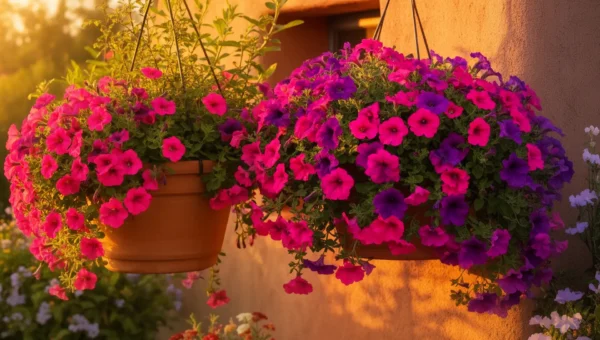
How to Propagate Petunias: Cuttings Root in 7–14 Days, Seeds Bloom in 10 Weeks

Petunia cuttings root in 7–14 days when you match method to cultivar type — and seeds hit full bloom in 10 weeks. Step-by-step guide with zone timing.
Cuttings or Seeds? The Answer Depends on Your Petunia Type
The biggest decision in petunia propagation isn’t technique — it’s which method matches your plants. Modern bedding petunias divide into two distinct groups, and choosing the wrong method means either seedlings that look nothing like the parent plant, or unnecessary work taking cuttings when seed would do fine.
F1 hybrid petunias — Wave, Tidal Wave, Supertunia, and Surfinia series — are bred through controlled cross-pollination between two inbred parent lines. Seeds from these plants produce offspring with unpredictable colors, reduced vigor, and altered growth habits, frequently reverting to ancestral traits. Vegetative propagation through softwood cuttings is the only way to replicate them accurately. This is why commercial growers propagate Wave-type petunias exclusively from cuttings rather than seed.
Open-pollinated (OP) petunias — old-fashioned grandifloras and multifloras sold from labeled seed packets — can be grown reliably from seed. Colors will match the packet description. If you collect seed from OP petunias already in your garden, nearby cross-pollination introduces some variability, but germination will be reliable.
One check before you start cutting: many premium cultivars carry plant patents. Vegetative propagation of patented varieties for resale or distribution is a federal offense. Personal, non-commercial propagation sits in a legal gray zone — read the plant label before taking cuttings from named branded series.

Three pre-planned garden beds, free
Stop staring at empty beds: printable plans with exact layouts, plant lists and planting calendars — yours free from the Garden Library.
| Petunia Type | Best Propagation Method | Notes |
|---|---|---|
| Wave, Supertunia, Surfinia | Cuttings only | F1 hybrid — seeds won’t come true |
| Grandiflora, multiflora (seed packets) | Seed | Colors reliable from packet; saved seeds may vary if cross-pollinated |
| Milliflora | Seed or cuttings | Both work; cuttings preserve exact cultivar |
| Named trailing series with plant patent | Cuttings for personal use only | Check the label; commercial propagation is illegal |
How to Propagate Petunias From Softwood Cuttings
The cutting window runs from late spring through late summer. Spring cuttings root fastest because auxin levels are highest in actively growing new growth. Late summer cuttings (August–September) are taken primarily to overwinter plants before frost — covered in detail below.
Step 1: Choose the Right Stem
Select a soft, non-flowering stem 3–4 inches long. Stems carrying flower buds root more slowly because the plant directs carbohydrates toward reproduction rather than root initiation. If buds are unavoidable, pinch them off immediately after cutting. Avoid woody, thickened stems at the plant base — they root slowly and tend to rot before roots form.
Step 2: Make the Cut and Strip Leaves
Cut just below a leaf node — the slight swelling where a leaf meets the stem. Auxin (indole-3-acetic acid, the hormone that triggers adventitious root formation) accumulates both at wound sites and through polar auxin transport from the shoot above, making the nodal zone the most active rooting location in the cutting [5]. Remove all leaves from the lower two-thirds of the stem, leaving two to three leaves at the tip to continue photosynthesis.
Step 3: The Dark Incubation Technique That Dramatically Improves Rooting
Research published in the Journal of Experimental Botany on petunia cutting propagation found that holding freshly prepared stems in darkness at 50°F for 48–72 hours before planting raised rooting rates from roughly 40% to nearly 100% [5]. The mechanism: dark exposure triggers extended IAA accumulation at the stem base, giving root primordia cells a stronger and longer auxin signal before they begin to differentiate. Under continuous light, this signal peaks early and fades before root cell clusters fully establish.
In practice: wrap prepared cuttings in barely moist paper towels, seal in a plastic bag, and hold them in the vegetable drawer of your refrigerator for 48–72 hours before planting. This step adds almost no time to the process and produces a measurable improvement in success rates, particularly for cuttings taken in warm mid-summer conditions when heat stress is high.
Step 4: Plant in the Right Medium
Fill a clean pot with a 50/50 mix of perlite and peat-free compost. Media pH should sit at 5.5–6.0 — above pH 6.5, iron availability drops sharply and cuttings develop interveinal yellowing before they root. Dip the cut end in rooting hormone powder (standard 0.3% IBA works well for home propagators; commercial growers use 2,500 ppm IBA for difficult cultivars). Make a hole with a pencil, insert the cutting 1.5 inches deep, and firm the medium around the stem. Water the medium before inserting cuttings, not after — watering-in can wash hormone off the cut surface.
Step 5: Maintain Humidity and Temperature
Cover the pot with a clear plastic dome or loose plastic bag. Keep temperature at 65–75°F (18–24°C) with bottom heat if available — 70°F is the practical minimum for reliable rooting according to the RHS softwood cuttings guide [7]. Position in bright indirect light; direct sun through plastic raises leaf temperature enough to desiccate cuttings before roots form.

Rooting Time and Aftercare
Commercial propagators root rapid cultivars in 10–14 days; home conditions without bottom heat typically run 2–3 weeks. Tug gently on the stem after 14 days — resistance means roots have anchored. Once rooted, remove the plastic cover and lower humidity gradually. Maintain low humidity around newly rooted cuttings: calcium and boron move through the plant only in the transpiration stream, and high humidity suppresses transpiration enough to cause meristem collapse and necrotic leaf tips in young petunia cuttings, according to MSU Extension [3]. Begin feeding with a balanced fertilizer containing micronutrients at 250 ppm nitrogen once the first new growth appears.
For full care guidance after your cuttings establish, visit our Petunia Growing Guide.
How to Grow Petunias From Seed
Seed propagation works best for open-pollinated grandifloras, multifloras, and millifloras. It offers the widest color and cultivar selection, lower cost, and access to varieties not sold as transplants. The key is starting early enough — petunias need 10–12 weeks indoors before they’re ready for the garden.
Sowing Timing by Zone
According to Iowa State Extension [1] and the University of Minnesota Extension [2], count backward 10–12 weeks from your last expected frost date:
| USDA Zone | Typical Last Frost | Start Seeds Indoors |
|---|---|---|
| Zone 4 | May 15–31 | March 1–15 |
| Zone 5 | April 15–30 | Feb 1–15 |
| Zone 6 | April 1–15 | Jan 15–Feb 1 |
| Zone 7 | March 15–31 | Jan 1–15 |
| Zone 8 | Feb 15–Mar 1 | Dec 1–15 |
| Zone 9 | Jan 15–Feb 1 | Nov 1–15 |
The Light Requirement Most Beginners Miss
Petunia seeds are near-invisible — roughly 250,000–300,000 per ounce [1] — and they require light to germinate. Do not cover them with compost. Press seeds gently onto the surface of moist starting mix with a pencil eraser to ensure soil contact, then mist lightly and cover the tray with clear plastic. Keep the tray out of direct sunlight during germination: the temperature under plastic in direct sun spikes well above the 75–80°F target and causes uneven germination or seedling death.
Seeds sprout in 7–10 days [1, 2]. As soon as seedlings emerge, drop the temperature to 60–65°F — the cooler environment produces stockier plants with stronger root systems than those grown warm throughout [2].
Light After Germination
Position grow lights or fluorescent tubes 4–6 inches above seedlings for 14–16 hours daily [1]. Seedlings receiving less light will stretch toward the window and arrive at transplant time too tall with too little root mass. A windowsill works if it receives direct sun for most of the day, but in northern zones before April, supplemental lighting is usually necessary.
Stop missing your zone's planting windows.
Select your US zone and month — get a complete checklist of what to plant, prune, feed, and protect right now.
→ View My Garden CalendarTransplanting
Move seedlings into individual cell packs when they show three true leaves. The first two leaves (cotyledons) are round and smooth; true leaves have the scalloped edges of a mature petunia. Handle seedlings by a leaf, never by the stem — a crushed stem is fatal, while a lost leaf is not.
Harden off seedlings over 7–10 days before planting: begin with 1–2 hours of sheltered outdoor exposure and build gradually to full outdoor conditions. Expose to direct sun only in the final 2–3 days of the process [2].
Taking Fall Cuttings to Overwinter Your Favorite Cultivar
If a hybrid petunia has performed exceptionally well — an unusual color, a trailing habit that filled your basket perfectly, or a variety you can’t find reliably at retail — take cuttings in August or September before frost ends the season.
Cut 2–3 inch softwood tip cuttings, remove lower leaves, and root them in small pots on a south- or west-facing windowsill [6]. Indoor air is dry enough that you typically won’t need a humidity dome; mist lightly every couple of days until roots form. Once rooted, water when the top inch of compost dries and feed monthly with diluted liquid fertilizer through winter.
In late winter, take a new round of cuttings from your overwintered stock before new growth gets too long. One mother plant kept through a single winter can supply dozens of rooted cuttings by April — enough to fill hanging baskets that would otherwise cost $8–12 each at the garden center. This is the standard approach for gardeners who grow petunias year after year without relying on annual retail availability.
A practical note: rooting in water is possible, but roots developed in water are structurally different from soil roots and the transition sets plants back by several weeks [6]. Soil or perlite is more practical when rooting more than two or three cuttings.
Propagation Failures: Symptoms, Causes, and Fixes
| Symptom | Most Likely Cause | Fix |
|---|---|---|
| Cuttings wilt within 48 hours | Direct sun, low humidity, or oversized cutting | Move to indirect light; add humidity dome; trim back to 3 inches |
| Stem rots at base | Overwatering or waterlogged medium | Water only when surface begins to dry; check drainage; reduce misting frequency |
| No roots after 4 weeks | Cold medium below 65°F, or woody cutting selected | Add bottom heat; take only soft new growth; try dark incubation before planting |
| Yellow leaves on rooted cuttings | Calcium/boron deficiency or pH above 6.5 | Feed with micronutrient fertilizer at 250 ppm N [3]; confirm media pH is 5.5–6.0 |
| Seedlings germinate then collapse | Damping-off fungus (overwatering + heat) | Improve air circulation; water only when surface dries; use sterile seed-starting mix |
| Seeds don’t germinate after 14 days | Buried too deep (blocking light) or temperature too low | Surface-press only; verify soil temp is 75–80°F with thermometer — most rooms sit at 68°F |
Frequently Asked Questions
Can you root petunia cuttings in water? Yes, though the roots that form in water are adapted to oxygen-rich aqueous conditions and die back when you pot the cutting into soil. The plant regenerates soil-adapted roots, but this transition adds 1–2 weeks to establishment time. If you do root in water, pot up when roots reach 1 inch rather than letting them extend further.
How long from cutting to first bloom? A rooted cutting potted into a 4-inch container in spring typically blooms within 4–6 weeks — faster than seed-grown plants because the cutting is already genetically mature. Seed-grown petunias take 10–12 weeks from sowing to first flower [1].
Can you save petunia seeds from your garden? From open-pollinated varieties, yes — seeds reproduce reliably. From F1 hybrids, seeds are either sterile or produce highly variable offspring that rarely resemble the parent. If you grow multiple petunia varieties together, cross-pollination between plants makes even OP seed saving unpredictable.
Sources
- Iowa State University Extension — How to Start Petunias from Seed Indoors
- University of Minnesota Extension — Growing Petunias
- Michigan State University Extension — Vegetative Petunia Propagation and Production Challenges (https://www.canr.msu.edu/news/vegetative_petunia_propagation_and_production_challenges)
- Greenhouse Product News — Producing Vegetative Petunias and Calibrachoa (https://gpnmag.com/article/producing-vegetative-petunias-and-calibrachoa/)
- PMC6881223 — Role of Auxin Homeostasis in Adventitious Root Formation in Petunia Cuttings (https://pmc.ncbi.nlm.nih.gov/articles/PMC6881223/)
- Gardening Know How — Propagate Petunia Cuttings (https://www.gardeningknowhow.com/ornamental/flowers/petunia/propagating-petunia-cuttings.htm)
- RHS — Softwood Cuttings (https://www.rhs.org.uk/propagation/softwood-cuttings)
- Iowa State University Extension — Selecting and Planting Petunias (https://yardandgarden.extension.iastate.edu/article/1999/2-19-1999/petunias.html)