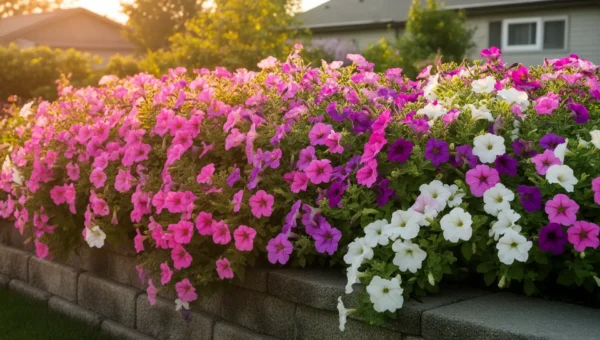
Zone 9 Petunias: Exact Planting Dates, Heat-Tolerant Varieties, and the Mid-Summer Cutback Trick

Zone 9 petunias fail when planted on a summer schedule. Discover the two-season planting calendar, 6 heat-rated varieties, and the cutback trick that triggers a fall rebloom.
Walk into any garden center in Zone 9 in late May and you’ll find petunias stacked to the ceiling. Buy them, plant them in June, and by mid-July they look like something left in a hot car — bare stems, scarce flowers, and a general air of defeat. It happens to Zone 9 gardeners every year, and it’s not a care problem. It’s a scheduling problem.
Petunias are cool-season annuals sold as summer flowers. Their bloom sweet spot is 55–80°F. Zone 9 summers in Houston, Phoenix, Sacramento, and Tampa regularly exceed 95°F from June through September — well above the threshold where petunias stop flowering and start surviving. The fix isn’t a different fertilizer or more frequent watering. It’s a different calendar: plant in fall or late winter, expect a summer lull, then execute one key technique in late July to unlock a second flush that carries you through October.
Here’s the complete Zone 9 petunia playbook — planting dates by sub-zone, a variety comparison by heat tolerance, and the mid-summer cutback technique explained.
The Zone 9 Reality: What This Climate Means for Petunias
Zone 9 stretches across Southern California’s inland valleys, Arizona’s low desert, Texas’s Gulf Coast, and most of Florida. Minimum winter temperatures run between 20°F and 30°F — mild enough for petunias to survive outdoors through winter rather than dying at first frost. That’s the good news.

Three pre-planned garden beds, free
Stop staring at empty beds: printable plans with exact layouts, plant lists and planting calendars — yours free from the Garden Library.
The challenge is summer. When daytime highs regularly exceed 90°F, petunia flower production drops sharply. Above 95°F, the plant aborts developing buds before they open and redirects energy toward seed production — the same survival response that causes vegetables to bolt in heat. This is why Zone 9 petunias don’t bloom continuously through July and August the way they do in Chicago or Portland. The plant isn’t sick. It’s responding exactly as it evolved to respond.
Zone 9 has two sub-zones with different spring timing:
- Zone 9a (minimum 20–25°F): inland California valleys, central Texas, northern Florida
- Zone 9b (minimum 25–30°F): coastal California, southern Arizona, Gulf Coast Texas, central and southern Florida
The practical difference is a two-week shift in last frost date — Zone 9b averages February 15, Zone 9a averages February 28. Both zones get the same summer heat. Both benefit from the same two-season strategy.
Zone 9 Petunia Planting Calendar

Petunias in Zone 9 have two planting windows: a fall window (September–November) and a spring window (January–April 15). Fall is the better choice. Plants established in September or October root into cooling soil, bloom steadily through winter, and peak in March–May before heat shuts them down.
| Month | Zone 9a | Zone 9b | What to Do |
|---|---|---|---|
| September | Start transplants | Start transplants | Fall window opens; ideal for AZ and FL |
| October | Best fall window | Best fall window | 65–80°F days — peak petunia conditions |
| November | Continue planting | Continue planting | Good through end of month |
| December | Watch for frost | Still plant | 9b extends to late December |
| January | Spring window opens | Spring window opens | Start seeds indoors for both sub-zones |
| February | Transplant after Feb 28 | Transplant after Feb 15 | Last frost dates; prime spring window |
| March | Peak spring planting | Peak spring planting | Best conditions for spring color |
| April 1–15 | Spring deadline | Spring deadline | Plant by April 15 before heat builds |
| May–June | Heat management | Heat management | Maintain existing plants; don’t transplant |
| Late July–Aug | Mid-summer cutback | Mid-summer cutback | Perform hard cutback to reset plants |
| August–September | Second flush | Second flush | New growth and blooms appear 3–4 weeks post-cutback |
Bonnie Plants confirms September 1–April 15 as the Zone 9 transplanting window — one of the longest petunia seasons in the country. UF/IFAS Extension specifically recommends October and November as the prime planting window for Florida conditions, which aligns with Arizona and coastal Texas timing as well.
If you start from seed, count back 10–12 weeks from your target outdoor date. For a September transplant date, start seeds indoors in late June or early July.
Varieties for Zone 9: Heat Tolerance Compared
Grandiflora petunias — the large-flowered classics found in most garden centers — are the worst performers in Zone 9 summers. Their wide petals hold moisture, accelerating petal blight in humid conditions, and they stop blooming at lower temperatures than smaller-flowered types. Save grandifloras for spring color from February through May, then replace them.
For plants meant to survive Zone 9’s full season, these six varieties cover the range of what’s available and how they actually perform:
| Variety | Type | Heat Rating | Self-Cleaning | Best For |
|---|---|---|---|---|
| Wave | Spreading | ★★★★☆ | Yes | Ground cover, large borders |
| Easy Wave (Berry Velour, Plum Vein) | Spreading | ★★★★☆ | Yes | Hanging baskets, mixed beds |
| Supertunia Vista Bubblegum | Trailing | ★★★★★ | Yes | Containers, window boxes |
| Petchoa SuperCals | Hybrid | ★★★★★ | Yes | Containers in peak heat zones |
| Madness Summer Series | Mounding | ★★★★☆ | No | Beds, borders, mixed plantings |
| Grandiflora types | Upright | ★★☆☆☆ | No | Spring-only; replace before June |
The Wave series was bred specifically to tolerate warmer temperatures, which is why it became the go-to recommendation for southern gardens. Mississippi State University Extension tested Easy Wave varieties in coastal Mississippi conditions and confirmed their reliability in hot, humid summers — spreading up to 3 feet and blooming continuously when properly fed.
Petchoa SuperCals are a cross between a petunia and calibrachoa, giving them the large flowers of a petunia and the heat endurance calibrachoa is known for. They’re the strongest choice if you live in the hottest parts of Zone 9 (Phoenix, interior Southern California valleys, or South Texas) and want container color that doesn’t require constant intervention.
The Madness Summer Series earned its name honestly — a Las Vegas gardening columnist specifically named it as one of the few petunia options capable of handling desert heat. It requires deadheading, but performs in conditions where most petunias give up.
For more on growing petunias alongside complementary plants, see our petunia companion planting guide.
Soil, Spacing, and Getting Plants Established
Sharp drainage is non-negotiable. Zone 9’s clay-heavy soils — common in Texas and parts of Florida — hold water in ways that cause root rot faster than drought ever would. Amend each planting area with compost before transplanting: roughly one part compost to three parts native soil changes the texture enough to matter.
In containers, any quality potting mix with perlite handles drainage automatically. Avoid mixes marketed as “moisture control” — they’re designed to retain water, which is the opposite of what petunias need.
Stop missing your zone's planting windows.
Select your US zone and month — get a complete checklist of what to plant, prune, feed, and protect right now.
→ View My Garden CalendarSpace transplants 10–14 inches apart. Petunias spread as they grow, and airflow between plants reduces the fungal pressure that Zone 9’s humid spring and fall seasons bring. Plant at the same depth as the nursery container — burying the stem base is unnecessary and invites stem rot in warm, moist soil.
Water and Fertilizer for Zone 9 Conditions
Watering
Established in-ground petunias need 1–2 inches of water per 7–10 days as a baseline. In Zone 9 summers, that schedule compresses: check soil every 2–3 days, since heat and evaporation drain moisture faster than standard weekly timing assumes. Container petunias in peak summer heat may need watering twice daily — one of the stronger arguments for drip irrigation, which delivers consistent moisture to roots without wetting foliage or flowers.
Wave petunias are particularly vulnerable to root rot if left in soggy soil, so consistent drainage matters as much as consistent moisture. Water deeply, then let the top inch of soil dry before watering again.
Fertilizing
Petunias are heavy feeders. Apply a balanced, water-soluble fertilizer weekly during the growing season — not monthly. In Zone 9, frequent watering is required, and frequent watering leaches nutrients quickly from both soil and containers. Monthly fertilizing under those conditions leaves plants hungry.
Keep the middle number (phosphorus percentage) at 10 or below during regular feeding. Excess phosphorus binds to iron in the soil, blocking root uptake and causing leaf yellowing — a common problem when gardeners apply heavy “bloom booster” formulas throughout the season. Save higher phosphorus ratios for the specific post-cutback recovery period described below.
The Mid-Summer Cutback: Zone 9’s Reset Button
By late July in Zone 9, your petunias look rough regardless of how well you’ve cared for them: bare stems, sparse flowers, and leggy growth stretching well past the container edge. This is the correct time for the hard cutback — not a sign that something has gone wrong, but the signal that the reset is due.
Why the cutback works
When temperatures exceed 80°F consistently, petunia stems stretch as the plant responds to heat stress. Flowers that do open go to seed quickly in the heat, and the plant enters a cycle where most of its energy goes toward seed development rather than new bud production. Removing the top growth interrupts this cycle immediately: with no above-ground growth to support, the root system redirects its stored energy into producing dense, new vegetative shoots from every node on the remaining stem. You’re forcing the plant to restart its growth cycle, timed to coincide with Zone 9’s cooling temperatures in August and September.
How to cut
Cut every stem to 4–6 inches above the soil line. Make each cut just above a node — the small bump where a leaf attaches to the stem. Each cut at a node produces two new growing tips rather than one, so a plant with 15–20 stems going into the cutback emerges with 30–40 new growth points coming out.
Timing in Zone 9
Cut back in late July to early August, when days are still hot but starting to shorten. Don’t wait until September: the plant needs 3–4 weeks of recovery time, and you want peak blooming to arrive in September and October when Zone 9 temperatures drop into the 75–85°F range that petunias prefer.
Post-cutback care
After cutting, water deeply once, then reduce frequency — the smaller canopy transpires less than the full plant. Apply a nitrogen-rich fertilizer to push new leaf and stem growth. Once fresh foliage emerges (typically 7–10 days after the cutback), shift to a balanced or phosphorus-forward formula to encourage flower bud formation. Expect blooms 3–4 weeks after the cutback.
This strategy is what separates Zone 9 petunia success from failure. Spring-only planting with no summer reset means 4–5 months of color. Fall planting plus the mid-summer cutback means 8–9 months of continuous display from one planting.
For a broader look at year-round care, see the complete petunia growing guide.
Three Problems Zone 9 Growers Face
Most petunia problems in Zone 9 trace to three causes. This table covers the symptoms and fixes for each:
| Problem | Symptom | Cause | Fix |
|---|---|---|---|
| Summer bud abortion | No flowers July–August despite healthy foliage | Temperatures above 95°F trigger seed-production mode | Perform mid-summer cutback; wait for fall rebloom in cooler temps |
| Tobacco budworm | Small holes in buds; flower buds fail to open; ragged petals | Heliothis virescens larvae tunneling into buds at night | Apply Bt spray at dusk, reapply every 7–10 days; or spinosad after dusk with 3-hour drying time before bees forage |
| Root rot | Wilting despite wet soil; yellowing lower leaves; soft stem base | Overwatering plus poor drainage, especially in clay soil | Reduce watering frequency; improve drainage with compost amendment; replace severely affected plants |
| Leggy, sparse stems | Long bare stems with few leaves; flowers only at tips | Heat-driven stretching plus insufficient pinching | Hard cutback to 4–6 inches above soil; follow post-cutback fertilizer protocol |
| Yellowing leaves | Pale green or yellow foliage despite regular watering | Excess phosphorus blocking iron uptake; or root rot | Switch to balanced fertilizer with phosphorus below 10; check soil drainage |
| Petal blight | Brown spots on flowers; petals rotting before fully open | Botrytis in humid conditions; worse when foliage stays wet | Water at soil level only; improve spacing for airflow; remove affected flowers |
Tobacco budworm deserves attention because it’s common in warm climates and often misdiagnosed as a fertilizer or heat problem. The adult moth lays eggs on petunia foliage; larvae hatch and immediately tunnel into flower buds, which is why you see buds that never open rather than leaves that look damaged. CSU Extension confirms Bt is highly effective on petunias specifically — the caterpillars feed on the surface of leaves and flowers, so the Bt is consumed before larvae can hide inside tissue. Apply late in the afternoon: Bt protein degrades rapidly in UV light, so evening application maximizes potency. Reapply every 7–10 days or after rain.
For the full Zone 9 problem-solving guide, see our petunia problems guide.
Frequently Asked Questions
Can petunias survive Zone 9 winters?
Yes. Zone 9’s mild winters (minimum 20–30°F) allow petunias to survive outdoors. Plants may die back slightly during cold snaps but often rebound. This is why fall-planted petunias can bloom continuously from October through May with minimal interruption.
Should I deadhead Zone 9 petunias?
Self-cleaning varieties — Wave, Easy Wave, Supertunia Vista, Petchoa SuperCals — don’t need deadheading. For mounding types like the Madness Summer Series, regular deadheading extends the bloom period and prevents seed-setting, which slows production.
How long do Zone 9 petunias bloom?
Fall-planted petunias typically bloom from October through May — a 7-month season. Add the mid-summer cutback and you gain 6–8 additional weeks of fall color, stretching the effective display season to 9 months from a single planting.
Can I grow petunias as perennials in Zone 9?
Zone 9’s mild winters make it theoretically possible — University of Arkansas Extension notes that petunias may overwinter and rebloom in mild climates. In practice, plants that survive summer and winter rarely perform as well in their second season as fresh transplants. Most Zone 9 gardeners replace petunias annually rather than carrying them over.
Sources
- Petunias — UF/IFAS Gardening Solutions, University of Florida Extension
- Petunia Zone Planting Guide — Bonnie Plants
- Why Petunias Get Leggy and the Hard Cutback That Saves Them — Your Flowers Guide
- Do Petunias Need Pruning — Gardening Know How
- Tobacco (Geranium) Budworm — Colorado State University Extension
- Petunias — University of Arkansas Cooperative Extension Service
- Wave Petunias Deserve a Place in Home Gardens — Mississippi State University Extension