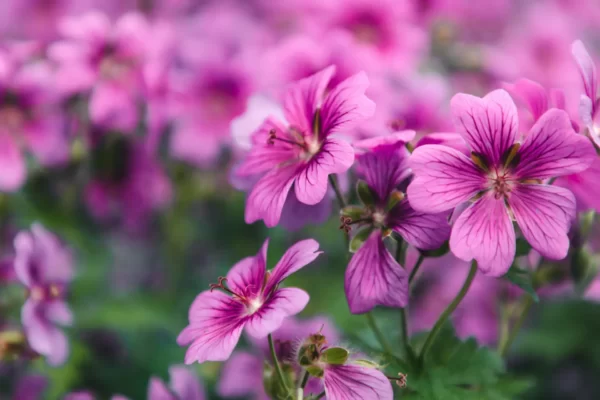
10 Best Companion Plants for Geraniums: Picks for Pest Control, Summer Color, and Containers

10 proven geranium companion plants matched for pest control, summer color, and containers — plus what the Japanese beetle research actually shows.
Geraniums (Pelargonium spp.) are among the most forgiving flowering plants for beds, borders, and containers — full sun, well-drained soil, consistent deadheading, and they bloom from planting right through to the first frost. But placing the right neighbors alongside them does more than fill gaps. A well-chosen companion can reduce pest pressure, attract the beneficial insects that eat those pests, extend the color season, and create container combinations that look intentional rather than accidental.
What most companion planting guides miss is the mechanism behind these benefits. In one case in particular — the relationship between geraniums and Japanese beetles — the real science produces a counterintuitive result that changes how you should use them. Below are 10 companions selected for specific, practical use cases, with growing condition notes for USDA zones 3–10.
Matching Companions to Geranium Growing Conditions
Any companion that fails to match at least two or three of geranium’s core preferences will either struggle or outcompete for the wrong reasons. Iowa State University Extension notes that annual geraniums need full sun (minimum 6 hours of direct sun daily), moist but well-drained soil, and roughly one inch of water per week in garden beds, with containers needing more frequent watering during hot weather. The RHS describes them as drought-tolerant once established, preferring fertile, neutral to slightly alkaline soil.
| Condition | Geranium requirement |
|---|---|
| Sun | Full sun, minimum 4–6 hours (6+ preferred) |
| Soil drainage | Well-drained; standing water kills roots quickly |
| Watering | Moderate; allow top inch to dry between waterings |
| Soil pH | 5.8–6.5 (slightly acidic to neutral) |
| Fertilizer | High-potassium; avoid high nitrogen |
Any companion that requires deep shade, consistently wet soil, or highly alkaline conditions will create problems rather than solve them.

Three pre-planned garden beds, free
Stop staring at empty beds: printable plans with exact layouts, plant lists and planting calendars — yours free from the Garden Library.
Companion Plants for Pest Control
1. French Marigold (Tagetes patula)
French marigolds are the most widely recommended companion for geraniums, and the mechanism behind the benefit is real — though with an important caveat about distance. Marigold flowers release thiophene-based volatile organic compounds (VOCs) that disrupt aphid reproduction. Research on French marigold volatiles found that flower VOCs (specifically from the blooms, not the leaves) reduced green peach aphid fecundity in lab conditions — but the effect is distance-dependent, working reliably within 1–2 feet and dissipating quickly in open air. Planted directly alongside your geraniums rather than relegated to a distant border, French marigolds deliver meaningful aphid suppression.
Both plants share near-identical growing requirements: full sun, moderate water, and well-drained soil. French marigolds top out at 6–12 inches, so they won’t shade taller geranium varieties. The visual combination of red or pink geranium flower heads with bright yellow or orange marigold blooms is also a classic summer container and border pairing that holds its impact from late spring to frost.
2. Sweet Alyssum (Lobularia maritima)
Sweet alyssum works differently from marigolds: rather than deterring pests directly, it functions as an insectary plant, attracting the natural predators that eat aphids, whiteflies, and thrips. The honey-scented flowers draw hoverflies, parasitoid wasps, and lacewings, all of which prey on or parasitize the insects that commonly target geraniums. Research published in plant protection literature found that sweet alyssum used as a companion plant reduced black bean aphid populations at a level comparable to chemical control, by increasing populations of hoverfly larvae and adult ladybirds.
Alyssum is also practical from a design standpoint: it grows as a low carpet, 4–6 inches tall, filling the ground beneath upright geraniums and suppressing weeds at the same time. It tolerates the same sun and drainage conditions, though it performs best in the cooler parts of the season and may flag slightly in midsummer heat above 85°F (29°C) before rebounding. ‘Snow Crystal’ and ‘Clear Crystal White’ are reliable cultivars that bloom prolifically from planting to frost.
3. Basil (Ocimum basilicum)
Basil’s aromatic oils — particularly linalool, eugenol, and citronellol — are documented to deter whiteflies and thrips when planted nearby, and geraniums attract both of those pests in warm weather. The combination is especially practical for kitchen gardeners who want ornamental containers near a patio: basil delivers pest deterrence and culinary value from the same pot. Growing conditions align well: full sun, rich well-drained soil, and consistent moisture.
The one difference to watch is that basil wilts dramatically when underwatered, making it a useful soil moisture indicator — more responsive than geraniums, which tolerate some dryness without showing it. For the fullest growth, pinch basil flowers regularly through the season; bushier plants release more VOCs and suppress pests more effectively.
The Japanese Beetle Finding: More Complicated Than Most Guides Suggest

Most gardening articles describe geraniums as Japanese beetle repellents. The actual science is both more precise and more important to understand before you design your garden around it.
USDA ARS researchers identified the active compound: l-quisqualic acid in the petals of zonal geraniums (Pelargonium × hortorum). A 2011 PNAS study found that l-quisqualic acid mimics glutamic acid at insect neuromuscular junctions but is 2–3 orders of magnitude more potent. Japanese beetles that consume geranium petals undergo progressive paralysis — hind legs first, then forward — with complete immobilization occurring within 3 hours from as little as 4.63 nanograms of the compound. Zonal geranium petals contain 1.25 mg of l-quisqualic acid per gram of tissue, more than enough to cause the effect.
In the open garden, paralyzed beetles are easy prey for birds and ground beetles — and many don’t recover. The catch: geraniums don’t repel Japanese beetles. They attract them as a feeding site. Field research suggests that interplanting geraniums near roses can actually increase Japanese beetle numbers on the roses, because geraniums draw beetles in. If some eat enough petals to be paralyzed, the trap-crop effect works; if others move on before consuming a threshold dose, adjacent plants can suffer.
Practical recommendation: Plant geraniums as a deliberate trap crop at the garden’s edge, away from roses and other high-value plants you want to protect — not directly alongside them. Pair them with sweet alyssum to recruit the predatory insects that will finish off paralyzed beetles before they recover.
Companion Plants for Color and Visual Impact
4. Lobelia (Lobelia erinus)
Lobelia’s intense blue and violet flowers create one of the strongest color contrasts available for pairing with red, coral, or pink geraniums — the complementary relationship between blue and warm tones reads clearly from a distance in a border or across a patio. Trailing varieties like ‘Sapphire’ and ‘Cascade Blue’ work well as spillers beneath upright zonal geraniums in containers.
Lobelia prefers full sun to partial shade and similar drainage to geraniums, but performs best in the cooler parts of the season and often declines in midsummer heat above 80°F (27°C). Rather than replacing it when it fades, shear it back by half in July — it typically rebounds with a fresh flush when temperatures drop in August. In USDA zones 3–7, this makes lobelia a genuine spring-through-fall companion; in zones 8–10, it is primarily a cool-season plant best used in early spring and fall plantings.
5. Petunia (Petunia × hybrida)
Petunias and geraniums are natural container companions because they share nearly identical cultural requirements — full sun, well-drained soil, moderate water — and bloom simultaneously from late spring through frost without competing. The standard container design formula is one upright geranium as the thriller, petunias as the filler, and a trailing plant (calibrachoa or bacopa) as the spiller. The combination works because the plants’ growth habits differ even though their needs align.
Wave petunias and spreading varieties fill space beneath upright geraniums without blocking light. For borders, ‘Easy Wave’ and ‘Tidal Wave’ petunias intermix well with geraniums in mass plantings, keeping similar heights. The key difference to manage: petunias prefer slightly more consistent moisture than geraniums. In very hot weather, monitor container moisture levels to petunias’ slightly higher baseline rather than geraniums’ more drought-tolerant one.
Stop missing your zone's planting windows.
Select your US zone and month — get a complete checklist of what to plant, prune, feed, and protect right now.
→ View My Garden Calendar6. Calibrachoa (Million Bells)
Calibrachoa is the trailing companion for geraniums with the closest cultural match of any annual: it tolerates the same sun exposure, the same slightly acidic soil pH, and dries and rebounds at a similar rate. In a hanging basket or window box, calibrachoa naturally trails over the edge while upright geraniums hold the center — no design decision required, the plants’ habits dictate the structure. Unlike petunias, calibrachoa produces smaller, more numerous flowers, creating a finer texture that doesn’t visually overwhelm geraniums’ bold flower heads.
Choose calibrachoa colors that contrast with your geraniums: yellow or peach million bells alongside deep red geraniums, or purple alongside white. The color season for both runs from late spring to frost with no special succession planting required.
Container Companion Plants
7. Dusty Miller (Senecio cineraria)
Dusty miller is the silent amplifier in a geranium container: its silver-white felted foliage makes any geranium color — red, pink, coral, white — appear more saturated by contrast. From a growing-conditions standpoint, it is the most compatible companion on this list. Dusty miller tolerates full sun and drought as well as geraniums, is indifferent to sharing a pot, and won’t outcompete or shade them during the growing season. It’s also non-fragrant, which matters if you’re placing containers near seating areas where strong scents from multiple plants might clash.
Use it as a structural element: one or two dusty miller plants at the front edge of a large container, or at regular intervals in a border planting, creates visual rhythm without requiring additional color decisions. It holds its foliage quality through heat and drought better than most flowering companions.
8. Bacopa (Sutera cordata)
Bacopa produces tiny, delicate flowers — white or pale lavender — on fine trailing stems that reach 12–18 inches by midsummer. In a container alongside upright geraniums, the contrast in flower scale (geraniums’ bold 3–4 inch heads versus bacopa’s quarter-inch blossoms) creates a layered effect that looks complex with minimal plant selection effort.
The one growing condition requiring attention: bacopa prefers slightly more consistent moisture than geraniums and wilts quickly when dry, though it recovers well with watering. If you’re combining both in the same pot, water to bacopa’s slightly higher moisture needs — geraniums handle the extra moisture without issue in a well-draining mix.
9. Coleus (Plectranthus scutellarioides)
Coleus has traditionally been a shade-garden plant, which would make it incompatible with sun-loving geraniums. But newer sun-tolerant varieties — the ‘Kong’ series, ‘Main Street’ series, and ‘Stained Glassworks’ — handle 4–6 hours of direct sun reliably, opening up the combination for mixed containers in morning-sun or dappled-afternoon-sun positions. The bold, patterned foliage (red, burgundy, chartreuse, cream) provides season-long color independent of flowering, useful during periods when geranium bloom temporarily drops in peak summer heat.
Check sun tolerance on the label before buying: traditional shade coleus varieties will bleach and struggle in the same conditions that geraniums require. The right variety makes this a practical, visually rich combination; the wrong one creates a maintenance problem by midsummer.
Perennial Border Companion
10. Ornamental Salvia (Salvia nemorosa)
Ornamental salvia produces tall, upright spires of violet-blue or purple flowers that bloom in late spring and early summer, overlapping directly with geraniums’ first flush. In a mixed border, the combination creates strong vertical structure — salvia spires above mid-height geraniums — while the pollinators (bumblebees, hoverflies, solitary bees) that visit salvia for nectar also work the surrounding planting, benefiting the whole bed.
Salvia nemorosa is hardy in USDA zones 4–8, making it a reliable returning element around which you plant fresh geraniums each spring. It tolerates slightly drier conditions than geraniums once established — placing it at slightly elevated points in a border where drainage is fastest will keep both plants thriving. ‘Caradonna’ (deep violet stems and flowers) and ‘May Night’ (dark violet) produce the strongest color contrast alongside red or pink geraniums.
What to Avoid Planting with Geraniums
| Plant | Why it conflicts |
|---|---|
| Hostas and ferns | Require deep shade — will scorch in geranium’s full-sun conditions |
| Hellebores | Prefer richer, neutral to alkaline soil; struggle at geranium’s slightly acidic pH |
| Succulents | Need much faster drainage and far less water than geraniums |
| Mint | Spreads aggressively by runners; will crowd out geraniums within one season unless strictly contained |
| Impatiens (full sun) | Adapted to shade; scorch and fail in the sun levels geraniums require |
None of these conflicts involve chemical incompatibility — the constraint is purely growing conditions. Getting those right is the whole game in companion planting.
Frequently Asked Questions
Do geraniums repel Japanese beetles?
Not in the way most guides describe. Geranium petals contain l-quisqualic acid, which paralyzes Japanese beetles that eat them — but geraniums also attract beetles as a food source. Field research suggests interplanting geraniums near roses may increase beetle numbers on the roses rather than reduce them. Use geraniums as a trap crop at the garden’s perimeter rather than as a protective shield for nearby plants.
What are the best companion plants for geraniums in containers?
Calibrachoa (near-identical conditions, natural trailer), dusty miller (silver foliage amplifier), and bacopa (delicate white filler) are the most reliable container companions. All three tolerate geranium’s sun and drainage requirements without competing for resources. Petunias work well too, but require slightly more consistent watering than geraniums prefer.
Can geraniums grow with roses?
Yes, but with a caveat: if Japanese beetles are a problem in your area, placing geraniums directly alongside roses may draw more beetles to the area rather than fewer. Plant geraniums at the garden’s edge as a trap crop, not as an immediate rose neighbor. See our guide to rose companion plants for additional options that genuinely protect roses.
Key Takeaways
Choose companions based on what you need them to do. French marigolds and sweet alyssum provide genuine pest control through different mechanisms — VOC deterrence versus beneficial insect recruitment. Lobelia, petunias, and calibrachoa extend visual impact with minimal extra effort. Dusty miller and bacopa build design structure in containers. Ornamental salvia connects the annual bed to a perennial border and brings pollinators. And geraniums themselves are best understood as paralyzers rather than repellents when it comes to Japanese beetles — most useful as a trap crop at the garden’s edge. For year-round growing, see our guide to indoor geranium cultivation.
Sources
- USDA Agricultural Research Service. “Geraniums Could Help Control Devastating Japanese Beetle.” 2010. https://www.ars.usda.gov/news-events/news/research-news/2010/geraniums-could-help-control-devastating-japanese-beetle/
- Ranger, C.M. et al. “Rare excitatory amino acid from flowers of zonal geranium responsible for paralyzing the Japanese beetle.” Proceedings of the National Academy of Sciences, 2011. https://pmc.ncbi.nlm.nih.gov/articles/PMC3029778/
- Iowa State University Extension. “Growing Annual Geraniums.” https://yardandgarden.extension.iastate.edu/how-to/growing-annual-geraniums
- Clemson Cooperative Extension. “Geranium.” Clemson University. https://hgic.clemson.edu/factsheet/geranium/
- Royal Horticultural Society. “How to Grow Pelargoniums.” https://www.rhs.org.uk/plants/pelargonium/growing-guide