

Indoor Geraniums That Actually Bloom: The Light, Water, and Rest Cycle Every Pelargonium Needs

Pelargonium won’t bloom indoors without the right temperature drop at night — here’s the exact light, watering rhythm, and seasonal rest cycle that keeps zonal and regal types flowering.
Most indoor geraniums end up at a south-facing window and promptly stop doing much. The plant stays alive, puts out some leaves, maybe throws one flower cluster — but the continuous bloom you see outdoors never materializes. The usual advice is “more light,” which helps, but it’s rarely the whole answer.
The real reason geraniums underperform indoors is usually temperature, not light. Pelargonium — the correct genus name for the plants most people call geraniums — is a day-neutral plant. Research published in Frontiers in Plant Science confirms that its flowering is controlled by average daily temperature, not by how many hours of daylight it receives. You can’t compensate for a 72°F house with a grow light. Temperature has to drop.
This guide covers everything from identifying which type of geranium you have, to the exact temperature windows that trigger flowering in different types, to the watering rhythm that prevents the two most common indoor killers — root rot and oedema. If your geraniums have been flowering disappointingly, the answer is almost certainly in one of the sections below.
What Type of Geranium Are You Growing?
The plant most people call a geranium is botanically a Pelargonium — a South African genus that doesn’t go fully dormant and will flower year-round indoors given the right conditions. For the complete botanical story, our geranium vs. Pelargonium explainer covers the differences between the two genera in detail.

Three pre-planned garden beds, free
Stop staring at empty beds: printable plans with exact layouts, plant lists and planting calendars — yours free from the Garden Library.
Four types do well as houseplants, but they behave differently enough that generic care advice doesn’t apply equally to all of them.
| Type | Bloom Period Indoors | Best Indoor Placement | Flowering Temperature | Notes |
|---|---|---|---|---|
| Zonal | Year-round possible | South or west window | 65–70°F day, 55°F night | Most forgiving; widest cultivar range |
| Ivy-leaved | Spring through fall | Hanging basket, bright window | 65–70°F day | Most prone to oedema; never leave water in saucer |
| Regal (Martha Washington) | Spring, sometimes fall | Cool, bright room | 50–60°F nights to trigger buds | Won’t flower in a warm living room |
| Scented-leaved | Occasional | Any bright spot | 65–70°F | Grown mainly for fragrant foliage; easy indoors |
The Regal row is critical. A Martha Washington geranium placed in a 70°F living room will produce healthy foliage and almost no flowers. The reason isn’t insufficient light — it’s that regal types require cool nights to initiate buds, a point explained with mechanism in the temperature section below.
Light: The Primary Bloom Switch
Pelargonium needs more direct light than almost any other common houseplant. South- and west-facing windowsills are your best options, according to Clemson Cooperative Extension, especially in winter when the sun angle drops. Aim for at least six to eight hours of direct sun daily — anything less and you’ll get vegetative growth but sparse flowering.
When natural light falls short, supplemental lighting works reliably. Clemson’s data shows that 40-watt daylight-spectrum cool fluorescent tubes placed 12 inches above the plants and running for 16 hours per day produce satisfactory indoor growth and flowering. The University of Minnesota Extension recommends LED grow lights with red and blue spectrum bulbs as an efficient alternative. A timer set from mid-morning to late evening keeps the schedule automatic — 16 to 18 hours of combined natural and artificial light is the indoor target.
What happens without enough light is predictable: stems elongate toward the nearest light source, internodes lengthen, and the plant puts energy into reaching light rather than producing flower buds. That’s the classic indoor geranium failure — tall, leafy, non-flowering plants that growers often blame on wrong fertilizer or wrong soil when the actual problem is a north-facing window in January.
Temperature: The Factor That Actually Controls Flowering
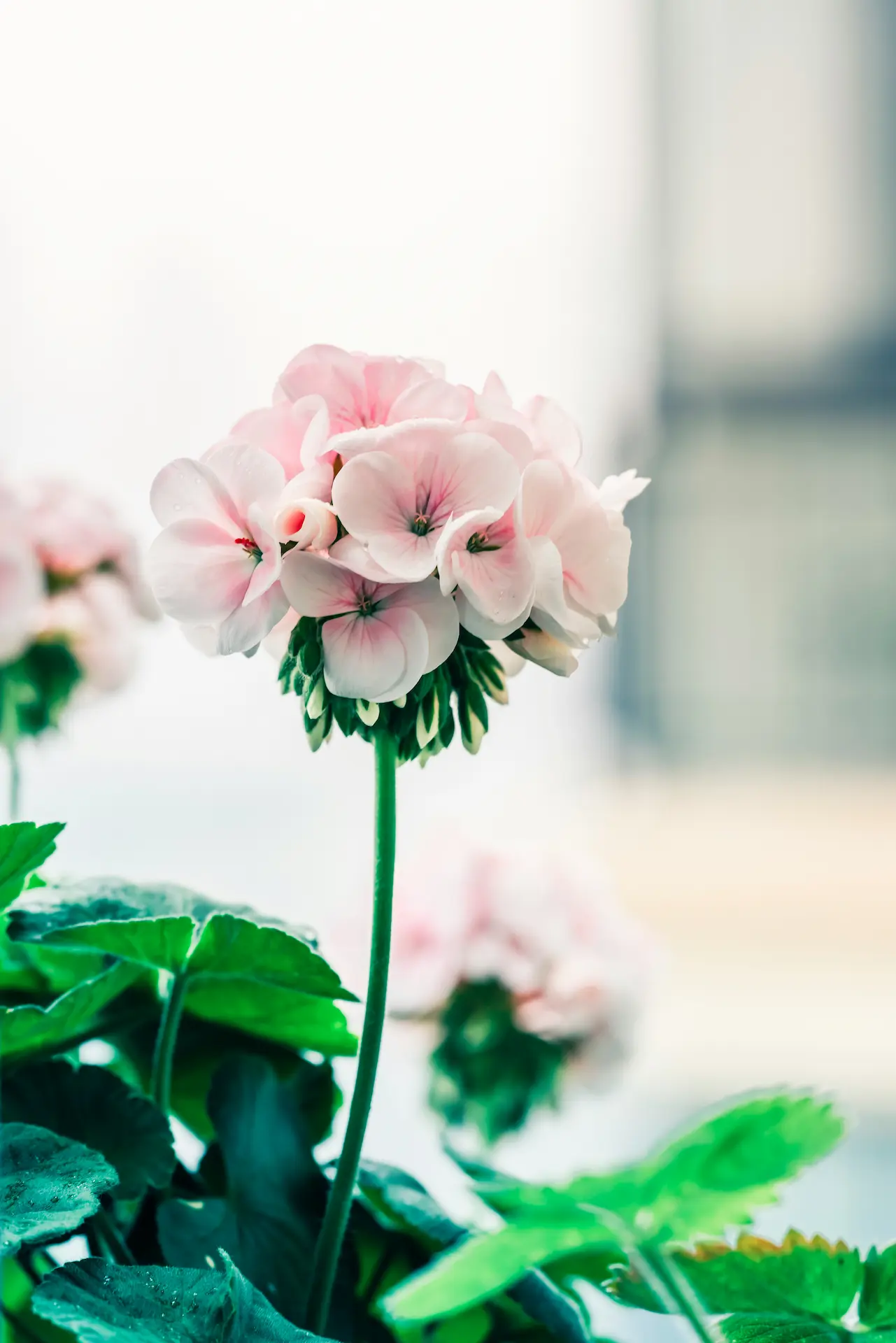
Here’s the mechanism most care guides miss: Pelargonium is a day-neutral plant. Research published in Frontiers in Plant Science classifies it as non-photoperiodic — its flowering is not triggered by day length. Average daily temperature is the primary driver instead. The optimal range for flower initiation is 68–77°F during the day and 57–61°F at night.
This explains several things that confuse indoor growers:
- Why geraniums can bloom year-round indoors when given enough light and appropriate temperatures
- Why they slow down near a hot south window in July — temperatures above 80°F suppress flowering even when light is excellent
- Why bringing them into a centrally heated room in October often produces lush growth but no flowers — most heated homes stay above 65°F day and night, without the cooler overnight dip that triggers bud initiation
For zonal and ivy-leaved types, Clemson Cooperative Extension recommends maintaining 65–70°F during the day and allowing temperatures to fall to around 55°F at night. That cooler overnight temperature mimics the seasonal conditions of Pelargonium’s native South African highland habitat and matters as much as daytime warmth.
Regal geraniums (Martha Washington types) are more demanding. The University of Minnesota Extension specifies 50–60°F nights specifically to initiate flower buds. That makes them excellent in a cool spare bedroom, enclosed sunporch, or unheated room in winter — but unreliable in a centrally heated main living area unless you can create a cool microclimate near a window.
Watering: The Dry-Cycle Principle
Geraniums tolerate dry soil far better than wet soil — this is a firm principle, not a rough guideline. Clemson Cooperative Extension recommends allowing soil to dry to a depth of 4 to 6 inches before watering, then applying water until some drains from the container bottom. The University of Minnesota’s threshold is slightly more conservative: wait until the top 1 to 2 inches are dry, then water thoroughly.
Both approaches share the same logic: Pelargonium roots need oxygen between waterings. Consistently wet soil forces roots into anaerobic conditions where cellular energy production collapses and decay begins. By the time foliage yellows, the roots are often already compromised. If you’re seeing yellowing leaves alongside persistently moist soil, our guide to geranium yellow leaves walks through all seven causes and how to distinguish them by leaf pattern and soil moisture.
Oedema: The Indoor Geranium Problem Most Growers Misdiagnose
If you notice small, raised, cork-colored blisters on the undersides of leaves — especially after a cloudy stretch in late winter or early spring — that’s oedema, not a fungal infection. It’s the most commonly misdiagnosed Pelargonium problem in indoor growing.
The Pacific Northwest Pest Management Handbooks (Oregon State University Extension) describes the mechanism precisely: oedema develops when soil temperature exceeds air temperature while soil moisture and humidity are both elevated. Roots absorb water faster than leaves can transpire it. Cells fill beyond capacity, rupture, and die — producing the characteristic corky, tan-colored lesions on the lower leaf surface. Once formed, those lesions don’t disappear, but the plant doesn’t die from them, and new healthy leaves replace affected ones as conditions improve.
Ivy-leaved geraniums and the zonal cultivar ‘Irene’ are most susceptible. Prevention focuses on managing the soil-air temperature balance:
Stop missing your zone's planting windows.
Select your US zone and month — get a complete checklist of what to plant, prune, feed, and protect right now.
→ View My Garden Calendar- Don’t water on overcast, cool days when transpiration is suppressed
- Keep soil pH at 6.0 (5.5 for ivy-leaved types) — higher pH increases susceptibility
- Remove saucers after watering; don’t let pots sit in standing water
- Maintain good airflow around plants, especially in winter when windows are closed
- Avoid placing pots directly on cold stone or concrete floors, which lower pot temperature and widen the soil-to-air temperature gap
One research finding worth noting: far-red light exposure showed promise in preventing oedema symptom expression in controlled trials cited by the PNW Handbooks. Full-spectrum LED panels that include far-red wavelengths may provide additional protection during low-light winter periods when oedema risk is highest.
Feeding: Balanced in Spring, High-Potassium at Flower
The fertilizer shift most indoor growers miss: switch from a balanced feed to a high-potassium fertilizer once flower buds form.
In spring, when plants are producing new stems and leaves, apply a balanced soluble fertilizer at half-strength every two to three weeks, as recommended by the University of Minnesota Extension. Clemson Cooperative Extension suggests semi-monthly applications from March through October as the general schedule. The RHS recommends switching to a high-potassium fertilizer — a tomato feed works well — applied fortnightly throughout the flowering period.
The mechanism behind this switch: nitrogen drives leafy stem and root growth; potassium directs energy toward flower production and strengthens cell walls. Keeping nitrogen levels high when the plant is trying to bloom produces more foliage at the expense of flowers. If your geranium looks healthy and green but isn’t flowering much, switching to a high-K feed is worth trying before reconsidering the light arrangement.
For feeding ideas using kitchen ingredients, our homemade geranium fertilizer guide covers organic alternatives that work well for container plants.
Reduce or stop fertilizing through winter or during low-light periods when the plant isn’t actively growing. Fertilizing a resting plant raises soil salt concentration without benefit — elevated salts damage root cells at their tips. Always water before fertilizing to avoid salt stress on dry roots.
Soil and Container
Drainage is the non-negotiable requirement. Clemson Cooperative Extension’s proven formula — equal parts garden loam, peat moss, and coarse sand or perlite — produces a mix that holds moisture briefly then drains fast enough to prevent root oxygen depletion. Standard commercial potting mixes work equally well if they’re not too dense or peat-heavy; avoid mixes marketed for moisture retention.
Two container rules that matter in practice:
Drainage holes are mandatory. Water pooling at the bottom of a sealed container creates the same anaerobic root zone as overwatering. If you’re using a decorative outer pot without drainage, use it as a cache pot only — with a plastic nursery pot inside — and empty the outer pot within an hour of watering.
Don’t overpot. Geraniums perform better when slightly potbound. A container significantly larger than the root ball holds excess wet soil around roots that haven’t grown into it yet, creating a persistent moisture trap. Move up one pot size — 1 to 2 inches wider in diameter — when roots appear at drainage holes or begin circling visibly when you check.
Pruning and Deadheading
Deadheading — removing spent flower stems at their base — is the simplest action that keeps geraniums flowering continuously. When a flower cluster finishes, the plant redirects energy into seed production. Removing the spent stem redirects that energy into new bud formation instead. Deadhead as soon as the last floret in a cluster fades, not just when the whole stem looks unsightly.
The RHS recommends pinching back the tips of stems in spring or early summer to encourage branching. When an apical growing tip is removed, it stops the auxin flow that suppresses lateral buds lower on the stem. Those buds activate, and each becomes a new flowering shoot. A single pinched stem can produce three to five lateral branches where only one existed — more stems means more flower points per plant.
For overwintered plants coming back into growth, both Iowa State University Extension and Illinois Extension recommend a hard prune to one-third of the plant’s original height. Cut back to firm green tissue and remove any soft, brown, or hollow stems entirely. New growth appears within two to three weeks, and the plant reaches flowering size faster than if you’d left the leggy overwintered growth in place.
Overwintering: Three Methods, Honest Assessment
The right method depends on how many plants you have, what temperatures your space provides in winter, and how much light you can offer.
| Method | Best For | Temperature Needed | Reliability | Primary Risk |
|---|---|---|---|---|
| Potted houseplant | Small numbers with sunny window | 60–65°F | High | Leggy growth if light is poor |
| Cutting propagation | Best fresh plants for spring | 65–70°F for rooting | High | Stem rot if humidity too high during rooting |
| Bare-root storage | Large numbers, limited space | 45–55°F | Lower | Desiccation; needs genuinely cool storage space |
Method 1 — Potted houseplant: Dig or pot before the first frost, cut back by one-third to one-half, and place in a bright window at 60–65°F. Water when the soil surface is dry to the touch. Plants can bloom sporadically through winter if light is adequate and temperatures drop slightly at night. Iowa State University Extension notes that geraniums do well at 60–65°F — cooler than the 68–72°F most main living areas maintain in winter.
Method 2 — Cutting propagation (recommended for most growers): Take 3 to 4-inch terminal cuttings in late summer or early fall while the parent plant is actively growing. Remove lower leaves and allow the cut end to callus for one to two hours in open air before sticking into rooting medium. Here’s the step most propagation guides get wrong for geraniums: do not cover cuttings with a plastic dome or humidity tent. Unlike most houseplant cuttings, Pelargonium roots more reliably in open, well-ventilated conditions — the high humidity under a dome encourages the stem rot this genus is particularly prone to. Use a soilless rooting mix such as perlite or a perlite-peat blend, keep it evenly moist but not saturated, and provide bright indirect light. Roots form in three to eight weeks depending on season and temperature. Cuttings taken in September often root within three to four weeks; winter cuttings under lower light take six to eight weeks.
Method 3 — Bare-root storage: Dig before hard frost, shake soil from the roots, and hang plants upside down or store in open paper bags in a cool (45–55°F), dark, well-ventilated space. Two to three times during winter, soak the roots in water for one to two hours to prevent complete desiccation. In early March, cut back to firm green tissue, pot into fresh mix, and move to a bright window. Iowa State University Extension is candid: this is the least reliable of the three methods and works best with a genuinely cold storage space. A heated basement that stays at 60°F doesn’t provide the right conditions; you need a space that holds 45–55°F reliably through winter.
Common Problems: Diagnostic Guide
| Symptom | Most Likely Cause | Fix |
|---|---|---|
| Corky brown blisters on leaf undersides | Oedema (soil waterlogged + cool air) | Stop watering on cloudy days; improve drainage; target soil pH 6.0 |
| Long bare stems, few or no flowers | Insufficient light or temperatures too high | Move to south window; add 16-hour grow light; check overnight temperature |
| Yellow older leaves, soil consistently moist | Root rot / overwatering | Allow full dry-out cycle; inspect roots; repot if brown and mushy |
| Brown crispy leaf margins | Fertilizer salt accumulation | Flush soil thoroughly with plain water; reduce fertilizer concentration |
| Grey fuzzy coating on flower clusters | Botrytis blight (cool, damp, still air) | Remove affected parts; improve airflow; reduce humidity; deadhead promptly |
| White cottony masses in leaf axils | Mealybugs | Dab with rubbing alcohol on a cotton swab; treat with insecticidal soap |
| Silvery stippling across leaf surface | Spider mites (hot, dry air) | Improve ventilation; apply insecticidal soap; avoid dry forced-air heating near plants |
| Regal type — good light but no flowers | Night temperature above 60°F | Move to a room that drops below 60°F at night in winter |
Frequently Asked Questions
Can geraniums bloom indoors year-round?
Yes — zonal Pelargoniums can flower continuously indoors if they receive six or more hours of direct light, daytime temperatures around 65–70°F, and nights that cool to around 55°F. Because Pelargonium is day-neutral (flowering isn’t triggered by day length), the right temperature range is sufficient to maintain the bloom cycle through all four seasons.
Why won’t my Martha Washington geranium flower indoors?
Regal types require cool nights — 50 to 60°F — to initiate flower buds. In a centrally heated home that stays above 65°F through the night, they produce foliage but not flowers. Try a cool bedroom, unheated sunporch, or enclosed entryway that drops into that range in winter.
Should I cover geranium cuttings with a plastic dome?
No. Unlike most houseplant cuttings, Pelargonium roots more reliably in open, well-ventilated conditions. High humidity under a dome promotes the stem rot this genus is prone to. Keep the rooting medium moist and leave the cuttings uncovered.
What’s the difference between a geranium and a Pelargonium?
True geraniums (cranesbills) are hardy perennials that die back in winter and overwinter underground. Pelargoniums are tender South African perennials — the familiar flowering plants sold as bedding and indoor “geraniums.” Our geranium vs. Pelargonium explainer covers the complete botanical and care distinction.
How often should I water indoor geraniums in winter?
Much less than in summer. In a 55–65°F room with reduced light, soil dries very slowly. Press a finger 1 to 2 inches into the soil — water only when it’s dry at that depth. In winter, this often means watering every two to three weeks, or once monthly for plants in cool dormant storage.
Key Takeaways
Indoor geranium success comes down to two mechanisms: understanding that flowering is driven by temperature (not day length), and managing watering tightly enough to prevent root rot and oedema. Get those two right and everything else follows.
If you’re deciding which type to start with, begin with a zonal geranium — they’re the most tolerant of typical indoor conditions and produce the widest range of flower colors and forms. If you have a cool room that drops below 60°F in winter, a Martha Washington geranium will reward you with dramatic spring flowers that zonal types can’t match. Scented-leaved types are the easiest of all — they need minimal care and produce fragrant foliage year-round even when flower production is low. Browse the full Pelargonium plant catalog for cultivar ideas across all four types.
Sources
- Growing Geraniums Indoors — Clemson Cooperative Extension HGIC
- Growing Geraniums as Annual Flowers in Minnesota — University of Minnesota Extension
- How to Overwinter Geraniums — Iowa State University Extension
- How to Grow Pelargoniums — RHS Growing Guide
- Flowering Mechanisms and Environmental Stimuli for Flower Transition — Frontiers in Plant Science (PMC8839403)
- Geranium (Pelargonium spp.)-Oedema — Pacific Northwest Pest Management Handbooks (OSU Extension)
- How to Overwinter Geraniums for Next Year’s Garden — Illinois Extension
- Geranium Diseases — Penn State Extension


