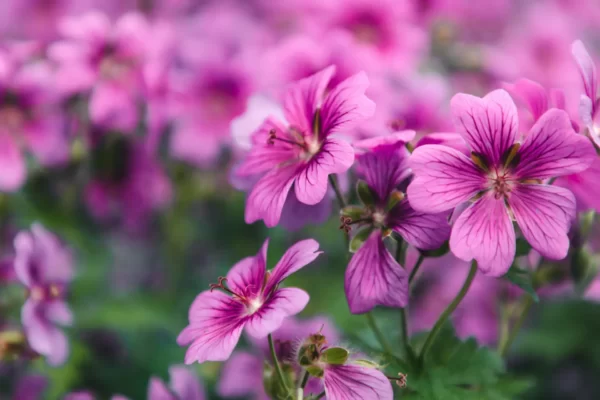
Zone 8 Geraniums: Plant in March, Pick Ivy-Leaf for Summer Heat, Keep Blooming to November

Zone 8 geraniums bloom March to November if you pick heat-tolerant varieties and know the summer cutback trick that triggers fall rebloom.
Zone 8 is one of the best climates in the country for geraniums — but only if you understand what the calendar actually looks like. You get a long spring bloom from March through June, a summer challenge when heat tops 85°F, and then a fall comeback window in September and October that most gardeners never see because they pulled their plants in August. Get the variety selection and summer management right and your geraniums will carry color for eight months straight.
This guide covers the exact planting calendar for Zone 8a and 8b, which variety types perform in southeastern heat versus Pacific Northwest conditions, and the one mid-summer technique that separates gardeners who get October color from those who don’t. If you want the full care profile for the plant itself, the Geranium and Pelargonium growing guide covers the basics in detail.
Zone 8 Geranium Planting Calendar
Zone 8 splits into two sub-zones with slightly different frost dates. Zone 8b (coastal Southeast, Pacific Northwest lowlands) warms up about a week earlier than 8a. Both allow outdoor planting in March — which is earlier than most geranium guides suggest, since most are written for northern gardeners.
| Task | Zone 8a | Zone 8b |
|---|---|---|
| Start seeds indoors | December 26 | December 18 |
| Last average frost | March 20 | March 12 |
| Transplant outdoors | Late March | Mid-March |
| Peak spring bloom | April – June | April – June |
| Summer heat management | July – mid-August | July – mid-August (SE only) |
| Fall bloom window | September – October | September – October (SE) / continuous (PNW) |
| Bring indoors / take cuttings | Before first frost, November | Before first frost, November – December |
The December seed-start date surprises most Zone 8 gardeners. Because Zone 8’s last frost is mid-to-late March, and seeds need 12 to 16 weeks to reach transplant size, you start indoors in late December. Buy transplants if you miss the window — established 3- to 4-inch plants from a nursery in early March are a perfectly sound approach and what most Zone 8 gardeners use.

Three pre-planned garden beds, free
Stop staring at empty beds: printable plans with exact layouts, plant lists and planting calendars — yours free from the Garden Library.

Choosing Varieties for Zone 8
Not all geraniums handle Zone 8 summers equally. The biggest mistake Zone 8 gardeners make is planting Regal (Martha Washington) types, which need cool nights to set buds and simply stop blooming once temperatures climb past 70°F. Stick with zonal or ivy-leaf types for outdoor performance.
| Type | Zone 8 Performance | Summer Heat Tolerance | Best Use | Named Cultivars |
|---|---|---|---|---|
| Zonal (heat-tolerant series) | Best overall | Good with afternoon shade above 85°F | Beds, containers, borders | Maverick, Americana, Patriot |
| Ivy-Leaf | Excellent in coastal Zone 8; good in SE with afternoon shade | Moderate — needs shade after 2 p.m. in extreme heat | Hanging baskets, cascading containers | Summer Showers, Balcon |
| Scented-Leaf | Good; some die back in cold snaps and resprout in spring | Good | Herb gardens, containers | Rose, Lemon, Peppermint types |
| Regal / Martha Washington | Poor outdoors in Zone 8 | Very low | NOT recommended for Zone 8 outdoor planting | — |
For the hottest parts of Zone 8 — central Texas, the Deep South — Texas A&M AgriLife Extension specifically recommends treating standard geraniums as a cool-season annual unless you plant heat-tolerant cultivars. The Bexar County extension names ‘Strawberry Sizzle’ and ‘Violet’ as the two varieties that can handle San Antonio’s full-sun summer conditions [3]. In the Pacific Northwest Zone 8 — Seattle, Portland, coastal Oregon — temperatures rarely crack 90°F, so standard zonals like ‘Maverick’ and ‘Cameo’ bloom continuously without any shade management.
Ivy-leaf geraniums deserve special mention for hanging baskets in Zone 8. Their trailing habit means better air circulation than dense bed plantings, and their waxy leaves lose less moisture in heat. ‘Balcon’ and the ‘Summer Showers’ series are the workhorses here. The catch: when afternoon temperatures hit 90°F or above, even ivy-leaf types slow down. Morning sun with shade from 2 p.m. onward keeps them productive.
For companion planting ideas that pair well with geraniums in Zone 8 beds, see the guide to geranium companion plants.
Soil, Spacing, and Planting
Geraniums are not demanding about soil chemistry, but they are unforgiving about drainage. In Zone 8 where spring rains can be heavy and summers bring either drought or intense humidity, a well-draining bed prevents the root rot that kills more Zone 8 geraniums than frost does.
Target soil pH 6.5 — mildly acidic. University of Georgia Extension recommends testing your soil before planting; if pH falls below 5.5, work in 2½ pounds of lime per 100 square feet [2]. Incorporate 3 to 4 inches of organic matter (compost or aged bark) before planting to improve drainage in clay-heavy southeastern soils. Pre-plant fertilizer: 2 to 3 pounds of 5-10-15 or 6-12-12 per 100 square feet worked into the top 6 inches.
Space plants 12 to 18 inches apart in beds, 18 to 24 inches for larger zonal types. Crowded plants in Zone 8 humidity invite botrytis — the gray mold fungus that thrives in poor airflow. Plant at the same depth as the nursery container. Water in thoroughly, then allow the top inch to dry before watering again.
Watering and Fertilizing Through the Season
Geraniums want consistent moisture but not wet feet. The finger-test is the most reliable guide: if the top inch of soil is dry, water deeply. If not, wait. In Zone 8 summers, that cycle might be every 2 to 3 days in beds and daily for containers in full sun.
When you water, water thoroughly — UGA Extension recommends wetting soil to a depth of 10 to 12 inches to encourage deep root growth rather than shallow surface roots that stress easily in heat [2]. Water in the morning so foliage dries before nightfall; wet leaves overnight in Zone 8’s humid summers create ideal conditions for bacterial leaf spot.
Fertilize with a balanced granular fertilizer such as 10-10-10 every 4 to 6 weeks through the growing season. For containers, a water-soluble formula at half strength every 3 to 4 weeks keeps plants from depleting the limited soil volume. Avoid high-nitrogen feeds: they push lush foliage at the expense of bloom, which is the reverse of what you want. For a homemade fertilizer approach using kitchen materials, see the geranium homemade fertilizer guide.
Managing Zone 8 Summers: The Heat Challenge
Here is the piece that most Zone 8 gardeners don’t know: geraniums are native to the cool, dry highlands of South Africa, where summer temperatures rarely exceed 75°F. Their photosynthesis and bud-formation pathways slow significantly above 85°F and effectively pause above 90°F. This is not disease, not a nutrient deficiency, and not a watering problem — it is a temperature-triggered physiological response. Understanding that mechanism changes how you manage July and August.
The difference between the Pacific Northwest and the Southeast matters here. In Seattle or coastal Oregon, Zone 8 summers stay mild — geraniums bloom continuously without any intervention. In Georgia, South Carolina, or inland Texas, a Zone 8 July can mean three weeks of daytime highs above 90°F. University of Georgia Extension notes that south Georgia geraniums produce their best blooms in spring, early summer, and late fall — not mid-summer [2]. That late-fall bloom is not an accident. It is the plant doing what its native climate programmed it to do: go quiet in extreme heat, then respond to the cooler temperatures of September.
The summer cutback strategy: In late July — when nights stay above 70°F and days consistently top 90°F — cut plants back by one-third to one-half. Remove all spent flower stalks. Reduce watering to once every 4 to 5 days for beds. Apply a 1- to 2-inch layer of mulch around plants to keep the root zone 10 to 15°F cooler than the air above it. This semi-dormancy period protects the root system, prevents the crown rot that kills stressed plants, and sets the plant up for vigorous fall regrowth. I’ve seen Zone 8 geraniums that looked finished by early August pushing 40 to 50 fresh buds by mid-September after this treatment — the plant is not dying; it is waiting.
Afternoon shade in July and August — even two to three hours of shade after 2 p.m. — can keep plants actively blooming through the worst of summer without a full cutback. A north-facing fence, a nearby shrub, or a shade cloth at 30% density all work. Clemson Cooperative Extension specifically recommends afternoon shade for ivy-leaf types when temperatures exceed 85°F [1].
Stop missing your zone's planting windows.
Select your US zone and month — get a complete checklist of what to plant, prune, feed, and protect right now.
→ View My Garden CalendarFall Rebloom: Zone 8’s Best Kept Secret
September in Zone 8 is when the work pays off. As nighttime temperatures drop back into the 60s and daytime highs fall below 85°F, geraniums push a flush of new buds that often outperforms the spring display. Plants that went through the summer cutback have had 6 to 8 weeks to build root reserves and are ready to push hard when conditions improve.
UGA Extension documents this regional pattern directly: in coastal Georgia, geraniums can bloom continuously until January when given frost protection [2]. That endpoint may be optimistic for most Zone 8 gardeners, but a solid run from mid-September through mid-November is realistic in most of the zone. In Zone 8b Pacific Northwest gardens, where the fall stays mild and dry, geraniums often outperform their spring performance in October.
Do not cut back again in September. Let the plant run. Deadhead spent blooms every 3 to 5 days to keep bud production moving. Resume normal watering and fertilizing as soon as night temperatures reliably drop below 70°F.
Overwintering Geraniums in Zone 8
Zone 8 minimum temperatures — 10°F to 20°F — kill Pelargoniums. Unlike some plants rated borderline for a zone, geraniums do not survive Zone 8 winters in the ground. Plan to bring them in or take cuttings before the first forecast frost, typically in November for most of Zone 8. Three methods work reliably:
Cuttings (easiest, lowest space requirement): In early October, take 3- to 4-inch stem cuttings with at least three nodes. Remove lower leaves, dip in rooting hormone, and insert into a well-draining potting mix. Roots develop in 3 to 4 weeks. Keep on a sunny windowsill at 55 to 65°F. These become next year’s plants. See the detailed step-by-step process in the geranium propagation from cuttings guide.
Pot and bring indoors: Before first frost, dig bed plants, pot into containers, and cut back by one-half. Place in a sunny south- or west-facing window. Water minimally — just enough to prevent complete drying. They’ll survive until March looking scraggly, then flush when moved back outside.
Bareroot dormant storage: Dig plants, shake off all soil, and hang upside down in a cool, dry location (45°F to 55°F) — a basement or attached garage works well. Soak the roots briefly every 3 to 4 weeks to prevent desiccation. Cut back by two-thirds before replanting in spring.
Common Problems and Fixes
| Symptom | Likely Cause | Fix |
|---|---|---|
| Yellow lower leaves with corky spots | Edema from overwatering | Allow soil to dry to 1-inch depth before watering; improve drainage |
| No blooms in July or August | Heat stress above 85–90°F | Add afternoon shade; apply cutback strategy; wait for September rebloom |
| Gray fuzzy coating on stems and flowers | Botrytis blight (cool, humid, poor airflow) | Remove affected material immediately; increase plant spacing; water only in morning |
| Leggy growth, pale leaves, sparse blooms | Insufficient direct sunlight | Move to a spot with 6+ hours of direct sun; morning sun is ideal |
| Wilting despite moist soil; black stem base | Root rot (Pythium or Rhizoctonia) | Remove plant; discard infected soil; treat area with fungicide; do not replant geraniums in same spot |
| Tiny white insects flying when plants are disturbed | Whiteflies | Apply insecticidal soap or pyrethrin spray; repeat every 7 to 10 days for 3 to 4 treatments |
For a full breakdown of why geranium leaves turn yellow — including the 7 specific patterns and what each indicates — see the geranium yellow leaves diagnostic guide.
Frequently Asked Questions
Can I leave geraniums in the ground over winter in Zone 8? No. Zone 8 minimum temperatures (10–20°F) will kill them. Dig and bring indoors, take cuttings, or use bareroot storage before the first hard frost in November.
Why did my geraniums stop blooming in July? Temperature. Pelargoniums evolved in cool South African highlands and their bloom cycle pauses above 85–90°F. This is normal. Give them afternoon shade, apply the mid-summer cutback, and expect flowers to resume in September when nights cool down.
Are geraniums deer resistant in Zone 8? Generally yes. The strong scent of geranium foliage deters most deer, which makes them a reliable choice for exposed beds in the Southeast and Pacific Northwest.
How long do Zone 8 geraniums bloom? With the right management — March transplant, summer shade or cutback, fall resume — you can expect color from late March through November, roughly eight months.
Sources
- Annual Geranium (Pelargonium) — Clemson Cooperative Extension, Home & Garden Information Center [1]
- Geraniums — University of Georgia Extension (CAES Field Report) [2]
- Geraniums — How to Grow & Propagate — Texas A&M AgriLife Extension, Bexar County [3]
- Geranium Planting Calendar by USDA Zone — GardeningByZone.com [4]
- Geranium Zone Planting Guide — Bonnie Plants [5]
- Geraniums — University of Florida IFAS Extension, Gardening Solutions [6]
- Pelargonium — NC State Extension Plant Toolbox [7]