

A Handbook for Successful Container Gardening For Beginners! Pot Up Your Plants

Hi there prospective master of container gardening! The idea of building your own personal oasis—no matter how small or large your area is—is simply so fascinating. You have come to the ideal location if you are fresh to the amazing world of growing plants in pots. What then does a novice’s guide to container garden success really mean? It’s all about knowing a few basic but totally vital rules: things like choosing the proper pots and the perfect soil, picking plants that will be happy campers in containers, and providing them the careful loving care they need to really grow in their cozy new homes. And now, guess what? Actually, it’s more satisfying and simpler than you would believe!
Container gardening is like opening a secret level of delight in gardening. Practically wherever—on a sunny balcony, a shaded patio, a brilliant windowsill, or even just by your front door—you can produce vivid flowers, delicious herbs, and even fresh vegetables practically anywhere. This article will lead you through all you need to know to pot your plants and see them flourish, whether your yard is little urban balcony begging for some green or large and just waiting for some potted accents. Let us get those hands filthy—in the greatest conceivable manner!
The Pleasure of Potted Paradise: Why Container Gardening Is Right for You
Let’s first consider why container gardening is so very popular and why it could be the ideal fit for you before we dig into the “how-to.” It’s more than simply plants in pots; it’s an entire gardening philosophy with some amazing advantages!
- Grow Plants Anywhere, Not Less essential! Containers have a certain kind of magic. Sunny stoop? Balances on the shaded apartment balcony? Brilliant kitchen window? Indeed, indeed, and indeed! Garden beds don’t restrict you.
- You become the master of your soil by means of total soil control. This means even if your garden soil isn’t optimal, you can supply the right growing environment for particular plants.
- Your superpower is mobility; want to follow the sun? Guard sensitive plants against an unexpected frost? Re-decorate your patio on a whim? One can transfer pots of plants.
- Fewer Weed Worries: Unlike a conventional garden bed, a rogue weed could show up but you will be handling considerably less unwelcome visitors.
- Gardening for Everyone: People of all ages and physical ability can enjoy gardening from easily reachable heights in containers.
Like any adventure, container gardening has certain special considerations to bear in mind. Pots, for example, dry out faster than garden beds; the roots have limited area to flourish; and nutrients wash away more quickly. But worry your green fingers about that? These are all obstacles that, with the correct knowledge, are readily controlled; thus, exactly what we are here to provide you.

Three pre-planned garden beds, free
Stop staring at empty beds: printable plans with exact layouts, plant lists and planting calendars — yours free from the Garden Library.
Essential Items You’ll Need for Your Container Gardening Starter Kit
Okay, ready to compile your tools? Consider this as your treasure map for a vibrant potted garden. Having these fundamentals on hand will help your container gardening adventure go from day one flawless and fun.
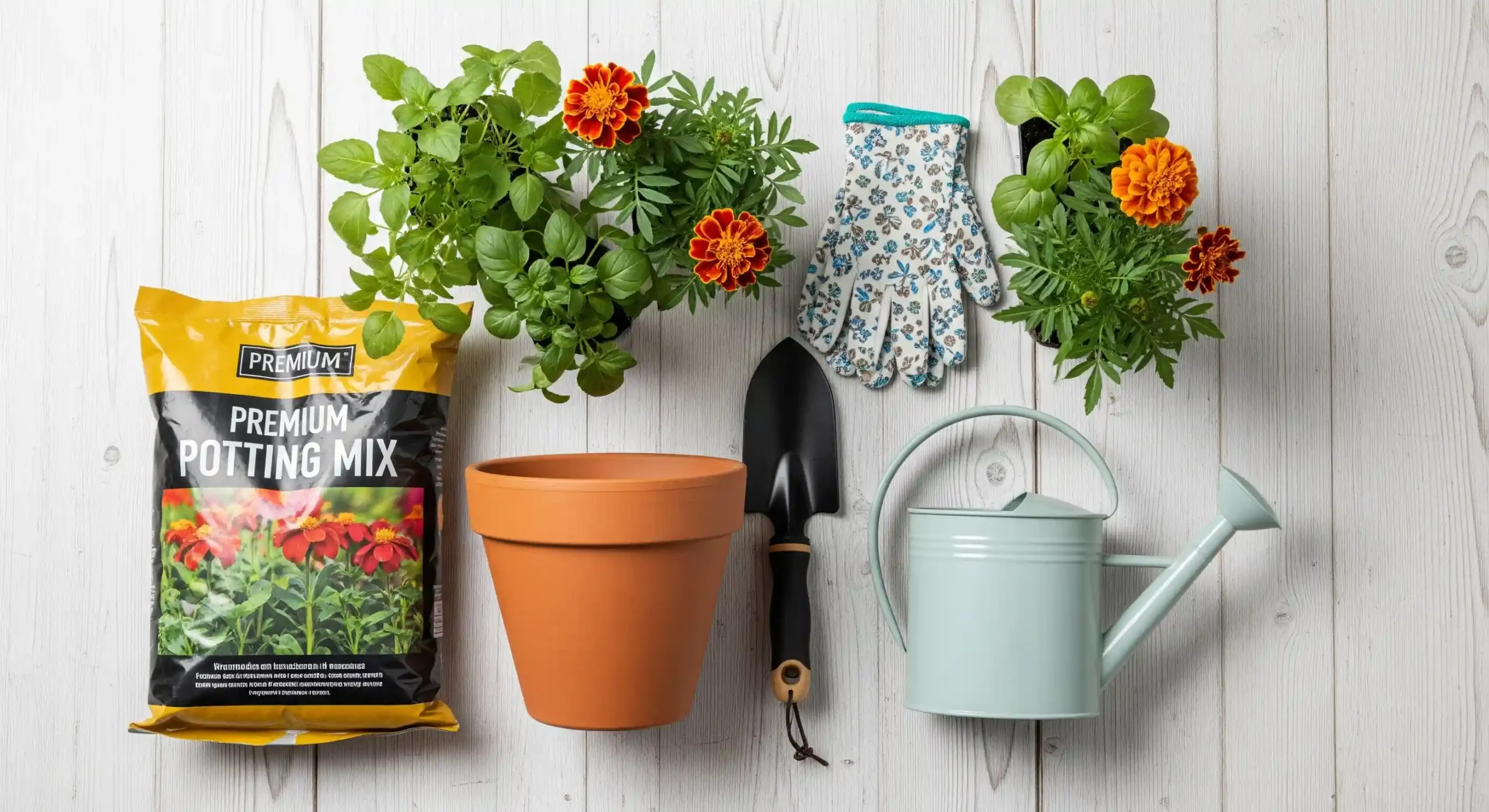
- You will need something to grow in, containers—pots, naturally! We will discuss choosing the ideal pots in a little more detail shortly.
- Potting Mix: This is not any ordinary soil. Super Important! You would want a decent quality potting mix designed especially for pots. (Spoiler: pots shouldn’t use garden soil.)
- Your plants will get thirsty and you will need a gentle nozzled watering can or hose to provide them with a decent drink without blasting them.
- Little holes and settling your plants into their new homes call for a small hand trowel.
- If you want to keep your hands clean and free from a sporadic thorn or splinter, a pair of gloves is a terrific idea even though they are optional.
- Fertilizer: Container plants will require a sporadic little nutritional boost. We will go over the ideal forms for novices.
- Your Selective Plants the show’s stars!
Having these ready will help the entire procedure seem to go effortlessly.
Selecting Your Ideal Pots: An Exploration into Containers
The pot you decide upon is your plant’s home, not just a beautiful container! Choosing the correct path here will help you greatly toward success.
Size Count: Choosing the Correct Pot Dimensions for Contented Plants
Plants, like people, require ample space to comfortably spread their roots.
The pot should preferably fit the mature root system of the plant. Should a pot be too tiny, your plant may rapidly become “root-bound,” with its roots filling the whole pot and beginning to circle, therefore impeding development and perhaps hastening drying out.
If a container is much too big for a small plant, the extra soil may remain wet for too long and cause root rot since the smaller plant cannot quickly sufficiently absorb all much moisture.
For tiny plants, a good general rule is to choose a pot roughly 1-2 inches larger in diameter than its current nursery pot; for larger plants, possibly 2-4 inches larger. This allows the roots fresh area to explore without overwhelming them.
A little detail here: Restricted roots in a small pot not only affect their physical area but also the plant’s capacity to effectively absorb nutrients and water, so stressing and unsatisfying the plant.
Material World: Advantages and disadvantages of several pot types
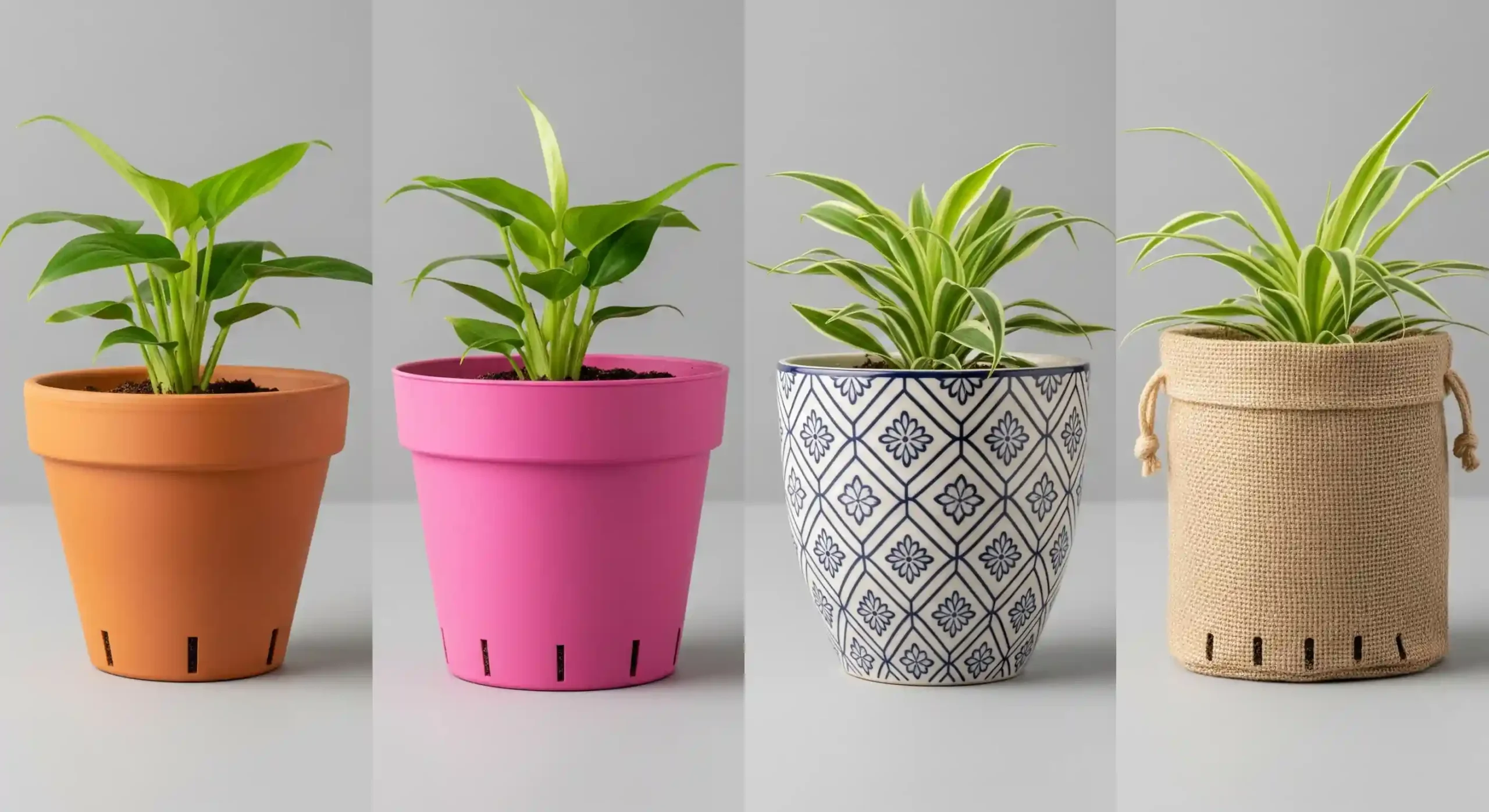
Pots come in an amazing range of materials, and each has own personality and set of advantages and drawbacks. Let’s separate them:
- Terracotta—also known as clay:
- Pros: The original pots’ porous nature lets air and moisture pass through their sides. Good for root health, this “breathing” also helps stop overwatering. They also appear really beautiful and timeless.
- Cons: They dry up far faster than other materials because they are porous, hence you will have to water more often. Particularly when full, they can be weighty and prone to splitting in cold climates.
- Regarding plastic:
- The pros are light weight, usually low cost, and a great range of colors and designs. Additionally excellent in moisture retention are plastic pots, which will help to reduce regular watering.
- Cons: Unlike terracotta, they are less permeable, hence excellent drainage is absolutely vital. Particularly under direct sunlight, less expensive plastic pots can also become brittle and break with time.
- Glazed ceramics:
- Pros: Usually exquisitely decorative, these give your room actual style statement. Their retention of moisture is improved by the glaze than by unglazed terracotta.
- Cons: They are frequently more expensive and can be somewhat weighty. Make sure they have a drainage hole; occasionally attractive pots lack this!
- Grow Bags Made of Fabric
- Pros: For good reason, these are starting to becoming really popular. They have great aeration and drainage; the fabric material helps “air prune” roots, therefore preventing their circling and eventual root-boundness.
- Cons: Usually needing daily watering in warmer weather, they dry up really rapidly. Though their utilitarian style is becoming more and more popular, they might not be everyone’s first option for ornamental appeal!
- Forest:
- One advantage of wooden planters is their strong insulating quality for roots, therefore shielding them from fast temperature swings. They also look quite naturally beautiful.
- One drawback of untreated wood is eventually rotting. Look for naturally rot-resistant timbers like cedar or redwood, or think about coating wooden planters with plastic (with drainage holes, naturally!).
- For metal:
- Benefits include sleek, modern appearance and great durability from metal containers.
- Cons: Metal can get rather hot in bright sunlight, possibly scorching the roots of your plant. Double-walled models are ideal or metal pots should be used in shadier areas. Given they are non-porous, good drainage is also crucial.
Drainage Is Not Negotiable; The Key to Contented Roots
This is the one golden rule in container gardening: your pots HAVE to have drainage holes! I cannot stress this more.
Why is it thus so important? Just as much as they need water, plant roots must subsist on oxygen. Should a pot lack holes allowing extra water to escape, the soil gets wet. This moist environment causes all the air pockets to collapse, therefore drowning the roots and producing a sad, usually fatal condition known as root rot. Good drainage stops this and lets fresh oxygen reach the roots.
What if the decorative pot you love doesn’t have holes? Do not lose hope! Your choices are few but somewhat unique. It’s like a “cachepot: just put your plant in a somewhat smaller plastic nursery pot (that does have drainage holes) then slide that inside the ornamental pot. Watering lets you remove the inner pot, let it drain entirely, and then plop it back. Alternatively, if you’re handy and the material allows (like some plastics or ceramics), you might be able to carefully drill drainage holes yourself.
Let’s dispel a widespread fallacy. Adding gravel, pot shards (crocks), or pebbles to the bottom of a pot helps drainage, as you may have heard. Regretfully, this is an old gardening story that is actually unhelpful. By producing a “perched water table,” this technique actually reduces drainage by essentially preventing the water from readily moving from the finer potting mix into the coarser gravel layer, therefore keeping the roots weter for longer. Now you know the science behind why you should avoid the gravel; this is a quite common beginning error! You just need clear drainage holes and decent potting mix.
The Groundwork of Success: All About Potting Mix
Once you have your ideal pot, consider what should go inside it. Your container gardening success depends totally on the correct growing media.
Stop buying the wrong pot size.
Enter plant type and growth goal — get exact pot diameter, depth, and volume before you spend a cent.
→ Find the Right PotWhy Garden Soil is a No-Go for Pots (a Typical Beginning Blunder!)
This is a major one, folks, and a mistake most first-time container gardeners make. Your pots should not include straight soil from your yard or garden. Though garden soil behaves somewhat differently in the little area of a container, I realize it appears like “dirt is dirt.”
The enemy is compaction; garden soil compacts rather readily in a pot. This compresses those essential air spaces, which makes root breathing and growth difficult. Imagine attempting to run a marathon in shoes two sizes too small – that’s what it’s like with roots in compacted garden soil!
Compacted garden soil likewise drains somewhat badly in pots. When damp, it can produce a thick, muddy sludge that directly causes root rot.
Garden soil can also be home to many weed seeds, plant diseases, and pests—all of which you most certainly want not to bring into your pure potted environment. One of the nicest things you could do for your container plants is definitely buy a premium potting mix.
Deciphering Potting Mix: Essential Components and Their Uses
Thus, what makes “potting mix”—sometimes known as “potting earth—so unique? Usually devoid of actual soil, Designed to offer the ideal mix of moisture retention, aeration, and light structure for container-grown roots, this well crafted combination of elements. Let’s review some typical elements:
- Usually the primary body of the mix is either peat moss or coconut coir.
- One classic component that excels in maintaining nutrients and moisture is peat moss.
- Made from coconut husks, coconut coir is a renewable substitute with superb fluffy structure and excellent moisture retention.
- Perlite or Vermiculite: Look at the tiny white particles in your potting mix. Usually, that is perlite.
- Lightweight volcanic rock known as Perlite resembles small styrofoam fragments. It’s great for drainage and aeration—that is, for building air pockets.
- Another lightweight mineral that promotes aeration and can hold some moisture and nutrients is vermiculite.
- Excellent organic components found in many potting mixes are compost or worm castings. They enhance the general soil structure and gradually contribute important nutrients.
- You might also discover things like finely shredded bark fines (for structure), wetting chemicals (to assist the mix absorb water if it gets very dry), or a starting charge of fertilizer to give your plants an initial boost.
For beginners, what is better—store-bought or do-it-yourself potting mix?
While some expert gardeners like making their own custom potting mixes, for beginners I absolutely advise beginning with a premium, store-bought potting mix.
These mixes are easy pre-blended to give most container plants a balanced habitat.
It removes the guesswork involved in correctly balancing several substances.
Look for credible brands; don’t hesitate to invest a little more for a good quality mix; your plants will thank you!
Choosing Your Players: Top Plants for Novices in Container Gardening
Now comes the really exciting part— selecting your plants! Although many plants can be grown in containers, some are clearly more tolerant and appropriate for novices.
Think little and mighty: give Compact and Dwarf Varieties top priority.
Look for plants that are naturally adapted for the somewhat more limited existence in a pot whether you are perusing the nursery or seed packages.
Many species have been especially developed for container culture. Search for descriptive words on plant tags or in seed catalogs such as “dwarf,” “compact,” “patio,” “bush,” or ” Container variety.” Usually bred to stay smaller, be more prolific in limited area, or have a tidy growth pattern ideal for pots, these types are found in seed catalogs.
Top Plant Choices for Pots (Grouped for Simple Selection):
Perfect for starting your container garden are these amazing, reasonably easy-to-grow choices:
- Simple Herbs ( Oh, the taste!):
- Basil: Enjoys the sun; fresh basil transforms a kitchen.
- Mint: Super simple, but be advised it’s an aggressive spreader! Mint should have its own pot to help to keep it under control.
- Chives: Beautiful purple blooms and delicate oniony taste.
- A culinary classic, parsley can be curly or flat-leaf.
- Hardy, sun-loving Mediterranean herbs are oregano and thyme.
- Bright flowering annuals ( instantaneous cheer!):
- Petunias: Rainbow of colors cascading in bloom form.
- Marigolds are cheerful, highly forgiving, and quite bug-deterring.
- Perfect for adding color to shaded areas (search for disease-resistant kinds). Impatiens
- Classic, sun-loving, and drought-tolerant once established geraniums (Pelargoniums).
- Zinnias draw butterflies; they are brilliant, strong.
- Simple Leafy Greens (So delicious!).
- Lettuce—especially loose-leaf varieties—keeps producing and you can pick outer leaves.
- A favorite for cool-weather is spinach.
- Kale and Swiss chard are hardy and plentiful even in lower temperatures.
- Startner-Friendly Small Vegetables (Yes, you can!):
- Compact, low-maintenance plants like bush beans require little support.
- Look for “patio” or “determinate” types like “Tiny Tim” or “Bush Early Girl.” Dwarf tomatoes
- Many of the smaller sweet and hot pepper species shine in pots.
- Radishes: Extremely fast growers!
- Choose round or shorter varieties of carrots, such as “Paris Market” or “Little Finger.”
For floral beauty, “Low-Maintenance Flowers for New Gardeners” can provide extra inspiration; if you’re focused on growing edibles, you might discover helpful starting points in publications like “Easiest Vegetables for Beginner Gardeners.“

Taking Care of Your Potted Beauties: Key Container Maintenance Advice
Now it’s time to keep your plants happy; you have your pots, mix, and tools! There are several special subtleties in container care.
Watering Wisdom: Thirsty Pots: How Often and How Much?
Though it’s common for novices, this is not always the toughest aspect; it’s not necessary either.
Key Idea to Remember: Generally speaking, plants living in containers dry out far faster than those growing in the ground. This is so because the pots are exposed to air and sun on all sides, which causes faster evaporation; the small soil volume contains less water.
The most accurate way to find out whether your plant needs water is the traditional finger test. About one inch or two down into the potting mix, stick a finger. It is probably time to water if it seems dry at that depth. Hold off briefly if it still feels damp.
How should one properly water? One should do so completely. This implies watering until water freely leaks out of the drainage holes at the pot’s bottom. This guarantees that, not only the top layer but also the whole root ball becomes wet.
Forget Fixed Schedules: The type and size of the plant, the pot size and material (terracotta dries faster than plastic), the weather (hot, windy days imply more watering), and how root-bound it might be will all substantially affect how often you will need to water. No miraculous “water every X days” calendar exists. You have to routinely examine your plants.
Consistent moisture is especially more important since that smaller root area we discussed also implies less soil volume to buffer against drying out.
Feeding Your Friends: Why Fertilizing Container Plants Matters
Consider fertilizer to be your potted plants’ nutrition.
The fundamental principle to keep in mind is nutrients leaving pots with every watering. Some of the soluble nutrients in the potting mix are washing away too every time you water completely and see it drain out. Container plants therefore depend on you to provide fresh food.
Fertilizer Types Fit for Novices:
- For beginners, liquid fertilizer is usually a fantastic option. As directed on the product label, you dilute a concentrated liquid fertilizer in water and apply it when you water! It supplies easily available nutrients for the plants. During the busy growing season, which runs spring and summer, you might do this every two to four weeks.
- Often granular, slow-release fertilizers, they can be mixed into your potting mix upon planting or sprinkled over top of the soil. Each time you water, they are meant to release nutrients gradually over several weeks or perhaps months. This is a quite handy “set it and forget it” (nearly!) choice.
Always follow label directions; this is absolutely vital. Just as much as too little fertilizer can be detrimental, too much can “burn” the roots of your plant. Your finest manual is the directions on the fertilizer package.
Let There Be Light: Matching Plants to Your Sunlight Situation
Plants have preferences for sun level, same as humans do!
Spend some time noting the areas you intend to put your containers. Throughout the day, these places get how much direct sunlight? Is it full sun (6+ hours of direct sun), part sun/part shade (around 4-6 hours, perhaps with some afternoon shade), or largely shade (less than 4 hours of direct sun, or dappled light)?
Select plants whose needs for light fit your situation. Nearly invariably, plant tags and seed packets will reveal the type of light a plant likes. Usually, trying to grow a sun-loving tomato in deep shade or a shade-loving hosta in sweltering afternoon sun is a formula for disappointment.
The Benefits of Mobility: Moving Pots for Best Growth (and Fun!)
One amazing advantage of container gardening is that your garden is not fixed!
Move your pots without thinking twice. Does a plant receive perhaps too strong afternoon sun? Put it somewhere with some afternoon shade. Are your spring annuals through yet? Move them from the best location and add your summer bloomers.
If a late spring frost is expected, this mobility also lets you shield delicate plants indoors or under cover from unanticipated weather. Besides, rearranging your potted beauties can give your room a new look and be just simple fun!
Guidelines such as “Watering Established Garden Plants” may provide some broad watering ideas that also apply to knowledge of plant needs, even in pots.
Typical Container Gardening Mistakes (and How to Steer Clear!)
It’s quite normal for us all to make mistakes while learning something new! Knowing some of the typical mistakes, though, will help you prevent them and ensure that your potted plants remain healthy. Let’s examine a handful and, more crucially, how to avoid or correct them.
First mistake is either overwatering or underwatering.
Belief it or not, the symptoms can seem really similar! Yellowing leaves, drooping, and general discontent. While underwatering results in the plant deprived of the moisture it requires, overwatering causes root rot—that is, roots cannot breathe.
The answer is to rely on the reliable finger test to verify soil moisture before watering and to abandon any strict watering plan. Make sure your pots drain very well.
Second mistake: using garden soil.
Pot soil seems deep, muddy, or peels away from the sides when dry. Plants can struggle, seem stunted, or develop root rot.
Use an excellent quality potting mix especially designed for containers constantly, always, always. It is well worth every dollar.
Third mistake is selecting too small pots.
Symptoms: Your plant seems to dry up really quickly even with regular watering. You can find roots looping on the ground surface or popping out of the drainage holes. The plant’s development can stop or slow down.
Solution: As your plants flourish, don’t hesitate to pot them into a somewhat larger container. Most plants will value the additional space given their roots.
The fourth mistake is forgetting about drainage—or blocking it!
Symptoms include a moist soil long after it has been watered; plants seem languid; leaves may yellow and droop. Root decay follows this fast track.
Make sure every pot features drainage holes. And keep in mind—no gravel at the bottom—this actually worsens drainage!
Neglecting to fertilize is mistake five.
Plants may display slowed development, have pale or yellowish leaves (particularly older ones), or yield less fruits or seeds than expected.
Remind yourself that nutrients wash out of pots. During their growing season, follow a consistent feeding plan including a fertilizer suitable for your plants.
The sixth mistake is incorrect plant or light.
Sun-loving plants in too much shade may grow leggy—stretched out—and produce few blooms. In too much direct sunlight, shade-loving plants may scorish, brown, or crispy leaves.
The solution is to closely monitor your light conditions and select plants fit for them. Read those plant tags!
Let not this list frighten you! Consider it as insider knowledge to enable your success. Every gardener picks skills by experience.
Q&A on Container Gardening: Your Mostly Asked Questions Answered
Many times, people just starting out with containers have some really interesting questions. Let’s address some typical ones right now!
Starting container gardening today, what exactly do I definitely need?
The bare-bones needs are a pot with good drainage holes, some quality potting mix, the plant itself, and a method of watering if you’re really keen to start with just one plant. As you proceed, you can add further tools.
For a total novice in containers, which are the really easiest plants?
Things like marigolds are joyful and strong; you cannot go wrong with them. Quick to cultivate and quite satisfying is leafy lettuce. For herbs, mint is quite simple (just put it in its own container, as it likes to wander!).
I should really water my container plants how often? Surely there is no magic number?
You are completely correct; magic numbers do not exist. All of it boils down to soil moisture analysis. About one inch or two, stick your finger. If it seems dry, water. If it’s damp, wait. Checking is always advisable since factors such container size, material, weather, and plant type all affect.
Could I just put dirt from my backyard into my pots? Tell me once more, please, the reasons not!
Please resist; I know it’s tempting. Potted garden soil becomes quite compact, which results in poor drainage and inadequate air for the roots of your plant, thereby producing unhappy, usually unhealthy, plants. Specifically made to be light and airy for container living is potting mix.
For beginners, what sort of pots are usually best or most forgiving?
Plastic or glazed ceramic pots can be a little more forgiving for novices since they often hold moisture a little better than unglazed terracotta, which can dry out rather rapidly. Just make sure whatever you decide has those vital drainage holes!
Fertilizing makes me uneasy! How can I avoid damaging my plants?
Don’t panic! The secret is to pay great attention to the directions on the fertilizer label. Start with a balanced liquid fertilizer, dilute it as advised (maybe even a little less than advised initially if you’re worried), and apply it to damp soil. You’ll pick it up quickly!
Finally, you did it and enjoy your thriving potted paradise!
And finally you have it! You have now passed through the fundamentals of starting with the amazing universe of growing plants in containers. Well done on starting these first steps! With a little information about picking the correct pots and soil, selecting happy plants, and providing them the care they require, you absolutely can develop a beautiful and thriving container garden, according to this beginners’ guide to container gardening success.
Recall that container gardening is a beautifully fulfilling path rather than a race. Most essential, have fun designing your very own potted paradise, regardless of size; don’t be scared to explore, learn as you develop (we all do!). It is quite unique to be delighted in witnessing a plant grow under your care. Happy gardening, buddy!


