

How to Propagate Agapanthus by Division (And Why Seeds Are Worth the 3-Year Wait)

Learn how to propagate agapanthus by division and seed — with zone timing tables, fan-count minimums, and the root-restriction mechanism that makes divisions flower faster.
Agapanthus is one of the easiest plants to propagate — once you know what the roots are doing. A clump that’s been quietly filling a pot or border for four or five years is primed for division: the rhizomes have multiplied, each one ready to become an independent plant. Seeds are a slower route, taking three to five years to produce flowers, but they’re almost no effort and can throw up unexpected colour variations worth waiting for. This guide covers both methods with zone-specific timing, a step-by-step division walkthrough, and the cultivar check that most seed-sowing guides skip entirely.
The Biology Behind Agapanthus Propagation
Before you grab a spade, it helps to understand what you’re actually splitting. Agapanthus grows from fleshy rhizomes — horizontal stems that sit just below or at the soil surface — each producing a fan of strap-like leaves above and a network of thick, white, rope-like roots below. According to Clemson Cooperative Extension, those roots can stretch a full foot out from the rhizome and grow near the soil surface rather than deep underground. That architecture matters when you’re dividing.

The other thing worth understanding is why a slightly crowded agapanthus often flowers better than one with room to spare. Root restriction appears to trigger a stress response: a plant whose roots fill every inch of the pot has limited scope to produce more vegetative growth, so it puts energy into reproduction — flowers and seeds — instead. As NC State Extension notes, container-grown agapanthus blooms best when allowed to become rootbound. Overpot it and you’ll get lush foliage and almost no blooms. This is not a reason to leave clumps forever untouched, but it is a reason not to divide more often than every four to five years, and not to replant divisions into pots far larger than their root mass.
There are two practical ways to make new plants: division, which preserves the parent’s genetics exactly, and seed, which doesn’t. The right choice depends on what you’re starting with and how much patience you have.

Three pre-planned garden beds, free
Stop staring at empty beds: printable plans with exact layouts, plant lists and planting calendars — yours free from the Garden Library.

Division: The Faster Path to More Plants
Division is the recommended propagation method for agapanthus because it’s quicker, more reliable, and produces plants genetically identical to the parent. The RHS confirms that division is the best way to make more plants of a cultivar — seeds will grow into something different, but a division is an exact clone.

Divided plants can flower within one to two years of separation, compared to three to five years from seed. The trade-off is that division takes more physical effort, especially on a large, established clump with roots that have been growing for years.
When to Divide: A Zone-by-Zone Guide
Timing recommendations for agapanthus division vary depending on who you ask — and often on where you garden. Spring and fall are both viable windows, but they suit different situations.
| USDA Zone | Best Window | Rationale |
|---|---|---|
| 7-8 | Late March to April | Spring division gives roots time to establish before summer heat. RHS timing for temperate climates. Avoid if late frosts expected. |
| 9-10 | Early fall (September-October) | Clemson Extension and Texas A&M recommend fall in warmer regions — plants establish over a cooler winter and are primed to flower the following spring. |
| Containers (any zone) | Spring | Wisconsin Extension: repot in spring so the root system stabilises before the plant flowers. Later divisions reduce the chance of blooms that same year. |
The most reliable rule: divide after flowering rather than before it. That way the plant has completed its reproductive cycle for the year and can redirect energy to root re-establishment. The University of Wisconsin Extension confirms that division is best done after flowering but can be done any time — just accept a possible bloom skip in year one if you divide mid-season.
In terms of frequency, potted specimens need division every four to five years once they’re actively pushing roots out of the drainage holes or visibly bursting from their container. In-ground clumps can go longer — some gardeners leave them eight to ten years — but flowering declines once the rhizomes become too congested and nutrient-depleted.
How to Divide Agapanthus: Step by Step
You’ll need: a sharp, clean spade or garden fork, a serrated knife or pruning saw, a bucket of water, and your target planting spots prepared in advance. The whole process, once you’ve lifted the clump, takes about twenty minutes.
Step 1 — Dig the clump. Work in a circle 8 to 12 inches beyond the outermost leaves, using a spade to cut down around the root ball. Clemson Extension emphasises digging as large a root ball as possible — the long surface-running roots are your plant’s water and nutrient infrastructure, and cutting them all short sets the division back significantly. The root system typically sits no more than twelve inches deep.
Step 2 — Lift and expose. Rock the clump free, then shake or rinse soil from the roots so you can see what you’re working with. You’ll find a tangle of thick white rope-like roots attached to multiple rhizome sections, each sprouting a fan (or several fans) of leaves.
Step 3 — Choose your method. For large clumps, the outer-section method is often easier: rather than lifting the entire plant, slice around the perimeter with a spade, prise out outer sections, and leave the central crown in place. This approach, highlighted by Horticulture Magazine, saves the effort of lifting a very heavy root mass and barely disturbs the parent plant. For container plants or smaller clumps, a full lift and cut is more practical.
Step 4 — Make the cuts. Each division needs at least three to five leaf fans and a firm section of rhizome with a healthy root attachment. Fewer than three fans and the division may survive but will be slow to establish and likely to skip flowering for two seasons. Use a sharp knife — dull blades crush and tear tissue, creating entry points for rot. Discard any sections with soft, brown, or hollow rhizomes.
Step 5 — Plant at the right depth. NC State Extension specifies planting rhizomes one inch deep. Texas A&M recommends placing the neck slightly above the soil line, then spreading the roots over a mound of soil inside a hole twice as wide as the root mass. The goal is the same: rhizomes just at or barely below the surface, not buried deep. Deep planting delays or prevents flowering.
Step 6 — Water in and mulch. Water deeply immediately after planting. Texas A&M’s post-division schedule: daily for the first week, every other day for the second week, every third day for weeks three and four. Apply one to two inches of mulch to retain moisture, but keep it away from the crown. Hold off on fertiliser for three to four weeks — root wounds need to callous before the plant can use nutrients effectively.
Why Divisions Sometimes Skip Flowering in Year One
A newly divided agapanthus may produce lush foliage but no flowers in its first season — and this is normal, not a sign something went wrong. The explanation is straightforward: the plant’s immediate priority after division is rebuilding the root mass that was cut away. Until root volume reaches a threshold where the plant can reliably support a flower spike, it doesn’t commit to producing one. NC State Extension notes that divided plants may not bloom in the first year after separation.

To encourage flowering in year two, make sure the division went into full sun (agapanthus needs at least six hours), apply a low-nitrogen fertiliser with phosphorus (such as a 5-10-10 formula) in early spring to support root and flower bud development, and resist the urge to repot into a larger container. If you give the roots room to run, the plant will prioritise vegetative growth over reproduction. Patience and mild root restriction are the most effective tools here.
Stop missing your zone's planting windows.
Select your US zone and month — get a complete checklist of what to plant, prune, feed, and protect right now.
→ View My Garden Calendar
Growing Agapanthus from Seed: Slower, But With an Upside
Seed propagation takes longer — realistically three to five years before you see a flower, though some sources cite two to three years under ideal conditions. For most gardeners who want more of an existing cultivar, division makes more sense. But seed offers something division cannot: variation. Because agapanthus seeds do not come true to type, each seedling is genetically unique. As the RHS puts it, you might get a gem among the seedlings. If you’re happy to wait and curious to see what emerges, seed propagation is genuinely interesting.

Check Your Cultivar First
Before collecting seed, confirm that your agapanthus actually produces viable seeds. Many modern cultivars — particularly compact dwarf varieties and some newer introductions bred for extended flowering — are sterile hybrids. They produce seed pods that look normal from the outside but contain no viable seed. If you’re unsure, check the cultivar name against the breeder’s specifications. Sterile cultivars must be propagated by division; attempting to grow them from seed is a three-year exercise in disappointment. When in doubt, collect a few pods, open them once dry, and look for plump, winged black seeds — flat, papery, or absent seeds indicate sterility. For a guide to the main species and hybrid types, the agapanthus varieties guide covers which types are most reliably seed-fertile.
Harvesting Seeds at the Right Time
Leave the spent flower heads on the plant through late summer. Seed pods are typically ready to harvest in July or August, and slightly later (August to September) in USDA zones 9-10 where the season extends longer. The signal to harvest: pods that have turned from green to pale brown and are beginning to crack open naturally. Don’t collect too early — immature seeds have poor germination rates. Don’t wait too long either, or the seeds will disperse.
Cut the pod stalk just below the cluster and place the pods in a paper bag (not plastic — plastic traps moisture and promotes mould). Leave the bag in a dry, warm spot for one to two weeks until the pods split fully and release their seeds. Seeds can be sown immediately for best germination rates, or stored in a sealed container in a cool, dry location until spring.
Sowing Agapanthus Seeds
Fill shallow seed trays with a mix of peat-free compost and perlite, roughly 50:50. Avoid standard potting mix that contains fertiliser — Gardening Know How notes that fertilised mix causes seeds to rot. Press seeds lightly onto the surface and cover with no more than a quarter inch of the same mix or horticultural grit.
Temperature is the factor most articles skip: agapanthus seeds germinate most reliably between 60 and 68 degrees F (15-20 degrees C). Below 60 degrees, germination slows dramatically or stalls. Above 75 degrees, you risk damping off. A warm windowsill or unheated greenhouse works well in late summer; a heat mat set to 65 degrees F is ideal if sowing in spring indoors.
Keep the mix consistently moist but not waterlogged. Germination typically takes one to four months according to Wisconsin Extension, though Gardening Know How reports roughly one month in warm conditions. Once seedlings emerge, move the tray to a cooler, brighter spot to prevent leggy growth. Seedlings growing in low light produce weak, thin leaves and rarely develop into strong flowering plants.
Growing On to Flowering Size
Pot seedlings into individual 3-inch containers once they’re large enough to handle — usually when they have two or three leaves. Grow them on through their first summer, overwintering in a frost-free greenhouse or indoors (zones 8 and below). In spring of year two, pot up into 6-inch containers and move outdoors once frost risk has passed.
Realistically, most seed-grown agapanthus reach flowering size in their third or fourth year. Wisconsin Extension puts the range at three to five years; NC State Extension cites up to five years. Plants that receive consistent moisture, good light, and a balanced feed through the growing season tend toward the lower end of that range. First flowers are often modest — one or two spikes — but the plant fills out quickly once it begins blooming.
Division vs. Seed: Which Method Is Right for You?
| Factor | Division | Seed |
|---|---|---|
| Time to flowers | 1-2 years | 3-5 years |
| True to parent | Yes (exact clone) | No (each plant unique) |
| Number of new plants | Low (2-6 per clump) | High (dozens from one pod) |
| Physical effort | High (lifting, cutting) | Low (sowing, potting on) |
| Suitable for sterile cultivars | Yes | No |
| Cost | Zero (tools you likely own) | Near-zero (seed trays, compost) |
For most gardeners, division is the answer — especially if you want the same blue or white flower color as the parent. Seed makes sense if you’re growing agapanthus species (rather than named cultivars), enjoy growing plants from scratch, or want to experiment with what genetics throws up. A few gardeners do both: divide now for reliable plants, sow a tray of seeds as a long-term project.

Frequently Asked Questions
How often should I divide my agapanthus? Every four to five years for container plants, or when you notice flowering declining and the roots actively pushing out of the drainage holes. In-ground clumps can go longer — up to eight years — but benefit from division if bloom counts drop noticeably.
Can I divide agapanthus in summer? Yes, though it’s not ideal. Wisconsin Extension confirms division can be done anytime, but summer divisions in hot climates have higher stress and transplant shock. If you must divide in summer, do it early in the morning, water heavily, and provide temporary shade for the first week.
My divided agapanthus hasn’t flowered in two years — what’s wrong? Check three things: sun (less than six hours and flowering stalls), pot size (too large means all leaves, no blooms), and feed (high nitrogen promotes foliage over flowers). Switch to a phosphorus-heavy fertiliser in early spring and, if in a container, consider moving to a tighter pot. Also see the agapanthus problems guide for other possible causes.
Will agapanthus seeds germinate without stratification? Most sources and grower experience suggest agapanthus seeds do not require cold stratification — they are warm-season germinators. Fresh seed sown immediately after harvest at 60-68 degrees F typically performs well without any pre-treatment.
Can I propagate agapanthus from a single leaf or cutting? No. Agapanthus does not propagate from leaf cuttings or stem cuttings. The viable methods are division (rhizome sections with roots and leaf fans) and seed. Any section without a rhizome attached will not root.
Bringing It All Together
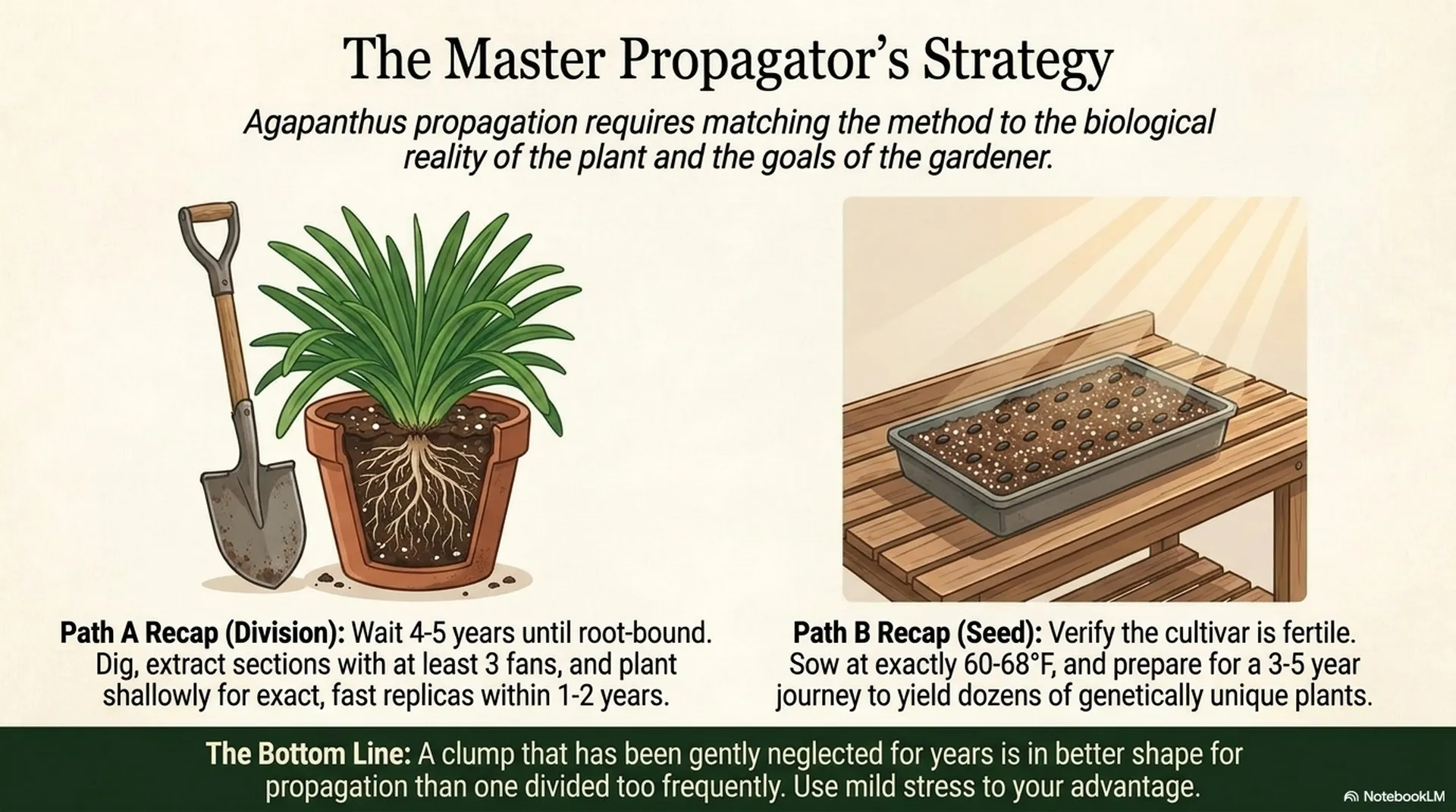
Propagating agapanthus is genuinely straightforward once you understand the biology behind it. The plant’s fleshy rhizomes divide cleanly, the roots — though long — establish well when handled carefully, and a clump that’s been gently neglected for four or five years is actually in better shape for division than one divided too frequently. If you want free, true-to-type plants quickly, dig, split, and replant in fall or early spring. If you want the experience of growing something new and don’t mind a long wait, sow seeds fresh in late summer and enjoy what comes up in year three or four.
For timing your division around your climate and setting up your plant for the strongest possible growing season, the complete agapanthus growing guide covers hardiness, winter care, and the container vs. in-ground debate in full.
If you want the full picture on tools, timing, and aftercare for all perennial types, our guide to how to divide plants covers the universal process alongside grasses and rhizomes.
Sources
- NC State Extension — Agapanthus (African Lily, Lily of the Nile)
- University of Wisconsin Extension — Agapanthus
- Clemson Cooperative Extension — Tips and Tricks for Growing Lily of the Nile
- Royal Horticultural Society — How to Grow Agapanthus
- Horticulture Magazine — Two Main Ways to Propagate Agapanthus
- Gardening Know How — Agapanthus Seed Propagation
- Travis County Master Gardeners, Texas A&M Extension — Divide Agapanthus Now for Spring Blooms


