

Top 20 Plants for Container Gardens: Thriving Vegetables, Herbs, and Flowers for Pots

Without a single patch of grass, picture walking out onto your balcony to cut fresh basil for supper or savouring morning coffee amid brilliant blooms. I am here to tell you it is well within your reach, even if that seems like a gardener’s fantasy.
Indeed, practically anywhere you can design a beautiful and useful garden with containers. From years of tending patios and fire escapes, the secret is not magic — it is about selecting the right plants for container gardens: special types bred or naturally designed to flourish in the small space of a pot.
This is not just a haphazard list. It is a carefully chosen selection of validated winners. We will discuss the most delicious herbs to transform your cooking, the most gorgeous flowers that bloom all season, and the tastiest vegetables that outshine anything you will find at the grocery store. By the end, you will have a precise shopping list of nearly guaranteed success plants, together with expert advice on how to keep them thriving.
The Pot Is the Key to Success, Not the Plant
Before we dive into the top 20 plants, let us review three golden principles that apply to every single container. Most beginners stumble here. Mastering these basics will transform an average container garden into an exceptional one.

Three pre-planned garden beds, free
Stop staring at empty beds: printable plans with exact layouts, plant lists and planting calendars — yours free from the Garden Library.
Container Size and Drainage
This is the most important rule: never choose a pot that is too small. Bigger is almost always better. A larger pot holds more soil, retains more moisture and nutrients, and gives roots room to develop. Whatever you choose, it must have drainage holes. Plants sitting in waterlogged soil are unhappy plants destined for root rot. If you fall in love with a decorative pot without holes, use it as a cache-pot — place your plant in a standard nursery pot inside it, and empty the saucer after watering.
The Right Soil Mix
Step away from backyard soil. Garden dirt compacts readily in pots, blocking air and water from reaching roots. Invest in a premium, lightweight potting mix instead. These mixes are formulated with compost, perlite, and peat moss to retain moisture while staying loose and airy. For vegetables and herbs that need excellent drainage, add extra perlite at a ratio of roughly one part perlite to four parts potting mix. For moisture-loving plants like lettuce and ferns, a straight potting mix works perfectly.
Watering and Feeding
Containers dry out far faster than in-ground beds, especially on hot, windy days. Use the finger test: push a finger one inch into the soil. Dry means water now. Damp means check again tomorrow. Consistent feeding is essential too, as frequent watering flushes nutrients from the mix. A balanced liquid fertiliser every two to four weeks during the growing season keeps plants healthy and productive. For heavy feeders like tomatoes and peppers, switch to a high-potassium tomato feed once flowers appear.
Top 20 Plants That Thrive in Containers
These are not plants that merely survive in pots. These are plants that genuinely prefer the controlled environment a container provides — or at least perform brilliantly with the right setup.
Part 1: Vegetables for Your Patio Harvest
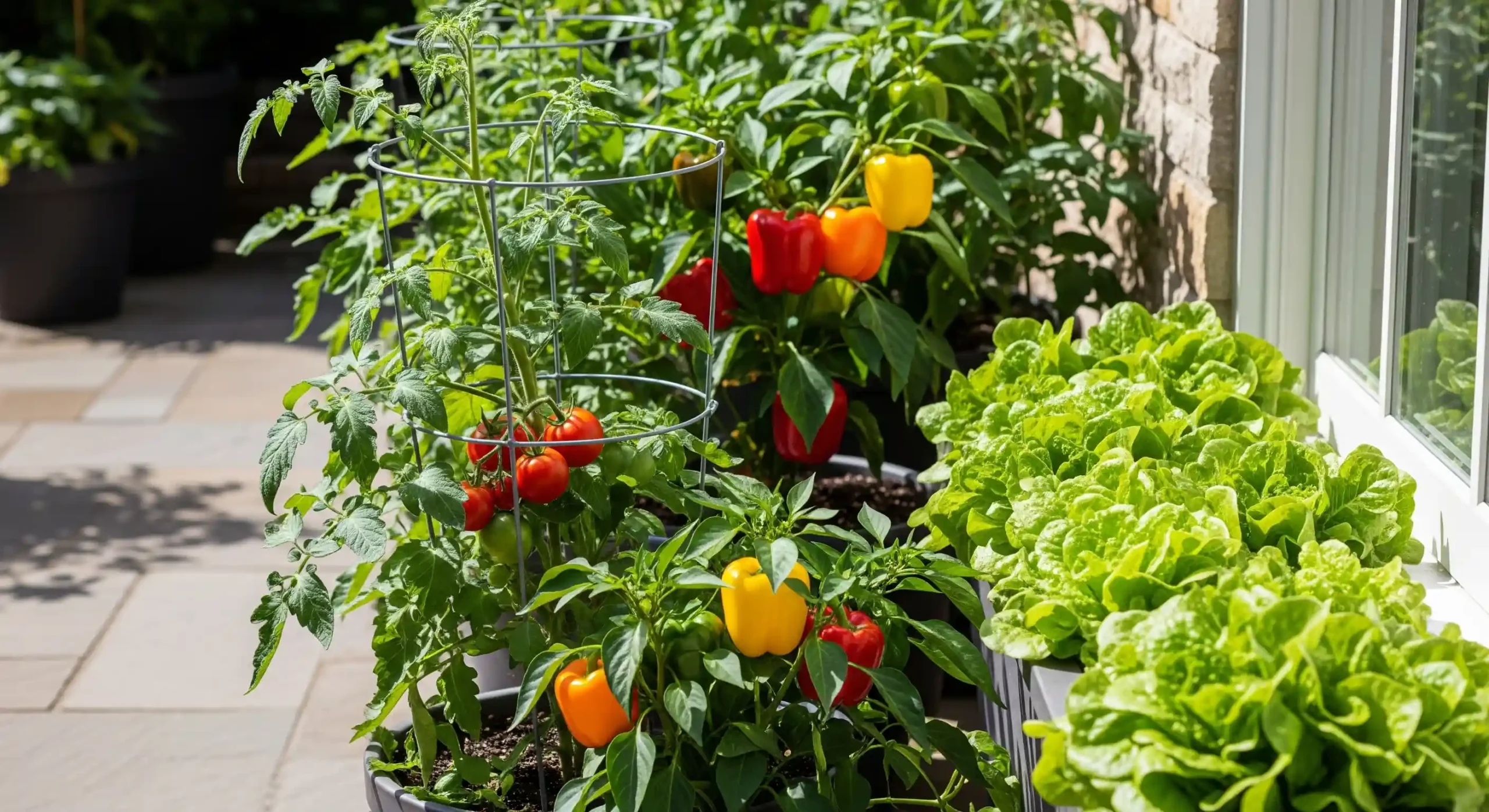
1. Bush and Patio Tomatoes
Why it works: Determinate cultivars like ‘Tumbling Tom’, ‘Patio’, and ‘Bush Early Girl’ grow to a compact, manageable size and produce fruit in one productive flush — perfect for pots. Unlike sprawling indeterminate types, they do not demand a tall trellis or constant pruning.
- Perfect container: Minimum 5 to 7 gallons. Never go smaller.
- Expert tip: Plant your tomato deeply. Bury the stem so the lower few inches are underground — the fine hairs on the stem will develop into additional roots, producing a far stronger plant with better nutrient uptake.
- Watch out for: Blossom end rot, caused by inconsistent watering. A drip tray or self-watering pot helps enormously.
2. Bush Beans
Why it works: You get all the flavour of fresh green beans without needing a large trellis. For their footprint, bush beans are remarkably productive.
- Perfect container: A 3 to 5-gallon pot at least 8 inches deep.
- Expert tip: Succession sow every two to three weeks for continuous harvests all summer. This technique, known as succession planting, is the container gardener’s best friend.
3. Leafy Greens: Lettuce, Spinach, and Arugula
Why it works: Shallow root systems make these plants ideal for wide, shallow containers, window boxes, and even repurposed colanders. They are also fast-growing — some varieties are ready to harvest within 30 days of sowing.
- Perfect container: Any container at least 6 inches deep. Wider is better for yield.
- Expert tip: Position them in partial shade during summer. Intense heat triggers bolting (flowering), which turns leaves bitter. A north-facing windowsill or dappled shade under a larger plant works perfectly.
- Harvest method: Use the cut-and-come-again technique — harvest outer leaves only and the plant will continue producing for weeks.
4. Kale and Swiss Chard
Both are genuine workhorses. Kale handles cold snaps that would kill tomatoes, extending your growing season well into autumn. Swiss chard adds ornamental value with its vibrantly coloured stems in red, yellow, and white — beautiful enough to earn a place in a decorative mixed planting.
- Perfect container: 2 to 3 gallons per plant.
- Expert tip: Harvest outer leaves regularly to encourage the centre to keep producing. If kale gets leggy, strip the lower leaves and mound soil around the stem.
5. Radishes and Carrots
Radishes are arguably the fastest crop you can grow — ‘Cherry Belle’ is ready in 22 days. Use them as gap-fillers between slower crops. Carrots require deeper pots but do brilliantly in containers where you can control soil quality and eliminate the rocks or clay that cause forked roots in the ground.
- Perfect container: At least 12 inches deep for carrots; any container for radishes.
- Expert tip: Choose shorter carrot varieties like ‘Chantenay’ or ‘Paris Market’ for containers under 12 inches deep.
6. Peppers (Sweet and Hot)
Peppers love heat, and the confined space of a container warms up faster than open ground, giving plants a head start. Both sweet bell peppers and chillies perform superbly in pots.
- Perfect container: 3 to 5 gallons.
- Expert tip: Place your pepper pots against a south-facing wall. The wall absorbs heat during the day and radiates it at night, mimicking the Mediterranean conditions peppers thrive in. Switch to a high-potassium feed once flowers form.
7. Courgette (Zucchini)
Courgettes have a reputation as space-hungry monsters, but compact bush varieties like ‘Patio Star’ and ‘Bush Baby’ are excellent in large containers. One plant will produce more than most families can eat through summer.
- Perfect container: At least 10 gallons — bigger is better here.
- Expert tip: Hand-pollinate flowers with a small paintbrush if you notice fruits failing to develop. In limited space, bees may not visit enough flowers for natural pollination.
Part 2: Herbs That Belong in Every Container Garden

8. Basil
Basil is arguably the most rewarding herb you can grow in containers. The gap between fresh garden basil and the plastic-packaged supermarket version is immense. Basil is a sun worshipper — give it the hottest, brightest spot you have.
- Perfect container: 6 to 8 inches wide per plant.
- Expert tip: Pinch off flower heads as soon as they appear. Once basil flowers, the leaves turn bitter and the plant begins to decline. Regular pinching also encourages bushy, productive growth. Grow sweet basil (Genovese), Thai basil, and purple basil together for a visually striking herb pot.
9. Rosemary
Rosemary is practically purpose-built for container growing — it naturally grows in thin, rocky Mediterranean soils and thrives on neglect. Overwatering is the one thing that will kill it. Drought stress is nothing; wet roots are fatal.
Stop missing your zone's planting windows.
Select your US zone and month — get a complete checklist of what to plant, prune, feed, and protect right now.
→ View My Garden Calendar- Perfect container: Any terracotta pot with excellent drainage. Terracotta breathes, which helps prevent root rot.
- Expert tip: Mix grit or perlite generously into your potting mix — at least 30% by volume. Water only when the soil is completely dry.
10. Thyme
Like rosemary, thyme is a Mediterranean native that prefers poor, well-drained soil and plenty of sun. It is also one of the most productive cooking herbs per square inch of container space. A single 6-inch pot of thyme will supply a household’s cooking needs for months.
- Expert tip: Harvest regularly to prevent woody growth. Cut back to just above where the woody stem ends — never cut into old wood, which will not regenerate.
11. Mint
Here is a crucial rule: always grow mint in its own container. Mint spreads aggressively via underground runners and will overwhelm everything else if planted in a mixed pot. In its own container, however, it is magnificent — vigorous, productive, and virtually impossible to kill.
- Expert tip: Submerge the entire pot in the soil if growing in a raised bed, leaving only the rim above the surface. This contains the runners while still allowing the plant to access moisture.
12. Chives
Chives are among the easiest herbs to grow and one of the first to reappear each spring. They are also pollinator-friendly — their purple flowers attract bees and hoverflies. Snip leaves down to an inch from the base and they regenerate within days.
13. Parsley
Parsley is a biennial typically grown as an annual. Both flat-leaf (Italian) and curly types do well in containers. It prefers slightly richer soil than other Mediterranean herbs, so a standard potting mix without added grit suits it best.
Part 3: Flowers That Make Containers Spectacular
14. Petunias
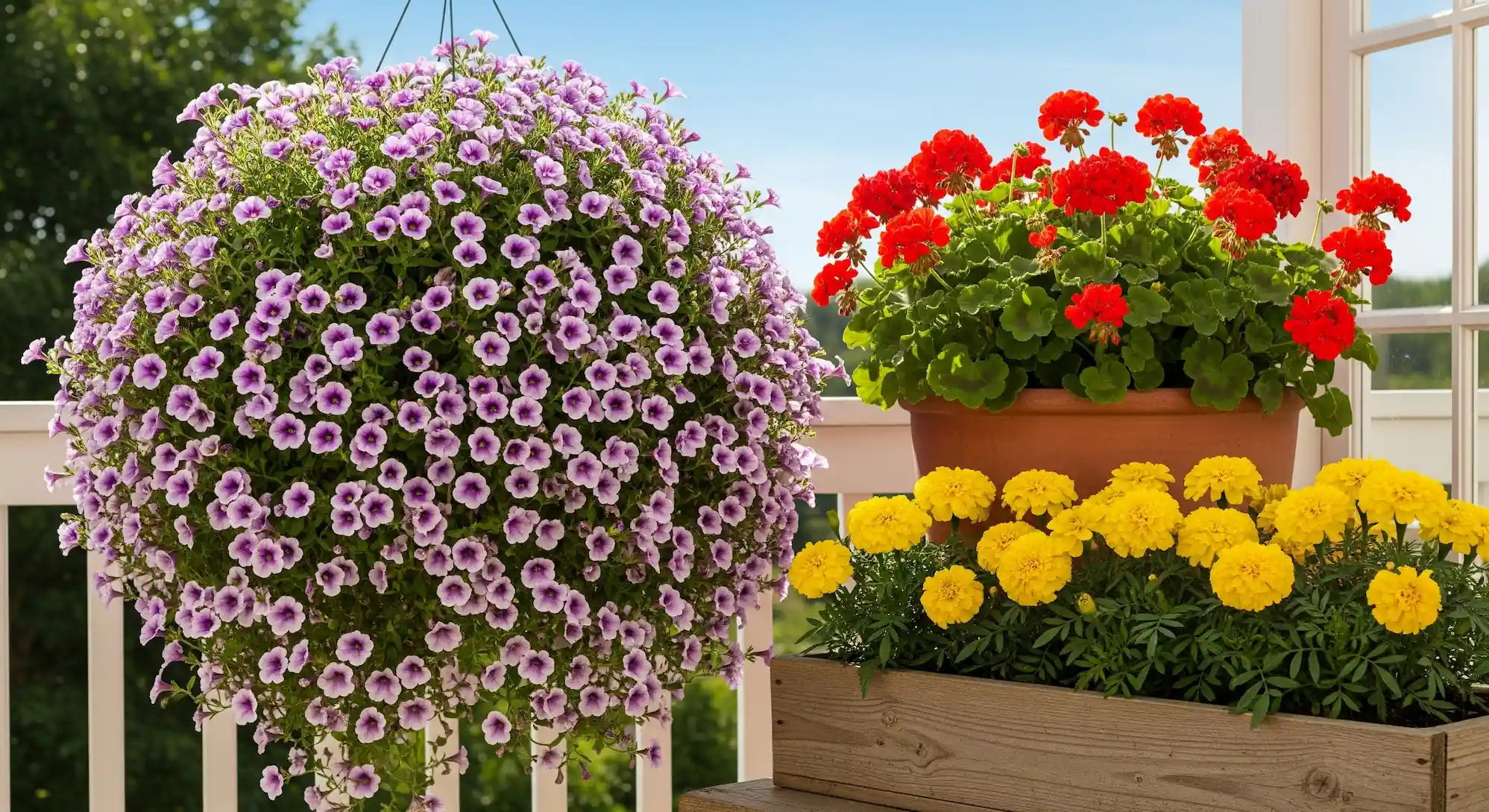
Petunias are one of the most reliable container flowers available, blooming prolifically from late spring through the first frost. Wave and trailing varieties cascade beautifully over pot edges and hanging baskets.
- Expert tip: Deadhead regularly and give them a hard cut back by two-thirds in mid-summer if they get leggy. They will bounce back within two weeks looking completely rejuvenated.
15. Geraniums (Pelargoniums)
Few plants match geraniums for sheer, cheerful reliability. They tolerate heat, forgive missed waterings, and flower relentlessly. The zonal types with bold circular leaf markings are the classic container choice; ivy-leaved geraniums trail magnificently from hanging baskets.
- Expert tip: Geraniums are tender perennials — they will not survive frost outdoors. Before the first autumn frost, bring them inside and cut back by half. They will overwinter happily on a bright windowsill and go back outside the following spring.
16. Calibrachoa (Million Bells)
Calibrachoa is essentially a self-cleaning petunia — it rarely needs deadheading and produces masses of small, bell-shaped flowers in virtually every colour imaginable. It is a trailing plant that looks spectacular in hanging baskets and mixed containers where it cascades over the edges.
17. Marigolds
Marigolds pull double duty: they are beautiful and they repel whiteflies, aphids, and other common vegetable pests through the scent of their foliage. Plant them around the edge of vegetable containers as a natural pest barrier. African marigolds are tall and bold; French marigolds are compact and perfect for pot edges.
- Expert tip: Marigolds also attract beneficial insects. Their open flower structure is accessible to hoverflies, whose larvae are voracious aphid predators.
18. Lavender
Container-grown lavender is a sensory experience — brush against the foliage and your whole patio fills with fragrance. In a pot, you have complete control over drainage and soil pH, which makes it far easier to meet lavender’s exacting requirements than in open ground.
- Perfect container: Terracotta pots with generous drainage holes and a gritty, alkaline mix.
- Expert tip: Avoid large plastic pots — they retain moisture too long. Trim back by one-third immediately after flowering to prevent the plant becoming woody and sprawling.
19. Fuchsias
Fuchsias are the undisputed champions of shaded balconies and north-facing patios. Their pendulous flowers thrive in conditions where sun-loving plants struggle. Trailing fuchsias in hanging baskets are among the most spectacular displays possible in partial shade.
- Expert tip: Fuchsias are thirsty plants. On hot days they may need watering twice. Feed weekly with a high-potassium fertiliser during the flowering period for maximum blooms.
20. Dahlias
Compact pompom and dinner-plate dahlias are outstanding in large containers. They flower from mid-summer through autumn, providing colour long after spring bedding plants have faded. Choose compact varieties like ‘Bishop’s Children’ or ‘Gallery’ series for containers.
- Perfect container: At least 5 gallons per tuber.
- Expert tip: Pinch out the growing tip when the plant is 12 inches tall to encourage branching and more flowers. Deadhead religiously — every spent bloom removed is energy directed back into new buds.
Combining Plants: The Thriller, Filler, Spiller Method
Now that you have your plant list, let us talk about combining them for maximum visual impact. Professional container designers use the Thriller, Filler, Spiller formula for every mixed pot they create.
- Thriller: One tall, dramatic focal plant that draws the eye. Examples: a tall ornamental grass, a standard fuchsia, a bold dahlia, or a spike plant (Dracaena).
- Filler: Two or three mid-height plants that fill out the body of the pot and complement the thriller. Examples: geraniums, compact marigolds, heucheras, or basil.
- Spiller: Trailing plants that cascade over the pot edge to soften the container and link it visually to the ground. Examples: Calibrachoa, trailing petunias, ivy, or sweet potato vine.
Aim for one thriller, two to three fillers, and at least one spiller in every mixed container. This formula works in any size pot and with any colour scheme.
Troubleshooting the Most Common Container Garden Problems
Yellowing Leaves
Yellow leaves on container plants almost always point to one of three causes: overwatering (the most common), nutrient deficiency, or natural senescence of lower leaves on mature plants. Check the soil first — if it is consistently wet and the pot has no drainage, you have a watering problem. If the soil is dry and the yellowing is widespread, apply a balanced liquid feed.
Wilting Despite Watering
If a plant wilts immediately after watering, or the soil is wet, suspect root rot. Remove the plant from its pot and inspect the roots. Healthy roots are white or tan and firm. Rotten roots are brown, slimy, and smell unpleasant. Trim away all affected roots with sterile scissors, dust with sulphur powder, and repot into fresh, well-draining mix.
Leggy, Stretched Growth
Stretching (etiolation) is caused by insufficient light. The plant is growing rapidly in search of a brighter spot. Move the container to a sunnier position. For already-leggy plants, pinch back the growing tips to encourage bushier growth, and increase light levels going forward.
No Flowers Despite Healthy Growth
This is usually a feeding problem. Too much nitrogen produces lush foliage at the expense of flowers. Switch to a high-potassium feed (tomato food works well for flowering plants generally). Also check that the plant is getting enough direct sunlight — most flowering container plants need a minimum of six hours of direct sun per day.
Soil Repels Water After Drying Out
When potting mix dries out completely and shrinks away from the pot edges, water runs straight down the gap without being absorbed. The solution is to stand the pot in a bucket of water for 30 minutes, allowing the mix to rehydrate fully from the bottom up. After that, water from the top until you see flow from the drainage holes.
Frequently Asked Questions
What is the best all-purpose container for beginners?
A 10-inch terracotta pot with drainage holes is an excellent starting point for most herbs and flowers. For vegetables, go straight to a 5-gallon minimum. Terracotta breathes, is heavy enough to prevent toppling, and wicks away excess moisture — all advantages for beginners prone to overwatering.
Can I reuse potting mix from last year?
Yes, but with preparation. Old potting mix becomes compacted, depleted of nutrients, and can harbour disease organisms from the previous season. Before reusing, break it up thoroughly, add at least 25% fresh mix by volume, and stir in a slow-release granular fertiliser. Avoid reusing mix from a pot where plants showed signs of disease.
How do I prevent containers from drying out too fast?
Several strategies help: add water-retaining crystals to the potting mix at planting time; use self-watering pots with built-in reservoirs; mulch the soil surface with grit or bark to reduce evaporation; and group pots together so they create a microclimate with higher humidity. Light-coloured or white pots stay cooler and retain moisture longer than dark ones.
Is it better to plant one type per pot or mix plants?
Both approaches work. Single-species pots are easier to manage because you can tailor watering and feeding to that plant’s needs precisely. Mixed containers using the Thriller-Filler-Spiller method are more visually striking. The key rule for mixed pots: every plant in the container should have similar water, light, and soil requirements. Never plant drought-tolerant rosemary next to moisture-loving basil in the same pot.
When should I repot?
Repot when roots are visibly emerging from the drainage holes, when the plant wilts within a day of watering, or when growth has stalled despite regular feeding. Choose a new pot no more than two sizes up — too large a pot retains excess moisture around the roots before they can fill the space.
Seasonal Container Gardening Calendar
Container gardening does not stop when summer ends. Here is how to keep your containers productive and attractive year-round:
- Spring (March–May): Start tender annuals indoors (tomatoes, basil, petunias). Plant hardy perennials, herbs, and spring bulbs outside after the last frost. Repot overwintered plants into fresh mix.
- Summer (June–August): Peak growing season. Water daily during heat waves. Feed every two weeks. Deadhead flowers regularly. Succession sow fast crops like radishes and lettuce.
- Autumn (September–November): Replace summer annuals with autumn interest plants — ornamental kale, heathers, pansies, and cyclamen. Bring tender plants (geraniums, dahlias, fuchsias) inside before the first frost.
- Winter (December–February): Focus on evergreen structure with conifers, hellebores, and ornamental grasses. Reduce watering for dormant plants. Protect pots from cracking by wrapping in bubble wrap or bringing them into a sheltered spot during hard frosts.
Final Thoughts
Container gardening rewards patience and attention in equal measure. The plants on this list are not just survivors — they are genuine performers that will fill your outdoor space with food, fragrance, and colour from the last frost of spring through the first frost of autumn. Start with two or three that excite you most, learn their rhythms, and build from there. The Thriller-Filler-Spiller formula, combined with the right pot, the right soil, and consistent care, will have your containers looking spectacular within a single growing season.
Remember: every experienced container gardener has killed plants. The difference is they learned why, adjusted, and tried again. The only true failure in container gardening is not starting at all.
Sources
- Royal Horticultural Society. Container Gardening. RHS.
- Peirce, Pam. Golden Gate Gardening. Sasquatch Books, 2010.


