

Organic Pest Control for Zucchini: How to Stop Vine Borers, Squash Bugs, and Aphids Before They Win

Stop vine borers before they bore in, squash bugs before they harden, and cucumber beetles before bacterial wilt spreads — organic pest control for zucchini.
Three days before the sawdust-like frass appeared at the base of my zucchini stem, the larvae were already inside. By the time squash vine borers show that telltale pile of orange-green debris, they’ve bored through the crown — and most organic sprays can’t reach them. That timing problem is the most important thing to understand about organic pest control for zucchini.
Each of the four major zucchini pests requires a different approach. Squash vine borers have a narrow treatment window before larvae enter the stem, after which even Bacillus thuringiensis (Bt) becomes ineffective. Squash bugs destroy plants through cell-rupturing feeding rather than simple sap-sucking, which changes which organic tools actually work against them. Cucumber beetles carry a lethal bacterial disease in their feces, making prevention the only viable strategy once plants are in the ground. Aphids and whiteflies are the most forgiving pests on this list, but applying insecticidal soap too early eliminates the beneficial insects already working on the problem.
This guide walks through each pest’s biology, gives you a diagnostic framework before you treat, and explains exactly which tools work at which life stage — and which are wasted effort.
Which Pest Is Attacking Your Zucchini?
Matching treatment to pest and life stage is the single most important step in organic pest control. Diatomaceous earth has no effect on hard-shelled adult squash bugs. Bt cannot reach squash vine borer larvae once they’re inside the stem. A wrong diagnosis costs you a plant.

Three pre-planned garden beds, free
Stop staring at empty beds: printable plans with exact layouts, plant lists and planting calendars — yours free from the Garden Library.
| What You See | Likely Pest | Act By |
|---|---|---|
| Orange or greenish sawdust at stem base; sudden wilting | Squash vine borer larvae | Immediately — slit stem to remove; prevent with spinosad before entry |
| Bronze-grey leaf patches; flat dark nymphs under leaves; crusty debris at stem base | Squash bugs | While nymphs are small (first two instars) |
| Wilting starts on one leaf, spreads to vines over 7–14 days; yellow-green striped beetles present | Cucumber beetle + bacterial wilt | Prevention only — infected plants cannot be cured |
| Sticky honeydew; curled leaves; small soft clusters on leaf undersides | Aphids | When colonies are dense with no predator activity |
| Tiny white insects that flutter when disturbed; yellowing foliage | Whiteflies | When established on multiple leaves |
| Ragged holes in leaves; yellow-green spotted or striped beetles feeding | Cucumber beetle (direct feeding) | At transplant — use row covers or kaolin clay |
Squash Vine Borers: The 48-Hour Window
The squash vine borer (Melittia cucurbitae) mimics a wasp — orange-banded abdomen, metallic wings, loud buzz in flight — which tells you nothing useful about how to stop it. What matters is that its larvae bore directly into your zucchini’s stem crown within hours of hatching, and once inside, they’re shielded from every contact pesticide on the market.
This includes Bt. Bacillus thuringiensis is widely recommended for squash vine borers, but UMN Extension is direct on this point: Bt requires ingestion, and the larvae are inside the stem. Once they’ve entered, Bt cannot reach them. Spinosad is the correct organic choice — applied to the outside of stems and soil at the base, it intercepts newly hatched larvae in the brief window between emergence from the egg and burrowing into the plant.
When do adults fly? In zones 4–6, adults emerge late June to early July and are active through mid-July. In zones 7–9, emergence can begin in May, with two overlapping generations possible. Pheromone traps (sold as squash vine borer lures) remove the guesswork: when your trap captures more than five moths in a single week, begin spinosad applications. Maine Organic Farmers and Gardeners recommend applying spinosad to the base of every stem twice, spaced five to seven days apart, during peak flight. That window stays open for roughly two to four weeks.
If larvae are already inside, look for the diagnostic sign: a small hole at the stem base surrounded by moist orange or greenish frass. Slit the stem lengthwise with a clean knife, locate and remove any white larvae, and bury the wounded section under two to three inches of moist soil. New roots regenerate from buried nodes above the injury, sometimes saving the plant even after significant damage.
Prevention strategies with research backing
Blue Hubbard squash planted as a perimeter crop around your zucchini bed is the most effective single preventive tool documented in the research. eOrganic cites Connecticut trials where using Blue Hubbard as a trap crop reduced squash vine borer damage in the main planting by 88%. Moths prefer Blue Hubbard strongly enough that targeted spinosad applications to just the perimeter rows protect the entire bed.
The second approach is variety selection. Standard zucchini varieties are Cucurbita pepo — the squash vine borer’s preferred host. Cucurbita moschata, which includes butternut squash and its relatives, has dense, solid stems that larvae struggle to penetrate. Tromboncino, an Italian heirloom C. moschata variety, is confirmed by Clemson HGIC as essentially immune to squash vine borer due to this stem density. Harvested the day after flowers drop, Tromboncino has nearly identical flavor and texture to zucchini. On farms where vine borer pressure is severe across zones 4–7, replacing summer squash with Tromboncino is the most reliable long-term solution.
For complete identification and early-season monitoring guidance, see our guide to squash vine borers in zucchini.
Squash Bugs: The Lacerate-and-Flush Feeder
The standard description of squash bug feeding — ‘pierces and sucks sap’ — understates how they actually kill plants. Colorado State University Extension describes their feeding more precisely as ‘lacerate and flush’: squash bugs inject enzymes that rupture plant cells, then extract the resulting fluid. This destroys the xylem and phloem — the water-conducting tissue — faster than the plant can compensate. Heavily infested plants wilt even in well-watered soil, because the structural system for moving water has collapsed.
Adults are brownish-black, flat-backed, and about 5/8 inch long. They overwinter in plant debris and leaf litter near previously infested beds, becoming active in spring. Egg-laying typically begins around mid-June in most of the US. Eggs are yellowish-brown to brick red, deposited in clusters on leaf undersides, and hatch in approximately one week. Nymphs mature in four to six weeks. There is generally one generation per year in zones 4–6, with a potential second in warmer regions.
The critical treatment window: Young nymphs in their first two instars have soft cuticles that organic contact treatments can penetrate. Large nymphs and adults have hardened exoskeletons that resist most organic insecticides. This makes weekly egg surveys from mid-June onward the most important single action. Check leaf undersides, stem bases, and shaded soil near the crown. Crush egg masses with your thumb or lift them off with tape the moment you find them — each cluster you destroy is 10–20 fewer nymphs in two weeks.
When small nymphs are present, your options are:
- Diatomaceous earth dusted around stems and on leaf undersides — effective against early-instar nymphs, whose soft cuticles are physically damaged by silica particles. Colorado State Extension approves DE combined with pyrethrins for certified-organic squash bug management. Reapply after each rain. Note: DE has no effect on hard-shelled adult squash bugs, and it harms soft-bodied beneficial insects, so apply away from open flowers.
- Trap boards (cardboard or wood squares placed on the soil overnight) exploit squash bugs’ instinct to shelter in dark spaces. Lift boards each morning and drop the gathered adults into soapy water. No chemicals, steady results, effective even on adults that sprays miss.
- Neem oil applied directly to small nymphs disrupts molting through azadirachtin’s hormonal action. Apply at dusk to protect pollinators; effectiveness drops sharply against hardened adults.
Avoid mulching around the base of squash plants — mulch provides the sheltered, dark conditions that squash bugs actively seek and consistently increases infestation severity, per Colorado State Extension.

The biological ally most growers don’t know about
Trichopoda pennipes, the feather-legged fly, is a native tachinid parasitoid that lays its eggs on squash bug adults and nymphs. After hatching, larvae burrow inside the host, feed on its body fluids, and exit through the abdomen, killing the bug. NC State Extension entomologists document parasitism rates as high as 80% on squash bugs under favorable conditions. The fly also suppresses reproduction in hosts it hasn’t yet killed — infected bugs lay significantly fewer eggs even while still alive.
Trichopoda flies are present throughout the United States and are attracted by flat umbel flowers in the carrot family (Apiaceae). Planting dill, fennel, or cilantro allowed to flower near your zucchini bed draws these flies into the garden. This is companion planting with a documented biological mechanism, not garden folklore.
Stop missing your zone's planting windows.
Select your US zone and month — get a complete checklist of what to plant, prune, feed, and protect right now.
→ View My Garden CalendarFor the full squash bug control protocol, see our complete squash bug guide. For focused guidance on using DE correctly, see diatomaceous earth for zucchini pests.
Cucumber Beetles and Bacterial Wilt: Prevention or Nothing
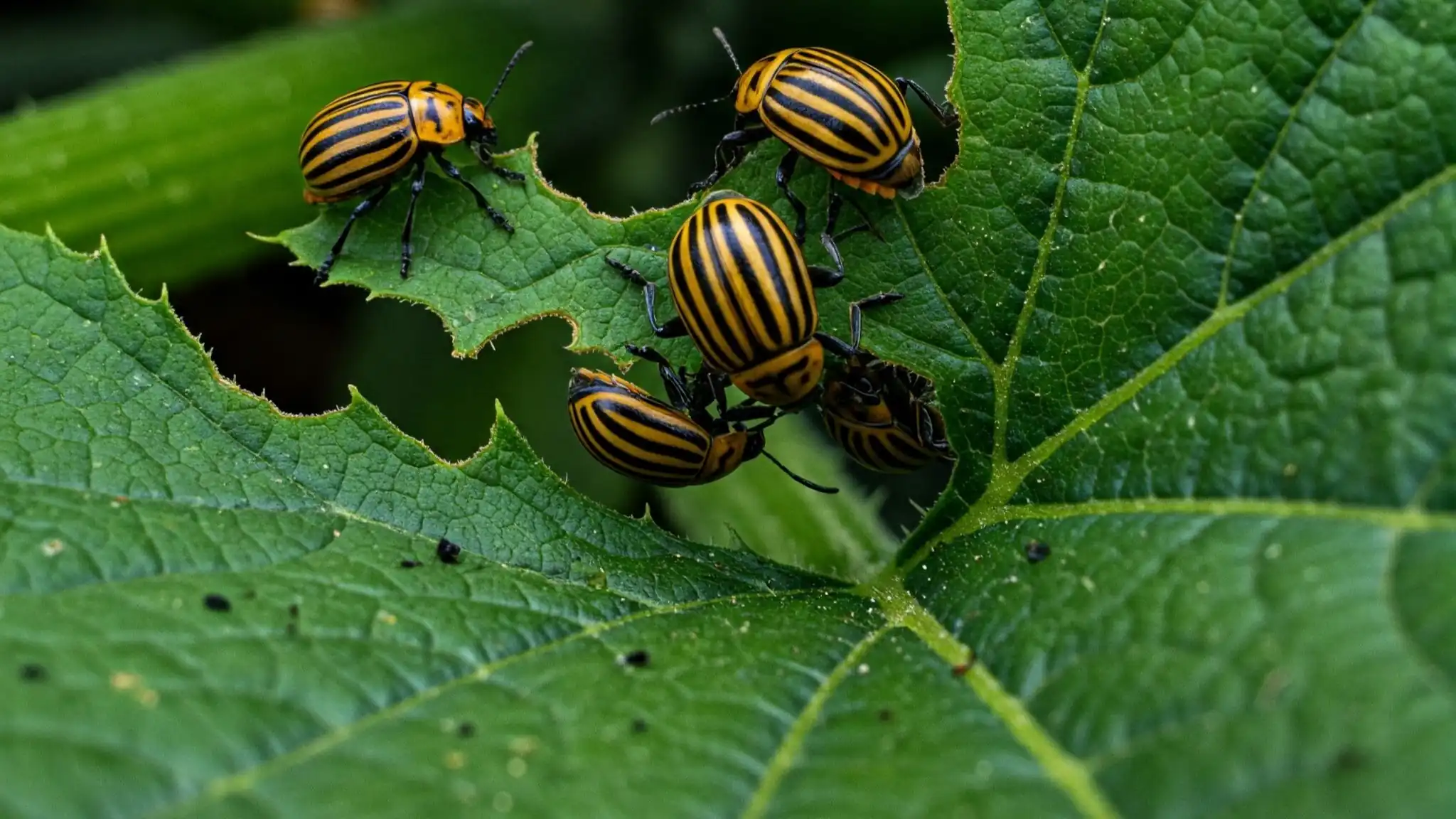
Cucumber beetles cause visible leaf damage, but their greater threat is invisible. The striped cucumber beetle (Acalymma vittatum) carries Erwinia tracheiphila — the bacterium causing bacterial wilt — in its feces. University of Maryland Extension explains the infection route: as beetles feed and defecate on open wounds, Erwinia tracheiphila enters the vascular system through moisture contact (rain, dew, irrigation). It then colonizes tissue from the inside outward.
Once bacterial wilt takes hold, a single infected leaf wilts, then the stem, then major vines. Plants die within 7 to 14 days of first symptoms. Non-infected parts of the plant continue growing during this period, which makes early diagnosis confusing. There is no organic treatment for an infected plant.
The wilting strand test confirms bacterial wilt before you remove a plant: cut a wilting stem near the base, press the two cut ends together for ten seconds, then slowly pull them apart. A thin, milky, thread-like strand stretching between the cut surfaces confirms Erwinia tracheiphila. A clean break indicates a different problem — possibly drought stress or squash vine borer damage instead.
Preventing beetle contact before infection occurs
Row covers installed at transplant and secured to the soil provide complete physical exclusion of beetles during the most vulnerable period — emergence through bloom. Penn State Extension cites Iowa State University research showing that extending row covers just ten days past the start of flowering significantly reduced bacterial wilt incidence without reducing yields. The practical implication: you don’t need covers for the whole season, but earlier removal raises infection risk. During the covered period, hand-pollinate by transferring pollen from male flowers (slender stems, pollen-covered centers) to female flowers (small fruit at the base) using a small brush.
Kaolin clay, sold as Surround WP (OMRI-listed for organic production), applied twice weekly creates a fine film on leaf and stem surfaces that deters beetle landing without blocking pollinators or light. Penn State Extension cites Massachusetts and New York research confirming that kaolin clay reduced both beetle populations and defoliation in cucurbit crops. Apply from transplant through the bloom period; reapply after each significant rain event.
Aphids and Whiteflies: The Soft-Target Strategy
Aphids and whiteflies are the most straightforward zucchini pests — soft-bodied, slow to develop resistance, and vulnerable to treatments that have no effect on harder pests. The main risk isn’t the pests; it’s spraying too aggressively too early and eliminating the ladybugs, lacewings, and parasitic wasps that are already working the problem.
Check leaf undersides weekly. Light aphid pressure — a few dozen insects per leaf with no honeydew buildup or leaf curling — often resolves within a week if natural predators are present. If you see ladybug larvae (orange and black, alligator-shaped) or lacewing eggs (tiny white ovals on hair-like stalks) on the plant, hold off on spraying for five to seven days and let beneficial insects respond first.
Treat when you see dense colonies covering multiple stems, heavy honeydew causing sooty mold, significant leaf curl, or no evidence of predator activity.
Insecticidal soap formulation: Use a 1–2% solution of pure castile soap — approximately 2.5 to 5 tablespoons per gallon of water. Do not substitute dish detergent; Clemson HGIC warns that additives in household cleaners damage foliage. Test hard water compatibility by mixing the solution in a jar: scum formation after 15 minutes means minerals are reducing effectiveness — switch to distilled or collected rainwater. Apply early morning or late afternoon, never in full sun or above 90°F, targeting leaf undersides where aphids and whiteflies concentrate. Repeat every four to seven days during active infestations; the soap leaves no residual protection once dry.
Seasonal Defense Calendar
Most zucchini pest problems are predictable by date and zone. Deploying each tool before the pressure arrives is consistently more effective than responding to established infestations.
| Timing | Action | Target Pest |
|---|---|---|
| At transplant | Install floating row covers; secure all edges to soil | Cucumber beetles, SVB moths |
| First 2 weeks | Apply kaolin clay every 3–4 days; set yellow sticky traps | Cucumber beetles |
| Mid-June | Begin weekly leaf-underside surveys; deploy trap boards overnight | Squash bug eggs and early nymphs |
| Late June (zones 4–6) / Late May (zones 7–9) | Hang pheromone traps; apply spinosad to stem bases when >5 moths/week captured | Squash vine borers |
| At first flowering | Remove row covers; hand-pollinate if covers were extended | Pollinator access |
| July onward | Apply insecticidal soap when aphid colonies are dense; reapply DE after rain | Aphids, whiteflies, squash bug nymphs |
| Post-harvest | Till soil 2–4 inches deep; remove all vine and stem debris | SVB pupae and squash bug adults overwintering |
Companion planting that supports this calendar: Nasturtiums planted 2–3 per zucchini plant function as trap crops for aphids and cucumber beetles — check them first during weekly monitoring, and you’ll often find pest populations concentrated there. Dill and fennel allowed to flower near the bed attract Trichopoda pennipes for squash bug parasitism and parasitic wasps that reduce aphid pressure. Blue Hubbard squash planted at the perimeter is the highest-leverage single addition in areas where squash vine borers are a recurring problem.
The most reliable organic program isn’t any single product — it’s knowing each pest’s biology well enough to intervene at the point of maximum leverage, before infestations reach the stage where organic tools no longer work. For our full guide to all zucchini growing challenges, see 15 common zucchini problems and solutions.
Frequently Asked Questions
Does neem oil work on squash vine borers?
Neem oil is not effective once larvae are inside the stem. Azadirachtin disrupts insect molting and feeding, but it must contact the insect to work — the larvae are protected inside plant tissue. Spinosad applied to the stem exterior before larvae enter is the correct organic option. Use pheromone traps to time applications during peak adult flight, and apply twice, five to seven days apart.
How do I confirm my zucchini has bacterial wilt?
Cut a wilting stem near the base, press the two ends together for ten seconds, then slowly pull them apart. A thin, milky, thread-like strand stretching between the cut surfaces confirms bacterial wilt caused by Erwinia tracheiphila. Infected plants must be removed and discarded (not composted) to prevent beetles from spreading the pathogen to healthy plants nearby.
What kills squash bugs organically?
Timing matters more than the product. Diatomaceous earth and insecticidal soap work on first- and second-instar nymphs — once they harden into adults, these treatments lose effectiveness. Trap boards collect adults for daily removal. Attracting Trichopoda pennipes flies by planting dill or fennel near your zucchini adds a biological control layer with documented parasitism rates up to 80% on squash bugs — no spray achieves that consistently.
Can I grow zucchini without any pesticides?
In low-pest-pressure regions, yes. Row covers at transplant, weekly egg surveys, trap boards for squash bugs, and companion planting with nasturtiums and Apiaceae flowers can manage most pest problems without spray applications. In the eastern US — where squash vine borer pressure is consistently high — a two-application spinosad treatment during peak flight is typically necessary to protect standard zucchini. Growing Tromboncino or another Cucurbita moschata variety instead eliminates vine borer pressure entirely.
Sources
- Clemson HGIC — Cucumber, Squash, Melon & Other Cucurbit Insect Pests
- Colorado State University Extension — Squash Bug Management in Home Gardens
- eOrganic — Biology and Management of Squash Vine Borer in Organic Farming Systems
- UMN Extension — Squash Vine Borers
- Maine Organic Farmers and Gardeners — Squash Vine Borer Fact Sheet
- Penn State Extension — Deterring Striped Cucumber Beetles in Organic Cucurbit Production Systems
- University of Maryland Extension — Striped Cucumber Beetles and Bacterial Wilt
- NC State Extension Entomology — Trichopoda Fly
- Clemson HGIC — Tromboncino Squash
- Clemson HGIC — Insecticidal Soaps for Garden Pest Control


