Beyond the Basic Pot: Innovative Solutions for Plant Health
The Development of the Plant Pot
Usually made of terracotta or, more recently, plastic, the modest plant pot has served its main purpose for centuries: containing soil and roots. Still, these conventional containers provide little knowledge of the vital, concealed environment deciding plant health. Largely invisible to the plant owner, below the soil surface lies a complex world of root activity, moisture dynamics, and nutrient exchange. Common plant care problems are greatly exacerbated by this lack of visibility, especially the widespread problems of overwatering and underwatering, which can cause root rot, stress, and finally, plant death. As container gardening gains popularity, with U.S. consumers spending considerably on it ³, the need for better tools and more knowledge to guarantee plant success has grown. The need for better tools and more information to guarantee plant success has grown as container gardening gains popularity and U.S. consumers spend much on it.
This paper investigates the expanding area of creative plant pot designs and related technologies meant to go beyond simple containment. It investigates ways that enable plant owners with improved monitoring tools to have unparalleled visibility and information on the subterranean plant environment. The aim is to offer a thorough study of these developments, looking at how they solve the flaws of conventional pots and support better plant health. Key areas of innovation we will explore include the growth of sensor-based monitoring and automation via smart pots, the effect of new materials like breathable fabrics on root development, and improvements in visual monitoring using transparent materials and color-changing indicators. Understanding these changing technologies will help plant lovers to make more educated decisions to support flourishing indoor and outdoor gardens.
Seeing is Believing: The Growth of Clear Pots
Adopting clear plant pots is among the most obvious answers to the problem of the concealed root zone. Dismystifying situations below the soil line, this straightforward but powerful invention offers instant visual access to the roots of the plant and the surrounding substrate.⁵ Grounded in direct observation, this openness changes plant care from a guessing game depending on surface conditions or pot weight into a more informed practice.
Thorough Benefits Study
The benefits of using clear pots arise directly from this increased visibility, therefore affecting several vital elements of plant care:
- Evaluation of Root Health: Maybe the most important advantage is the capacity to directly track the health and growth of the root system without having to unpot and maybe stress the plant.⁵ Users can see root color (healthy roots are usually white or light tan), evaluate root density, spot early indications of issues like root rot (dark, mushy roots), find soil-dwelling pests, and decide whether a plant is becoming root-bound (roots circling the bottom of the pot). Given that roots are essential for anchoring the plant and absorbing water and nutrients, this monitoring tool is crucial for preserving general plant health. This visual verification clarifies choices on repotting.⁷ Moreover, transparent pots are especially helpful for cutting propagation since they let growers quickly observe when new roots appear and are ready for transplanting.⁷ Many people find this direct look into the root zone particularly useful for unusual or newly acquired plants whose particular needs could be less known.
- Moisture Visualization:⁸ Conventional techniques for measuring soil moisture, such as the “finger test,” often only evaluate the top layer of soil and can be misleading about conditions deeper in the pot.⁴ Clear pots let users view the moisture spread across the whole substrate profile, hence overcoming this restriction. Condensation patterns on the inside of the pot give hints about humidity levels in the soil; visible darkening of the substrate when wet helps to determine when the plant actually requires water and whether water has penetrated the whole root ball after watering. This guarantees more constant and suitable hydration by preventing both overwatering—a frequent cause of root rot—and underwatering. Even if other signs point to time, users say transparent pots help them know when not to water.⁸
- Monitoring the Substrate: Apart from moisture, transparency lets one evaluate the developing medium itself.⁵ Users can visually check for substrate compaction, see how well it drains, see the distribution of roots inside the medium, and decide whether the mix seems appropriate for the particular plant’s needs.⁵ This visual feedback can guide choices on when and how to change or replace the substrate.
- Aesthetic and Educational Value: For many plant lovers, seeing the complex root network growing inside the pot gives their plant presentation a particular aesthetic aspect. It emphasizes the sometimes invisible half of the life of the plant. Furthermore, transparent pots are a great learning tool. Users can acquire a deeper, more intuitive knowledge of their plants’ needs and reactions by visually linking the look of the roots and substrate with the plant’s watering schedule and general health.⁶ This knowledge can enhance general plant care abilities by extending beyond the particular plant in the transparent pot.
Dealing with the Disadvantages
Though they have benefits, the openness of these pots also brings possible drawbacks:
- Algae Growth: The same light that allows visibility can also promote the growth of algae on the inner surfaces of the pot where moisture and nutrients are available.⁸ Though usually thought to be harmless to the plant itself, many people find the green film ugly.⁸
- Sensitivity to Light: Some plant roots do not tolerate light well. Certain species’ roots, including many ferns (Bird’s Nest, Maidenhair), Calatheas, Chinese Evergreens, and Peace Lilies (Spathiphyllum), have developed in low-light environments and can be stressed or perhaps harmed by too much light exposure.⁷ For these plants, the continuous light of the root zone in a transparent pot can be harmful, so conventional opaque pots are preferable.⁷ Even for less sensitive plants, very bright, direct sunshine can cause root scorch as well.⁸
- Additional Concerns: Some users mention pragmatic problems like roots growing aggressively through the drainage holes, maybe calling for the pot or roots to be cut during repotting.⁸ Certain plant behaviours could also be influenced; for example, some Begonias might be prompted by the light to generate offsets (babies) underground opposite the pot wall, where they could get crushed and need help.⁸ Other plants prone to generating many offsets, such snake plants or Pileas, could have similar effects.
Practical Issues & Mitigation
Often, the possible downsides of clear pots—especially algae growth and light sensitivity—are rather simple to offset. Many people use transparent pots as nursery pots, which they then set inside bigger, opaque ornamental cache pots.⁶ While the outer cache pot blocks light during daily display, preventing algae and protecting sensitive roots, this method offers the monitoring advantages when the inner pot is lifted out for inspection. It also provides more aesthetic flexibility.⁶ Clear plastic food containers—like deli containers or cups—can be easily changed for people looking for affordable options by adding drainage holes to act as functional clear pots.⁶
Clear pots’ usefulness exposes a basic trade-off: the main disadvantage of light exposure is naturally related to the main advantage of visibility. Light-sensitive roots may suffer and the conditions for possible algae growth are also produced by the light penetration allowing monitoring.⁵ Often resulting in the practical compromise of employing cache pots, this requires a deliberate decision by the user balancing the benefits of direct observation against the possible drawbacks for particular plants or aesthetic preferences.
Table 1: Pros and Cons of Clear Pots
| Feature | Description | Benefit/Drawback | Mitigation/Consideration | Suitable Plant Types (Examples) |
| Root Visibility | Allows direct observation of root health, density, color, and growth patterns.5 | Benefit: Early detection of issues (rot, pests, root-bound).5 | Useful for propagation monitoring.7 | Orchids, Aroids (Monstera, Philodendron), Hoya, Hoyas.7 |
| Moisture Check | Enables visual assessment of substrate moisture levels and distribution throughout the pot.5 | Benefit: More accurate watering decisions, prevents over/underwatering.5 | Complements other methods like checking pot weight.8 | Most houseplants, especially those sensitive to moisture fluctuations. |
| Substrate Check | Allows observation of substrate condition, compaction, and drainage.5 | Benefit: Helps evaluate suitability of growing medium. | Most houseplants. | |
| Algae Growth | Light penetration can encourage algae growth on the inner pot surface.8 | Drawback: Primarily aesthetic concern, generally not harmful to plant.8 | Use an opaque outer cache pot to block light.8 Horticultural charcoal may help.8 | N/A |
| Light Sensitivity | Some plant roots are negatively impacted by light exposure.7 | Drawback: Can cause root stress or damage in sensitive species.7 | Use an opaque outer cache pot.8 Avoid direct, intense sunlight.8 | Less Suitable: Ferns, Calatheas, Chinese Evergreens, Peace Lilies.7 |
| Aesthetic/Edu. | Offers unique visual appeal; aids learning about plant needs.5 | Benefit: Enhances display and user understanding. | DIY options available using clear containers.6 | Most houseplants. |
Decoding Moisture: Color-Changing Indicators & Materials
Many plant owners still find it difficult to measure soil moisture accurately, which can result in harmful watering habits.⁴ Although transparent pots give visual cues, another kind of invention seeks to offer even more straightforward, simpler signals: color-changing moisture indicators. Ranging from basic biodegradable stakes to complex electronic sensors, these devices convert subsurface moisture levels into simple, understandable visual cues, so guiding the decision of when to water.
Investigating Indicator Technologies
These visual moisture guides are based on several different technologies:
- Passive Absorption-Based Indicators: These indicators function by physically absorbing moisture from the surrounding soil, which causes a visible change.
- Biodegradable Paper/Fiber Indicators—e.g., PlantDoc: Reflecting an environmentally aware attitude, these indicators are usually made from strong, plant-based paper or fiber materials coated or impregnated with non-toxic, hydrochromic (water-changing color) inks or paints.⁴ The indicator itself is a tiny replica of the soil’s wetness; it changes color—usually from white when dry to green or another color when wet—as it absorbs moisture.⁴ The indicator dries as the soil dries, so often from the top down it reverts to its original hue, offering a gradient indication.⁴ Often among the main selling points are being plastic-free, created from sustainable materials, and completely home compostable after their useful life.⁴
- Plastic Sticks with Replaceable Cores—e.g., Sustee: Commonly found, plastic sticks with replaceable cores usually consist of a robust plastic housing holding a replaceable core created from specially treated nonwoven fabric.¹³ Capillary action draws moisture up from the soil into the core material. A color change (e.g., from white to blue) visible through a tiny window on the stick’s outside occurs when the core reaches a particular moisture level. Over time, the inner core’s efficacy declines, thus these need periodic replacement of the inner core.
- Opacity-Changing Indicators: A unique technique detailed in patent literature is a porous body member that lets water flow to a particular moisture-indicating material.¹⁵ This material is opaque when dry and becomes transparent or clear when wet; it reversibly alters its opacity, not color. This change in opacity exposes a permanently colored layer lying directly under the indicating material.¹⁵ The top layer turns transparent when the soil (and hence the indicator) is wet, so revealing the underlying hue. The top layer becomes opaque when dry, hiding the hue. This method seeks to offer a very obvious wet/dry signal and avoids possible problems connected to hazardous or leaching color-changing chemicals used in older indicator types.¹⁵ Popular indicators like PlantDoc and Sustee, which oscillate between an opaque white state (dry) and a colored state (wet), visually function conceptually with this opacity-change mechanism, implying its use for enhanced safety and visual clarity.
- Digital Indicators: Using basic electronics, these indicators usually use a soil moisture sensor—often capacitive, occasionally resistive—embedded in a probe put into the ground.¹⁶ Varying with moisture content, the sensor detects the electrical characteristics of the soil. Usually an RGB LED, the output of an indicator light is then controlled by this measurement.¹⁶ The LED changes color depending on the identified moisture level; for example, green might show enough moisture, red might indicate dryness, and intermediate hues like yellow or orange could reflect levels in between.¹⁶ These systems call for a power source—battery or mains connection—and might gain from user calibration to consider various soil compositions and particular plant requirements.¹⁶
- Chemical Indicators: Historical Background & Alternatives: Historically, moisture indicators commonly included chemical compounds such Cobalt Chloride (CoCl₂) because of their unique color shift from blue (anhydrous) to pink (hydrated).¹⁵ But worries about the toxicity and possible cancer-causing properties of cobalt compounds have prompted limits and a move toward more safer substitutes, especially in Europe.¹⁵ Although less frequent in today’s consumer plant pot indicators, several non-cobalt chemical indicators exist mostly for industrial use or desiccants. These include copper chloride (CuCl₂) mixed with silica gel (yellow to blue-green change), manganese-based compounds (blue to brown), methyl violet (orange to green), and other pH-sensitive or humidity-sensitive dyes applied to porous materials like silica gel or paper.¹⁸ Natural pigments like anthocyanins are also known to change color with pH (related to moisture in some situations), but the supplied material for pot indicators does not specifically mention them.²⁶
Comparative Study
Selecting the appropriate moisture indicator calls for several elements to be considered:
- Reliability and Accuracy: Results might differ. Good contact between the indicator and the soil as well as the wicking characteristics of both influence passive absorption indicators greatly. User reviews draw attention to possible problems: some PlantDoc indicators said to have bent or black edges owing to moisture, while others believed they remained wet longer than the soil really needed.¹⁰ After prolonged use, some Sustee users noted the indicator failing to change color correctly.¹⁴ While soil type can affect electronic sensors and they may need user calibration for best accuracy, they provide the possibility for more exactness.¹⁶ Many people think the conventional “finger test” is inaccurate for evaluating moisture levels further inside the pot.⁴
- Cost and Longevity: Lifespans vary greatly. Biodegradable indicators such as PlantDoc usually last 2 to 6 months before requiring replacement.⁴ Sustee indicators’ replaceable core is advised to be changed every six to nine months.¹⁴ Though reviews say some less expensive models fail after just a few months, electronic meters have a possibly longer lifetime depending on construction quality and battery life.⁴ This has a direct bearing on cost-effectiveness. Though they have ongoing replacement expenses, biodegradable choices are usually cheap per unit.⁴ Stick-type indicators have a fair initial cost; replacement cores incur continuous expenses.¹⁴ Typically, electronic meters are the most expensive to buy up front.¹⁷
- Ease of Use: The main draw of color-changing signals is their ease of use; a fast look shows the moisture level.⁴ Some electronic indicators with LED lights, though, could be hard to read in bright daylight, and depending on dexterity or plant foliage density, accessing tiny buttons to turn on the reading could be annoying.
- Environmental Effect: Sustainability is starting to be a major differentiator. By decomposing naturally in compost or soil, paper-based, biodegradable indicators clearly outperform plastic waste.⁴ On the other hand, electronic devices generate e-waste and plastic stick indicators add to plastic waste. The shift away from dangerous chemicals like Cobalt Chloride also shows a rising environmental and health awareness in the market.¹⁵
Driven by both regulatory pressure and consumer desire for safer products, the development of moisture indicators obviously reflects a market trend away from possibly harmful chemical formulations such as Cobalt Chloride.¹⁵ With biodegradability and plastic-free designs rising as important selling factors for newer products like PlantDoc, this change supports non-toxic alternatives.⁴
People negotiating this market have a natural trade-off. As some user comments imply, low-cost, simple, and environmentally friendly alternatives like biodegradable paper indicators sometimes sacrifice durability and maybe dependability.⁴ On the other hand, while options like plastic sticks with replaceable cores or electronic meters may have longer lives or maybe more accuracy, they are more expensive, use plastic or electronic waste, and may not have the intuitive simplicity of passive indicators.¹⁴ Individual priorities will determine the decision: budget, environmental issues, desired lifetime, and convenience of use all need to be balanced.
Table 2: Comparison of Moisture Indicator Technologies
| Technology Type | Example Products | Mechanism | Pros | Cons | Lifespan / Cost Tier |
| Biodegradable Fiber | PlantDoc 4 | Plant-based fiber absorbs soil moisture, hydrochromic ink/paint changes color (e.g., white↔green).4 | Low cost per unit, biodegradable, compostable, plastic-free.4 | Short lifespan (2-6 months), potential reliability/durability issues.10 | Short / Low |
| Plastic Stick/Core | Sustee 13 | Nonwoven fabric core wicks moisture, triggering color change (e.g., white↔blue) in window.13 | Clear visual cue, longer core life than biodegradable.14 | Higher initial/replacement cost, plastic waste, potential failures.14 | Medium / Medium |
| Electronic LED | DIY projects 16, various meters 17 | Soil moisture sensor (capacitive/resistive) drives LED color change (e.g., green↔red).16 | Potentially accurate, provides gradient info. | Highest cost, requires power/batteries, may need calibration.16 | Long / High |
| Reversible Opacity Patent | Concept 15 | Porous material allows water to make top layer transparent, revealing colored layer beneath.15 | Potentially very clear indication, avoids hazardous dyes.15 | Implementation details/commercial availability not specified. | N/A / N/A |
The Smart Pot Revolution: Sensors, AI, and Connectivity
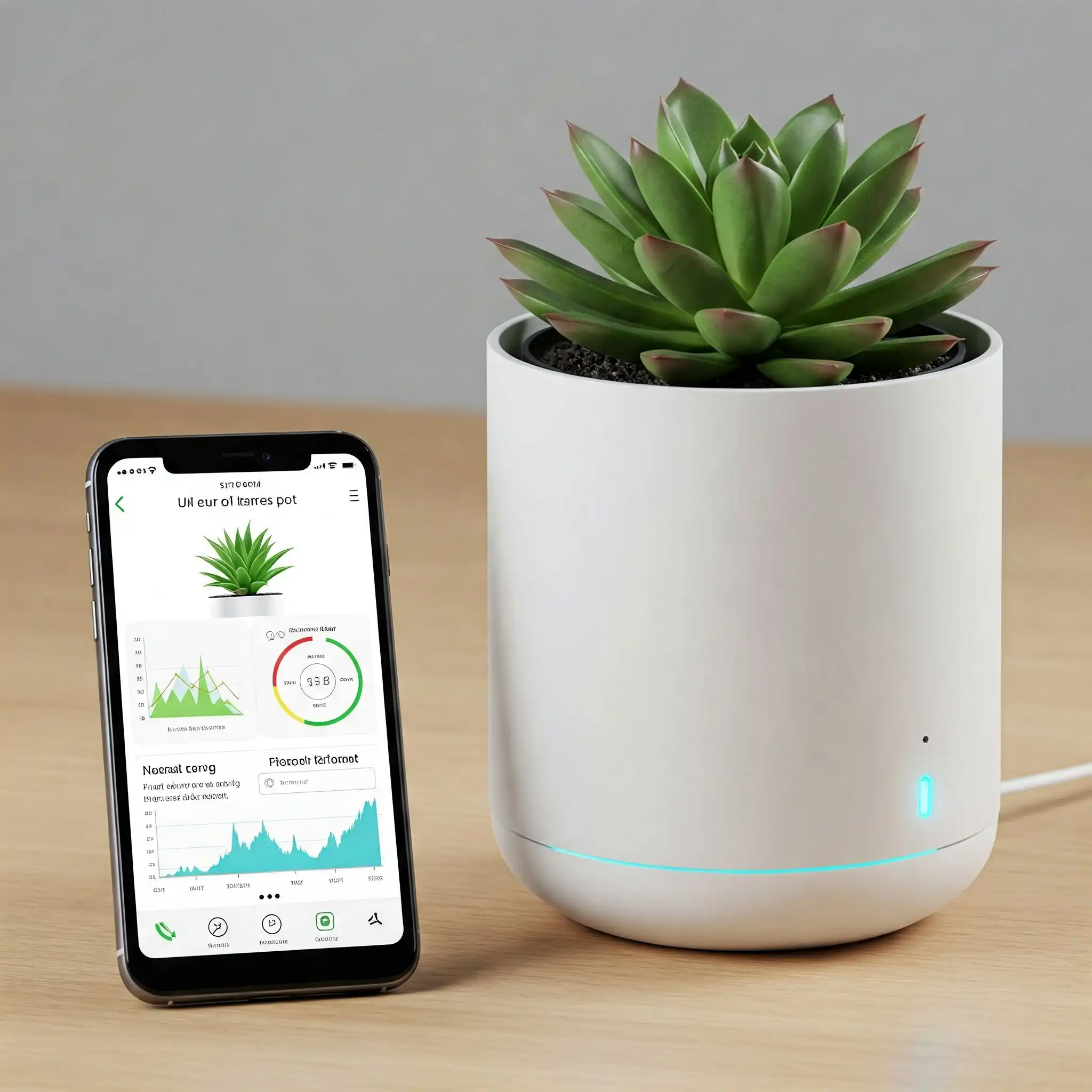
Beyond passive monitoring, the “smart pot” is a major advance in plant care technology. These are integrated systems, not just containers; they actively monitor plant conditions and often automate necessary care duties by including sensors, microprocessors, connectivity, and occasionally actuators like pumps or lights.³ Aiming to remove the uncertainty and variability from plant care, this revolution provides data-driven insights and automated support to enable plants to flourish.

Smart Features: A Thorough Exploration
Smart pots have very different capabilities, but typical tech elements are:
- Sensor Suites: At the core of every smart pot is a group of sensors collecting information on the plant’s surroundings. Almost all are soil moisture sensors. Other regularly included sensors track humidity, air temperature, and ambient light levels.¹ Many systems also include sensors to track the water level in their internal reservoirs.³² While high-end integrated gardens like Gardyn even employ cameras to visually track plant development and health, more sophisticated systems might have sensors for soil nutrient levels or pH ³.
- Artificial Intelligence and Machine Learning: The incorporation of artificial intelligence (AI) and machine learning (ML) defines the latest generation of smart pots. Early smart pots mostly tracked conditions and activated actions depending on pre-set thresholds or generic plant databases.²⁸ But modern systems such as LeafyPod ¹ and Gardyn ¹ use algorithms that learn from the particular plant’s interaction with its surroundings. These artificial intelligence systems can dynamically change and optimize watering schedules over time, moving beyond static databases to provide really individualized care, by examining how a specific plant’s soil moisture reacts to watering events under different conditions (light, temperature, humidity). Although many systems still rely on plant databases for initial setup and general care recommendations ²⁸, the trend is toward adaptive learning for fine-tuned optimization.
- Automated Actions: Smart pots can automate important care duties depending on sensor data and algorithmic decisions. The most frequent feature is automated watering, which sends a measured amount of water from an internal reservoir straight to the soil or roots.¹ Some integrated systems also provide automatic lighting by means of built-in LED grow lights that replicate the whole spectrum of sunlight and change intensity or duration depending on plant requirements or simulated day/night cycles.
- Control and App Connectivity: Usually, smart pots’ user interface is a smartphone app. These apps let users track sensor data in real-time, get alerts and notifications (e.g., low water reservoir, suboptimal temperature or light conditions), manually override automated settings if desired, access plant care tips and databases, and often see historical data or progress reports. Smart pots are increasingly connecting with larger smart home systems such Apple HomeKit, Google Home, and Amazon Alexa to enable voice control or participation in home automation programs.³³
- Participatory Components: A different part of the smart pot market emphasizes inclusion and personality. Products such as PLANTSIO Ivy, Masdio, Vibezy, Plantagotchi, and others have tiny displays showing animated emotions or emojis matching the plant’s perceived state (e.g., happy, thirsty, cold) or in reaction to user involvement.²⁷ Others include touch interaction or gesture sensing.³³ Especially for novices or children, these qualities seek to provide a more interesting, pet-like experience by changing plant care into something more participatory and maybe enjoyable. Some models show time, date, or weather information and also serve as desk devices.³⁴
Highlighting the Landscape (Product Samples)
Ranging in features and pricing, the smart pot industry is varied.
- Planters with Artificial Intelligence: LeafyPod distinguishes itself with its focus on AI-driven adaptive watering, complete sensor suite (light, soil moisture, humidity, temperature, water level), app control, and cordless design (battery life > three months). Connectivity calls for a Wi-Fi bridge. About $148 will get you a starter kit (one planter + bridge). Using artificial intelligence, cameras, and hydroponics, ¹ Gardyn is a high-end, integrated system controlling up to 30 plants concurrently in a vertical orientation.
- Interactive “Pet” Pots: Included in this category are PLANTSIO Ivy, Masdio, Vibezy, Plantagotchi, Odpaltoy, TPHRAVAL. Usually, they have expressive displays (49+ noted), sensors (usually seven smart sensors), app connectivity, and occasionally gesture interaction. Generally little, made for individual plants, and priced between $70 and $90.
- Integrated Growing Systems: Often, integrated growing systems mix automation with hydroponics or other soil-free techniques. AeroGarden uses a pump-driven hydroponic system with adjustable LEDs and notifications for adding plant food. Available in different sizes, ⁴² Click & Grow ($90 for Smart Garden 3) provides a more straightforward system with self-contained soil pods and LED lighting. ⁴² Plantaform ($500) uses app-controlled automated environmental control with “fogponics” (nutrient mist). An IoT pot with automated watering and air cleaning capabilities is ¹ KORU.²⁹ For control and monitoring, LG’s Tiiun Mini links to the LG ThinQ app.¹ Ingarden concentrates on cultivating microgreens on soil-less pads under LED illumination.
- Conceptual & Standalone Sensors: The SeaCal Smart Plant Pot idea sought to educate consumers improved care by means of sensor monitoring (soil moisture, precipitation, humidity, temp, light) and app recommendations depending on a horticultural database.²⁸ Often stake-like devices put into conventional pots, standalone smart plant sensors link to apps to offer information on moisture, light, temperature, and occasionally nutrients/pH.³⁰⁰ Real-time monitoring is provided by the iLight sensor connecting to the Tuya app via Bluetooth.¹⁷

Assessing Trade-offs
Although smart pots provide notable improvements, possible users should weigh the following trade-offs:
- Cost vs. Convenience: Smart pots’ high level of automation and data delivery provides unmatched convenience, particularly for busy people or those without a green thumb. However, this convenience comes at a considerably higher price point compared to traditional pots or simpler monitoring solutions like clear pots or moisture indicators.
- Automating vs. Engaging: For some, the charm of gardening is in the hands-on contact with plants. Highly automated systems could reduce this pleasure. The interactive “pet” pots, on the other hand, emphasize emotional connection and gamification instead of conventional horticultural practices, providing a different kind of involvement.
- Technology Dependence: Smart pots create reliance on technology. Most need mains connection; others like LeafyPod have long-lasting batteries ³². They need power, consistent Wi-Fi access—usually through a bridge ³⁵—and useful smartphone apps. Possible points of failure not found with conventional pots are sensor failures, pump failures, software bugs, or app support discontinuation. For cordless models, battery life is a major factor (LeafyPod says >3 months ³², Masdio says only 8 hours standby without power ³⁴).
- AI & Learning Curve: The evolution from simple monitoring and fixed automation schedules toward adaptive AI-driven care is a major development in the smart pot industry. While older systems depended on generic databases ²⁸, newer models use machine learning to know how a particular plant reacts to its particular environment and watering events, therefore enabling dynamic optimization of care routines.¹ This indicates a shift toward more individualized and maybe more efficient automated plant husbandry.
- Market Segmentation & Philosophy: At the same time, the market reveals a split in user concentration. Aiming for maximum plant growth and yield with least user involvement, one route stresses pragmatic automation as seen in systems such LeafyPod and Gardyn.¹ The other route emphasizes emotional companionship, as seen in the PLANTSIO Ivy and Masdio lines, using interactive displays and “personalities” to foster an emotional connection and make plant care seem more like interacting with a pet.²⁷ These unique strategies serve various user desires and motivations.
- Vendor Lock-in & Data Privacy: Relying on proprietary apps and, in some cases, specialized hardware like LeafyPod’s Bridge ³⁵ creates possible vendor lock-in, which complicates component mixing and matching or ecosystem switching. Moreover, the advanced artificial intelligence systems operate by gathering thorough data on the plant and its surrounding environment. Although meant to maximize treatment, this data collecting naturally brings up standard Internet of Things (IoT) issues about data privacy, security, and the manufacturer’s long-term dedication to preserve the required cloud services and app support.
These technological differences and various philosophies have resulted in obvious market segmentation. Entry-level (<$100) is occupied by basic sensor pots and interactive “pet” pots.²⁷ More advanced single-plant artificial intelligence systems like LeafyPod sit in the mid-range (~$150 starter kit).³⁵ The premium tier ($400-$700+) is represented by high-capacity, integrated hydroponic or aeroponic systems built for major indoor gardening or food production.¹ This stratification shows the various requirements, finances, and technical preferences of contemporary plant owners.
Table 3: Feature Matrix of Selected Smart Pot Systems
| Feature | LeafyPod | PLANTSIO Ivy / Masdio | Gardyn | AeroGarden Bounty Elite | Click & Grow Smart Garden 3 | Plantaform |
| Sensors | Moisture, Light, Temp, Humidity, Water Lvl | Moisture, Light, Temp (7 sensors claimed) | Cameras, Temp, Humidity, Water Lvl | Water Lvl, Nutrient Reminder | Basic (likely water level) | Temp, Humidity, Water Lvl |
| AI/Learning? | Yes (Adaptive Watering) 32 | Yes (Claims AI chip, expressions) 38 | Yes (Growth monitoring, management) 1 | No | No | Yes (Environmental adjustment) 1 |
| App Control? | Yes 32 | Yes (Tuya Smart App) 33 | Yes 1 | Yes (On-device display also) | No (Simple operation) | Yes 1 |
| Automation Level | High (Watering, Monitoring) | Medium (Watering, Monitoring) | Very High (Watering, Lighting, Monitoring) | High (Watering, Lighting) | High (Watering, Lighting) | Very High (Mist, Lighting, Env.) |
| Watering Method | Reservoir, Top-down sprinkler 37 | Reservoir, Auto-absorption 33 | Hydroponic (Pumped water) | Hydroponic (Pumped water) | Wick-based from reservoir | Fogponics (Nutrient mist) 41 |
| Lighting? | No (App provides recommendations) 32 | No | Yes (Integrated LEDs) 1 | Yes (Adjustable LEDs) | Yes (Integrated LEDs) | Yes (Integrated LEDs) 1 |
| Plant Capacity | 1 (Small/Medium pot size) 35 | 1 (Small pot size) 31 | 30 1 | 9 | 3 | Multiple (Uses pods) 1 |
| Interactive Elements? | No | Yes (Emojis/Expressions, Gestures) 38 | No | No | No | No |
| Connectivity | Wi-Fi via required Bridge 35 | Wi-Fi (Direct or via Tuya) 33 | Wi-Fi | Wi-Fi | N/A | Wi-Fi |
| Price Range | ~$148 (Starter Kit) 35 | ~$70 – $90 34 | High (System likely $600+) 51 | ~$429 42 | ~$90 42 | ~$500 41 |
| USP | AI adaptive watering, Cordless, Sensors | Interactive “pet” experience | High-capacity AI hydroponics with cameras | Established hydroponics, adjustable | Simple pod system, easy start | Soil-free fogponics, automated env. |
Breathing Space: The Benefits of Fabric Pots
Unlike inventions aimed at monitoring or automation, fabric pots are a material-based method to improve plant health by actually changing the root zone environment. Often referred to by brand names like Smart Pots or simply as fabric grow bags, these containers are made from breathable, porous textiles, providing a sharp contrast to the impermeable walls of conventional plastic or terracotta pots.⁵²
Air Pruning: The Science Behind It
Fabric pots’ main benefit is a technique known as **”air pruning.”**⁵³ Roots in traditional hard-sided containers often grow outward until they reach the unyielding wall, at which point they are deflected and start to circle around the inside edge of the pot. Root circling like this might result in a chaotic, ineffective root mass focused at the borders.⁵²
Fabric pots stop this. A root tip touches air when it grows outward and contacts the porous fabric wall.⁵² Relative lack of moisture right at the fabric interface and exposure to air cause the very tip of the root to dehydrate and naturally stop its elongation. Rather than just circling the borders, this “pruning” effect tells the plant to start new lateral (side) roots further back along the main root, therefore promoting the branching of the root system to fill the whole volume of the pot with a dense network of fine feeder roots.⁵²
Effect on Plant Health
This air pruning mechanism, together with the natural qualities of the fabric, produces several notable advantages for plant health:
- Improved Root Structure: Air pruning’s main effect is a greatly enhanced root system design. Rather than long, circling, less-branched roots, plants create a dense, fibrous root mass with a far higher number of root tips spread over the soil volume.⁵² This greatly enlarges the surface area accessible for nutrient and water absorption, therefore promoting more efficient uptake and more robust top growth.⁵² Particularly in fruiting and flowering plants, manufacturers frequently connect this better root system straight to improved general plant health and maybe higher yields, as captured by catchphrases like “More roots means more fruits!”.
- Enhanced Aeration & Drainage: The breathable quality of the fabric is essential.⁵³ Often lacking in waterlogged or compacted soil in conventional pots, it provides great air exchange all over the root zone, therefore providing roots with the oxygen they require for good respiration.⁵³ Moreover, the fabric’s porosity guarantees excellent drainage; too much water may readily escape from the pot’s bottom and sides, therefore avoiding the waterlogged conditions that cause root rot, a frequent problem in non-porous containers.⁵³
- Temperature Regulation: Fabric pots provide better thermal insulation and control than plastic pots.⁵³ On hot, sunny days, the porous fabric lets evaporative cooling happen as moisture wicks through and evaporates from the outer surface. This can prevent heat stress that could harm roots and impede development by keeping the root zone much cooler—possibly 20-30°F cooler than black plastic in direct sunlight.⁵² On the other hand, in cooler temperatures or early in the growing season, the fabric lets the soil warm up more quickly in the sun than insulated plastic, therefore encouraging earlier root activity and establishment.⁵²
Material Qualities and Factors
Usually, fabric pots are made from robust synthetic textiles.
- Material Composition: While other companies like Viagrow might use 100% new polypropylene (PP) felt, Smart Pots use a patented, proprietary nonwoven fabric ⁵².⁵⁴
- Durability & Longevity: These pots are meant to last and be reused over several growing seasons.⁵³ With many consumers allegedly using them for more than ten years, Smart Pots says a lifetime of three to five years or more.⁵⁵ Usually resistant to tearing and fraying, they can sometimes survive being left outside in subzero temperatures without harm.⁵²
- Safety & Organic Use: Material safety is first for gardeners cultivating edible plants. Leading companies like Smart Pots underline that their fabric is lead-free and BPA-free, therefore qualifying them for organic gardening.⁵² They also point out that using virgin materials prevents possible pollution from heavy metals or other unwanted chemicals sometimes present in recycled materials used by foreign rivals.⁵⁵
- Practical Features: Many fabric pots have strong handles—either cut into the fabric or sewn-on straps—to help move the containers, particularly larger sizes.⁵² Users must be aware of watering frequency since their great drainage allows the soil to dry out more quickly than in plastic pots; liberal watering is usually advised.⁵⁶
Unlike monitoring-oriented technologies like clear pots or smart pots, fabric pots show a unique creative path. Aiming to create a basically healthier and more efficient subterranean system, their main contribution is the active alteration of the physical root architecture of the plant by means of air pruning.⁵² Their uniqueness comes from this emphasis on maximizing the root zone.
Apart from the obvious advantages to plant physiology, fabric pots also attract because of secondary benefits connected to health and sustainability. Their longevity and seasonal reuse make them a possibly more environmentally friendly choice than single-use or easily broken plastic pots.⁵³ Moreover, the clear assertions of being lead-free and BPA-free specifically address the issues of health-conscious gardeners, especially those cultivating food organically, therefore enhancing safety confidence.⁵²
Manufacturers regularly underline the connection between the enhanced root structure promoted by air pruning and actual performance results. The value proposition centers on claims of higher yields, bigger fruit, quicker growth, and earlier marketable size attainment, which directly ascribe these advantages to the better root system and improved environmental conditions—aeration, drainage, temperature—provided by the fabric container.⁵²
Table 4: Fabric Pot Features and Benefits
| Feature | Mechanism/Description | Benefit to Plant Health | Comparison to Plastic Pots | Example Brands |
| Material Type | Porous, breathable nonwoven fabric (e.g., proprietary textile, polypropylene).52 | Allows air and water exchange through pot walls. | Plastic is impermeable. | Smart Pots, Viagrow |
| Air Pruning | Root tips reaching fabric dehydrate due to air exposure, stopping linear growth & stimulating branching.53 | Prevents root circling; promotes dense, fibrous root mass throughout soil volume.55 | Plastic causes roots to circle around the perimeter.52 | Smart Pots, Viagrow |
| Aeration | Breathable fabric allows oxygen to reach the entire root zone.53 | Provides essential oxygen for root respiration; prevents anaerobic conditions. | Limited air exchange in plastic pots, especially if soil is compacted or wet. | Smart Pots, Viagrow |
| Drainage | Porous fabric allows excess water to drain freely from bottom and sides.53 | Prevents waterlogging and reduces risk of root rot. | Drainage limited to bottom holes; can easily become waterlogged. | Smart Pots, Viagrow |
| Temp Regulation | Evaporative cooling keeps roots cooler in heat; soil warms faster in cool conditions.52 | Reduces heat stress; promotes earlier growth in spring. | Plastic pots can overheat significantly in sun; slower to warm in cool weather. | Smart Pots, Viagrow |
| Durability/Reusability | Designed for multi-season use (3-10+ years); often freeze-tolerant.53 | Reduces waste compared to single-season or brittle pots. | Plastic pots can become brittle and crack over time, especially with UV exposure/cold. | Smart Pots, Viagrow |
| Safety (BPA-free?) | Often claimed to be BPA-free and lead-free, using virgin materials.52 | Important for organic gardening and growing edible plants. | Safety depends on the specific plastic used; potential concerns with some recycled plastics. | Smart Pots |
Beyond the Pot: Integrated Systems and Niche Innovations
Although developments in pot materials and embedded sensors are notable, the evolution of plant care technology goes beyond that to include integrated growing systems and different niche designs meeting particular needs or preferences.
Designs for Self-Watering
Self-watering planters provide a low-tech or tech-assisted approach to keep consistent moisture levels, therefore solving the frequent problem of uneven watering. Common mechanisms consist of:
- Wicking Systems: These use absorbent materials—like ropes or porous materials—that draw water upwards from a reservoir at the base of the planter into the main soil compartment by capillary action, therefore providing moisture as the soil dries.³
- Subirrigation: These designs have a water storage space under the soil, separated by a barrier but letting water slowly seep up or be pulled by roots.² Advanced systems such as Tournesol’s modular containers include moisture sensors in the reservoir system to control water release, therefore generating a vacuum to halt flow when the soil has enough moisture.²
Self-watering systems’ main advantages are consistent moisture delivery suited to the plant’s uptake rate, greatly lowering the risk of both over- and underwatering, conserving water by minimizing evaporation and runoff, and lowering the frequency of user intervention.² From basic ceramic designs like the AllModern Patti to glass and metal planters from West Elm and LSA International, many instances can be found.⁵¹
Soil-Less Solutions
Several creative systems go beyond soil completely and use other techniques to send water and nutrients straight to plant roots:
- Hydroponics: A well-known method, this one calls for growing plants in a nutrient-rich water solution devoid of soil. Gardyn, AeroGarden, and the Turf Hydroponic System all use this approach, usually with pumps to circulate the nutrient solution.
- Aeroponics: Taking hydroponics a step further, aeroponic systems hang plant roots in the air inside a chamber and periodically spray them with a nutrient-dense solution.³ Particularly for leafy greens and herbs, this approach offers great oxygen levels to the roots, therefore possibly promoting faster growth and better yields. It also gets rid of diseases in the soil and lets exact nutrient tracking be done.
- Aquaponics: Combining aquaculture—raising fish—with hydroponics, this intriguing concept builds a symbiotic ecosystem.⁵⁹ While the plants filter and purify the water for the fish, fish waste offers natural fertilizer (nutrients) for the plants. This provides a one-of-a-kind and interesting visual display and helps to create a mostly self-sustaining cycle, therefore removing the need for soil and artificial fertilizers.⁵⁹
- Fogponics: A variation on aeroponics, used by systems like Plantaform, fogponics delivers water and nutrients to roots via a fine mist or fog, therefore doing away with the need for soil.
Designs that save space
Innovations emphasizing verticality and modularity have grown popular as urban living rises and gardening space shrinks.
- Vertical Gardens: Maximizing greenery in little floor space, these systems let many plants grow vertically on walls, fences, or freestanding structures.³ Often, they use modular panels, fabric pockets, or stackable containers. From basic pocket planters to more complex modular systems like the Noku Canvas, which combines self-watering technology into a wall-mounted display, examples vary. These are perfect for tiny patios, balconies, and apartments.³
- Modular Pots: Some designs have stackable or interlocking parts that let people build unique planter layouts to fit their space and aesthetic tastes.⁵⁹
Unique and Niche Ideas
Apart from useful developments, certain inventions serve particular aesthetic preferences or philosophical points of view:
- Floating Pots: Using magnetic levitation technology, these pots hang tiny plants in mid-air over a foundation, therefore producing a remarkable, futuristic visual impact.³⁸ Although mostly an aesthetic curiosity, supporters say the 360-degree rotation could maybe provide more consistent sun exposure.⁵⁹
- Biodegradable Pots: Made from renewable materials including bamboo fiber, coconut coir, or compressed peat moss, these pots are meant to decompose naturally over time after being planted directly in the ground or composted.⁵⁹ Their primary draw is sustainability, which helps to lower landfill waste and provide a substitute for durable plastic pots.⁵⁹
- Hanging Pots/Pods: A traditional space-saving technique, hanging planters raise plants, which can enhance light exposure and keep them out of reach of pets or small children.⁵⁹
Convergence and Sustainability Trends
Watching these various inventions shows a tendency toward convergence, especially in higher-end items. Many sophisticated “pots” are really integrated plant care systems that mix several technologies—such as hydroponics or fogponics with AI-driven monitoring, sensor suites, and automated LED lighting—into a single, all-encompassing unit. Especially aimed at indoor gardening and food production, this indicates a change from simply enhancing the container to offering a whole, optimal growing environment.
Clearly, environmental issues are a major driving force for invention in several sectors. Biodegradable pot creation specifically aims to cut plastic waste.⁵⁹ Self-watering designs and AI-optimized smart pots are most praised for their water conservation advantages.²⁷ Soil-free techniques such as hydroponics and aeroponics, which remove the need for conventional soil mediums, also exhibit natural resource efficiency. This constant focus emphasizes sustainability as a value proposition that is more and more relevant in the contemporary plant care industry.
Market Differentiation
At last, the market shows a clear difference between innovations targeting niche interests and those meant for general appeal. Self-watering planters and vertical gardening systems are two examples of technologies that meet common demands for convenience and space efficiency.² By contrast, products like levitating pots mostly attract aesthetic novelty ³⁸, while complicated systems like aquaponics appeal to enthusiasts wanting to build unusual biological ecosystems.⁵⁹ This distinction shows various market segments motivated by practicality, design, particular interests, or technological curiosity.
Choosing the Appropriate Innovation for Healthier Plants
From the simple terracotta pot to today’s technologically sophisticated plant care solutions, the path marks a remarkable transformation. From basic transparency to complex AI-driven systems, innovations provide plant owners an unmatched variety of tools and insights to control plant health more efficiently. We have investigated how fabric pots promote better root development via material science, how smart pots use sensors and artificial intelligence for data-driven monitoring and automation, how color-changing indicators provide simplified watering cues, and how clear pots offer direct visual access to roots and moisture. Moreover, niche designs and integrated systems serve particular needs such space-saving, soil-free growing, sustainability, or pure aesthetics. The common thread linking these developments is the desire of moving beyond guesswork and offering the means for more informed, consistent, and eventually successful plant care.
The individual user’s needs, experience level, budget, and gardening objectives greatly influence which innovation is best. The study suggests the following to help with choice:
- For novices or chronic over/under-waterers: Learning plant responses from clear pots’ visual feedback—ideally used with an opaque cache pot to reduce algae/light concerns—is priceless. Easy-to-understand watering cues are provided by simple colour-changing moisture indicators such as stick-type Sustee or biodegradable PlantDoc. With little effort, basic self-watering planters can also offer consistency.
- For Busy People or Tech Lovers: Smart pots provide data analysis and automation. For optimal care with less interaction, the decision is between more data-centric, highly automated systems (e.g., LeafyPod) or interactive “pet” kinds (e.g., PLANTSIO Ivy, Masdio). If space and money allow, integrated smart gardens—e.g., Click & Grow, AeroGarden—are feasible.
- For Gardeners Seeking Maximum Growth/Yield (particularly edibles): Highly advised are fabric pots, such Smart Pots, for their demonstrated capacity to improve root structure, aeration, and drainage, therefore promoting strong growth. Advanced hydroponic or aeroponic systems—such as Gardyn, AeroGarden—offer interesting, albeit more complicated and expensive, solutions for maximum control and possibly better yields in indoor environments.
- For Urban Dwellers with Limited Space: From basic pockets to integrated walls like Noku Canvas, vertical gardening systems are perfect for maximizing green space on walls or balconies. Smaller houses also benefit from compact smart gardens—e.g., Click & Grow Smart Garden 3, Ingarden for microgreens.
- For the eco-conscious: Give biodegradable pots top priority for direct planting or composting. Select reusable, robust fabric pots instead of disposable plastic. Think about smart pots made for effective water use or self-watering planters that save water.
- Design-oriented people should look at visually appealing choices like sleek self-watering planters from companies like West Elm or LSA International ⁵¹, unusual levitating pots, or visually appealing aquaponic systems.
Future Directions
The incorporation of technology into plant care is probably going to quicken. Deeper integration with smart home systems, ongoing focus on sustainable materials and circular design ideas, the creation of more complex and affordable sensors (maybe aimed at particular nutrient deficits), and the expectation of more improvements in AI algorithms for even more adaptive care all can be expected. Innovations on display at CES and other events, including artificial plant boxes, bioengineered air-purifying plants, and sophisticated self-watering systems like LeafyPod ³⁹, indicate continuous progress. In the end, these developments provide strong new means to nurture our relationship with the natural world, changing the simple plant pot into an active partner in promoting more vibrant, healthier plant life.
Sources
- 10 Best Indoor Planters That Are Design-Forward Solutions For Effortless Home Gardening, opened: may 3, 2025, https://www.yankodesign.com/2025/04/25/10-best-indoor-planters-that-are-design-forward-solutions-for-effortless-home-gardening/
- Are Self-Watering Pots Right For Your Plant Picks? A Guide | Tournesol Siteworks, opened: may 3, 2025, https://tournesol.com/blog/optimizing-your-plants-health-with-self-watering-pots
- 5 Innovative Products to Transform Your Container Garden – Green and Prosperous, opened: may 3, 2025, https://www.greenandprosperous.com/blog/5-innovative-products-to-transform-your-container-garden
- What is a moisture meter for indoor plants? – PlantDoc, opened: may 3, 2025, https://plantdoc.co/blogs/news/what-is-a-moisture-meter-for-indoor-plants
- Transparent pot for plants, ideal for orchids – Plant and Stories, opened: may 3, 2025, https://plantandstories.com/en/substrates/86-transparent-pot-for-plants-transparent-pot-for-culture.html
- Effective Plant Care: Benefits of Using Clear Nursery Pots – Lemon8, opened: may 3, 2025, https://www.lemon8-app.com/@cherenesgreens/7487216095200461358?region=us
- Why Grow Plants in Clear Pots – Nursery & Garden Supplies, opened: may 3, 2025, https://nurseryandgardensupplies.com.au/why-grow-plants-in-clear-pots/
- PROS AND CONS CLEAR ORCHID POTS FOR PLANTS ? : r …, opened: may 3, 2025, https://www.reddit.com/r/houseplants/comments/15nkvpw/pros_and_cons_clear_orchid_pots_for_plants/
- Top 3 Benefits of Using Clear Pots for Your Houseplants | TikTok, opened: may 3, 2025, https://www.tiktok.com/@monstrofarm/video/7235241003953753387
- PlantDoc Monstera: Biodegradable Color-Changing Moisture Meter …, opened: may 3, 2025, https://plantdoc.co/products/plantdoc
- Color-Changing Plant Moisture Indicator Set – Robert Kline Art, opened: may 3, 2025, https://robertklineart.com/color-changing-plant-moisture-indicator-set/
- Color Change Moisture Indicator for Houseplants Biodegradable and a Great Gift for Plant Lovers Plantdoc Mini Monstera Rhaphidophora – Etsy, opened: may 3, 2025, https://www.etsy.com/listing/1001228006/color-change-moisture-indicator-for
- Plant Watering Indicator, Size M – Click & Grow, opened: may 3, 2025, https://www.clickandgrow.com/products/plant-watering-indicator-size-m
- Sustee Aquameter, White, Medium, Set of 2 – Soil … – Amazon.com, opened: may 3, 2025, https://www.amazon.com/IPPINKA-Sustee-Plant-Moisture-Sensor/dp/B01N66KCJB
- US8997682B1 – Moisture indicator for potted plant soil – Google Patents, opened: may 3, 2025, https://patents.google.com/patent/US8997682B1/en
- Smart Indoor Plant Monitor – Know When Your Plant Needs Watering – Instructables, opened: may 3, 2025, https://www.instructables.com/Smart-Indoor-Plant-Monitor-Know-When-Your-Plant-Ne/
- Top 5 Soil Moisture Meters: Detailed Reviews and Buying Guide – Rare Indoor Plants, opened: may 3, 2025, https://rareindoorplants.com/blogs/plant-care/best-soil-moisture-meters
- Silica gel – Wikipedia, opened: may 3, 2025, https://en.wikipedia.org/wiki/Silica_gel
- Cobalt Chloride Test Paper Moisture Detection Strips for Leaf Transpiration & Combustion Experiments ents – Indigo Instruments, opened: may 3, 2025, https://www.indigoinstruments.com/test_strips/leak_detection/moisture-detection-test-papers-33813-cocl.html
- Sensing Bioavailable Water Content of Granulated Matrices: A Combined Experimental and Computational Study – PMC, opened: may 3, 2025, https://pmc.ncbi.nlm.nih.gov/articles/PMC9953787/
- What Kind of Moisture Indicator Do I Need? | CRS BLOGables, opened: may 3, 2025, https://www.chromres.com/blog/what-kind-of-moisture-indicator-do-i-need-2/
- Moisture indicators | VWR – Avantor, opened: may 3, 2025, https://si.vwr.com/store/product/26022594/moisture-indicators
- Humidity Indicator Paper (Cobalt chloride free) – Johnson Test Papers, opened: may 3, 2025, https://www.johnsontestpapers.com/products/qualitative-tests/qualitative/moisture-indicator-paper
- Moisture Indicators – With or without cobalt chloride – ESSLAB, opened: may 3, 2025, https://esslabshop.com/collections/moisture-indicators-with-or-without-cobalt-chloride
- 5%-15% Testing Humidity Indicator Card Non Cobalt Chloride, opened: may 3, 2025, https://topcod.en.made-in-china.com/product/MXNQCjDycZWI/China-5-15-Testing-Humidity-Indicator-Card-Non-Cobalt-Chloride.html
- Anthocyanidins and anthocyanins: colored pigments as food, pharmaceutical ingredients, and the potential health benefits – PMC, opened: may 3, 2025, https://pmc.ncbi.nlm.nih.gov/articles/PMC5613902/
- Smart Plant Pots – AliExpress Business, opened: may 3, 2025, https://inbusiness.aliexpress.com/wholesale/Smart-Plant-Pots.html
- SeaCal Smart Plant Pot – Integrated Innovation Institute – Carnegie Mellon University, opened: may 3, 2025, https://www.cmu.edu/iii/about/news/2017/projects-and-research-seacal-smart-plant-pot.html
- KORU — IoT-Enabled Smart Plant Pot | SaM Solutions, opened: may 3, 2025, https://sam-solutions.com/blog/smart-plant-pot/
- The Future of Gardening: Exploring the Potential of Smart Plant Sensor, opened: may 3, 2025, https://theconnectedshop.com/blogs/tech-talk/the-future-of-gardening-exploring-the-potential-of-smart-plant-sensors
- Smart Sensor Enabled Flower Pot Providing Real Time Monitoring of Plant Needs | eBay, opened: may 3, 2025, https://www.ebay.com/itm/405605262603?chn=ps&mkevt=1&mkcid=28&var=675907271055&google_free_listing_action=view_item
- LeafyPod: The ultimate smart planter, opened: may 3, 2025, https://www.leafypod.one/
- Ivy Smart Plant Pot – Evolved Chargers, opened: may 3, 2025, https://evolvedchargers.com/products/ivy-smart-plant-pot
- Robot Plant Pot,7 Smart Sensors, with 49 Rich Expressions,LCD Screen Display, for Interior Decoration,APP Control(Green) – Amazon.com, opened: may 3, 2025, https://www.amazon.com/FENGKUI-Pot%EF%BC%8Crobot-Expressions%EF%BC%8CLCD-Interior-Decoration%EF%BC%8CAPP/dp/B0D9LV6Z2C
- LeafyPod Starter Package, opened: may 3, 2025, https://shop.leafypod.one/products/leafypod-bridge-planter-package
- CES 2025: Smart Self-Watering Planter Keeps Your Plants Alive With Help From AI, opened: may 3, 2025, https://mymodernmet.com/leafypod-ai-smart-planter/
- LeafyPod: AI-powered self-watering smart planter – Kickstarter, opened: may 3, 2025, https://www.kickstarter.com/projects/leafypod/self-watering-smart-planter
- PLANTSIO Smart pet Planter Robot Guidance on … – Amazon.com, opened: may 3, 2025, https://www.amazon.com/PLANTSIO-Guidance-Adorable-Companion-Interaction/dp/B0C8FKLPMW
- We Found the Ultimate Gadget for Deadbeat Plant Parents at CES 2025 – CNET, opened: may 3, 2025, https://www.cnet.com/home/we-found-the-ultimate-tool-for-deadbeat-plant-parents-at-ces-2025/
- CES 2025: The Leafypod is a self-watering plant pot – Wallpaper Magazine, opened: may 3, 2025, https://www.wallpaper.com/tech/leafypod-selfwatering-plant-pot-ces-2025
- I can’t wait to try out these 3 great plant tech gadgets that I saw at CES 2025 | TechRadar, opened: may 3, 2025, https://www.techradar.com/home/smart-home/i-cant-wait-try-out-these-3-great-plant-tech-gadgets-that-i-saw-at-ces-2025
- The 8 Best Indoor Smart Gardens You Can Buy in 2025 – CNET, opened: may 3, 2025, https://www.cnet.com/home/smart-home/best-indoor-garden/
- Masdio Smart Flowerpots, with Artificial Intelligence, Time Temperature Display, and Numerous Expressive Animations Based On The Environment, for Indoor Decoration, Gifts(Green) – Amazon.com, opened: may 3, 2025, https://www.amazon.com/Masdio-Flowerpots-Intelligence-Temperature-Environment/dp/B0CPSXZFDS
- Smart Plant Ivy – Future of AI, opened: may 3, 2025, https://smartplantivy.com/
- Vibezy Interactive Plant Pot – Smart Planter, AI Pet Plantagotchi, tamagotchi, Leafypod and Plantiboy, Robot Flower with Feelings, Electric Maceta, Indoor Flowerpot with Water, Digital Gifts (Purple) – Amazon.com, opened: may 3, 2025, https://www.amazon.com/Vibezy-Interactive-Plant-Pot-Plantagotchi/dp/B0DSBJXSSS
- Ivy Smart Planter Endless Fun Over 49 Rich Expressions 7 Smart Sensors And AI Chips Make Raising Plants Easy And Fun – AliExpress, opened: may 3, 2025, https://www.aliexpress.com/item/1005007281709108.html
- CES 2025: This Smart Planter Will Care for Your Houseplants While You’re Away, opened: may 3, 2025, https://lifehacker.com/tech/leafypod-smart-planter-ces-2025
- LeafyPod: Smart Wi-Fi Connected Planters and Hub with AI-Powered Watering on Gadget Flow, opened: may 3, 2025, https://thegadgetflow.com/product/leafypod-smart-wi-fi-connected-planters-and-hub/
- AI-powered self-watering smart planter by LeafyPod » FAQ – Kickstarter, opened: may 3, 2025, https://www.kickstarter.com/projects/leafypod/self-watering-smart-planter/faqs?category_id=52&ref=discovery_location&total_hits=7774
- LeafyPod The Ultimate Smart Planter – YouTube, opened: may 3, 2025, https://www.youtube.com/watch?v=ikELsxEgVXI
- 11 Best Self-Watering Planters That’ll Legit Save Your Greenery – House Beautiful, opened: may 3, 2025, https://www.housebeautiful.com/shopping/home-accessories/g64288486/best-self-watering-planters-pots-review-guide/
- Amazon.com : Smart Pots 20-Gallon Smart Pot Soft-Sided Container, Tan with Strap handles, opened: may 3, 2025, https://www.amazon.com/Smart-Pots-20-Gallon-Soft-Sided-Container/dp/B008X0M5KC
- Shop Grow Pots and Fabric Pots for Your Garden – Grow Organic, opened: may 3, 2025, https://www.groworganic.com/collections/smart-pots
- Viagrow 10 Gal. Breathable Fabric Root Aeration Polypropylene Pot …, opened: may 3, 2025, https://www.homedepot.com/p/Viagrow-10-Gal-Breathable-Fabric-Root-Aeration-Polypropylene-Pot-with-Handles-V10GAPOT-5/202985191
- smartpots.com, opened: may 3, 2025, https://smartpots.com/wp-content/uploads/2021/12/Smart-Pot-Cannabis-Catalog.pdf
- Smart Pots Fabric Planter – Keene Garlic, opened: may 3, 2025, https://keeneorganics.com/product/smart-pots-fabric-planter/
- Smart Pot® Fabric Planters, opened: may 3, 2025, https://smartpots.com/
- Smart Pot® Urban Lil’ Shorty Raised Bed Fabric Planter (Green) – Park Seed, opened: may 3, 2025, https://www.parkseed.com/products/products-smart-pot-urban-lil-shorty-raised-bed-fabric-planter-green-44257
- 7 Innovative Plant Pot Designs – Local Botanist, opened: may 3, 2025, https://localbotanist.com.au/news/innovative-plant-pot-designs/