

8 Micronutrients Your Plants Can’t Live Without — Deficiency Symptoms and Fixes

Your plants may be starving for iron, zinc, or boron — even after fertilizing. Here’s how to diagnose all 8 micronutrient deficiencies and fix them fast.
Your plant has been fertilized all season. The soil drains well, watering is consistent, and light isn’t the problem. But new leaves keep emerging yellow — veins still green, growth barely moving.
This is what micronutrient deficiency looks like, and it’s one of the most frustrating diagnoses in gardening because standard fertilizers don’t fix it. Most fertilizer bags list three numbers: nitrogen, phosphorus, potassium. Those are macronutrients. The eight trace elements plants also need — iron, manganese, zinc, copper, boron, molybdenum, chlorine, and nickel — appear in most bags only when you read the fine print, if at all.
According to a review published in PMC on the elements of plant micronutrients, roughly 30 to 40 percent of all plant proteins require a metal cofactor — usually one of these eight — to work correctly. Iron enables photosynthesis. Zinc controls DNA transcription. Molybdenum makes nitrogen metabolism possible. When any one of them runs short or becomes chemically unavailable, the effects show up fast and in the newest growth first.
This article gives you a single diagnostic table for all eight deficiencies, explains the biological mechanism behind each one, and walks you through exactly how to fix the problem — starting with the step that matters most, and it isn’t buying a fertilizer.

Three pre-planned garden beds, free
Stop staring at empty beds: printable plans with exact layouts, plant lists and planting calendars — yours free from the Garden Library.
What Are Micronutrients — And Why Standard Fertilizers Miss Them
Macronutrients (nitrogen, phosphorus, potassium) are consumed in large quantities — hundreds of pounds per acre in intensive agriculture. Micronutrients are needed in quantities sometimes 10,000 times smaller, which is why the word ‘micro’ appears in their name. But small requirement does not mean optional.
The eight essential plant micronutrients are iron (Fe), manganese (Mn), zinc (Zn), copper (Cu), boron (B), molybdenum (Mo), chlorine (Cl), and nickel (Ni). Each plays a specific biochemical role that no other element can substitute. Penn State Extension identifies their core functions: iron and copper drive redox chemistry in photosynthesis and respiration; manganese splits water molecules to power photosystem II; zinc activates the enzymes that build DNA and regulate protein synthesis; boron controls cell membrane integrity and cell division; molybdenum enables the enzymes that reduce nitrate and fix nitrogen; chlorine regulates stomata; nickel drives urease, the enzyme that releases nitrogen from urea.
Most general-purpose 10-10-10 or 5-5-5 fertilizers contain no micronutrients at all. Premium blends sometimes include a trace element package, but amounts vary and labels rarely specify how much of each is present. The result: consistent feeding for years can still leave plants deficient if the soil or growing conditions are limiting one of these eight elements.
The pH Problem: Why Nutrients Lock Out of Reach
Most micronutrient deficiencies aren’t caused by absent nutrients. They’re caused by the wrong soil pH making those nutrients chemically unavailable to roots.
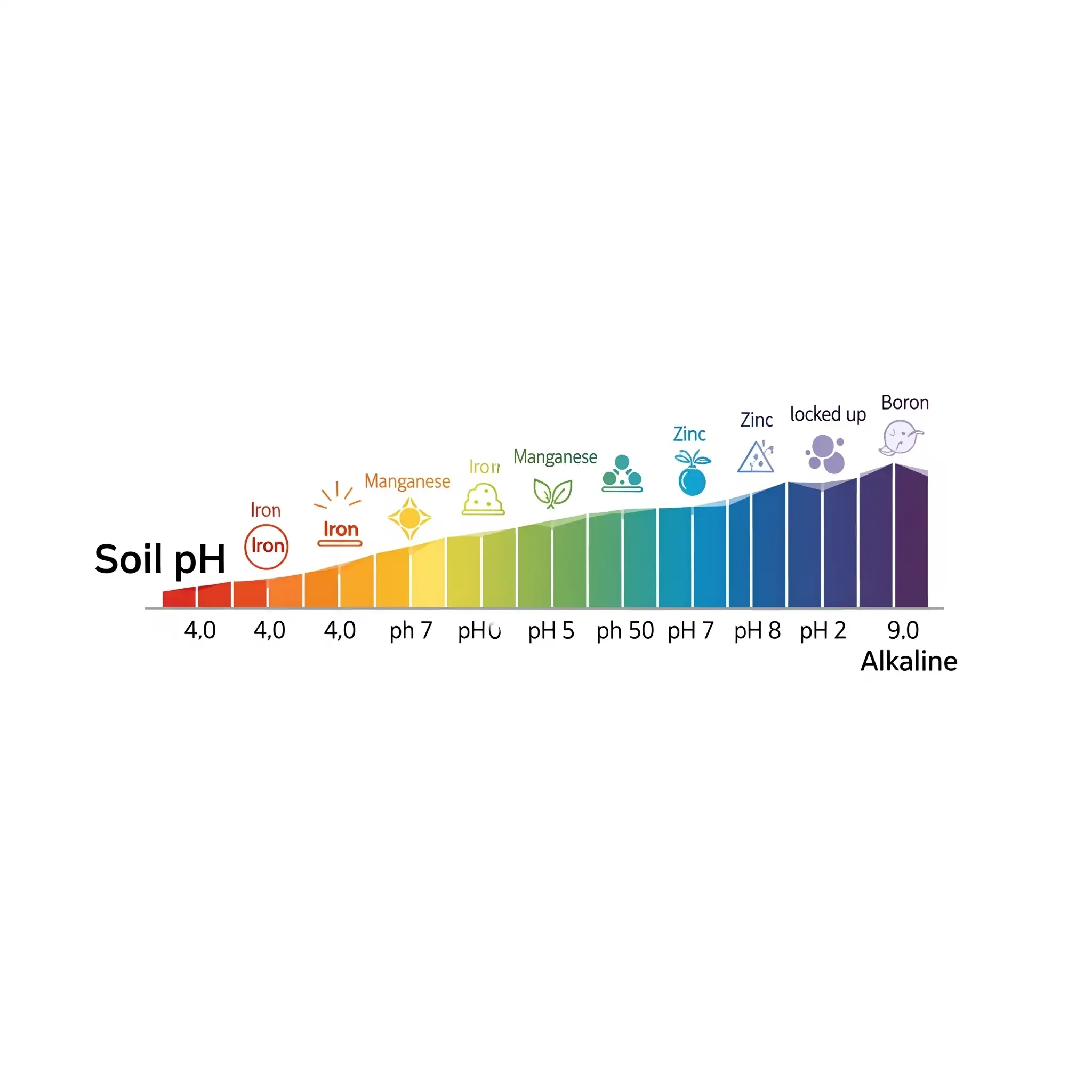
Iron provides the clearest example. In neutral to alkaline soil (pH above 6.5), iron ions react with hydroxide to form ferric hydroxide — an insoluble compound roots cannot absorb. The iron is physically present throughout the soil, but bound in a form roots can’t access. This is why acid-loving plants like azaleas, blueberries, and rhododendrons show yellow leaves so often on alkaline soils: not because the soil lacks iron, but because the iron is locked away.
The same pH lockout affects manganese, zinc, and boron. The University of Delaware Cooperative Extension confirms that at alkaline pH, iron, manganese, zinc, and boron all shift into forms unavailable to plant roots. Clemson Cooperative Extension’s soil pH guide confirms that above pH 6.5, most micronutrients become significantly less available to plants.
Molybdenum is the important exception. It behaves in reverse. Research on molybdenum’s role in plant production shows that molybdenum becomes more soluble and available at higher pH — each pH unit increase approximately 100-fold increases molybdate solubility. Acidic soils below pH 5.5 strongly limit molybdenum availability. If your brassicas show molybdenum deficiency symptoms, lowering pH will make the problem worse.
A soil test that tells you your pH is the single most useful diagnostic tool for micronutrient deficiency — more useful than any visual symptom guide. A pH of 6.0 to 6.5 keeps the widest range of micronutrients accessible to most garden plants. Improving your soil’s organic matter content also helps — you can read more in our complete guide to improving garden soil.
All 8 Micronutrient Deficiencies at a Glance
Because all eight micronutrients are immobile once inside the plant, deficiency symptoms always appear first on the newest growth. This is the single most useful diagnostic principle: if yellowing or distortion starts at the tips of young leaves and new shoots, suspect a micronutrient. If symptoms appear on old leaves first, suspect a mobile nutrient — nitrogen, phosphorus, or magnesium.
| Micronutrient | Primary Visual Symptom | Leaves Affected First | pH Note | First Fix |
|---|---|---|---|---|
| Iron (Fe) | Interveinal chlorosis — yellow leaf, green veins | Youngest, newest | Worsens above pH 6.5 | Chelated iron, foliar or soil drench |
| Manganese (Mn) | Interveinal chlorosis, sometimes tan spots | Younger to mid-age leaves | Worsens above pH 6.0 | Manganese sulfate foliar spray |
| Zinc (Zn) | Interveinal chlorosis plus rosetting (bunched small leaves) | Terminal/new growth | Worsens above pH 7.0 | Zinc sulfate or chelated zinc |
| Copper (Cu) | Dark green wilting, stunted growth, blue-green tinge | New growth | Worse on sandy soils, not pH-driven | Dilute copper sulfate foliar spray |
| Boron (B) | Terminal bud death; distorted or hollow growth | Growing tips, fruit, root veg | Worsens above pH 7.0 and in drought | Borax soil drench — apply carefully |
| Molybdenum (Mo) | Pale leaves, twisted ‘whiptail’ in brassicas | Older leaves (unusual) | Worsens on ACIDIC soil — opposite of others | Raise pH with lime; sodium molybdate |
| Chlorine (Cl) | Wilting, tip chlorosis, small leaves | Youngest leaves | Rarely deficient outdoors | Usually no action needed |
| Nickel (Ni) | Leaf tip necrosis; seeds fail to germinate | New growth | Worse in leached sandy soils | Usually no action needed |
Iron: The Most Common Micronutrient Deficiency
Iron deficiency is the problem gardeners encounter most often, particularly in high-pH soils, recently limed beds, hard-water areas, and container plants that have been watered with alkaline tap water for months.
The symptom is interveinal chlorosis on the youngest leaves: the leaf turns yellow but the veins stay sharp green. As the deficiency deepens, the contrast sharpens until the leaf approaches white, and new shoots begin to die back from the tip. According to Iowa State University Extension, in susceptible trees like pin oak and river birch, untreated iron deficiency can cause gradual branch dieback over several years.
Why do young leaves show symptoms first? Iron is immobile inside the plant — once deposited in older tissue, it stays there. When iron supply falls short, the plant cannot redistribute existing iron to new growth, so young leaves emerge already deficient.
Penn State Extension identifies high growing-media pH as the most common cause of iron deficiency in garden and container plants. Before adding iron fertilizer, check your soil pH. If it reads above 6.5, the iron may already be in your soil — it just needs the pH brought down to become accessible. In my experience, correcting pH first before applying chelated iron gives lasting results; without that correction, the deficiency returns every growing season.
For treatment, chelated iron outperforms simple iron sulfate on alkaline soils because the chelate holds iron in soluble form across a wider pH range. EDDHA chelates remain effective up to pH 9, while EDTA breaks down above pH 6.5. For container plants, the RHS recommends liquid seaweed products containing sequestered iron as a gentle, reliable correction.
Stop guessing your soil pH.
Enter your soil type and test reading — get exact lime or sulfur rates for your plants in seconds.
→ Calculate Soil NeedsIf you grow acid-loving plants like azaleas, rhododendrons, or blueberries, maintaining soil pH between 4.5 and 5.5 is the most effective long-term iron strategy — more reliable than annual chelated iron applications.
Manganese: Iron’s Look-Alike That Hits Different Leaves
Manganese deficiency looks almost identical to iron deficiency: interveinal chlorosis with veins staying green. The key diagnostic difference is which leaves are affected first. Iron deficiency hits the newest leaves hardest because iron is immobile and goes to new growth when supply is short. Manganese deficiency typically shows more prominently on slightly older, mid-canopy leaves — though the RHS notes there is meaningful overlap and soil testing is the reliable way to distinguish the two.
The mechanism matters here. Manganese is essential for photosynthesis specifically because it drives the water-splitting reaction in Photosystem II — the step where the plant extracts electrons from water molecules to power the whole system. Without enough manganese, the photosynthetic electron pump runs at reduced capacity, which is why chlorosis appears unevenly rather than all at once.
Maples are particularly vulnerable to manganese deficiency, especially those planted in limey or high-pH soils. According to Iowa State University Extension, manganese chlorosis in maples is common across the upper Midwest, where native soil pH tends toward alkaline.
Treatment: the RHS and University of Minnesota Extension both recommend foliar sprays containing manganese sulfate for quick correction. Foliar feeding bypasses the soil pH problem entirely — the leaf absorbs manganese directly through its surface. Two to three applications spaced three weeks apart are usually needed for full recovery. Simultaneously, soil acidification prevents recurrence.
Zinc: When Rosetting Joins the Chlorosis
Zinc deficiency produces a distinctive combination that sets it apart from iron and manganese: interveinal chlorosis on new leaves paired with ‘rosetting’ — the terminal leaves cluster together in an abnormally tight bunch because zinc is required for auxin synthesis, and without sufficient auxin the internodes between leaves fail to elongate. The result looks almost like a miniature cabbage at every growing tip.
This stunted, bunched growth habit is the clearest distinction from iron deficiency. Both cause interveinal chlorosis on young leaves, but iron-deficient plants maintain their normal growth habit while zinc-deficient plants look compressed and abnormal at the tips.
According to the PMC review on plant micronutrients, zinc is the central cofactor for enzymes controlling DNA transcription, RNA processing, and translation — functions fundamental to every dividing cell. This explains why growing tips suffer first and most severely: the cells that need to divide rapidly to create new leaves simply cannot function without zinc.
Zinc availability drops sharply above soil pH 7.0. High phosphorus levels can also block zinc uptake by competing at the same root absorption sites — a relevant factor if you’ve recently applied a phosphorus-heavy fertilizer. According to the UA Cooperative Extension guide, zinc sulfate or chelated zinc applied as a soil drench or foliar spray corrects most deficiencies within two to four weeks.
Copper: The Stealth Deficiency
Copper deficiency is genuinely rare in most garden soils because copper is naturally abundant and plants need very little of it. When it does occur — most commonly in sandy, low-organic-matter soils or heavily cropped fields — the symptoms are distinctive enough to distinguish from the more common deficiencies.
Rather than the typical yellowing, copper-deficient plants often appear unusually dark green, with wilting new growth despite adequate moisture. The UA Cooperative Extension guide describes stunted, darkened shoots that eventually die back from the tips in severe cases. Copper plays a central role in lignin synthesis — the compound that makes stems rigid — and in photosynthetic electron transport through the plastocyanin protein. When copper is short, young stems become floppy before showing any color change.
Treatment is a dilute foliar spray with copper sulfate. Copper toxicity is a real risk if over-applied: it accumulates in soil and damages earthworm populations at elevated concentrations. Apply conservatively and only based on a confirmed soil or tissue test, not a suspected deficiency.
Boron: The Double-Edged Micronutrient
Boron has the narrowest gap between deficiency and toxicity of any micronutrient. Penn State Extension flags this explicitly: it is easier to accidentally over-apply boron than any other trace element, and the symptoms of toxicity (scorched leaf margins, yellowing leaf tips) can appear at application rates only slightly above the correction dose.
Boron deficiency shows up primarily in growing tips, flower buds, and storage organs rather than leaves alone. In cauliflower and broccoli, it causes hollow stems and brown, crumbling curd. In celery, brown cracks appear through the stalks. In turnips and swedes, the heart discolors and rots from the inside. In strawberries, it produces distorted, misshapen fruit. The RHS explains why: boron is essential for cell wall formation, so the symptom is tissue death at the exact points of maximum cell division and growth — tips, hearts, developing seeds.
Drought stress worsens boron deficiency by reducing the transpiration stream that carries dissolved boron through the plant. Deficiency symptoms often appear during dry spells even when soil boron levels are technically adequate — the delivery mechanism breaks down before the supply does. Consistent, even watering helps prevent this.
If a soil test confirms boron deficiency, borax applied to soil at one to two ounces per 100 square feet is the standard correction. Do not exceed this rate or apply without testing first.
Molybdenum: The One That Works in Reverse
Molybdenum breaks the rules that apply to every other micronutrient. It’s the least abundant of the eight in plant tissue, it has a reversed pH relationship, and its deficiency often looks more like nitrogen deficiency than a trace element problem.
Where iron, zinc, manganese, and boron become less available as pH rises, molybdenum becomes more available. Research on molybdenum’s role in plant production shows that every pH unit increase approximately 100-fold increases molybdate solubility in soil. Acidic soils below pH 5.5 strongly restrict molybdenum availability through increased adsorption onto soil oxides.
The practical implication: if your brassicas (broccoli, cauliflower, cabbage, kale) show yellowing leaves and the characteristic twisted, cup-shaped growth the RHS calls ‘whiptail’, applying lime to raise pH is often the correct response — even before adding molybdenum fertilizer. A pH adjustment from 5.5 to 6.5 can dramatically increase the molybdenum already present in soil.
Molybdenum is also essential for nitrogen fixation in legumes. The nitrogen-fixing bacteria in root nodules require it to function. Without adequate molybdenum, beans, peas, and clovers behave as though nitrogen-starved even in otherwise fertile soil. This is a misdiagnosis that leads gardeners to over-apply nitrogen when the real problem is an acidic soil limiting molybdenum.
Chlorine and Nickel: The Overlooked Two
Chlorine and nickel complete the list of eight essential micronutrients, but deficiency in either is genuinely rare in garden settings.
Chlorine is required for the water-splitting step in Photosystem II and for stomatal regulation. Garden soils almost always contain adequate chlorine — most irrigation water, rain, and atmospheric deposition supply far more than plants need. Container plants grown exclusively on distilled or heavily purified water could theoretically show deficiency (wilting, tip chlorosis on young leaves), but this is uncommon in practice.
Nickel was the last element confirmed as essential for plants, added to the official list in 1987. It’s the catalyst for urease, the enzyme that converts urea into a plant-usable form of nitrogen. Nickel deficiency causes a specific symptom: necrosis at leaf tips and failure of seeds to germinate properly. Like chlorine, deficiency rarely occurs in field soils — contamination from tools, dust, and water is usually enough. The cases that do occur are in highly acidic, leached, sandy soils with very low organic matter. UConn Extension confirms that both elements are essential micronutrients, noting that deficiency, while rare, rounds out the diagnostic picture.
How to Fix Micronutrient Deficiencies (Start Here)

Before buying any product, get a soil test. County cooperative extension offices and university labs test for pH and key nutrients for $15 to $40. Without a test, you risk treating the wrong deficiency or adding a nutrient that’s already present at sufficient levels.
Step 1: Correct pH first. For most micronutrient deficiencies (iron, manganese, zinc, copper, boron), target pH 6.0 to 6.5. If your soil tests above 6.5, aluminum sulfate lowers pH quickly (effect within days to weeks), while elemental sulfur lowers it more slowly but more durably (bacterial conversion takes weeks to months depending on temperature and moisture). Clemson Cooperative Extension recommends applying sulfur at least two to three months before planting when possible. For acid-loving plants, target 4.5 to 5.5 rather than the general 6.0 to 6.5 range. Note: if you suspect molybdenum deficiency in brassicas, raise pH rather than lower it.
Step 2: Choose the right form. Chelated micronutrients (EDTA, EDDHA, DTPA chelates) stay soluble and available across a wider pH range than sulfate forms. If your soil pH is above 7.0 and you can’t easily lower it, chelated forms are essential. Below pH 7.0, sulfate forms (iron sulfate, manganese sulfate, zinc sulfate) work reliably and cost less. Our organic vs. synthetic fertilizer guide covers the broader trade-offs in product selection.

Step 3: Add organic matter consistently. Well-aged compost and organic mulches increase soil organic matter, which naturally chelates micronutrients and releases them gradually as it decomposes. Organic matter also buffers against pH swings that cause lockout. For more on building soil structure, see our guide to improving garden soil.
Step 4: For container plants, use a micronutrient-complete liquid fertilizer or a seaweed-based product. The RHS specifically recommends these for containers because frequent watering leaches trace elements faster than field soil can replenish them. Learn the full approach in our guide to fertilizing houseplants.
Toxicity warning. More is not better. Boron and copper are both toxic at concentrations only slightly above their optimal range — copper in particular accumulates in soil over time. If you’ve applied micronutrient products recently, test before applying again. For help recognizing over-application symptoms, see our article on identifying and fixing fertilizer burn.
Frequently Asked Questions
Can a 10-10-10 fertilizer fix a micronutrient deficiency?
No. Standard NPK fertilizers don’t contain iron, manganese, zinc, copper, boron, molybdenum, chlorine, or nickel. You need a product specifically labeled as a micronutrient supplement or a complete trace element blend. Check the label for each element by name before buying.
My plant has yellow leaves with green veins. Is it iron or manganese?
Both cause interveinal chlorosis, but the affected leaf age differs. Iron deficiency appears on the youngest, newest leaves first. Manganese deficiency typically shows on slightly older, mid-canopy leaves. If you can’t tell from leaf age alone, a soil test will confirm which is low — or both may be affected simultaneously in high-pH soils.
How quickly does chelated iron work?
Foliar applications of chelated iron show improvement within one to two weeks as the treated leaves green up. Severely yellowed leaves won’t recover — they’ll be replaced by healthy green growth from new shoots. For persistent problems, address soil pH alongside the foliar treatment so new growth has access to iron through the roots.
My cauliflower has twisted leaves and hollow stems. What’s causing it?
Twisted leaves in cauliflower — the symptom the RHS calls ‘whiptail’ — typically indicate molybdenum deficiency, most common on acidic soil below pH 5.5. Hollow stems point to boron deficiency, particularly in dry conditions or soils high in calcium from overliming. Both can occur simultaneously. Test for each before treating, since the pH corrections for these two deficiencies point in opposite directions.
Do I need micronutrient supplements if I compost regularly?
Regular compost additions significantly reduce deficiency risk by replenishing trace elements lost to plant uptake and leaching. However, pH problems can still lock out nutrients even in compost-rich soil. Periodic pH monitoring — every two to three years — catches problems before deficiency symptoms appear.
Key Takeaways
The eight plant micronutrients — iron, manganese, zinc, copper, boron, molybdenum, chlorine, and nickel — are the difference between plants that survive and plants that thrive. Standard fertilizers don’t supply them, and most deficiencies are caused not by absent nutrients but by soil pH conditions that lock available nutrients away from roots.
Start with a soil test and your pH. Fix pH first. Then target specific deficiencies with the right product form — chelated for alkaline soils, sulfate forms for neutral to slightly acid conditions. Add compost consistently, and you’ll build soil that supplies micronutrients steadily without constant intervention.
Sources
- PMC/NIH — The Elements of Plant Micronutrients
- RHS — Nutrient Deficiencies
- Penn State Extension — Principles of Plant Nutrition: Essential Nutrients, Function, Deficiency, and Excess
- UA Cooperative Extension — Guide to Symptoms of Plant Nutrient Deficiencies
- University of Delaware Extension — Identifying Nutrient Deficiencies in Ornamental Plants
- UConn Home and Garden Education Center — Watch Out for These Nutrient Deficiency Symptoms
- PMC — The Role of Molybdenum in Agricultural Plant Production
- Clemson Cooperative Extension HGIC — Changing the pH of Your Soil
- Iowa State University Extension — Micronutrient Deficiencies of Trees


