

12 Bedroom Plants That Purify Air: Ranked by What the Science Actually Shows

These 12 bedroom plants are ranked by actual research — not just the 1989 NASA study. Find out which ones produce oxygen while you sleep.
Plants won’t replace your air purifier. A 2019 meta-analysis of 196 chamber experiments found the median clean air delivery rate for a single potted plant is just 0.023 m³ per hour — and you’d need somewhere between 10 and 1,000 plants per square meter of floor space to match the air exchange that ordinary building ventilation provides for free. The American Lung Association is blunt: open a window for 10 minutes and you’ll do more for your bedroom air quality than a shelf of pothos.
So why does this guide exist? Because plants do three things a HEPA filter can’t. Certain species use Crassulacean Acid Metabolism to release oxygen specifically at night — the hours you’re sleeping in that sealed room. Others regulate humidity in dry, centrally heated bedrooms. And decades of biophilia research confirm that living plants lower cortisol and improve sleep quality independently of any VOC removal. This guide ranks 12 bedroom plants by the strength of the evidence behind them — not just the 1989 NASA study that every other list recycles.
Why Bedrooms Demand Different Plants
Most air-purifying plant guides are written for living rooms. Bedrooms impose four stricter requirements.
Low-light tolerance. Most bedrooms — especially north- or east-facing rooms — lack the bright indirect light many houseplants need. A struggling plant produces fewer active leaves and its air-purifying capacity drops with its health.

Three pre-planned garden beds, free
Stop staring at empty beds: printable plans with exact layouts, plant lists and planting calendars — yours free from the Garden Library.
You might also find mulches for tomatoes ranked moisture helpful here.
CAM photosynthesis. Standard C3 plants close their stomata at night, stop absorbing CO₂, and switch to releasing it. CAM (Crassulacean Acid Metabolism) plants invert this: they fix carbon dioxide at night and release oxygen in darkness. This is a real desert-evolved adaptation — found in snake plants, aloe vera, gerbera daisies, and orchids — that makes them the only plants actively improving your bedroom air while you sleep.
Pollen. If you have allergies or asthma, a flowering plant releasing pollen while you sleep 7–8 hours can trigger symptoms. Many of the strongest air-purifying species (snake plant, pothos, aglaonema) are foliage-only and shed no airborne pollen indoors.
Humidity. Central heating drops bedroom humidity to 20–30% in winter. Peace lily, areca palm, and Boston fern transpire enough moisture to nudge humidity meaningfully upward in a small bedroom, helping prevent dry mucous membranes that disrupt sleep.
The 12 Best Bedroom Plants for Air Quality
Each plant below is graded by the evidence behind its air-purifying claims: Grade A = multiple peer-reviewed studies with specific removal data; Grade B = tested in the original NASA study and cited in university extension research; Grade C = traditional recommendation with emerging or limited peer-reviewed bedroom-scale data.
| Plant | Evidence | CAM (night O₂) | Low-Light | Pet Safe |
|---|---|---|---|---|
| Snake plant | A | Yes | Excellent | No |
| Spider plant | A | No | Good | Yes |
| Peace lily | A | No | Good | No |
| Golden pothos | A | No | Excellent | No |
| Dracaena | B | No | Good | No |
| Gerbera daisy | B | Yes | Poor | Yes |
| Aglaonema | B | No | Excellent | No |
| English ivy | B | No | Good | No |
| Rubber plant | B | No | Good | No |
| Areca palm | B | No | Poor | Yes |
| Aloe vera | C | Yes | Poor | No |
| Boston fern | B | No | Good | Yes |
1. Snake Plant (Dracaena trifasciata) — Grade A

The snake plant tops this list because of one physiological trait no other common bedroom plant has as reliably: it’s a CAM plant. After dark, it opens its stomata, absorbs carbon dioxide, and releases oxygen — the opposite of what most plants do while you sleep. University of Connecticut Extension cites NASA research confirming it removes benzene, formaldehyde, trichloroethylene, xylene, and toluene from sealed air. It also tolerates extremely low light and needs watering only every 2–6 weeks, making it virtually indestructible for a beginner. In my experience growing snake plants in north-facing rooms where other air-purifying species gave up within a season, it’s the only one that maintained healthy leaf growth and coloration through winter without supplemental lighting.
Bedroom care: Bright indirect light preferred but tolerates deep shade; water only when the top two inches of soil are fully dry; avoid waterlogged soil — root rot is the main failure mode. Thrives between 60–80°F. See our snake plant care guide for full details.
Pet safety: Contains saponins. Toxic to cats and dogs (drooling, nausea, vomiting). Place on a high shelf if pets share the bedroom.
2. Spider Plant (Chlorophytum comosum) — Grade A
Spider plant has some of the most specific removal data of any plant you can buy at a garden center. A 2022 peer-reviewed systematic review (PMC10005924) recorded 95% formaldehyde removal efficiency and a 56% reduction in PM2.5 particulate matter — fine particles from road traffic, cooking fumes, and candles small enough to penetrate deep into the lungs. For a bedroom near a busy road or in a recently renovated apartment, those numbers are real.
It’s also the safest choice on this list for homes with cats and dogs. Unlike most strong performers, it’s listed as non-toxic by the ASPCA. The cascading spiderettes it sends out on long runners propagate easily — one plant becomes five in a season.
Bedroom care: Low to medium light; water when the top inch of soil dries out; avoid direct sun, which bleaches the leaves. Excellent in a hanging planter or at the edge of a shelf. See our spider plant care guide.
Pet safety: Non-toxic to cats and dogs (ASPCA).
3. Peace Lily (Spathiphyllum spp.) — Grade A
Peace lily is one of the best-documented air-purifying plants across multiple independent reviews, including the original NASA study (benzene, formaldehyde) and a 2021 peer-reviewed review (PMC8279815) that confirmed it among the plants with demonstrated VOC removal capacity. In a bedroom, it offers a secondary benefit few competitors provide: it transpires significant moisture continuously, acting as a passive humidifier in dry, heated rooms. It also droops visibly when thirsty — a built-in watering indicator that removes any guesswork.
Bedroom care: Performs best in bright indirect light; tolerates low light with slower growth. Keep soil consistently moist. Mist leaves occasionally in dry conditions.
Stop killing plants with wrong watering.
Select your plant, pot size, and climate zone — get a precise watering schedule with amounts and timing.
→ Build Watering SchedulePet safety: Toxic to cats, dogs, and horses — contains insoluble calcium oxalate crystals causing oral irritation, drooling, vomiting, and difficulty swallowing (ASPCA). Not suitable for bedrooms with free-roaming pets.
4. Golden Pothos (Epipremnum aureum) — Grade A
Pothos earns Grade A with hard numbers: the 2022 systematic review (PMC10005924) recorded 81–96% formaldehyde removal efficiency. Formaldehyde — the most common indoor VOC, released by furniture, flooring, and pressed-wood products — is the pollutant most likely at elevated levels in a newly furnished bedroom. Pothos attacks it reliably, and it’s the most forgiving plant on this list: it tolerates irregular watering, low light, neglect, and temperature swings better than any other Grade A species.
The trailing habit makes high shelves its natural home — keeping it out of reach of pets and children, both important since pothos is toxic to both.
Bedroom care: Tolerates low light well, though growth slows; water when the top two inches dry out; trim vines at 6–8 feet to maintain vigour. Full guide: pothos care guide.
Pet safety: Toxic to cats, dogs, and young children (calcium oxalate). Keep out of reach.
5. Dracaena (Dracaena fragrans) — Grade B
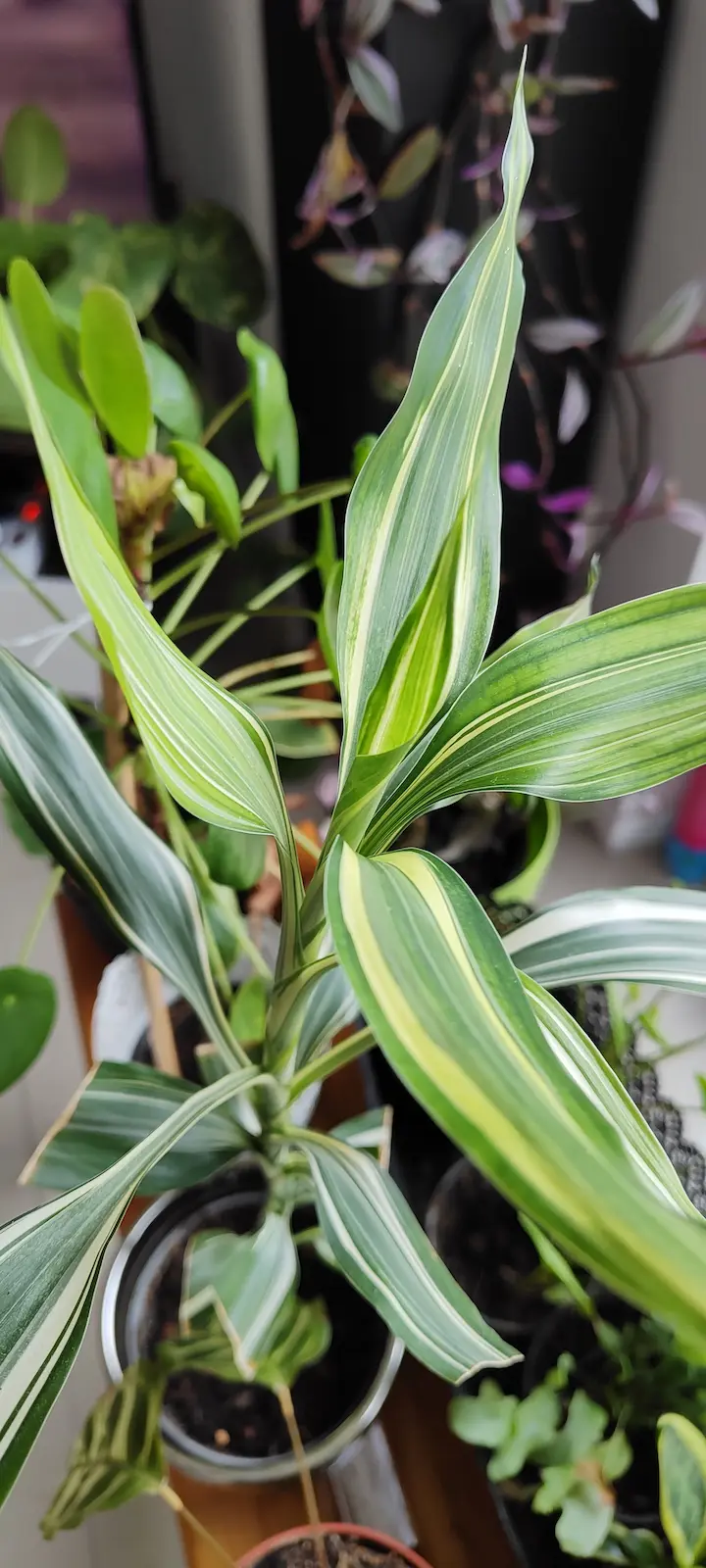
Dracaena is one of the most-tested genera from the 1989 NASA study. University of Connecticut Extension cites specific data: the Warneck dracaena removed 50% of formaldehyde from sealed chamber air in 24 hours. A 2022 systematic review added that Dracaena sanderiana removed 60–77% of benzene over 72 hours. With over 40 species in the genus, the corn plant (D. fragrans) is the most widely available bedroom variety — compact enough for most rooms and tolerant of moderate shade.
Bedroom care: Bright indirect light preferred; tolerates medium light. Water when the top inch dries. Sensitive to fluoride in tap water — brown leaf tips often mean fluoride buildup. Use filtered or rainwater where possible. Compare varieties in our Dracaena marginata vs. fragrans guide.
Pet safety: Toxic to cats and dogs (saponins). Keep out of reach.
6. Gerbera Daisy (Gerbera jamesonii) — Grade B

The gerbera daisy is one of the only flowering plants on this list with a genuine bedroom-specific advantage. University of Connecticut Extension explicitly lists it among the species that continue to produce oxygen at night — unusual for a flowering plant. NASA’s study also confirmed it removes benzene and trichloroethylene. Those two properties together — nighttime CAM oxygen production and meaningful VOC removal — make it stand out from most other flowering houseplants.
They look similar but grow very differently — schefflera vs umbrella plant explains.
The limitation is light. Gerbera needs bright, direct or bright indirect light to thrive. It belongs on a south- or east-facing windowsill, not a shaded corner. Treat it as a seasonal indoor plant — most cultivars perform well for one to two years before declining.
Bedroom care: 4–6 hours of bright light daily; keep soil moist but well-drained; deadhead spent blooms to extend flowering; water at the base to prevent crown rot.
Pet safety: Non-toxic to cats and dogs (ASPCA).
7. Aglaonema / Chinese Evergreen — Grade B

Aglaonema earns its place specifically for low-light performance. It tolerates darker conditions than almost any other plant on this list — making it ideal for north-facing bedrooms or windowless rooms where other plants would fail. UF/IFAS Extension describes it as growing 1–3 feet tall with minimal care requirements, and NASA’s research found it effective against formaldehyde and benzene. Full care details are in our Chinese evergreen care guide.
One note: red and pink cultivars are striking but need considerably more light than plain green varieties. In a dark bedroom, choose a green cultivar.
Bedroom care: Low to medium light; water when the top inch of soil dries out; avoid temperatures below 60°F and cold drafts from windows or AC units.
Pet safety: Toxic to cats and dogs (calcium oxalate). Not suitable for bedrooms shared with pets that roam freely.
8. English Ivy (Hedera helix) — Grade B

English ivy removes benzene and formaldehyde according to NASA’s original study and is referenced across multiple university extension guides. Its trailing growth habit makes it natural for hanging planters or high shelves, which has the added benefit of keeping it away from pets while maximizing exposed leaf surface area. In a slightly damp bedroom or basement room, ivy is worth prioritizing — it handles humidity fluctuations better than most.
Two cautions: ivy causes contact dermatitis in some people who handle it frequently (wear gloves when pruning), and it’s toxic to pets. See our comparison of English ivy vs. pothos if you’re deciding between the two.
Bedroom care: Moderate indirect light; keep soil consistently moist; mist leaves in dry conditions to prevent spider mites. Prefers cooler temperatures (50–70°F) over warm, centrally heated rooms.
Pet safety: Toxic to cats and dogs. Place on a high shelf or in a hanging planter out of reach.
9. Rubber Plant (Ficus elastica) — Grade B

The rubber plant’s large, glossy leaves give it a structural advantage: more leaf surface area means more stomata, which means more contact with room air. A 2021 peer-reviewed review (PMC8279815) included the closely related Ficus benjamina among plants with documented removal of formaldehyde, benzene, xylene, and toluene. Ficus elastica shares the same genus and similar leaf physiology. In a bright bedroom, a single mature rubber plant covers more air volume than two or three compact plants.
The practical note: rubber plants can reach 6 feet indoors and dislike being moved. Choose a permanent spot in bright indirect light and leave it there.
Bedroom care: Bright indirect light; water when the top two inches of soil dry out; wipe dust from leaves monthly to keep stomata unobstructed. Avoid cold drafts. Full guide: rubber plant care guide.
Pet safety: Toxic to cats, dogs, and humans (latex sap and ficin enzyme cause skin irritation). Handle with gloves when pruning.
10. Areca Palm (Dypsis lutescens) — Grade B
The areca palm has impressive chamber-study numbers: the 2022 systematic review (PMC10005924) recorded 88% total VOC removal and 96% carbon monoxide reduction. It also transpires roughly one liter of moisture per day — more than any other plant on this list — making it genuinely effective at raising humidity in dry, heated bedrooms. The ASPCA lists it as non-toxic to cats and dogs, which is rare for a plant with this level of VOC performance.
The bedroom limitation is light. Areca palms need bright indirect light and decline slowly in shade. For a well-lit bedroom, it’s an excellent choice. For darker rooms, choose snake plant, aglaonema, or pothos instead. Tips for maximizing humidity from your plants: how to increase indoor humidity.
Bedroom care: Bright indirect light; water when the top inch dries out; mist fronds or use a pebble tray with water to support the plant’s own transpiration cycle.
Pet safety: Non-toxic to cats and dogs (ASPCA).
11. Aloe Vera — Grade C
Aloe earns its place as a CAM plant that produces oxygen at night — a genuine bedroom benefit shared only by snake plant, gerbera, and orchids on this list. NASA’s original study also found some formaldehyde removal capacity. Grade C reflects the lighter body of peer-reviewed bedroom-scale data compared to the Grade A and B plants above, and the significant light requirement that prevents it from performing well in most UK bedrooms or north-facing rooms. A stressed, light-deprived aloe doesn’t purify air effectively.
Place it on a south or east windowsill where it gets at least 4 hours of direct or bright indirect light. Secondary benefit: fresh aloe gel remains one of the most effective first-aid remedies for minor burns.
Bedroom care: Bright light essential; water only when the soil is bone dry (every 3–4 weeks in winter); terra cotta pot preferred for better drainage. Full details in our aloe vera care guide.
Pet safety: Toxic to cats and dogs (saponins and anthraquinones). Keep out of reach.
12. Boston Fern (Nephrolepis exaltata) — Grade B
Boston fern removes PM10 particulate matter at 92% efficiency — the highest particulate removal rate of any plant on this list, according to the 2022 systematic review. It’s also a strong formaldehyde absorber and one of the most effective passive humidifiers available. The ASPCA lists it as non-toxic to cats and dogs, making it a rare combination: strong evidence, high effectiveness, and pet-safe.
The trade-off is maintenance. Boston ferns need constant soil moisture — fronds brown within days if the soil dries out — and prefer humidity above 50%. In a centrally heated bedroom, this means daily misting or a dedicated humidity tray. If you can meet those conditions, it’s one of the best performers on the list. If not, spider plant delivers similar results with a fraction of the effort.
Bedroom care: Indirect light; water frequently to maintain consistent moisture; mist daily or use a pebble tray. Avoid heating vents and cold drafts. See our guide to best low-light indoor plants for bedrooms where ferns won’t thrive.
Pet safety: Non-toxic to cats and dogs (ASPCA).
The Soil Secret: Why the Pot Matters as Much as the Plant
The most important finding from recent research isn’t about which plant to buy — it’s about where most of the purifying actually happens. The 2022 systematic review (PMC10005924) found that root zone microorganisms perform approximately 90% of VOC removal, with just 10% coming from leaf surfaces. The plants in NASA’s original study weren’t filtering the air through their leaves alone; they were feeding a microbial community in the soil doing most of the biochemical work.
Choosing between these two? norfolk island pine vs araucaria breaks down the pros and cons.
Two practical consequences: First, keep the soil surface exposed. UF/IFAS Extension notes that leaf litter and decorative mulch blocking the soil surface reduces microbial air-cleaning effectiveness. Don’t pile decorative stones over the potting mix. Second, avoid overwatering. Waterlogged, anaerobic soil suppresses the aerobic microorganisms that degrade VOCs and instead encourages mold growth, which can trigger allergies and respiratory irritation. A healthy, well-draining soil with active microbial life outperforms an identical plant in dense, compacted potting mix every time.
How Many Plants Does Your Bedroom Actually Need?
Honestly, the research is humbling. The 2019 Cummings and Waring meta-analysis found that the median clean air delivery rate for a single plant is 0.023 m³ per hour, and you’d need 10–1,000 plants per square meter of floor space to match the natural air exchange that standard building ventilation provides. The American Lung Association estimates roughly 680 plants in a 1,500-square-foot home for meaningful VOC reduction — a figure that reframes any four-pot arrangement as symbolic rather than medicinal.
The practical middle ground: University of Connecticut Extension and NASA both recommend one healthy plant in a 6- to 8-inch pot per 100 square feet. For a typical 150-square-foot bedroom, that’s 1–2 plants. At that density, don’t expect dramatic VOC reduction. Do expect modest humidity improvement, genuine nighttime oxygen from CAM species, documented reductions in cortisol and psychological stress, and real (if modest) particulate and VOC filtering.
The most effective combined strategy: 1–2 well-chosen plants prioritizing CAM species for night oxygen, plus opening your window for 10–15 minutes each morning. Indoor air accumulates pollutants overnight and is typically 2–5 times more contaminated than outdoor air — ventilation is the one intervention that consistently outperforms everything else.
They look similar but grow very differently — air plant vs moss ball explains.
Frequently Asked Questions
Do bedroom plants actually purify the air?
Yes, with realistic expectations. Plants remove VOCs, reduce particulate matter, and regulate humidity through well-documented processes. In a real bedroom at 1–2 plants, the air quality impact is smaller than a dedicated HEPA purifier but real and cumulative — especially for CAM species producing oxygen overnight. The biggest single improvement is still ventilation: 10 minutes of open windows each morning.
Which single plant is best for a bedroom?
Snake plant for dark or low-light bedrooms — it tolerates near-shade and produces oxygen at night. Peace lily for brighter rooms without pets — it combines strong multi-VOC removal with passive humidity regulation. Spider plant if you have cats or dogs — the highest-performing non-toxic option on this list.
Are any of these plants safe for cats and dogs?
Four are non-toxic according to the ASPCA: spider plant, gerbera daisy, areca palm, and Boston fern. The remaining eight (snake plant, peace lily, pothos, dracaena, aglaonema, English ivy, rubber plant, aloe vera) are toxic to pets to varying degrees. Always verify current information on the ASPCA Animal Poison Control database before introducing any new plant to a home with pets.
Should I worry about plants releasing CO₂ at night?
No. Standard plants do switch from oxygen production to CO₂ release at night, but the quantities are too small to affect a bedroom’s air composition measurably. A sleeping adult exhales roughly 200 ml of CO₂ per minute; a potted plant produces a fraction of that. CAM plants (snake plant, aloe, gerbera) reverse this entirely and release oxygen overnight. Nighttime CO₂ from plants is not a reason to remove them from your bedroom.
Sources
- University of Connecticut CAHNR — Houseplants for Healthier Indoor Air
- UF/IFAS Extension — Houseplants That Clean the Air
- Cummings & Waring (2019) — Potted plants do not improve indoor air quality: a review and analysis of reported VOC removal efficiencies (PubMed)
- American Lung Association — Actually, Houseplants Don’t Clean the Air
- PMC10005924 — A Systematic Review on Mitigation of Indoor Air Pollutants Using Plant-Based Methods (2022)
- PMC8279815 — The Role of Indoor Plants in Air Purification and Human Health (2021)
- ASPCA Animal Poison Control — Peace Lily Toxicity


