

How to Increase Humidity for Indoor Plants: 9 Methods Ranked by Effectiveness, Cost, and Room Size

Pebble trays raise humidity by just 3–7%. Here are 9 methods to increase humidity for indoor plants, ranked by effectiveness, cost, and the room size they can actually cover.

A pebble tray raises the humidity around your plant by 3 to 7 percent — measured right at the water surface, 1.5 inches above the tray. Drop six inches higher, and that gain disappears entirely. Your calathea, sitting at pot height, feels none of it.
This is the calibration problem that frustrates most indoor gardeners: the common advice — pebble trays, misting, bathroom placement — ranges from marginally effective to genuinely useless for plants with real humidity needs. Meanwhile, the methods that work well — humidifiers, plant grouping, terrariums — often get a single sentence with no guidance on which fits your room size, budget, or plant collection.
This guide covers the biology of why humidity matters, the actual measured effectiveness of each method, and a ranked comparison across nine approaches — including cost, room size, and ongoing maintenance. Sources include Penn State Extension, University of Nebraska Extension, UNH Extension, UF/IFAS Extension, and two peer-reviewed studies on vapor pressure deficit and stomatal physiology.
Why Humidity Matters: The Transpiration and Stomatal Mechanism
Plants lose water through their leaves constantly. The process — transpiration — happens through microscopic pores called stomata, and its rate is governed not by the number you read on a hygrometer but by something more precise: vapor pressure deficit (VPD).

Free printable garden plans for when you’re ready to grow outside too
Three pre-planned beds — pollinator, kitchen and cut-flower — from the free Blooming Expert Garden Library.
VPD is the gap between how much moisture the air actually holds and how much it could hold at saturation. When your heated living room drops to 25% relative humidity in January, VPD spikes sharply. A steep water-vapor gradient forms across your plant’s leaf surfaces, pulling moisture out faster than the roots can replace it [8].
Here’s why VPD matters more than raw humidity readings: the same 70% relative humidity produces a VPD of 0.55 kPa at 60°F but jumps to 1.45 kPa at 90°F — nearly three times the water stress from what looks like identical conditions on your hygrometer, according to Michigan State University Extension [6]. Temperature and humidity interact, and VPD captures that interaction.
The plant’s response to rising VPD is immediate. Guard cells flanking each stomatal pore sense the drying air and, within minutes, ramp up production of abscisic acid (ABA) — a stress hormone synthesized autonomously inside the guard cells themselves [9]. ABA activates ion channels that expel potassium and chloride from the guard cells, deflating them. The stomata close.
Closed stomata stop water loss. But they also block carbon dioxide from entering the leaf. No CO₂ means no photosynthesis. Research published in New Phytologist found that sustained high VPD suppresses stomatal conductance and eventually drives reduced plant growth through carbon starvation and hydraulic failure in the water-conducting tissue [7]. For tropical species that evolved in forests where humidity rarely dips below 60%, the dry air of a centrally heated US home in January is a chronic physiological stressor.
The brown tips and crispy leaf edges you see are the downstream result of this cascade. Marginal tissue loses turgor pressure first because the thin cells there have the least water reserve. If low humidity persists, new leaves emerge smaller and without characteristic features — the plant is rationing, not sick. Damaged tissue won’t recover; adequate humidity protects the next leaf, not the current one.
How Much Humidity Do Your Plants Actually Need?
Not every houseplant needs the same target. Knowing your plant’s requirement lets you choose the right method — or combination — instead of over-engineering a solution for plants that don’t need it.
| Humidity Range | Plant Examples | Notes |
|---|---|---|
| Low: 20–40% RH | Cacti, succulents (Echeveria, Sedum, Aloe), ZZ Plant, Snake Plant, Cast Iron Plant (Aspidistra) | Evolved in arid conditions; excess humidity risks rot and fungal disease. Standard US homes suit these fine year-round. |
| Medium: 40–60% RH | Pothos, Philodendron, Monstera, Dracaena, Rubber Plant, Fiddle Leaf Fig, Aglaonema | Most US homes reach this range in summer. Winter heating is the main challenge. |
| High: 60–80% RH | Calathea, Prayer Plant (Maranta), Ferns, Nerve Plant (Fittonia), Orchids, Bromeliads, Air Plants (Tillandsia), Peace Lily, Rex Begonia | These are the plants most at risk in heated US homes. Nebraska Extension confirms they need 70–80% for genuine health [4]. |
The practical tension: Nebraska Extension notes that humans are comfortable at 30–50% RH, while most tropical plants want 70–80% [4]. For a mixed collection, aim for 50–60% as a compromise — acceptable for medium-need plants and within reach for most humidity-raising methods.
Before committing to any method, measure your baseline with a hygrometer. US homes on forced-air heat in January commonly read 20–30% RH. That gap tells you exactly how hard any method needs to work — and whether one approach alone can close it or you’ll need to layer two or three.
9 Methods to Increase Humidity for Indoor Plants, Ranked
Each method below is rated by how much it actually raises humidity, what it costs to set up and maintain, and how large an area it covers. Methods are ordered from most to least effective.
1. Whole-Home HVAC Humidifier
Effectiveness: Very High — maintains target RH throughout entire home
Initial cost: $200–600+ (professional installation required)
Ongoing cost: Lowest per-room cost when spread across whole home
Coverage: Entire home
Maintenance: Annual professional service
A bypass or fan-powered humidifier integrated into your HVAC system is the most comprehensive solution for homes with plants in multiple rooms. It monitors and maintains a set humidity level automatically, requires no daily attention, and typically uses less energy per unit of humidity delivered than multiple portable units running simultaneously [4].
The drawback is upfront cost and the need for professional installation. If your humidity problem is concentrated in one or two rooms, a portable unit delivers the same result for significantly less. Whole-home units shine when you’re running a serious plant collection across several spaces in a cold-climate home where winter humidity routinely drops below 25%.
2. Portable Humidifier (Ultrasonic or Evaporative)

Effectiveness: Very High — controllable to any target RH level
Initial cost: $30–250 depending on capacity and features
Ongoing cost: Electricity + filter replacement for evaporative models
Coverage: Single room (matched to unit capacity)
Maintenance: Weekly cleaning to prevent mold and mineral buildup
Stop killing plants with wrong watering.
Select your plant, pot size, and climate zone — get a precise watering schedule with amounts and timing.
→ Build Watering ScheduleA portable humidifier placed close to your plants is the most practical single-purchase solution for most indoor gardeners, according to UNH Extension [2]. It’s the only method that lets you dial in a specific target — say, 55% RH — and hold it regardless of how dry the outside air gets.
Ultrasonic vs. evaporative: Ultrasonic humidifiers vibrate water into a cool mist and run quietly; the trade-off is white mineral dust on nearby surfaces if you use hard tap water (use distilled or filtered water to prevent this). Evaporative models blow air through a wet wick; they self-regulate and won’t over-humidify, but the wick needs periodic replacement. Warm-mist (steam) humidifiers produce sterile moisture but are slightly less energy-efficient. Any type works well for plants.
Place the unit 3–6 feet from your plant cluster, not aimed directly at foliage. Excessive direct misting from a humidifier can cause fungal spots on leaves. Clean the water tank weekly — a humidifier circulating contaminated water does more harm than dry air.
3. Grouping Plants Together
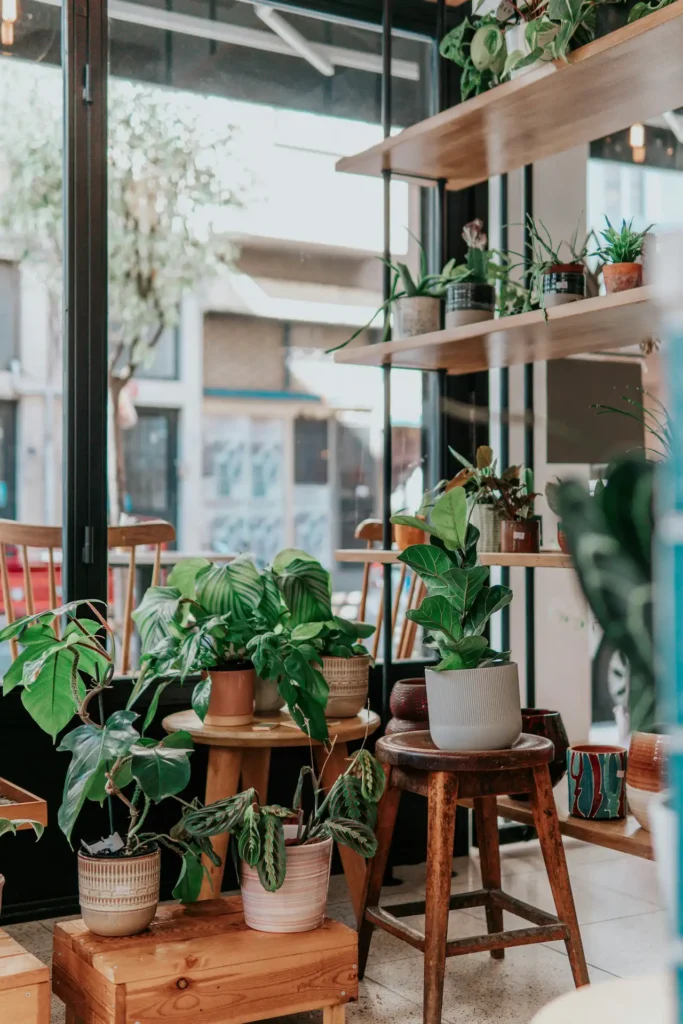
Effectiveness: High — up to 15% RH increase in the cluster microclimate
Initial cost: Free
Ongoing cost: None
Coverage: 3–4 feet around the cluster
Maintenance: Inspect regularly for pests (dense groupings can shelter them)
Every plant releases water vapor through its leaves via transpiration. When you group plants together, their collective transpiration raises the humidity in the air immediately surrounding them — creating a microclimate that benefits the whole cluster [4]. The effect is localized but real: Nebraska Extension describes the result as “a small pocket of slightly higher humidity,” and growers consistently report meaningful differences in leaf health between clustered and isolated specimens of the same species [4].
Group strategically. UF/IFAS Extension recommends separating plants by humidity requirement: put your calatheas, ferns, and orchids together; keep succulents and cacti in a separate area, since elevated humidity increases their rot risk [5]. Low-airflow spots — away from heating vents and ceiling fans — help the microclimate persist longer between watering cycles.
Grouping works best as part of a layered strategy. Plants clustered together on a large pebble tray, near a humidifier, achieve humidity levels that no single method sustains alone.
4. Bathroom or Kitchen Placement
Effectiveness: Moderate — naturally 40–60% RH in actively used bathrooms
Initial cost: Free
Ongoing cost: None
Coverage: Whole small room
Maintenance: Monitor light levels and temperature swings
Bathrooms and kitchens maintain higher ambient humidity than the rest of the house because of daily water use — showers, cooking, dishwashing. An active bathroom in a US household typically runs 40–60% RH during the day, making it genuinely suitable for medium-humidity plants like ferns, pothos, and peace lilies without any additional intervention [2].
The constraint is light. Most bathrooms have limited or no natural light, and interior kitchens are often not much better. Penn State Extension notes this as the key variable: the humidity benefit is real, but only plants tolerating low-to-medium light will survive long-term in most bathrooms [1]. Ferns, pothos, and small philodendrons are good candidates. Fiddle leaf figs and orchids needing bright indirect light are not.
Temperature fluctuation is a secondary concern. Bathrooms can spike during showers and cool rapidly afterward, which stresses temperature-sensitive species like calatheas. If the plant is going in the bathroom, choose one that tolerates both the humidity variation and the temperature swings.
5. Terrarium, Glass Cloche, or Bottle Garden
Effectiveness: High within enclosure — maintains 60–90% RH inside
Initial cost: $20–200+ depending on container size
Ongoing cost: Negligible
Coverage: Single plant or small collection inside the enclosure
Maintenance: Occasional ventilation; monitor for mold and excess condensation
Closed or semi-closed glass containers trap water vapor from plant transpiration and soil evaporation, recycling it back into the immediate environment, according to Penn State Extension [1]. The result is a consistently high-humidity microclimate that requires no electricity and almost no ongoing effort.
This method suits small, slow-growing plants with genuinely high humidity needs: nerve plants (Fittonia), small ferns, mosses, miniature orchids, and Tillandsia. UNH Extension notes that unused fish tanks work as makeshift terrariums during winter months — a cost-effective option if you have one in storage [2].
The limitation is ventilation. Fully sealed containers develop mold on soil and roots. Leave a small gap, or open the lid for 30 minutes daily. A sealed terrarium is impractical for large plants or any species needing good air movement — it’s a targeted tool, not a universal solution.
6. Double-Potting with Moist Sphagnum Moss
Effectiveness: Moderate — steady low-rate evaporation around root zone
Initial cost: $5–15 for dried sphagnum moss
Ongoing cost: Periodic remoistening of moss
Coverage: Individual plant
Maintenance: Check moss moisture monthly; watch for mold
Place your plant’s nursery pot inside a slightly larger decorative pot and fill the gap between the two with moist sphagnum moss or coco coir. As the moss slowly releases moisture through evaporation, it raises the humidity in the air directly surrounding the foliage — the zone that matters most for leaf health.
This method won’t raise room humidity, but it creates a localized buffer that can mean the difference between crispy leaf margins and healthy tissue on a single treasured plant. It’s particularly useful for orchids (which naturally grow with roots exposed to humid air in forest environments) and for calatheas positioned on a low-light shelf far from the main humidifier.
Keep the moss damp but not saturated — squeeze it and only a drop or two should emerge. Saturated moss in a confined gap leads to rot at the base of the nursery pot. If white mold appears on the moss surface, reduce moisture and improve airflow around the pot.
7. Pebble Tray
Effectiveness: Low — 3–7% RH increase at 1.5 inches above water; zero measurable effect at 12 inches
Initial cost: $5–20 for tray and pebbles
Ongoing cost: None (refill water weekly)
Coverage: Immediate vicinity only
Maintenance: Weekly refill; monthly cleaning to prevent algae
Pebble trays have an outsized reputation. The theory is sound — water evaporating below the plant raises surrounding humidity — but independent measurements by plant enthusiasts using hygrometers tell a more honest story. At 1.5 inches above the water surface, relative humidity increases by 3–7% (more in summer, less in winter). At 12 inches above the tray — roughly where your plant’s leaves actually are — there is no measurable effect.
Penn State Extension confirms this: the water vapor diffuses into the whole room, making “almost no overall impact on the relative humidity” [1]. For plants that need 60–80% RH and are sitting in 25% winter air, a pebble tray alone does not close the gap.
Where pebble trays do help: as a supplement to other methods, particularly plant grouping. Use a tray that’s large relative to the pot — more water surface area means more evaporation. Always keep the pot base above the waterline to prevent root rot. For a deeper look at using LECA substrates with pebble-style setups, see our guide on monstera humidity with LECA pebbles.
8. Open Water Containers Near Heat Sources
Effectiveness: Low to Moderate — modest local evaporation; most effective near radiators or heating vents
Initial cost: Free
Ongoing cost: None (refill weekly)
Coverage: Very localized (1–2 feet radius)
Maintenance: Change water weekly to prevent stagnation
Placing bowls or vases of water near your plants — or on top of radiators or near heating vents — accelerates evaporation and adds moisture to the surrounding air. UF/IFAS Extension mentions this approach as a low-effort complement to other methods, noting that even cut flowers in vases nearby contribute to local humidity as their water evaporates [5].
The effect is similar in scale to a pebble tray but covers a slightly larger radius when heat is actively driving evaporation rather than relying on ambient temperature alone. It won’t transform a dry room, but it’s a zero-cost supplement in homes where a radiator or vent already sits near your plant shelf.
Change the water at least weekly — stagnant water in warm areas breeds bacteria. Wide, shallow containers evaporate more water per hour than deep narrow ones.
9. Misting
Effectiveness: Very Low — humidity returns to baseline within 2–5 minutes
Initial cost: Free to $15 for a spray bottle
Ongoing cost: None
Coverage: Individual plant, temporary only
Maintenance: Daily spraying (with negligible lasting benefit)
Misting is the most popular humidity advice online and the least effective in practice. Penn State Extension states directly: “After a plant is misted, a rise in humidity only lasts until the water evaporates. This can happen in a matter of minutes” [1]. Nebraska Extension goes further: to make a real difference through misting alone, you would need to spray your plants every few minutes, continuously [4]. The brief spikes between sessions accomplish nothing meaningful for chronic humidity stress.
I’ve kept a calathea on a misting-only regimen through a January in a heated apartment — brown tips continued appearing on every new leaf regardless of how often I sprayed. Switching to a small humidifier stopped the browning within two weeks. That gap in outcomes is what the science predicts: VPD doesn’t respond to momentary spikes.
Where misting does provide genuine benefit: removing dust from large-leaved plants (which improves light absorption and gas exchange), providing temporary moisture for Tillandsia and other air plants between soakings, and refreshing foliage during extreme heat spikes. Think of it as plant hygiene, not humidity management.
The risk side: misting fuzzy-leaved plants like African violets causes water to sit in the leaf hairs, promoting fungal disease. In cool rooms with poor air circulation, misting encourages gray mold (Botrytis) on dense-foliage plants. University of Maryland Extension recommends misting only in the morning so foliage dries completely before evening [3]. If you have succulents, skip misting altogether.
Method Comparison: Effectiveness, Cost, and Room Coverage
| Method | Effectiveness | Setup Cost | Coverage | Maintenance |
|---|---|---|---|---|
| Whole-home HVAC humidifier | Very High | $200–600+ | Entire home | Annual service |
| Portable humidifier | Very High | $30–250 | Single room | Weekly cleaning |
| Terrarium / glass cloche | High (enclosed) | $20–200 | Single plant | Occasional ventilation |
| Grouping plants | High (localized) | Free | 3–4 ft radius | Pest checks |
| Bathroom / kitchen | Moderate | Free | Small room | Monitor light |
| Double-pot + sphagnum | Moderate | $5–15 | Single plant | Monthly remoistening |
| Open water containers | Low to moderate | Free | 1–2 ft radius | Weekly water change |
| Pebble tray | Low | $5–20 | 1–2 ft radius | Weekly refill + clean |
| Misting | Very Low | $0–15 | Minutes only | Daily (negligible benefit) |
Layering Methods for Maximum Effect
No single method works equally well in every situation. Combining two or three approaches produces more reliable results than relying on one.
Large open living room with multiple tropicals: A portable humidifier combined with plant grouping is the most effective and cost-efficient pairing. The humidifier provides the bulk of the humidity lift; grouping maintains a slightly elevated microclimate between humidifier cycles. Add a hygrometer to confirm you’re holding 50–60% before calling it done.
Single treasured high-humidity plant in a dry room: Double-pot with moist sphagnum, place it on a large pebble tray, and position it near (not directly in front of) a small ultrasonic humidifier. All three layers target the immediate vicinity of one plant and can maintain 65–70% RH around an individual calathea or nerve plant without humidifying an entire room.
Budget constraint, no humidifier: Group all your humidity-loving plants together in the most naturally humid room available (often a kitchen). Add open water containers near any heat source, and supplement with a pebble tray under the group. This won’t reach 70% RH in a heated winter room, but it can push a 25% baseline up to 35–40% — enough to prevent the worst browning in moderate-need plants.
Small, high-humidity species (nerve plant, small fern, Tillandsia): A terrarium or sealed glass cloche eliminates the need for any other method. These enclosed environments sustain near-tropical humidity with no electricity and almost no maintenance. Pair with appropriate soil and manage airflow carefully to prevent mold buildup.
Signs You’re Using Too Much Humidity
Over-humidifying is a real risk, especially in smaller rooms or around low-humidity plants. The upper safe limit for most plant collections is 60% RH; for strict tropicals, 80% is the ceiling. Above those thresholds, problems accumulate faster than benefits.
Signs of excess humidity:
- Persistent condensation on windowpanes or glass surfaces near plants
- Gray or white mold (Botrytis or powdery mildew) on soil surface or lower leaves
- Soft, black rot at the base of stems — especially in succulents or cacti
- Yellow leaves and poor growth despite correct light and watering
- Musty smell near the plant cluster
If you observe any of these, reduce humidifier output, space plants slightly apart to improve airflow, and check that drainage holes aren’t blocked. MSU Extension notes that zero VPD — 100% saturation — is as problematic as extreme dryness: plants need to transpire to move nutrients through their vascular system, and completely saturated air shuts that process down [6].
Low-humidity plants — succulents, cacti, aglaonema, ZZ plants, snake plants — should never share a humidifier’s range with your tropical collection. Keep them separated, or skip humidity methods for that corner of the room entirely.
Frequently Asked Questions
What is the fastest way to increase humidity for indoor plants?
A portable humidifier. It can raise room humidity by 20–30 percentage points within an hour and maintain that level indefinitely. Grouping plants is the second fastest free option, though the effect is smaller and more localized.
Do pebble trays actually work?
They produce a measurable but very small effect: 3–7% RH increase directly above the water surface, dropping to zero by 12 inches up. For plants sitting at table height in a dry room, the benefit is negligible as a standalone method. Use pebble trays as a supplement, not a primary strategy [1].
How often should I mist my plants for humidity?
Misting should not be your primary humidity strategy. The effect lasts 2–5 minutes before humidity returns to baseline. Misting is useful for leaf cleaning and refreshing air plants, but not for sustained humidity management.
What humidity level do most indoor plants need?
Most tropical houseplants thrive at 50–60% RH. High-humidity plants (calatheas, ferns, nerve plants, orchids) prefer 60–80%. Low-humidity plants (succulents, cacti, snake plants, ZZ plants) are comfortable at 20–40% and can suffer if pushed higher [2][4].
Can I increase humidity without a humidifier?
Yes, though the ceiling is lower. Grouping plants in a naturally humid room with a pebble tray and open water containers can realistically add 10–15% RH above ambient. For plants needing 60%+ in a 25% winter environment, that combination likely won’t be enough without a humidifier or terrarium enclosure.
Will overwatering my plants increase humidity?
No — it causes root rot. The humidity plants benefit from is in the air, not the soil. Overwatered soil creates anaerobic conditions that rot roots and block the water uptake the plant needs to stay turgid. For watering guidance by plant type, see our guide on how often to water indoor plants.
Sources
- Penn State Extension — Humidity and Houseplants
- UNH Extension — How Can I Increase Humidity Indoors for My Houseplants?
- University of Maryland Extension — Temperature and Humidity for Indoor Plants
- Nebraska Extension (Lancaster County) — Success with Houseplants – Humidity
- UF/IFAS Extension Duval County — Houseplants and Humidity in NE Florida Winters
- MSU Extension — Why Should Greenhouse Growers Pay Attention to Vapor Pressure Deficit?
- Grossiord et al. (2020) — Plant responses to rising vapor pressure deficit. New Phytologist
- UNL Passel2 — Transpiration – Factors Affecting Rates of Transpiration
- PMC — Mechanisms of abscisic acid-mediated control of stomatal aperture


