

Rubber Plant (Ficus elastica) Complete Care Guide: 8 Varieties, Light, Pruning and Propagation

Everything you need to grow a thriving rubber plant indoors: varieties from Burgundy to Tineke, light, watering, pruning for shape, propagation by air layering, and how to fix common problems like leaf drop and leggy growth.
The rubber plant is one of those houseplants that looks like it belongs in the lobby of a boutique hotel — tall, sculptural, with thick glossy leaves that catch the light in a way few other indoor plants can match. And unlike many statement plants that demand fussy care to justify their looks, Ficus elastica is remarkably tolerant of the kind of benign neglect most of us actually provide.
Originally from the tropical forests of Southeast Asia — specifically northeast India, Nepal, Myanmar, Malaysia, and Indonesia — the rubber plant earned its common name from the milky white latex sap it produces when cut, which was once tapped commercially for natural rubber before Hevea brasiliensis (the Para rubber tree) replaced it as the industrial standard. In its native habitat, it grows into a genuine tree reaching 30 metres or more, with aerial roots thick enough to support massive canopies. Indoors, it stays far more manageable — typically 1 to 2.5 metres — but retains that same architectural presence that makes it one of the most popular houseplants worldwide.
What makes the rubber plant particularly rewarding is how clearly it communicates. Drooping leaves mean thirst. Leaf drop signals stress from cold, overwatering, or a sudden move. Leggy, stretched growth tells you it needs more light. Once you learn to read these signals, keeping a rubber plant happy becomes genuinely straightforward.
This guide covers the full picture: which variety suits your space, complete care requirements, how to prune and shape your plant for the look you want, propagation methods that actually work, and an honest breakdown of the problems you’re most likely to encounter.

Three pre-planned garden beds, free
Stop staring at empty beds: printable plans with exact layouts, plant lists and planting calendars — yours free from the Garden Library.
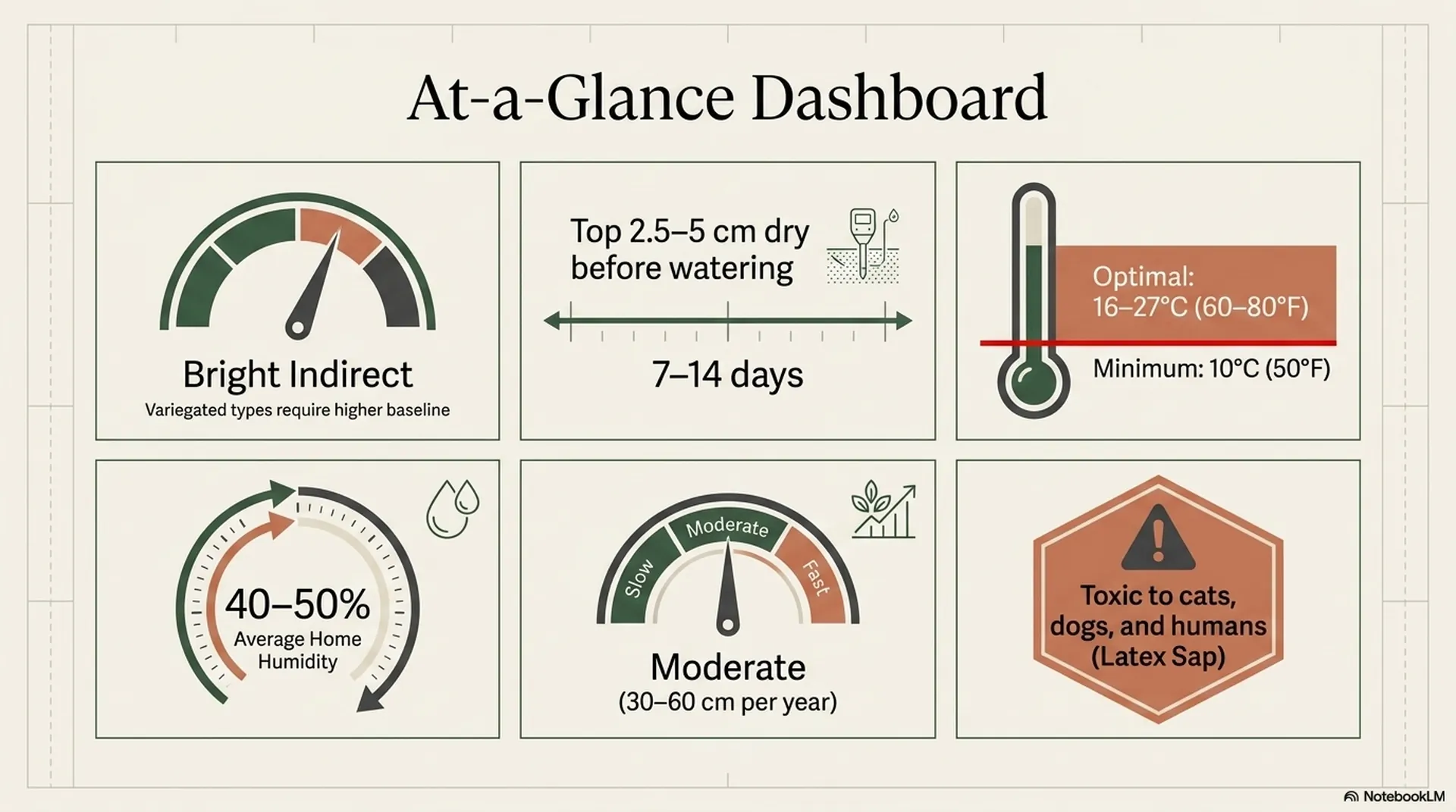
Rubber Plant at a Glance
| Care Factor | Requirement |
|---|---|
| Botanical name | Ficus elastica |
| Family | Moraceae (fig family) |
| Light | Bright indirect; tolerates medium light (variegated types need more) |
| Watering | Every 7–14 days; top 2.5–5 cm dry before watering |
| Temperature | 16–27°C (60–80°F); minimum 10°C (50°F) |
| Humidity | 40–50%+; tolerates average home humidity |
| Soil | Well-draining, slightly acidic to neutral (pH 5.5–7.0) |
| Fertiliser | Balanced liquid, half-strength, monthly spring–summer |
| Mature size (indoors) | 1–2.5 m (3–8 feet) |
| Growth rate | Moderate — 30–60 cm per year in good conditions |
| Toxic | Yes — cats, dogs, and humans (latex sap is a skin and eye irritant) |
Rubber Plant Varieties
The species plant — plain green Ficus elastica — is handsome enough on its own, but the cultivars are where it gets interesting. Each has distinctive colouring, and the care requirements shift slightly depending on how much variegation is present.

‘Burgundy’ (F. elastica ‘Burgundy’) — The most widely sold cultivar. New leaves emerge a deep, almost black-red and mature to very dark green with a burgundy underside. In bright light, the leaves hold their dark colouring beautifully; in lower light, they tend to revert toward plain green. This is the easiest variety to find and one of the most forgiving — a reliable choice for first-time rubber plant owners [1].
‘Tineke’ (F. elastica ‘Tineke’) — A variegated cultivar with leaves patterned in shades of green, cream, and white, often with a pink or rosy blush on the new growth sheaths. Tineke needs brighter light than solid-green varieties to maintain its variegation — in low light, new leaves come in progressively greener and the plant loses its distinctive look. This is one of the most popular variegated houseplants on the market, and for good reason: the colour variation is genuinely striking [3].
‘Ruby’ (F. elastica ‘Ruby’) — Similar to Tineke in pattern but with much more pronounced pink and red tones, particularly in the new growth. The variegation is tricolour: deep green, creamy white, and vivid pink-red. Ruby needs the most light of any rubber plant variety to maintain its colours — anything less than bright indirect light and the vibrant pinks fade significantly. It also tends to grow more slowly than solid-coloured types.
‘Robusta’ (F. elastica ‘Robusta’) — The largest-leaved cultivar, with broad, thick, deep green leaves that can reach 30 cm long. As the name suggests, this is the most vigorous grower of the group — it responds particularly well to good care with rapid, upright growth. If you want a big, bold, uncomplicated rubber plant that fills a corner quickly, Robusta is the one to choose [2].
‘Shivereana’ (F. elastica ‘Shivereana’) — A more unusual cultivar with mottled, camouflage-style variegation in shades of sage green, lime, and cream. The pattern is unique — no two leaves look quite the same. Shivereana is slower-growing and less commonly available than the varieties above, but its distinctiveness makes it sought after by collectors. Like other variegated types, it needs bright indirect light to maintain its patterning.
| Variety | Leaf Colour | Light Need | Best For |
|---|---|---|---|
| Burgundy | Deep red-black to dark green | Medium to bright indirect | Beginners; darker rooms |
| Tineke | Green, cream, white with pink sheaths | Bright indirect | Statement plant; decorative interest |
| Ruby | Green, cream, vivid pink-red | Bright indirect (high) | Colour-focused displays |
| Robusta | Deep green, extra-large leaves | Medium to bright indirect | Fast growth; filling large spaces |
| Shivereana | Mottled sage, lime, cream | Bright indirect | Collectors; unique patterning |
Light Requirements
Rubber plants are often labelled as low-light tolerant, and while they won’t die in a dim corner, they won’t thrive there either. In low light, growth slows dramatically, internodes stretch, leaves come in smaller, and variegated cultivars lose their colour. A rubber plant in a truly dark spot becomes leggy and sparse within a single growing season.
The ideal position is bright indirect light — near an east or west-facing window where the plant receives several hours of filtered light without prolonged direct sun hitting the leaves. In practice, a spot 1–2 metres from a south-facing window (with a sheer curtain or set to the side) also works well [1][2].
Some direct morning sun is actually beneficial, particularly for variegated varieties like Tineke and Ruby that need higher light to maintain their colouring. An hour or two of gentle morning sun from an east window won’t burn the leaves and helps the plant produce denser, more compact growth. What you want to avoid is intense afternoon sun — sustained direct sunlight from a south or west window can scorch the leaves, leaving brown, crispy patches that won’t recover [1].
The key signal to watch: if your rubber plant is producing small leaves with increasingly long gaps between them (leggy growth), it needs more light. Move it closer to a window and you’ll see the difference within a few weeks as new growth comes in tighter and more compact.
Solid-green varieties (Burgundy, Robusta) are the most adaptable to lower light conditions. Variegated types (Tineke, Ruby, Shivereana) should always be kept in the brightest spot you can offer without direct afternoon sun — their chlorophyll-poor variegated sections make them less efficient at photosynthesis, so they need more light to compensate.
Watering
Overwatering kills more rubber plants than any other mistake. These are not plants that want to sit in constantly moist soil — their thick, waxy leaves store water efficiently, and their roots rot quickly in soggy conditions.

The approach is simple: let the top 2.5–5 cm (1–2 inches) of soil dry out between waterings, then water thoroughly until it drains from the bottom of the pot. In summer, this typically means watering every 7–10 days; in winter, every 10–14 days or even less frequently as growth slows and the plant draws less water from the soil [1][2].
Stop missing your zone's planting windows.
Select your US zone and month — get a complete checklist of what to plant, prune, feed, and protect right now.
→ View My Garden CalendarPush your finger into the soil to check — if it feels moist at finger depth, wait. If it feels dry, water deeply and let the excess drain completely. Never leave a rubber plant sitting in a saucer of standing water.
The classic signs of overwatering are yellow leaves (particularly lower leaves) that feel soft and mushy, and a general droopiness even though the soil is wet. If you see these signs combined, check the roots immediately — they should be white or light tan. Black, mushy roots mean root rot has set in and you’ll need to repot into fresh, dry soil after trimming the damaged roots [1].
Underwatering is far less dangerous — the plant simply droops and lower leaves may curl inward. Water thoroughly and it recovers within a day. Between the two extremes, rubber plants always prefer too dry over too wet.
Water quality isn’t a major concern for rubber plants the way it is for calatheas or peace lilies. Standard tap water is fine for most varieties, though if your water is heavily chlorinated, leaving it out overnight before use is a reasonable precaution.
Soil and Potting
Good drainage is the single most important factor in rubber plant soil. Dense, water-retentive potting mixes that work for moisture-loving plants are a recipe for root rot with Ficus elastica.

A reliable mix: one part standard potting compost, one part perlite or coarse sand, and one part pine bark. This creates the fast-draining, well-aerated substrate that rubber plants need while retaining enough moisture to sustain growth between waterings. The ideal pH range is slightly acidic to neutral — 5.5 to 7.0 — and most standard potting mixes fall within this range without amendment [1][3].
Choose a pot with drainage holes — this is non-negotiable. Decorative pots without drainage work only if you use them as outer covers (cachepots) with a draining nursery pot inside, and you empty any accumulated water promptly after watering.
Repot every two to three years, or when roots begin circling the bottom of the pot or growing through drainage holes. Move up one pot size (2.5–5 cm larger in diameter) — rubber plants don’t mind being slightly pot-bound, and an oversized pot holds excess moisture that increases root rot risk. Spring is the best time to repot, when the plant is entering its active growth phase [2].
Temperature and Humidity
Rubber plants tolerate a wide temperature range by houseplant standards, performing well between 16–27°C (60–80°F). They’ll survive brief dips to 10°C (50°F) but sustained cold causes leaf drop, particularly from the lower branches. Keep them away from draughty windows in winter and never position them where cold night air pools around the pot [1][2].
Equally important: avoid sudden temperature swings. Moving a rubber plant from a warm room to a cold hallway, or placing it near a heating vent that cycles on and off, can trigger leaf drop even if the average temperature is within range. Consistency matters more than hitting a specific number.
Humidity is less critical for rubber plants than for many tropical houseplants. They perform perfectly well in average home humidity (40–50%) and show no particular stress in the 30–40% range that’s common in centrally heated homes during winter [2]. If you notice brown leaf edges — which is uncommon with rubber plants — a pebble tray or occasional misting can help, but most owners never need to worry about supplemental humidity.
This humidity tolerance is one of the rubber plant’s practical advantages over more demanding tropicals like calatheas and ferns. It’s a plant that genuinely adapts to the conditions most people already have in their homes, without requiring humidifiers or bathroom placement.
Fertilising
Rubber plants are moderate feeders during the growing season and don’t need feeding at all in winter.
Apply a balanced liquid fertiliser (such as 10-10-10 or 20-20-20) at half the recommended strength, once a month from April through September. Stop feeding entirely from October to March — the plant’s growth slows significantly in winter and surplus nutrients accumulate as harmful salts in the soil [1].
Signs of over-fertilising include a white crust on the soil surface, brown leaf tips, and in severe cases, wilting despite adequate watering (salt burn on roots). If you suspect overfeeding, flush the soil thoroughly with plain water — run water through the pot for several minutes to dissolve and wash out accumulated salts.
For variegated varieties, some growers use a slightly higher-nitrogen formula to support the plant’s reduced photosynthetic capacity, but this isn’t essential. The standard balanced approach works well for all varieties.
Pruning and Shaping
Left to its own devices, a rubber plant grows as a single unbranched stem — straight up, adding one leaf at a time, until it reaches the ceiling or you run out of patience. This columnar habit looks elegant when the plant is young, but eventually most owners want a fuller, bushier shape. That requires pruning.

Encouraging Branching
Rubber plants exhibit strong apical dominance — the growing tip at the top of the stem produces hormones that suppress side branching. Remove that tip, and the suppressed lateral buds below it activate, producing two or more new branches.
To encourage branching, cut the main stem just above a leaf node in spring or early summer, when the plant is actively growing. Use sharp, clean secateurs and make the cut at a 45-degree angle. New growth typically emerges from the two or three nodes immediately below the cut within four to six weeks [2].
For a bushier plant, you can repeat this process on the new branches once they’ve grown 15–20 cm. Each cut point typically produces two new branches, so a rubber plant that’s been pruned twice has four growing tips and a much fuller silhouette.
Managing Height
If your rubber plant has outgrown its space, cut the main stem to the desired height. The plant responds well to hard pruning — even cutting back to 30 cm above the soil line will produce new growth from dormant buds, though recovery takes longer with more severe cuts.
The pruned top section doesn’t need to go to waste — it’s an excellent candidate for propagation (see below).
Maintenance Pruning
Remove any dead, damaged, or yellowing leaves by cutting them at the base of the leaf stem. This keeps the plant looking tidy and redirects energy to healthy growth. Clean up any crossing branches that create a congested interior — good airflow through the canopy helps prevent fungal issues.
Important: Rubber plants bleed white latex sap from cut surfaces. This sap is sticky, stains fabric, and can irritate skin and eyes. Wear gloves when pruning, protect nearby surfaces, and dab the cut with a damp cloth to stop the flow. The sap also seals the wound naturally within minutes, so no wound sealant is needed.
Propagation
Rubber plants can be propagated by two methods: air layering and stem cuttings. Air layering has a significantly higher success rate and is the preferred method for experienced growers, while stem cuttings are simpler but less reliable. For a full step-by-step walkthrough of both methods — including the sap-rinsing technique most guides skip and a troubleshooting section for the most common failures — see our rubber plant propagation guide.

Air Layering (Recommended)
Air layering works by encouraging roots to form on a still-attached stem before you separate it from the parent plant. Because the cutting never has to survive without roots, the success rate is very high — typically 90% or better.
- Choose a healthy section of stem with at least two leaves. Make an upward-angled cut about one-third through the stem, roughly 30 cm below the tip.
- Insert a small piece of matchstick or toothpick into the cut to hold it open.
- Dust the wound with rooting hormone powder (optional but improves speed).
- Wrap the cut area with a generous handful of damp sphagnum moss, then wrap the moss tightly in cling film or a clear plastic bag, securing both ends with string or twist ties.
- Check the moss every week or two through the plastic — add water with a syringe if it begins to dry out.
- After four to eight weeks, you’ll see white roots growing through the moss. Once several roots are 5 cm or longer, cut the stem below the root ball and pot the new plant in moist potting mix [2][3].
The parent plant will produce new growth from below the cut point, often branching — so air layering doubles as both a propagation and a shaping technique.
Stem Cuttings
Take a 15–20 cm cutting from a healthy stem tip, with two to three leaves attached. Remove the lowest leaf, dip the cut end in rooting hormone, and plant in a moist mix of perlite and peat (or coir). Cover with a clear plastic bag to maintain humidity and place in bright indirect light.
The challenge with rubber plant cuttings is that the large leaves lose moisture faster than roots can form. Cutting the remaining leaves in half (horizontally) reduces transpiration and improves success rates. Even so, expect rooting to take six to eight weeks, with a success rate around 50–60% — considerably lower than air layering [3].
Water propagation is possible but unreliable for Ficus elastica. The stems tend to rot before rooting in water, particularly if the water isn’t changed frequently. Soil or perlite propagation with a humidity cover produces better results.
Latex Sap: Safety Warning
All parts of the rubber plant produce a milky white latex sap when cut or damaged. This sap is a natural defence mechanism and a significant irritant that deserves respect — it’s not merely cosmetic.

Skin contact causes irritation and contact dermatitis in sensitive individuals. Some people develop redness, itching, or a rash after handling cut stems without gloves. People with latex allergies should exercise particular caution, as Ficus elastica latex contains proteins that can cross-react with natural rubber latex allergies [1].
Eye contact is more serious — sap in the eyes causes burning, tearing, and temporary blurred vision. If this happens, flush the eye immediately with clean water for at least 15 minutes.
Ingestion causes oral irritation, drooling, and gastrointestinal upset in both humans and pets. The ASPCA classifies Ficus elastica as toxic to cats and dogs, with reported symptoms including vomiting, drooling, and decreased appetite [1].
Practical precautions:
- Wear gloves when pruning, propagating, or repotting
- Protect floors and furniture — latex sap stains fabric and wood
- Keep plants out of reach of cats, dogs, and small children
- Wash hands thoroughly after handling, even with gloves
- Dab cut surfaces with a damp cloth to stop sap flow quickly
Common Problems
| Problem | Most Likely Cause | Fix |
|---|---|---|
| Sudden leaf drop (multiple leaves) | Overwatering, cold draught, or sudden location change | Check soil moisture and roots; move away from cold; avoid relocating frequently |
| Yellow lower leaves | Overwatering or natural ageing | Reduce watering frequency; check drainage; a few lower leaves yellowing is normal |
| Leggy, stretched growth | Insufficient light | Move to brighter position; prune to encourage branching |
| Sticky leaves / tiny brown bumps | Scale insects | Wipe with rubbing alcohol on cotton buds; treat with neem oil or insecticidal soap |
| Brown, crispy leaf edges or patches | Sunburn from direct afternoon sun | Move to filtered light; damaged leaves won’t recover — prune and adjust position |
| Drooping leaves | Underwatering (if soil is dry) or root rot (if soil is wet) | Water if dry; inspect roots if soil is wet — trim mushy roots and repot |
| Variegation fading to green | Insufficient light for variegated cultivar | Move to brighter position immediately; new growth should show improved colour |
| White cottony masses in leaf joints | Mealybugs | Dab with rubbing alcohol; spray with neem oil; isolate plant from others |
A Note on Leaf Drop
Leaf drop is the most common complaint from rubber plant owners, and it’s worth understanding why it happens so frequently with this species. Ficus plants in general — including fiddle leaf figs and weeping figs — are notorious for dropping leaves in response to environmental changes. Moving a rubber plant to a new spot in the house, bringing it home from the garden centre, or even rotating it can trigger a flush of leaf loss [2].

The key is distinguishing between adjustment leaf drop (temporary, self-resolving within two to three weeks) and problem leaf drop (ongoing, caused by overwatering, cold, or pests). If the plant drops a handful of lower leaves after being moved but new growth continues at the top, that’s adjustment — leave it alone and let it settle. If leaves continue falling after three weeks, or if the plant drops young upper leaves, investigate watering, temperature, and root health.
Scale Insects and Sticky Leaves
Rubber plants are particularly prone to scale — small, brown, shell-like insects that attach to stems and the undersides of leaves. The telltale sign is sticky residue (honeydew) on the leaves and surrounding surfaces. Left untreated, scale weakens the plant, causes yellowing, and attracts sooty mould that blackens the leaves.
Treatment: wipe each visible scale insect with a cotton bud dipped in rubbing alcohol (isopropyl alcohol). Follow up with a neem oil spray applied to all leaf surfaces every seven days for three weeks to catch any insects you missed and to interrupt the breeding cycle. For severe infestations, a systemic insecticide may be necessary. Always isolate an infested plant from your other houseplants to prevent spread.
For a full diagnostic guide covering every rubber plant problem in depth — including the mechanism behind leaf drop, how to read brown spots by pattern, the overlooked fluoride cause of crispy leaf edges, and step-by-step emergency root rot protocol — see our rubber plant problems guide.
Frequently Asked Questions
How fast does a rubber plant grow?
In good conditions — bright indirect light, correct watering, and regular feeding during the growing season — expect 30–60 cm of new height per year. Variegated cultivars grow more slowly than solid-green types due to reduced chlorophyll. Growth essentially stops in winter regardless of conditions, which is normal. A rubber plant that hasn’t produced new leaves in months during summer likely needs more light or a larger pot.
Can I put my rubber plant outside in summer?
Yes, and many rubber plants respond exceptionally well to a summer outdoors. Place it in a sheltered spot with bright shade or dappled light — never direct midday sun, which scorches the leaves quickly after months indoors. Harden off gradually: start with a few hours of outdoor shade per day, increasing over a week. Bring it back inside when night temperatures consistently drop below 10°C (50°F). Watch for pests — outdoor plants are more exposed to spider mites and aphids, so inspect thoroughly before moving back indoors [2].
Why is my rubber plant leaning to one side?
Rubber plants grow toward their light source with remarkable persistence. A plant near a window will gradually lean toward the glass over weeks. The fix is simple: rotate the pot a quarter turn every week or two to encourage even, upright growth. If the lean is already pronounced, staking with a bamboo cane provides temporary support while the plant straightens out. Pruning the leaning top and allowing side branches to develop also creates a more balanced shape.
Is the rubber plant the same as the rubber tree used for making rubber?
No. The commercial rubber tree is Hevea brasiliensis, a completely different species from the Amazon basin. While Ficus elastica does produce latex sap — and was used for rubber production in small quantities in its native range — it was never the primary industrial source. The common name stuck because early European botanists noted the sap’s elastic properties. Today, Ficus elastica is grown almost exclusively as an ornamental plant [1].
Summary
The rubber plant’s appeal is straightforward: it’s a genuinely handsome plant with an architectural presence that most houseplants can’t match, and it’s far less demanding than it looks. Give it bright indirect light, let the soil dry between waterings, keep it away from cold draughts, and it will reward you with steady, upright growth and those thick, glossy leaves that make it one of the most recognisable houseplants in the world.
When it outgrows its space — and it will — prune confidently. Every cut produces new branches, and the pruned sections can become new plants through air layering. For step-by-step instructions on both methods, see our rubber plant propagation guide. Learn to read the plant’s signals: leaf drop means stress, leggy growth means more light, and sticky residue means scale. Address these promptly and a rubber plant will thrive for decades.
For more houseplant care guides — including plants that pair beautifully with rubber plants in a collection — explore our peace lily care guide, dieffenbachia guide, and our guide to the best houseplants for low-light rooms.

Sources
- Clemson Cooperative Extension. Rubber Plant. Home & Garden Information Center, Clemson University
- University of Minnesota Extension. Rubber Tree (Ficus elastica). UMN Extension
- NC State Extension. Ficus elastica (Rubber Plant). NC State Extension Gardener Plant Toolbox
- Royal Horticultural Society. Ficus elastica. RHS Plant Finder
- Why Your Rubber Plant Leaves Turn Yellow: 7 Specific Causes and the Fix for Each
- Rubber Plant Brown Tips: 6 Causes and How to Fix Them
- https://www.bloomingexpert.com/tips/rubber-plant/not-blooming/
- https://www.bloomingexpert.com/tips/rubber-plant/drooping-fix/
- Rubber Plant Dropping Leaves? Identify the Cause by Symptom Pattern
- curling leaves
- Rubber Plant Root Rot: 5 Causes and How to Fix Each
- https://www.bloomingexpert.com/tips/rubber-plant/stunted-growth-13/
- Brown Spots
- https://www.bloomingexpert.com/tips/rubber-plant/why-leggy/


