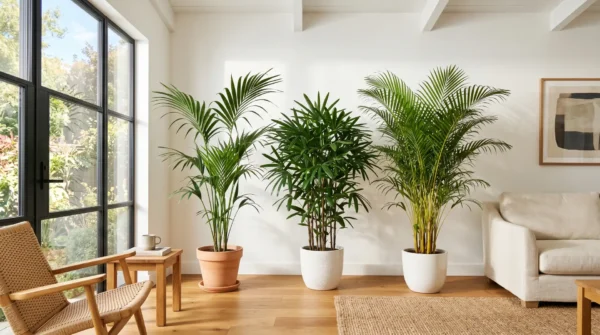
15 Best Houseplants for Low Light: Ranked by Foot-Candle Tolerance, Care Difficulty, and True Survival Minimum

Most ‘low light’ plants struggle below 100 foot-candles — these 15 genuinely don’t. Ranked by survival minimum, care difficulty, and USDA hardiness zone, with the biology behind shade tolerance explained.
A plant tag that says “thrives in low light” tells you almost nothing. Your eyes adapt to dim rooms in minutes, making an interior space with 30 foot-candles feel perfectly bright. At 30 foot-candles — roughly what a digital light meter reads in a north-facing room five feet from the window — most houseplants run a photosynthetic deficit: respiration exceeds carbon fixation, and the plant slowly declines. The 15 plants below can hold that line and, in the right conditions, cross it into genuine growth.
Each profile includes a survival minimum (the lowest foot-candle reading where the plant avoids decline), a thriving range (where you will see consistent new growth), an outdoor USDA hardiness zone, and a care difficulty rating on a 1–5 scale. We also explain the biology behind shade tolerance so you can understand which claims are real. For how to measure light in your home, see our houseplant light guide.

What “Low Light” Actually Means in Foot-Candles
Foot-candles (fc) measure light intensity falling on a surface — one fc equals one lumen per square foot. University extension services use foot-candles because they are measurable with an inexpensive digital meter, unlike qualitative terms like “bright indirect” or “low light.”

Here is what typical indoor positions register at midday, based on measurements from the University of Illinois Extension and UF/IFAS [3][4]:

Free printable garden plans for when you’re ready to grow outside too
Three pre-planned beds — pollinator, kitchen and cut-flower — from the free Blooming Expert Garden Library.
| Position | Approximate Foot-Candles |
|---|---|
| North window, directly in front | 75–150 fc |
| North window, 3–5 feet back | 25–75 fc |
| East or west window, 3–10 feet back | 50–150 fc |
| South window, 15–20 feet back | 75–150 fc |
| Interior room, no windows nearby | 10–25 fc |
Missouri Extension defines the full low-light category as 50–250 fc, with the most tolerant species managing as little as 10 fc under artificial light [1]. UF/IFAS sets a narrower low-light window of 25–100 fc; Illinois Extension pegs it at 75 fc [3][4]. Take 75–100 fc as your practical target for the majority of plants on this list.
Human vision adapts within 20–30 minutes of entering a dim room, making it useless as a light gauge. A $15 digital light meter, or a lux measurement from a smartphone app like Photone, gives you a number. Converting between units is straightforward: 1 fc = 10.76 lux, so a reading of 750 lux equals approximately 70 fc.
The Biology: Why Some Plants Are Built for Shade
Low-light tolerance is not a single trait. The houseplants below use three distinct mechanisms to function where others fail.

Antenna Expansion
The most common strategy: shade-adapted plants increase their ratio of light-harvesting proteins, specifically Light-Harvesting Complex II (LHCII). LHCII acts as an antenna, capturing photons and routing them to the reaction centers where ATP and NADPH are produced for photosynthesis. The more LHCII a plant carries, the more photons it captures per reaction center at low irradiance [8].
The chemical signature of this adaptation is a lower chlorophyll a/b ratio. Chlorophyll b is the dominant pigment in LHCII — shade plants carry more of it relative to chlorophyll a, which explains why they tend to be a deeper, darker green. Structurally, shade chloroplasts contain more stacked thylakoid layers (grana) than sun chloroplasts, increasing total photosynthetic surface area without increasing leaf thickness [8]. Research on Paeonia species under controlled shade conditions quantified the functional result: plants grown at 30% light intensity showed a significant drop in their light compensation point (the minimum illumination where photosynthesis exceeds respiration) alongside higher apparent quantum yield — meaning they converted each captured photon more efficiently [7].
CAM Photosynthesis
Snake plants use Crassulacean Acid Metabolism (CAM). Instead of keeping stomata open during the day — which works in bright light but wastes water under low irradiance — CAM plants open stomata only at night, absorbing CO&sub2; and storing it as malic acid. During daylight, closed stomata prevent water loss while the stored CO&sub2; feeds photosynthesis from whatever ambient light is available. This allows the snake plant to maintain positive carbon balance at light levels where C3 photosynthesis would be wasteful, and it is also the mechanism behind the plant’s legendary drought tolerance.
Rhizome Carbon Storage
ZZ plants take a third route: thick underground rhizomes store both water and carbohydrates. In near-zero-light conditions where net photosynthesis dips below zero, the rhizome releases stored energy to keep cellular functions running. This is a temporary strategy — rhizome reserves deplete over months, not years — but it explains why ZZ plants can survive the kind of neglect and near-darkness that would kill any other plant on this list.
The 15 Best Houseplants for Low Light
Plants are ordered by survival minimum, from most to least tolerant of low light. Care difficulty uses a 1–5 scale: 1 = nearly indestructible, 5 = expert conditions required.

1. Chinese Evergreen (Aglaonema)
Survival minimum: 10 fc | Thriving range: 50–200 fc | USDA zone (outdoor): 10–12 | Care difficulty: 2/5
Chinese evergreen holds the lowest confirmed survival minimum of any common houseplant: Missouri Extension documents tolerance as low as 10 foot-candles under artificial light [1]. In practice, this means it survives in interior spaces with no direct window access — office corridors, hallway corners, windowless bathrooms with overhead fluorescent lighting. The key rule: use dark-green cultivars (‘Maria’, ‘Emerald Bay’) for true low light; variegated and pink-red varieties need 100 fc or more to hold their color, since those leaf sections contain fewer chloroplasts per unit area. All parts are toxic to pets. Water when the top inch of soil dries out; reduce frequency further in winter. Our Chinese evergreen care guide covers cultivar selection in depth.
2. Cast Iron Plant (Aspidistra elatior)
Survival minimum: 10–15 fc | Thriving range: 25–150 fc | USDA zone (outdoor): 7–11 | Care difficulty: 1/5
The cast iron plant earns its name. NC State Extension rates it as tolerant of deep shade (fewer than two hours of any direct light), drought, heat, and nutrient-poor soil [6]. Missouri Extension confirms indoor viability at 150 fc under artificial light [1]. The trade-off is slow growth — new leaves emerge one or two at a time across the whole season — and it rarely flowers indoors in very low light. USDA zones 7–11 make it the most cold-hardy option on this list, suitable as a shaded ground cover across much of the southern US. For a direct comparison of its strengths against the snake plant, see our cast iron plant vs. snake plant comparison.
3. ZZ Plant (Zamioculcas zamiifolia)
Survival minimum: 50 fc | Thriving range: 75–150 fc | USDA zone (outdoor): 9–10 | Care difficulty: 1/5
ZZ plants survive low light not through photosynthetic efficiency alone but through the rhizome carbohydrate-storage strategy described above. At 50 fc it maintains glossy dark-green foliage without visible decline; below that it draws on stored reserves and eventually shows yellowing and stem etiolation. The survival floor sits noticeably higher than the Chinese evergreen or cast iron plant, but its near-zero maintenance needs compensate. One critical note: all parts are toxic to pets and humans if ingested. Water only when the soil is completely dry — overwatering kills ZZ plants far faster than low light. Full detail in our ZZ plant care guide.
Stop killing plants with wrong watering.
Select your plant, pot size, and climate zone — get a precise watering schedule with amounts and timing.
→ Build Watering Schedule4. Pothos (Epipremnum aureum)
Survival minimum: 25–50 fc | Thriving range: 100–200 fc | USDA zone (outdoor): 10–12 | Care difficulty: 1/5
Pothos tolerates survival conditions from 25 fc upward, though growth stalls noticeably below 75 fc. Cultivar selection matters significantly for low-light placement: ‘Jade’ (all dark green) and ‘Jessenia’ handle lower light better than ‘Marble Queen’ or standard ‘Golden Pothos’ — the lighter and more variegated the leaf, the fewer chloroplasts per unit area and the more light required to sustain growth. Penn State Extension recommends pothos specifically for low-light placement due to its tropical understory origin [2]. Full care detail in our pothos care guide.
5. Heartleaf Philodendron (Philodendron hederaceum)
Survival minimum: 50 fc | Thriving range: 100–200 fc | USDA zone (outdoor): 10–12 | Care difficulty: 2/5
The heartleaf philodendron survives at 50 fc and maintains visible growth at 100 fc or above. Illinois Extension lists it alongside Chinese evergreen, snake plant, and peace lily as a reliable low-light houseplant [4]. Like pothos, it originated in tropical forest understories where direct light rarely penetrates the canopy — the LHCII antenna-expansion mechanism is well-developed in both genera. It grows faster than most plants on this list, which makes light deficiency easy to spot: etiolated (stretched, pale) new growth between widely spaced nodes means it needs more light. Toxic to pets and humans if ingested.
6. Snake Plant (Dracaena trifasciata)
Survival minimum: 25–50 fc | Thriving range: 75–200 fc | USDA zone (outdoor): 9–12 | Care difficulty: 1/5
CAM photosynthesis (described above) underpins both the snake plant’s drought tolerance and its genuine low-light capability. At 25–50 fc it maintains positive carbon balance — growing slowly but not declining — a feat most C3 houseplants cannot match at those light levels. Penn State Extension and Iowa State Extension both recommend snake plants specifically for low-light placement [2][5]. Growth effectively stops below 50 fc, but the plant holds its form and foliage. In low light, water every four to six weeks rather than every two — lower photosynthesis means lower transpiration and slower water use. The variegated cultivars ‘Laurentii’ and ‘Moonshine’ need slightly more light than the standard dark green form to keep their markings.
If you are growing this for the first time, start with top 10 low maintenance.
7. Peace Lily (Spathiphyllum wallisii)
Survival minimum: 50–75 fc | Thriving range: 100–200 fc | USDA zone (outdoor): 11–12 | Care difficulty: 3/5
Peace lily is one of the rare flowering plants on this list that blooms in true low-light conditions — though you need at least 100–150 fc to trigger reliable flowering. Below 75 fc, the foliage holds but blooms stop. Illinois Extension specifically classifies peace lily as a reliable north-window plant [4]. Compared to others here, it needs more consistent moisture — never let it dry completely, as it wilts quickly and dramatically, though it recovers after watering. Keep it away from heating vents and drafts; it dislikes temperatures below 55°F. If yours is declining, our houseplant revival guide covers the most common causes.
8. Dumb Cane (Dieffenbachia seguine)
Survival minimum: 50–75 fc | Thriving range: 150–300 fc | USDA zone (outdoor): 10–12 | Care difficulty: 3/5
Dieffenbachia tolerates low light through a straightforward physical adaptation: large leaf surface area maximizes photon capture. At 50–75 fc the plant survives; below that it drops lower leaves and produces increasingly etiolated stems. Penn State Extension notes it adapts to low light by producing darker green, larger leaves with fewer variegations [2]. Its thriving range sits higher than most plants on this list (150–300 fc), making it better suited to medium-dim spots like east-facing windows than true dark corners. A toxicity warning: the sap contains calcium oxalate crystals that cause intense oral irritation — handle with gloves and keep away from children and pets.
9. Bird’s Nest Fern (Asplenium nidus)
Survival minimum: 50–75 fc | Thriving range: 75–200 fc | USDA zone (outdoor): 11–12 | Care difficulty: 3/5
Bird’s nest fern is epiphytic in nature — it grows anchored to tree trunks in tropical rainforests, where light is filtered through multiple canopy layers. This origin means it is built for low, diffuse light with high ambient humidity. The flat, undivided fronds (unlike the typical feathery fern form) maximize photon-capture surface per unit of biomass. It is non-toxic to cats and dogs. The moderate difficulty rating reflects a humidity requirement: it needs 50–60% relative humidity to prevent crispy frond margins, which rules out most heated US homes in winter without a pebble tray or humidifier. Our humidity guide covers the most effective options. Never mist the central rosette directly — trapped water rots the emerging fronds.
10. Prayer Plant (Maranta leuconeura)
Survival minimum: 50 fc | Thriving range: 100–200 fc | USDA zone (outdoor): 11–12 | Care difficulty: 4/5
Prayer plants fold their leaves upright at night in a movement called nyctinasty — likely a mechanism to reduce water loss during darkness, when transpiration is least productive. At 50 fc the plant survives; below that, the distinctive leaf markings fade and growth halts. It is non-toxic to pets. The high difficulty rating reflects three simultaneous requirements that rarely coexist in a dim room: 50%+ relative humidity, consistent soil moisture (not soggy, not bone dry), and fluoride-free water. Tap water fluoride accumulates in the leaf tips and shows as brown margins even when light is adequate. Use distilled or collected rainwater. The care requirements closely mirror those of calathea; our calathea care guide covers the relevant husbandry principles.
11. Spider Plant (Chlorophytum comosum)
Survival minimum: 25 fc | Thriving range: 100–500 fc | USDA zone (outdoor): 9–11 | Care difficulty: 2/5
Spider plant has one of the widest light-tolerance windows of any common houseplant — from 25 fc at the survival floor up to 1,000 fc in bright conditions. At 25 fc it survives but will not produce the “spiderettes” (hanging offshoots) that give the plant its visual appeal; you need 100 fc or more for consistent offset production. Non-toxic to cats and dogs, making it one of the safest choices for pet-owning households. See our pet-friendly houseplants guide for more options in this category. The variegated ‘Variegatum’ form needs more light than the all-green form to maintain its stripe pattern.
12. Corn Plant (Dracaena fragrans)
Survival minimum: 50 fc | Thriving range: 75–200 fc | USDA zone (outdoor): 10–12 | Care difficulty: 2/5
Dracaena fragrans and its close relative D. marginata both tolerate 50 fc, though the corn plant’s broader leaves make it slightly more shade-tolerant per unit of growing space. Missouri Extension lists Dracaena species alongside Chinese evergreen as reliably low-light-tolerant [1]. The practical risk at 50 fc is leggy growth — the central cane stretches toward any light source over time. Keeping it within five to eight feet of a window (even north-facing) prevents this. Dracaenas are sensitive to fluoride: brown leaf tips in low light often indicate water quality, not insufficient light. Use filtered or distilled water. Compare the two most common forms in our Dracaena marginata vs. fragrans guide.
13. Parlour Palm (Chamaedorea elegans)
Survival minimum: 50 fc | Thriving range: 75–150 fc | USDA zone (outdoor): 10–11 | Care difficulty: 3/5
The parlour palm is the most shade-tolerant palm species commonly available as a houseplant, native to the understory of Mexican rainforests where canopy reduces available light to around 1–5% of full sun — approximately 50 fc. Growth is slow in low light: expect one to three new fronds per season. Non-toxic to cats, dogs, and humans. The moderate difficulty rating reflects a dual risk: overwatering combined with cool temperatures triggers root rot faster than in many other plants here, and low humidity in winter causes brown frond tips. For placement specifically in north-facing rooms, our best plants for north-facing rooms guide covers window-by-window placement.
14. Arrowhead Vine (Syngonium podophyllum)
Survival minimum: 50 fc | Thriving range: 75–200 fc | USDA zone (outdoor): 10–12 | Care difficulty: 2/5
Arrowhead vine is fast-growing even at 75–100 fc, making it one of the better options if you want visible progress in a dim room. The leaf shape signals light status: in adequate light the classic arrow form is pronounced; in very low light, mature leaves develop broader, less divided lobes as the plant maximizes light-capture surface area. This morphological shift is an adaptation, not a problem. The variegated and pink cultivars (‘Pink Allusion’, ‘Holly M’) need 100–150 fc to hold their color; solid green forms handle lower readings best. Toxic to pets. It can trail or climb — a small support near a dimly lit wall encourages compact upright growth.
15. Calathea (Goeppertia / Calathea spp.)
Survival minimum: 50–75 fc | Thriving range: 75–200 fc | USDA zone (outdoor): 11–12 | Care difficulty: 4/5
Calathea earns its difficult reputation through three simultaneous requirements that rarely coexist in a dim room: 50%+ humidity, fluoride-free water, and temperatures between 65–85°F with no drafts. The low-light tolerance is genuine — calatheas evolved as rainforest floor plants where 50–100 fc is the standard environment — but the difficulty of meeting all three requirements simultaneously in a heated US home justifies the rating. Non-toxic to cats and dogs. Orbifolia and Makoyana are the most forgiving cultivars; Medallion and Ornata are more demanding. Full care detail in our calathea care guide.
Comparison Table: All 15 Plants at a Glance
Sorted by survival minimum. Foot-candle data drawn from Missouri Extension, Penn State Extension, UF/IFAS, Illinois Extension, and NC State Extension [1][2][3][4][6].
| Plant | Survival Min. (fc) | Thriving Range (fc) | USDA Zone | Difficulty | Pet Safe? |
|---|---|---|---|---|---|
| Chinese Evergreen | 10 | 50–200 | 10–12 | 2/5 | No |
| Cast Iron Plant | 10–15 | 25–150 | 7–11 | 1/5 | Yes |
| Pothos (‘Jade’) | 25–50 | 100–200 | 10–12 | 1/5 | No |
| Snake Plant | 25–50 | 75–200 | 9–12 | 1/5 | No |
| Spider Plant | 25 | 100–500 | 9–11 | 2/5 | Yes |
| ZZ Plant | 50 | 75–150 | 9–10 | 1/5 | No |
| Heartleaf Philodendron | 50 | 100–200 | 10–12 | 2/5 | No |
| Peace Lily | 50–75 | 100–200 | 11–12 | 3/5 | No |
| Dumb Cane | 50–75 | 150–300 | 10–12 | 3/5 | No |
| Bird’s Nest Fern | 50–75 | 75–200 | 11–12 | 3/5 | Yes |
| Prayer Plant | 50 | 100–200 | 11–12 | 4/5 | Yes |
| Corn Plant (Dracaena) | 50 | 75–200 | 10–12 | 2/5 | No |
| Parlour Palm | 50 | 75–150 | 10–11 | 3/5 | Yes |
| Arrowhead Vine | 50 | 75–200 | 10–12 | 2/5 | No |
| Calathea | 50–75 | 75–200 | 11–12 | 4/5 | Yes |
Matching Plants to Specific Rooms
The right plant for a dim room depends less on window direction and more on the actual foot-candle reading at the spot where the plant will sit. Measure before you buy.

These are practical placement rules based on the data above:
- Interior rooms with no windows (10–25 fc): Chinese evergreen (dark green cultivars only) or cast iron plant. A 6,500K full-spectrum LED panel placed 18–24 inches above the plant for 12–14 hours daily adds 50–150 fc reliably, pushing even a windowless space into the viable range for most plants. Our best grow lights guide covers specific options.
- North window, 3–5 feet back (25–75 fc): Snake plant, pothos (‘Jade’), spider plant, ZZ plant, heartleaf philodendron. These five hit their survival floor at or below 50 fc and require minimal supplementation.
- North window, directly in front (75–150 fc): The full list works here. Peace lily will flower; calathea holds its color; arrowhead vine grows visibly fast.
- East window, 3–8 feet back (50–150 fc): Any plant on this list except Dieffenbachia, which thrives at the higher end of the medium-light range (150–300 fc) and shows leggy growth below that.
For north-facing rooms specifically, our best plants for north-facing rooms guide covers window-specific placement in more depth.
How Low Light Changes Your Care Routine
Every care variable shifts when light drops below 200 fc. Ignoring this is the most common cause of overwatered, over-fertilized, and stunted houseplants in dim rooms.

Watering frequency drops significantly. Lower light means lower photosynthesis, which means slower growth, which means slower transpiration and reduced water uptake. A pothos that needs water every seven days near a bright window may only need it every 14–21 days in a dim corner. Check soil moisture rather than following a fixed calendar. Our watering frequency guide covers the finger-test and moisture meter methods in detail.
Fertilize less, not more. Most soluble fertilizers recommend monthly application during the growing season. In low light, cut that to every six to eight weeks at half concentration. Plants not actively photosynthesizing cannot use the nutrients — they accumulate as salts in the soil and cause root tip burn instead. The exception: peace lily and pothos in low light sometimes benefit from a diluted quarter-strength balanced fertilizer every eight weeks to compensate for reduced nutrient uptake efficiency.
Dust leaves regularly. In low light, every square millimeter of leaf surface matters. A layer of household dust reduces light absorption measurably. Wipe large-leaved plants (dumb cane, cast iron, bird’s nest fern) with a damp cloth every three to four weeks; rinse smaller-leaved plants like arrowhead vine in the shower.
Set realistic growth expectations. Even the most shade-tolerant plants on this list grow slowly below 100 fc. A ZZ plant at 75 fc might produce four to six new leaflets per month in summer. That is not failure — it is appropriate output at low irradiance. Expecting fast growth in dim conditions leads to overwatering in an attempt to force progress, which is the actual killer.
Frequently Asked Questions
Can I use a grow light to extend the range of these plants?
Yes, and it is the most effective intervention for interior rooms. A 6,500K full-spectrum LED panel at 18–24 inches for 12–14 hours daily adds 50–150 fc reliably. Our grow lights vs. sunlight guide compares intensity and spectrum options in detail.

How do I know if my plant needs more light?
Three reliable signals: (1) new leaves are noticeably smaller than older ones; (2) stems extend long distances between leaves (etiolation); (3) variegated plants lose pattern definition and revert toward all-green. These are the plant’s response to insufficient photons, not insufficient water. Moving the plant two to three feet closer to a window often resolves all three within four to six weeks.
Does “low light tolerant” mean no light at all?
No plant survives without light indefinitely. “Low light tolerant” means the plant’s light compensation point falls below 100 fc. Below that point the plant draws on stored reserves and eventually declines. Cast iron plant and Chinese evergreen have the lowest confirmed compensation points of common houseplants; even they will decline in a truly lightless room after several months.
Can I move these plants outdoors in summer?
Yes, cautiously. Most plants on this list are tropical and will thrive in shaded outdoor conditions (1,000–3,000 fc filtered) during warm months in USDA zones 9–12. Acclimate gradually — one to two hours of filtered outdoor shade daily for the first week — to prevent sunburn from the sudden increase in intensity. Bring them indoors before temperatures drop below 55°F. Cast iron plant (USDA zones 7–11) can stay outdoors year-round in most of the southern US.
Which low-light plants are safe for pets?
Cast iron plant, bird’s nest fern, spider plant, prayer plant, parlour palm, and calathea are non-toxic to cats and dogs. Chinese evergreen, ZZ plant, pothos, heartleaf philodendron, snake plant, peace lily, dumb cane, corn plant, and arrowhead vine are toxic if ingested. For a complete non-toxic plant list, see our pet-friendly houseplants guide.

For a complete step-by-step walkthrough, see 9 houseplants that survive a windowless room on artificial light alone.
Sources
- Lighting Indoor Houseplants — Missouri Extension (G6515)
- Low Light Houseplants — Penn State Extension
- Light for Houseplants — UF/IFAS Gardening Solutions
- Lighting for Houseplants — University of Illinois Extension
- Lighting for Indoor Plants and Starting Seeds — University of Minnesota Extension
- Aspidistra elatior (Cast Iron Plant) — NC State Extension Gardener Plant Toolbox
- Shade Effects on Growth, Photosynthesis and Chlorophyll Fluorescence in Paeonia Species — PMC
- Photosynthesis in Sun and Shade — Research School of Ecology (Chapter 12.1)