

Houseplant Light Guide: What ‘Low,’ ‘Medium’ and ‘Bright Indirect’ Really Mean in Your Home’s Rooms

Low light, medium light, bright indirect — but what do these labels actually mean in measurable terms? This guide gives you the lux numbers, a phone-app method for measuring any room, and a plant-by-plant reference table.
Your plant care app says your fiddle leaf fig needs “bright indirect light.” The label on your peace lily says “tolerates low light.” But what does that actually mean inside your home — in real, measurable terms? The answer most guides skip: it means specific lux values that you can measure with a free phone app in about two minutes.
Most houseplant advice operates entirely in fuzzy categories without giving you a way to verify whether your specific room qualifies. This guide fixes that. You’ll get the actual lux measurements behind each category, a step-by-step method for measuring light anywhere in your home, a room-by-room breakdown of what each window direction delivers, and a plant-by-plant reference table covering the most popular houseplants in the US.
Keep this guide bookmarked. Measure your rooms once, match your plants, and stop guessing.
Why “Low Light” and “Bright Indirect” Are Nearly Useless Labels
Walk into any garden center and you’ll find plants tagged with three or four light categories. The problem isn’t the categories themselves — it’s that no two sources agree on what they mean, and none give you a way to verify whether your specific spot qualifies.

Three pre-planned garden beds, free
Stop staring at empty beds: printable plans with exact layouts, plant lists and planting calendars — yours free from the Garden Library.
A north-facing room with a large window and no nearby obstructions might deliver 400 lux on a bright winter afternoon. A south-facing room with heavy sheers might deliver 200 lux. Both might be described as “low light” by the tag on the plant — but one will sustain a peace lily for years, and the other will slowly kill it.
Lux is the unit that makes this concrete. One lux equals one lumen of light per square meter — the standard international unit for measuring illuminance. You don’t need to memorize the physics. You just need to know the ranges for each category, then measure your rooms.
The Four Light Categories — With Actual Lux Numbers
These ranges are derived from horticultural extension research and reflect the light levels plants in each category need to sustain normal growth — not just survive. “Survival” light for most houseplants is lower than the minimums listed here; these ranges represent the conditions where plants actually grow, push new leaves, and maintain their natural color.
| Category | Lux Range | What It Looks Like | Typical Indoor Location |
|---|---|---|---|
| Low light | 50–250 lux | Comfortable for reading without a lamp, but no direct sun patches on the floor | North-facing rooms, hallways, corners, rooms with small or obstructed windows |
| Medium light | 250–1,000 lux | Bright enough to photograph without a flash; room feels well-lit but no sun patch on the plant | 3–8 ft from an east- or west-facing window; 6–10 ft from a south-facing window |
| Bright indirect light | 1,000–5,000 lux | Visibly bright; you’d notice it dimming if clouds rolled in; warm on your hand but no beam | Within 2–4 ft of an east- or west-facing window; screened or curtained south window |
| Direct sunlight | 10,000+ lux | A warm sun patch on the plant’s leaves; visibly hotter than the surrounding room | Right at an unobstructed south- or west-facing window; outdoors in summer |
One number that surprises most plant owners: full outdoor summer sun in the US can reach 80,000–100,000 lux. Your brightest indoor spot — even right at a south-facing window — typically tops out around 10,000–15,000 lux. That means even “bright indirect” inside is dim compared to what most plants evolved for outdoors. This is why sun-loving plants like succulents, bird of paradise, and cacti struggle inside even next to windows.
The gap between 250 lux and 1,000 lux matters more than most people realize. A peace lily at 300 lux will survive indefinitely. A fiddle leaf fig at 300 lux will begin dropping leaves within weeks. Same lux number, completely different outcomes — because the plants have different minimum thresholds.
How to Measure Light With Your Phone
You don’t need a dedicated light meter. A free smartphone app using your phone’s ambient light sensor gives readings accurate enough to make good plant placement decisions. The absolute numbers may vary slightly by phone model, but they’re consistent enough to distinguish low from medium from bright indirect — which is the only distinction that matters for plant placement.
Recommended Apps
- Lux Light Meter (iOS & Android) — Clean interface, reliable readings, free. Consistently among the top-downloaded light meter apps in both stores.
- Light Meter (iOS) — Simple and accurate. Shows both lux and footcandles (1 footcandle = approximately 10.76 lux).
- Lux Meter – Light Intensity (Android) — Uses the hardware ambient light sensor rather than the camera, which tends to give more consistent readings across lighting conditions.
How to Take a Measurement
- Open the app and let it stabilize for 5 seconds before noting the reading.
- Hold your phone face-up at the height of your plant’s leaves — not at waist level, not at the windowsill. The plant’s perspective is what matters.
- Take readings at three times of day: mid-morning (9–10 AM), midday, and mid-afternoon (2–3 PM). Average the three numbers. Light levels swing dramatically — a spot that reads 2,000 lux at noon may read 400 lux at 9 AM and 600 lux at 3 PM.
- Check in both summer and winter if possible. In northern states, winter light through the same window can drop to 20–30% of summer levels. A spot delivering 2,500 lux in July might deliver only 700 lux in January — enough to push a medium-light plant into survival mode.
- Note which direction the nearest window faces. This context helps you predict how readings will change through the seasons and day.
A practical example: if your phone reads 300 lux next to your plant, it’s in the low-to-medium transition zone. Survivable for peace lilies, pothos, and snake plants — but not enough for monstera or calathea to maintain their full leaf color and growth rate. Moving the plant 2–3 feet closer to a window often doubles or triples that reading.

How Window Direction Affects Indoor Light Levels
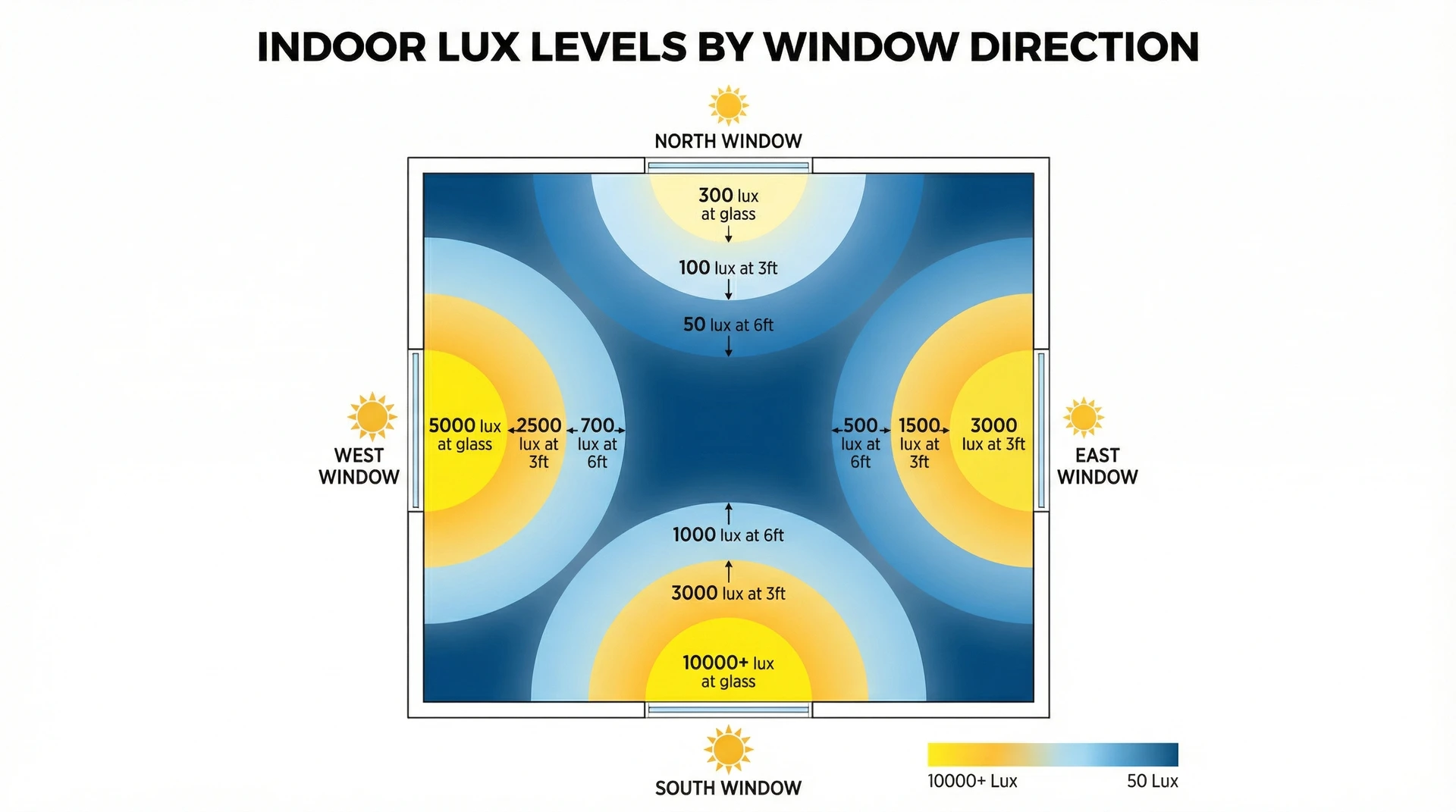
Window direction is the single biggest factor determining how much light a room receives. The table below gives typical lux readings at different distances from each window type under good weather conditions in the contiguous US. Your actual readings will depend on obstructions (trees, buildings, overhangs), glass type, curtains, and your latitude.
| Window Direction | Light Character | At Window | 3 ft Away | 6 ft Away |
|---|---|---|---|---|
| South | Strong direct sun for most of the day in summer; lower angle but still intense in winter | 5,000–15,000+ lux | 2,000–5,000 lux | 500–1,500 lux |
| East | Gentle morning sun (direct before ~11 AM), afternoon shade — ideal for most tropical houseplants | 2,000–5,000 lux | 1,000–2,500 lux | 300–800 lux |
| West | Strong afternoon sun (direct after ~1 PM); hotter and more intense than east-facing | 3,000–8,000 lux | 1,500–3,500 lux | 400–1,000 lux |
| North | Consistent but low indirect light year-round; no direct sun at any time of year in the US | 100–500 lux | 50–200 lux | 25–100 lux |
Light intensity drops dramatically with distance from a window — roughly following the inverse square law. A plant 6 feet from a south-facing window receives around 10–20% of the light available right at the glass. This is why moving a plant 2–3 feet closer to a window is often the single most effective change you can make.
Other factors that reduce indoor lux:
- Curtains and blinds: sheer curtains cut lux by 30–50%; heavy drapes by 80–90%
- Window glass: Low-E coatings on energy-efficient windows can reduce visible light transmission by 10–30%
- Season and latitude: In Chicago or Seattle, December light through the same south window runs at 25–35% of August levels
- Obstructions: A large tree, deep overhang, or neighboring building can reduce readings by 50% or more
North-facing rooms typically stay in the 50–500 lux range year-round — which sharply limits your plant options. See our guide to best plants for north-facing rooms for species specifically suited to these conditions. Similarly, rooms deeper in a building with only small windows may share lux characteristics with shade-tolerant garden plants — the same adaptation to sustained low light applies in both contexts.
Light Duration vs. Light Intensity: Both Matter
Your lux reading captures intensity at a moment in time, but plants also respond to how many hours of quality light they receive per day — the photoperiod. Two rooms can show identical lux at noon but deliver very different amounts of total daily light if one has direct sun for six hours and the other only for two.
A practical rule of thumb from horticulture extension research: most tropical houseplants need 8–12 hours of light at their minimum threshold to maintain active growth. A monstera receiving 1,500 lux for 10 hours a day will outperform the same plant receiving 2,000 lux for only 4 hours — even though the peak reading looks better.
In practical terms:
Stop missing your zone's planting windows.
Select your US zone and month — get a complete checklist of what to plant, prune, feed, and protect right now.
→ View My Garden Calendar- East-facing windows deliver good intensity for 4–6 hours in the morning, then drop to low indirect. Total daily light delivery is moderate but gentle — the reason east exposures suit so many tropical houseplants.
- South-facing windows deliver high intensity across the whole day in summer — good for high-light plants, potentially scorching for shade-lovers.
- North-facing windows deliver low but consistent light across the entire day — which is why some low-light plants actually do better in north rooms than in east rooms with intermittent shade.
If your phone reading seems borderline, measure again in the evening and check whether daylight is still reaching your plant at all. A spot that reaches 800 lux at noon but goes dark by 2 PM is delivering less total light than the peak reading suggests.
Plant-by-Plant Light Requirements
The table below covers the most widely sold houseplants in the US. Target lux values are midday averages at the plant’s leaf level. Window direction recommendations assume an unobstructed window in a standard US home — adjust based on your actual measurements.
| Plant | Light Category | Target Lux | Best Window | Signs of Too Little | Signs of Too Much |
|---|---|---|---|---|---|
| Monstera deliciosa | Bright indirect | 1,000–3,000 | East or West | Slow growth; small leaves with no fenestration (no holes); yellowing lower leaves | Bleached or pale patches on leaves; crispy brown edges |
| Peace lily | Low to medium | 100–500 | North or East | No blooms; drooping despite adequate water; very slow new leaf production | Brown leaf tips; yellowing; wilting in a bright sun patch |
| Calathea | Medium | 250–800 | East or North | Pattern fading to plain green; slow growth; leaves stay tightly rolled | Pattern bleaches out; leaf edges crisp and curl inward |
| Spider plant | Medium to bright indirect | 500–2,000 | East or West | Pale, washed-out leaves; very few or no spiderettes (plantlets) | Brown leaf tips; scorched centers on variegated forms |
| Fiddle leaf fig | Bright indirect | 1,500–4,000 | East or South (with sheer curtain) | Leaf drop; brown spots spreading from edges; no new growth for months | Bleached, dried-out patches; leaf curling upward |
| Snake plant (Sansevieria) | Low to bright indirect | 75–3,000 | Any direction | Very slow growth; pale yellow-green color (survives, won’t thrive) | Yellowing combined with soft patches (usually overwatering at play too) |
| Pothos (Epipremnum aureum) | Low to medium | 75–1,000 | Any direction | Variegation reverts to plain green; very slow vining; small leaves | Pale, washed-out leaf color; scorched patches on variegated leaves |
| ZZ plant (Zamioculcas zamiifolia) | Low to medium | 75–500 | North or East | No new growth (survives in near darkness but won’t push stems) | Yellowing leaves; bleaching of the deep green glossy surface |
| Bird of paradise (Strelitzia reginae) | Bright indirect to direct | 2,000–8,000+ | South or West | No bloom; leaves stay intact rather than splitting; pale olive color | Leaf edge scorch (rare indoors; most homes don’t get this bright) |
| Rubber plant (Ficus elastica) | Medium to bright indirect | 500–3,000 | East or West | Leaf drop; leggy growth; burgundy varieties fade to dark green | Pale or bleached patches on the large leaves |
| Cast iron plant (Aspidistra elatior) | Low | 50–250 | North | Very slow growth — but this plant grows slowly regardless; no other visible symptoms | Brown or bleached patches on the dark green leaves |
| Succulents & cacti | Bright indirect to direct | 2,000–10,000+ | South | Etiolation: stems stretch toward the light and become pale and thin | Sunburn scarring (white or brown patches) if moved from shade to full sun too quickly |
| Moth orchid (Phalaenopsis) | Medium to bright indirect | 1,000–3,000 | East or West | Fails to rebloom; leaves turn dark green and limp | Leaves yellow; pseudobulbs bleach white or develop red tinge |

Diagnosing Light Problems in Your Plants
Light problems show up in predictable ways, but they’re frequently misdiagnosed as watering problems because the symptoms overlap. Use this as a quick reference when something looks wrong.
| Symptom | Light Cause | Confirm It’s Light (Not Watering) |
|---|---|---|
| Yellowing leaves, mainly lower | Too little light | Soil is appropriately moist; no root rot when inspected |
| Pale, washed-out leaf color | Too little light (chloroplasts can’t produce pigment) | Plant is otherwise healthy; not root-bound; soil isn’t depleted |
| Leggy stems, large gaps between leaves | Too little light (etiolation — the plant stretching toward a light source) | Stems lean toward the nearest window; leaves are small relative to stem length |
| Bleached or pale patches on leaves | Too much direct sun (leaf scorch) | Damage appears on the side facing the window; patches are dry and papery, not mushy |
| Brown, crispy edges | Could be too much light or low humidity (or both) | If the plant is within 1 ft of a south or west window and browning worsened after summer arrived, light is the likely driver |
| No new growth for 3+ months (growing season) | Likely too little light | Measure lux; compare to the plant’s target range in the table above |
The most reliable diagnostic is a lux reading. If your measurement falls significantly below the plant’s target range in the table above, move it closer to a window before adjusting watering, fertilizer, or any other variable. Light is almost always the first thing to fix.
Using Grow Lights to Fill the Gap
If your readings are consistently below your plant’s minimum threshold and you can’t move the plant closer to a window, a grow light is the most direct solution. Modern LED grow lights are efficient, compact, and can reliably deliver 1,000–3,000+ lux at a distance of 12–18 inches — enough to push a medium-light plant into the bright indirect range.
A few principles to know before buying:
- Full-spectrum LEDs are the standard for houseplants. Look for lights marketed as “full spectrum” or covering 400–700 nm (the PAR range plants use for photosynthesis).
- Distance matters more than wattage. A 20W LED at 6 inches delivers far more usable light than the same light at 24 inches. Most houseplant grow lights work best at 12–18 inches above the canopy.
- Photoperiod: most tropical houseplants need 12–16 hours of grow light exposure per day to compensate for low ambient light. A timer is essential.
- You can supplement, not replace. Grow lights used alongside a window (even a north-facing one) are more effective than grow lights as the sole light source.
Adjusting for Seasons
Light levels inside your home change significantly with the seasons, even if your windows and furniture don’t. In the northern US (Zone 5 and above), winter represents the most challenging period for houseplants — lower sun angle, shorter days, and reduced light intensity combine to cut total daily light delivery to 20–40% of summer levels.
Practical seasonal adjustments:
- October–February: Move plants 1–2 feet closer to windows than their summer position. Even south-facing window spots that were “too bright” in July may fall into the acceptable bright indirect range by December.
- December–January: Consider supplemental grow lighting for any plant that was already borderline on lux in summer. A calathea that scraped by at 400 lux in September may drop below 150 lux in January without a position change.
- March–April: As spring light returns, monitor plants positioned close to south-facing windows — a spot that was fine in winter can become scorching once the sun angle rises and days lengthen. Gradually move plants back to summer positions or add a sheer curtain.
Re-measure with your phone app at the start of each season. A 10-minute measurement session every three months catches problems before your plants show stress symptoms.
Frequently Asked Questions
What is considered low light for houseplants?
Low light for houseplants is typically 50–250 lux — the range you’d find in north-facing rooms, interior spaces more than 6 feet from any window, or areas with obstructed windows. “Low light tolerant” doesn’t mean “no light tolerant.” Even the most shade-adapted houseplants (ZZ plants, cast iron plants, snake plants) need at least 50 lux to photosynthesize. Below 25 lux, virtually all houseplants will slowly decline.
Can a plant get too much indirect light?
Technically yes, but it’s rare indoors. True “bright indirect” tops out around 5,000 lux — far below the 10,000+ lux threshold where most houseplants start showing sun stress. The real risk is direct sun, not bright indirect. Shade-loving plants like calathea and peace lily can show bleaching and leaf curl if placed in bright sun patches, but they generally tolerate the upper end of the bright indirect range without damage.
How accurate are phone light meter apps?
Accurate enough for plant placement decisions — typically within 15–30% of a calibrated light meter under consistent conditions. That margin is smaller than the difference between light categories (low vs. medium vs. bright indirect spans hundreds to thousands of lux). The main limitation is that phone sensors are optimized for photography in the visible range, not strict horticultural measurement. Use your readings to categorize the space (low / medium / bright indirect) rather than as absolute lux values.
My plant is right next to a window. Why is it still struggling?
Several factors reduce light even at a window: direction (a north window delivers 100–500 lux even right at the glass), obstructions outside (a large tree or overhang), window treatments (even sheer curtains reduce lux by 30–50%), and time of year. Use your phone app to measure at leaf level rather than assuming proximity equals adequate light. Also consider whether the plant’s issue is light-related at all — fiddle leaf figs and monsteras, for example, frequently show leaf drop from drafts, temperature swings, or overwatering rather than insufficient light.
What light level is east-facing window indirect light?
At an unobstructed east-facing window, you can expect 2,000–5,000 lux right at the glass during the morning hours when the sun is shining in, dropping to 300–800 lux once the sun moves past and the window is in shade. Because of this swing, the average across a full day at an east window is closer to the medium range (500–1,000 lux) — which makes east exposures ideal for plants like spider plants, monsteras, and rubber plants that want consistent but not scorching light.
Sources
- University of Minnesota Extension. Lighting for Indoor Plants and Starting Seeds. UMN Extension.
- Clemson University Home & Garden Information Center. Indoor Plants – Cleaning, Fertilizing, Containers & Light Requirements. Clemson HGIC.
- University of Illinois Extension. Lighting for Houseplants. Illinois Extension.


