Lavender Spacing: 2-3 Feet Apart by Variety and Zone

Get exact lavender spacing distances for every species — plus the climate modifier most guides skip and a fix for plants already too close.
The wrong spacing decision kills more lavender than any pest or bad winter. Not immediately — it takes a season or two, but once fungal disease takes hold in an overcrowded planting, there is little you can do except start over. Getting the distance right at planting costs nothing but a few extra steps.
The standard advice — ‘plant lavender 2-3 feet apart’ — is a reasonable starting point, but it collapses under real conditions. A ‘Munstead’ English lavender in a dry zone 6 garden has almost nothing in common with a ‘Grosso’ lavandin in humid Georgia. They need different spacing, different logic, and different correction strategies when things go wrong.
This guide gives you exact numbers by species, a climate modifier to adjust for your conditions, and specific distances for hedge rows, border plantings, and containers. It also covers what to do if your lavender is already planted too close — a situation that is more common and more fixable than most articles admit.
Why Lavender Spacing Is a Disease-Prevention Decision
Lavender spacing is not a comfort question. It is a disease management decision, and understanding the mechanism makes the numbers stick.

Get a free pre-planned flower bed (vase-worthy from June to frost)
Printable planting plans for a cut-flower bed and a cottage pollinator bed — plant list, spacing, and calendar included.
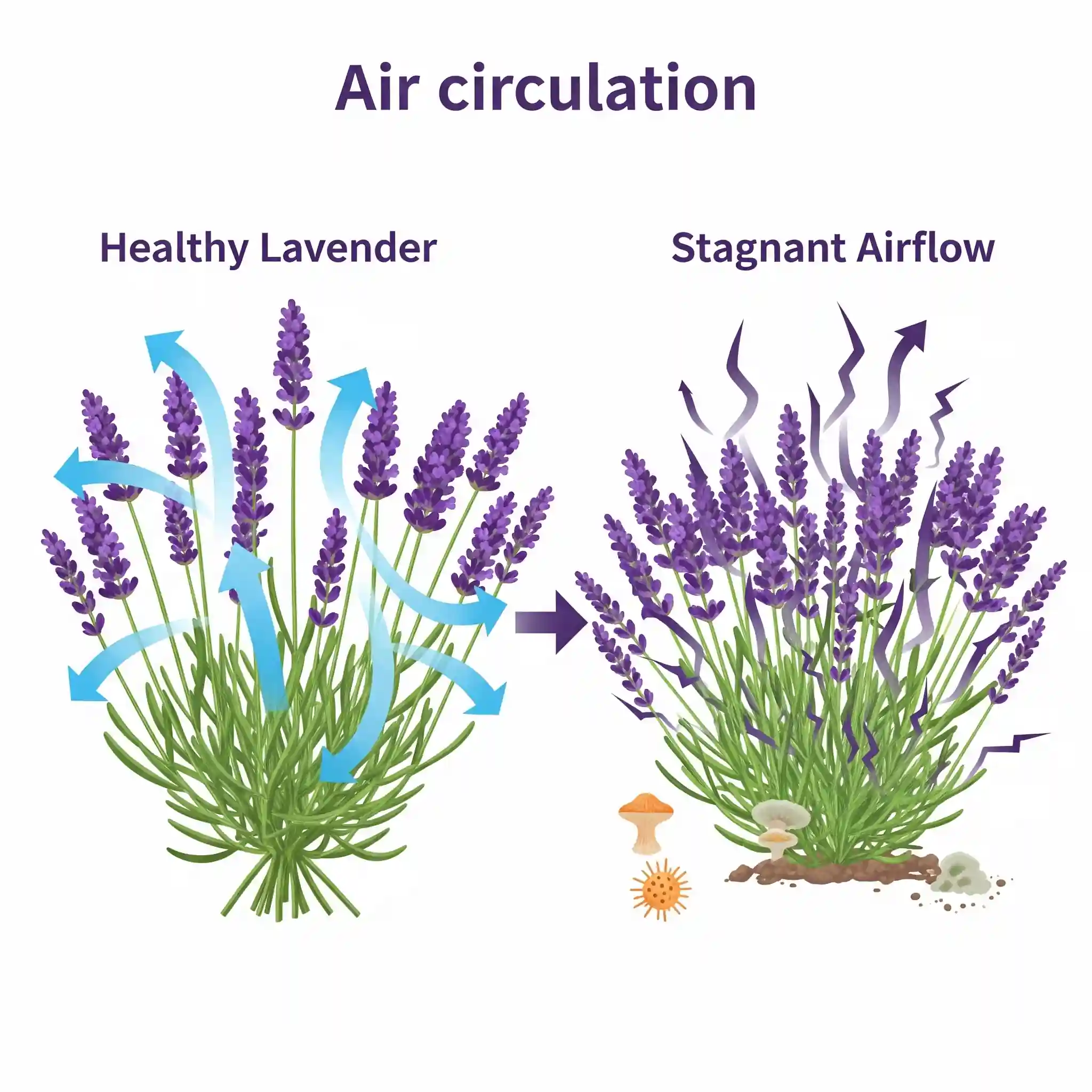
Lavender evolved in the rocky, wind-swept hillsides of the Mediterranean basin, where plants grow in natural gaps and summer air is reliably dry. In those conditions, foliage dries within minutes of a rain event. Move lavender to a humid climate and crowd the plants, and you have created the opposite: stagnant air, slow-drying leaves, and a microclimate where fungal spores germinate easily.
Two fungal diseases cause the most damage in overcrowded plantings:
Botrytis gray mold develops when moisture sits on leaves and stems for extended periods. The University of Illinois Extension identifies poor air circulation as one of the leading causes of lavender foliage disease. The spores are almost always present in soil and air — what they need is wet leaf surface, which crowded plants provide in abundance.
Phytophthora root and crown rot travels through wet soil. Close plantings trap rain and irrigation at soil level, creating the anaerobic conditions water molds need to spread from plant to plant. Research published in the journal Plant Disease identified Phytophthora nicotianae as one of the primary pathogens in lavender die-off events, particularly in poorly drained or high-density beds.
Beyond disease, tightly spaced plants compete for the same nutrient pool and shade each other’s lower canopy across seasons. Island Lavender describes root rot caused by chronically wet conditions as the most common killer of lavender — and close spacing is one of the most preventable contributing factors.
How to Calculate the Right Spacing from Mature Size
Before using any spacing table, learn the underlying formula — it protects you when you encounter a cultivar not on the list.
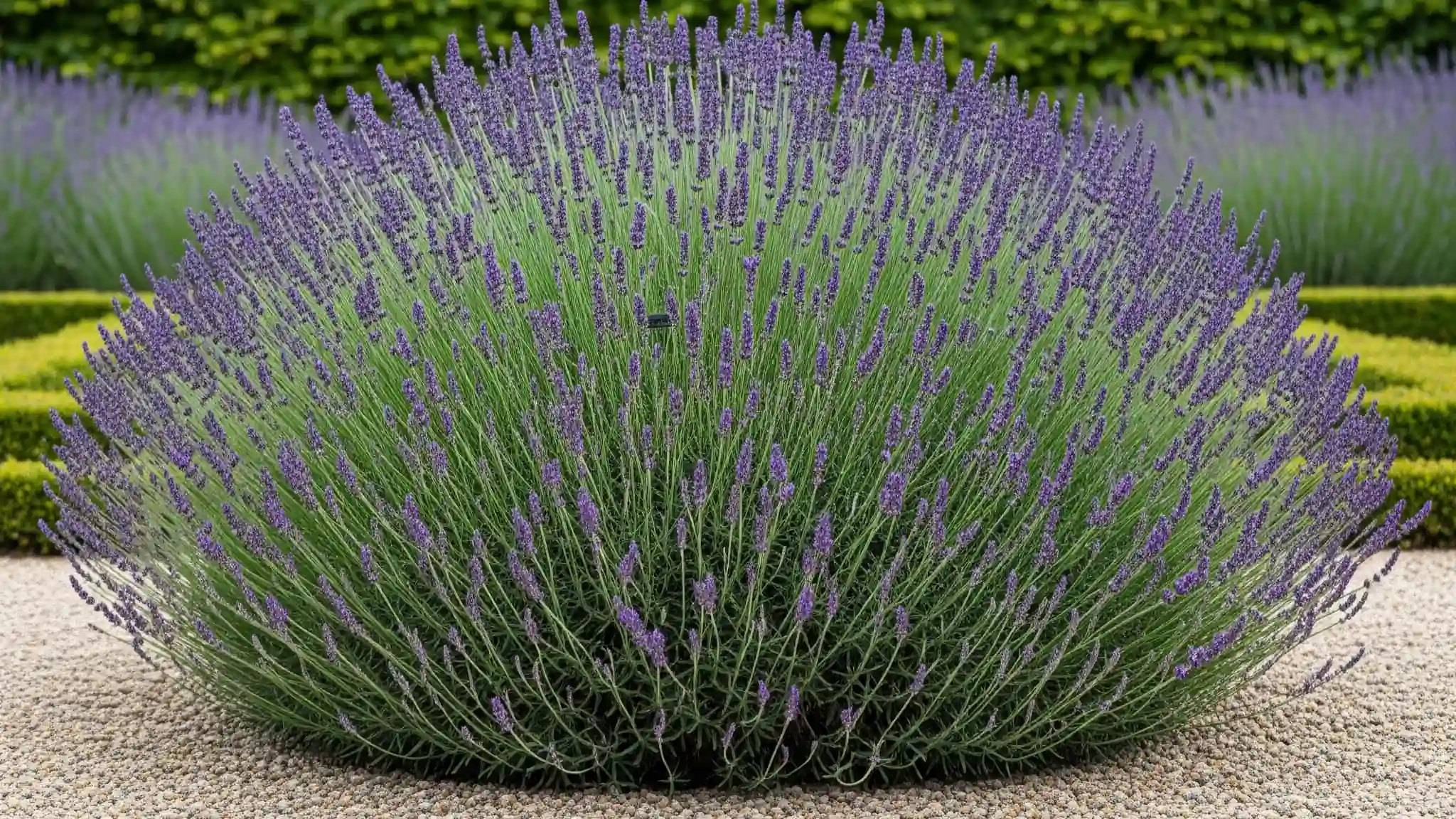
The rule supported by extension programs across multiple states: space lavender plants at roughly their mature width for in-ground bed specimens. A plant that reaches 24 inches wide at maturity belongs approximately 24 inches from its nearest neighbor. That gives each plant just enough clearance to reach full size without touching, and preserves the air channel between them.
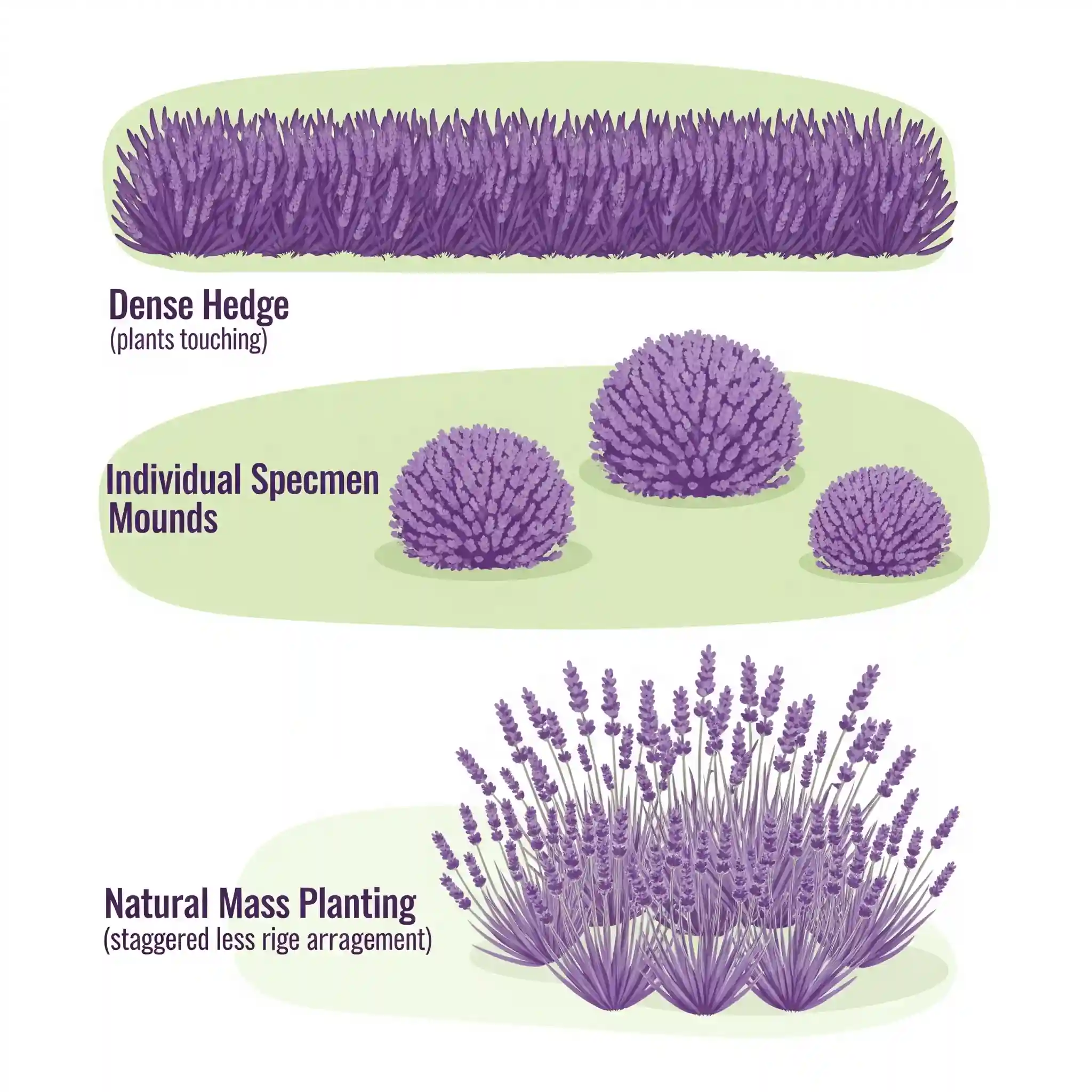
For hedges, the math shifts. You want visual continuity — no bare gaps between plants — so the planting distance drops to 50-60% of the mature width. A ‘Hidcote’ lavender that reaches 22 inches wide, planted at 13 inches apart, will form a gapless row within two to three seasons while still maintaining workable airflow.
The formula fails if you ignore mature size entirely. A nursery plant in a 4-inch pot gives no indication of what it becomes in three years. ‘Grosso’ lavandin reaches 46 inches wide at full maturity under good conditions. Planted at 18 inches apart, it will be completely overcrowded by year 3 — a situation that costs you either every other plant or an early start-over. Utah State University Extension confirms that lavender takes approximately three years to reach its full mature size, which is exactly why spacing errors are not obvious in the first season.
Spacing by Species — The Reference Table
Use this as your primary reference. Measurements are for in-ground garden bed planting; hedge distances appear in the final column.
| Group | Key Cultivars | Mature Width | Garden Bed | Hedge | USDA Zones |
|---|---|---|---|---|---|
| English compact L. angustifolia | Hidcote, Lady, Mini Blue, Jean Davis | 18-24 in | 18-24 in | 12-15 in | 5-8 |
| English standard L. angustifolia | Munstead, Twickel Purple, Vera | 20-26 in | 22-26 in | 15-18 in | 5-8 |
| Lavandin L. x intermedia | Grosso, Phenomenal, Provence | 36-46 in | 2.5-3 ft | 20-24 in | 5-11 |
| French L. dentata | Standard, Candicans | 24-32 in | 18-24 in (container preferred) | Not recommended | 8-11 |
| Spanish L. stoechas | Standard, Royal Anouk, Bandera Purple | 12-30 in | 18-30 in | 12-20 in | 8-11 |
A few notes on each group:
English lavender is the most winter-hardy group. Compact cultivars like ‘Hidcote’ and ‘Lady’ typically reach 18-24 inches wide — space them at 18-24 inches for beds, 12-15 inches for a formal hedge. The classic ‘Munstead’ tends to run slightly wider; 22-26 inches between plants gives it room without crowding. For a detailed comparison of the two most popular English cultivars, see our Hidcote vs. Munstead guide.
Lavandin hybrids like ‘Grosso’, ‘Phenomenal’, and ‘Provence’ are substantially larger. Plan for 36-46 inches of mature width and allow 2.5-3 feet between plants in most climates — that number increases in humid regions (see the climate modifier section below). Lavandin is the most climate-adaptable group, rated zones 5-11. For a broader look at the lavender family, our lavender varieties guide covers the full range.
French lavender (L. dentata) is a tender perennial for zones 8-11 that can reach 24-32 inches wide in warm conditions, but it is better suited to containers than in-ground planting for most US gardeners. Frost sensitivity means it needs winter protection north of zone 8, and its tendency to lose density makes formal hedging impractical.
Stop missing your zone's planting windows.
Select your US zone and month — get a complete checklist of what to plant, prune, feed, and protect right now.
→ View My Garden CalendarSpanish lavender (L. stoechas) varies considerably by cultivar. Standard types reach 24-30 inches wide and need 20-30 inches of space. Compact selections like ‘Royal Anouk’ stay under 15 inches wide and can be planted 12-15 inches apart for edging or small hedges. For more on how these types differ in habit and cold hardiness, see our English vs. French lavender comparison.
The Climate Modifier: Adjusting for Your Zone and Humidity
The species table gives baseline distances for temperate conditions — roughly zones 6-7 with moderate summer humidity. Your climate may push those numbers up or down significantly, and this is the variable most spacing guides ignore entirely.
Humidity is the key. Lavender in the humid Southeast, the Gulf Coast, or parts of the Pacific Northwest faces far higher disease pressure than the same variety growing in Colorado or the arid Southwest. Island Lavender describes the mechanism directly: in humid air, moisture sits on the leaves and within the dense foliage, creating an ideal breeding ground for fungi. The solution is not just choosing a more tolerant variety — wider spacing that keeps air moving through the canopy is equally important.
| Climate Type | Zone Examples | Spacing Adjustment | Notes |
|---|---|---|---|
| Cold / northern | Zones 5-6 (Midwest, Northeast) | Low end of range | Shorter season means smaller mature size; English lavender most suitable |
| Temperate / moderate | Zones 6-7 (Mid-Atlantic, inland West) | Standard distances | Use table values as given |
| Warm / moderate humidity | Zones 7-8 (Pacific Northwest, Mid-Atlantic coast) | Add 4-6 in to base spacing | Watch summer humidity; increase if morning fog is common |
| Hot / humid | Zones 8-10 (Southeast, Gulf Coast) | Add 6-12 in to base spacing | Prioritize Lavandin (‘Phenomenal’) or Spanish lavender; avoid pure English types |
| Arid / dry | Zones 7-9 (Southwest, Colorado, high plains) | Standard to slightly tighter | Low disease pressure; alkaline soils suit lavender naturally |
In practice, this means a ‘Grosso’ lavandin that gets 2.5 feet of space in Denver or Chicago needs 3-3.5 feet in coastal South Carolina. That extra 6-12 inches is not wasted — it is the air channel that keeps fungal pressure manageable without spraying.
Colorado State University Extension notes that Colorado’s naturally alkaline soils and reliable full sun suit lavender exceptionally well, making standard or even slightly tighter spacings workable there. The Southeast is the opposite case: if you are in zones 8-10 with humid summers, your best-performing lavenders will be Lavandin hybrids — ‘Phenomenal’ is widely cited for superior humidity tolerance — or Spanish lavender varieties. Pure English types struggle in Gulf Coast summers even at generous spacing, because their Mediterranean genetics simply did not prepare them for that combination of heat and humidity.
Spacing for Hedges, Borders, and Mass Plantings
How you plan to use the lavender changes the target spacing substantially.
Formal hedge — tight, continuous appearance:
Plant at 50-60% of mature width for visual continuity without dangerous crowding. For English ‘Hidcote’ (22 inches wide at maturity): space 12-15 inches apart. For ‘Grosso’ lavandin (46 inches wide): 20-24 inches in cool temperate climates, 24 inches in warmer regions. The Royal Horticultural Society recommends 30cm (12 inches) for compact hedge cultivars and 45cm (18 inches) for larger types.
A staggered double-row technique gives the fullest appearance fastest: plant two parallel rows 12 inches apart, with plants in the second row offset so they fall between the gaps of the first. This works particularly well for English lavender used as edging along paths or driveways, where you want width as well as density. I have used this approach for a ‘Hidcote’ border with plants at 14 inches in a staggered double row — it closed up completely by the second season and has held shape with a single annual prune every August.
Informal border or specimen planting:
Use full mature-width spacing — 18-24 inches for English lavender, 2.5-3 feet for Lavandin. Plants develop as distinct rounded mounds rather than a continuous mass. This is also the right spacing if you are growing for cut flowers or essential oil; crowded plants produce fewer and shorter stems because they direct energy upward toward light rather than into lateral development and bloom production.
Mass planting and commercial scale:
Penn State Extension recommends 3-4 feet between plants and 6-10 feet between rows for production lavender. The row spacing reflects equipment access, but the in-row spacing directly corresponds to mature-size requirements with a disease-prevention margin. At 3-foot centers on 6-foot rows, a one-acre planting holds roughly 2,400 plants.
Container Lavender: Pot Sizing by Cultivar Group
Container growing shifts the spacing question. Instead of the gap between plants, you are sizing the pot to the individual plant. One firm rule applies: one lavender per pot, always. Multiple plants in a single container restrict airflow through the crown and create the same nutrient and moisture competition you are trying to avoid in-ground. If you want a fuller display, group several pots together rather than crowding multiple plants into one.
| Cultivar Group | Examples | Min. Diameter | Ideal Diameter | Min. Depth | Key Note |
|---|---|---|---|---|---|
| English compact | Hidcote, Lady, Mini Blue | 12 in (30 cm) | 16 in (40 cm) | 12 in | Most versatile container choice; manageable long-term size |
| English standard | Munstead, Twickel Purple | 14 in | 16-18 in | 12 in | Grows slightly wider than compact types; plan for the larger pot from the start |
| Lavandin | Grosso, Phenomenal, Provence | 18 in | 20-24 in (50-60 cm) | 12 in | Large pot needed; refresh soil yearly or repot every 2-3 years |
| French (tender) | L. dentata | 12 in | 16 in | 12 in | Bring inside frost-free October through March north of zone 8 |
| Spanish | Stoechas, Royal Anouk | 10 in (compact cvs) | 14-16 in | 10 in | Excellent patio plant; compact types suit smaller pots and windowboxes |
Pot material matters as much as size. Terracotta and fabric grow bags both allow the breathability that plastic lacks — Island Lavender specifically recommends terracotta for its moisture-wicking properties, which help prevent root saturation. The Royal Horticultural Society advises mixing up to 25% coarse grit into potting compost for container lavender, keeping drainage sharp even as the compost breaks down over time.
Resist the temptation to size up aggressively. A large pot holds more moisture, which works against lavender’s preference for drying between waterings. Start at the recommended diameter and move up only when roots begin circling the drainage holes. For a complete guide to container lavender — including overwintering and repotting timing — see our lavender in pots guide.
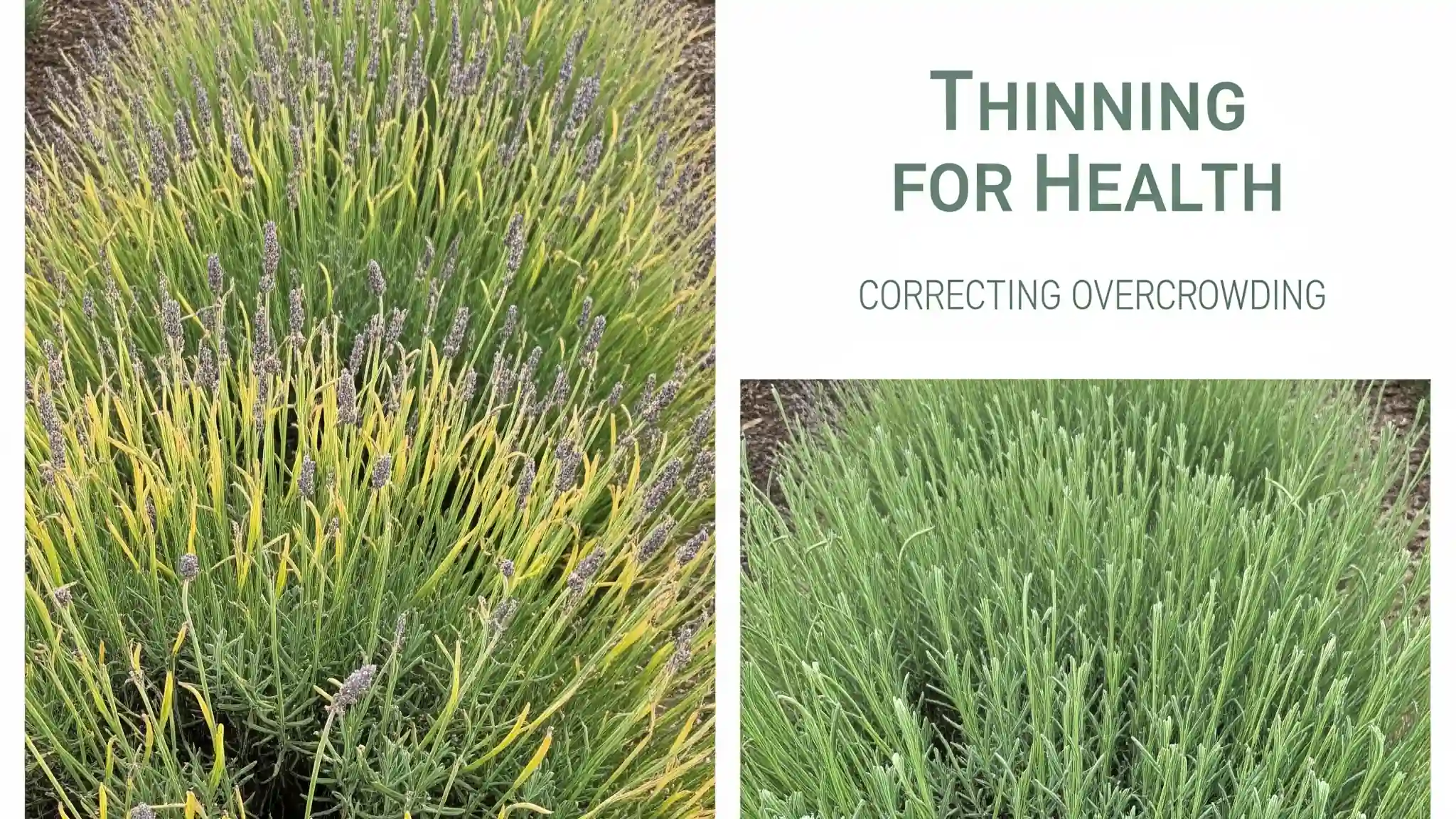
Correcting Overcrowding: What to Do When Plants Are Already Too Close
If your lavender is already planted too close, you have workable options — but there are firm limits on what the plant tolerates.
Recognizing the problem:
| Symptom | What It Indicates | Urgency |
|---|---|---|
| Foliage from neighboring plants intertwined | Physical overcrowding; airflow blocked at canopy level | Correct this season |
| Plants growing upward rather than outward | Light competition; reaching above neighbors for sun | Correct this season |
| Powdery white coating on lower foliage | Powdery mildew — humidity-driven fungal infection | Immediate; remove affected foliage then thin |
| Gray mold on stems or flower buds | Botrytis infection; active fungal spread in canopy | Immediate; thin and improve drainage |
| Noticeably fewer blooms than last season | Light or nutrient competition reducing flower output | Correct before next growing season |
| Brown basal wood with no new growth | Phytophthora crown rot — often fatal if roots are compromised | Immediate; remove affected plants, fix drainage |
What you cannot do:
Do not attempt to divide lavender. Unlike most perennials, lavender has a single main taproot and a woody crown — splitting it kills both halves. Gardening Know How confirms this as a firm botanical constraint. If you want more plants, propagate from softwood cuttings taken in early summer, not from root division.
Option 1 — Remove every other plant:
This is the cleanest solution for a row that is too dense. Cut losses on every second plant, pull the roots, and give the survivors immediate breathing room. The remaining plants fill in within one growing season. It feels drastic, but it is faster and more effective than nursing overcrowded plants through a second or third season of escalating disease.
Option 2 — Transplant the weakest plants:
This works if plants are still one to two years old and have not fully hardened into a woody crown. Dig up the smallest specimens and move them to a correctly spaced location. Timing matters: transplant in early spring once the ground has thawed, or in fall at least 6-8 weeks before the first frost. Gardening Know How warns explicitly against winter transplanting — if the ground is frozen, the root ball shatters on extraction.
After thinning, open up each remaining plant by removing crossing and inward-facing branches, then mulch with fine gravel rather than bark. Gravel accelerates drying around the crown, reflects heat upward, and reduces rain splash-back that carries fungal spores from soil to leaves. If you are already seeing signs of root rot in overcrowded plants, address both spacing and drainage together — correcting spacing alone will not rescue a plant with a compromised root system. Our lavender soil requirements guide covers the drainage fixes that should accompany any correction.
Frequently Asked Questions
Can lavender be planted 12 inches apart?
For compact English cultivars like ‘Hidcote’ or ‘Lady’, 12 inches is the minimum for a dense formal hedge — and only if you commit to pruning annually to control width. For individual bed specimens, 12 inches is too close for any lavender variety. The mature plant fills that gap within two seasons and disease risk climbs sharply once canopies start touching.
What happens if lavender is planted too close?
Overcrowded lavender follows a predictable path: intertwined foliage first, then reduced air circulation, then fungal disease — typically powdery mildew or Botrytis on the leaves and Phytophthora at the crown in severe cases. Plants also produce fewer flowers because they put energy into upward growth toward light rather than lateral development and bloom production.
Is 18 inches enough spacing for lavender?
For compact English types (Hidcote, Lady), 18 inches is an appropriate bed spacing that matches their mature width. For standard English types like Munstead, 18 inches is the minimum; 22-24 inches is safer. For any Lavandin hybrid (Grosso, Phenomenal), 18 inches is far too close — these plants reach 36-46 inches wide and will be completely overcrowded by year 3.
Should I adjust spacing in raised beds?
Yes, slightly. Raised beds drain faster and provide better air circulation at soil level than in-ground plantings, reducing disease pressure. You can plant at the lower end of the recommended range. Do not go below 15 inches for any English lavender — improved drainage helps, but plants still need physical air movement between their canopies, which pot depth and drainage cannot replace.
What is the minimum spacing for a lavender hedge?
The Royal Horticultural Society sets the minimum at 30cm (12 inches) for compact cultivars in a formal hedge. For practical results: 12-15 inches for small English types (Hidcote, Lady), 15-18 inches for Munstead, and 20-24 inches for Lavandin varieties. Below these numbers you will need to prune twice a year to maintain any gap at all, and disease risk increases each season regardless.
Sources
- Royal Horticultural Society — How to Grow Lavender
- Utah State University Extension — English Lavender in the Garden
- Colorado State University Extension — Growing Lavender in Colorado
- Penn State Extension — Agritourism Diversification: Lavender Production
- University of Illinois Extension — Lavender
- Gardener Report — Lavender Hedge Spacing: The Definitive Guide
- Gardener Report — Lavender Grosso Spacing: Definitive Guide
- Island Lavender — Is Humidity a Significant Factor in Growing Lavender Successfully?
- Island Lavender — What Are the Ideal Pot Sizes for Growing Lavender in Containers?
- Gardening Know How — Moving Lavender Plants: When and How to Transplant
- Garden Design — How to Grow Lavender Plants