

Lavender Growing Mistakes That Cause Root Rot: Soil pH, Drainage and Winter Wet to Avoid

The 10 lavender growing mistakes that cause root rot — overwatering, clay soil, crown burial, wrong variety, and more — each with a specific fix.
Lavender kills itself slowly, and the cause is almost always the same: root rot. In North American gardens, it is one of the most commonly planted and most commonly lost shrubs. Not because it is difficult — lavender lived for decades untended on Mediterranean hillsides long before anyone tried to grow it in Illinois or Oregon — but because gardeners apply standard garden logic to a plant that operates by completely different rules.
This is a subshrub that evolved on rocky limestone slopes in Provence, Andalusia, and the Dalmatian coast, where soil is thin, alkaline, and barely held together by grit, where rainfall arrives mostly in winter and summers are dry for months, and where the sun blazes for ten or more hours a day. Place it in a compost-amended bed in a humid Virginia summer, water it on a houseplant schedule, and plant it just a little too deep — and the fungal pathogens Phytophthora and Pythium, which are present in virtually every garden soil, will find the weakened roots and destroy them from the inside out.
These ten mistakes cover the full root rot pathway — from soil preparation through planting depth, watering, variety selection, and pruning — with a specific fix for each. Work through this list before your next planting and you will sidestep the problems that kill most lavender plants within three years.
You might also find orchids care mistakes helpful here.

Get a free pre-planned flower bed (vase-worthy from June to frost)
Printable planting plans for a cut-flower bed and a cottage pollinator bed — plant list, spacing, and calendar included.
Mistake 1: Overwatering — the Single Biggest Killer
Root rot in lavender is not caused by watering alone — it is caused by waterlogged soil creating anaerobic (oxygen-depleted) conditions in which water mould pathogens proliferate uncontrolled. Phytophthora nicotianae and multiple Pythium species are present in most garden soils but remain dormant when drainage is adequate. Sustained saturation — even a few days for a stressed plant — depletes the oxygen lavender roots need to function, triggering explosive pathogen growth that consumes fine feeder roots first, then works inward to the crown.
The symptoms are diagnostically cruel. An overwatered lavender wilts in exactly the same way as an underwatered one, because roots that have been consumed by rot cannot deliver water regardless of how much moisture surrounds them. By the time you see a grey-brown, mushy crown with a sour, fetid smell, the plant is almost certainly unsalvageable.
The fix: Established lavender in USDA zones 5–8 requires almost no supplemental irrigation outside its first growing season. Water new transplants deeply once a week for four to six weeks, then withdraw. After establishment, water only if no significant rainfall has occurred for three or more consecutive weeks. The soil at 3 inches depth should be bone dry before you water again — not just surface dry, not slightly damp.
Mistake 2: Planting in Clay or Compacted Soil
Clay soil can retain up to 40% of its weight in water and may hold it for three to five days after rain — a death sentence for lavender roots. Even soils that seem adequately draining for other garden plants can be lethal here. Standard loamy garden soil with a percolation rate of 0.5 inches per hour falls far short of the 2+ inches per hour that lavender thrives in. Compaction from foot traffic, machinery, or repeated rainfall on bare soil makes the problem significantly worse.
The mechanism is straightforward: slow drainage extends the period during which the soil around lavender roots remains saturated. The longer that period, the more opportunity Phytophthora has to infect. Heavy rain followed by a week of damp, cool weather is a particularly high-risk window.
The fix: Before planting, run the Percolation Test. Dig a 12-inch hole, fill it with water, and time how long it takes to drain completely. If water remains after two hours, drainage is inadequate. In clay-heavy soil, in-ground amendment alone is rarely sufficient — raised beds are far more reliable. Build them 10–12 inches high with a lean mix of two parts topsoil to two parts horticultural grit, with a handful of garden lime per square yard to raise pH toward the 6.5–7.5 range lavender prefers.
Mistake 3: Burying the Crown or Mulching Against the Stems
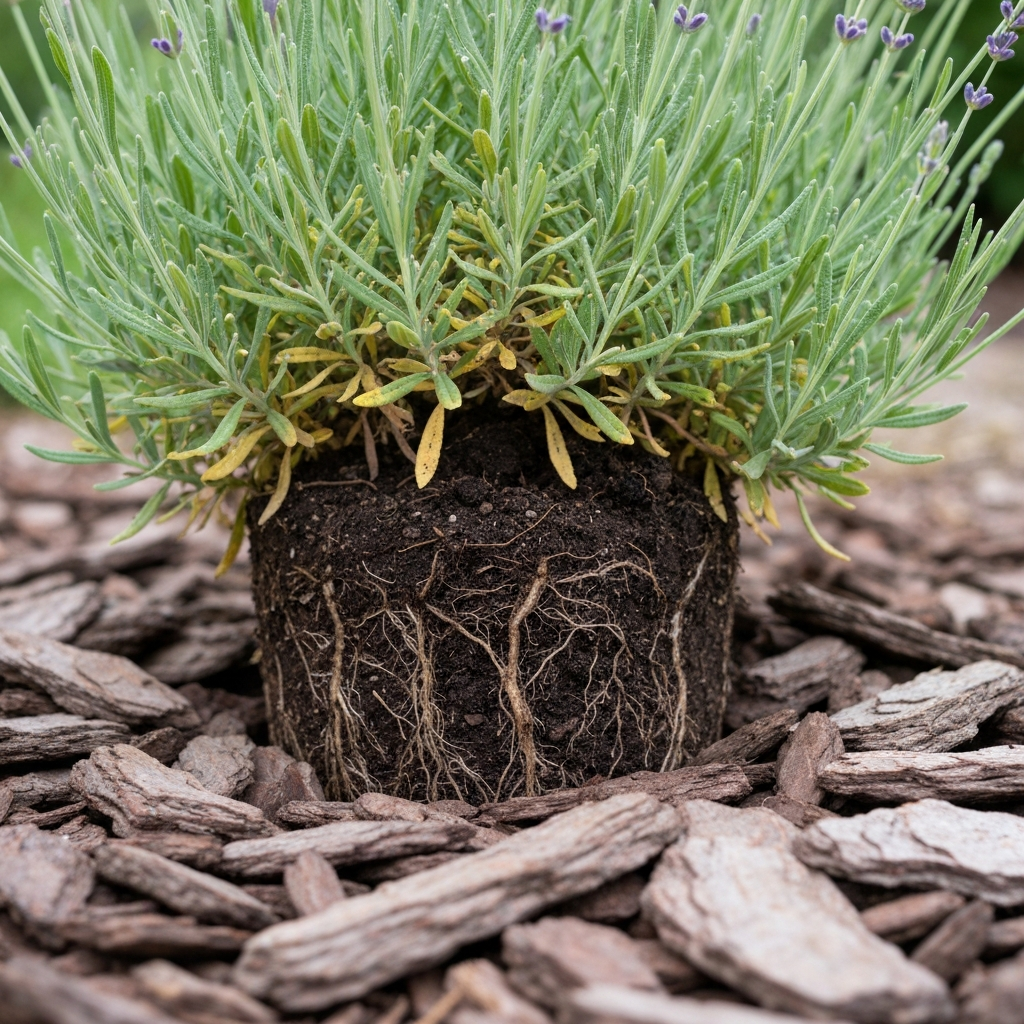
The crown — the junction point where the root system meets the aboveground stems — is the most structurally vulnerable part of the lavender plant. It has minimal bark protection and no tolerance for prolonged moisture contact. Planting even half an inch too deep submerges the crown into permanently moist soil. Applying organic mulch (wood chips, bark, leaf mould) directly against the base of the stems recreates that same moisture-contact environment at the crown, even when the soil below drains adequately.
This error is especially common among experienced gardeners who apply standard mulching practice — which is correct for roses, perennials, and most woody shrubs — to lavender. Research from the University of Maryland Cooperative Extension has found that the combination of crown burial and organic mulch approximately doubles the incidence of Phytophthora root rot in lavender plantings compared to surface-planted, mulch-free controls.
The fix: Plant lavender at exactly the depth of the nursery pot, or 1–2 cm proud (higher) to account for soil settling. If you mulch — and it is not necessary — use gravel, pea gravel, or crushed limestone rather than any organic material, and keep a 3-inch-wide, mulch-free collar around every stem base. Gravel mulch actively improves lavender conditions: it reflects radiated heat back up through the plant canopy, accelerates evaporation from the soil surface, and prevents soil particles from splashing up onto the crown.
Mistake 4: Planting in Rich, Fertile Soil
The instinct to improve soil before planting is correct for almost every other garden plant. For lavender, it is counterproductive. Rich, compost-amended soil drives the production of exactly the kind of lush, soft vegetative growth that lavender should not produce — and soft, rapidly grown tissue is disproportionately susceptible to fungal attack. Compost also increases the water-holding capacity of soil, directly compounding drainage problems.
In the wild, lavender grows in the garrigue — the sun-baked scrubland of southern France — where soil organic matter is typically below 1%, available nitrogen is minimal, and phosphorus and potassium are released slowly from weathering limestone. Under these conditions, lavender produces dense, woody stems and small, waxy aromatic leaves designed to minimize water loss and resist disease.
The fix: Do not add compost, manure, or balanced fertilizer to the planting hole or surrounding soil. A handful of garden lime is appropriate for acidic soils (below pH 6.5). If your soil is already fertile from years of composting, dilute it by incorporating horticultural grit to reduce both water retention and nutrient density. Established lavender does not need feeding — if you see pale, etiolated growth, investigate sun levels before assuming a nutrient deficiency.
Soil pH can make or break this plant — lavender best soil covers how to test and adjust.
Mistake 5: Insufficient Sun

Lavender requires a minimum of six full hours of direct sunlight daily. Partial shade does two things simultaneously: it encourages soft, disease-prone vegetative growth, and — critically — it suppresses evapotranspiration. Evapotranspiration is the mechanism by which water moves from soil through roots, up stems, and out through leaves. In full sun, a mature lavender plant can transpire several quarts of water per day, actively drawing moisture away from the root zone. In shade, this rate drops significantly, meaning the soil around the roots stays wetter for much longer after rain or irrigation.
Stop missing your zone's planting windows.
Select your US zone and month — get a complete checklist of what to plant, prune, feed, and protect right now.
→ View My Garden CalendarShade acts as a multiplier of every other mistake on this list. The same soil that dries adequately in full sun may remain saturated for days in a shaded border. The same watering frequency that is harmless in a south-facing bed may cause root rot in an east-facing one.
The fix: Choose a south- or west-facing location with no significant shade obstruction from buildings, trees, or tall fences. In the Pacific Northwest or any region with over 50 inches of annual rainfall, full sun is even more critical — it is one of the primary drying mechanisms keeping roots in safe moisture range between rain events. For a full walkthrough of site selection and establishment, see our Lavender Growing Guide.
Mistake 6: Poor Air Circulation
Lavender planted too close to solid walls, fences, or large neighboring shrubs develops a localized humid microclimate. High ambient humidity slows evaporation from leaf surfaces, keeps foliage damp for longer after rain or dew, and encourages both foliar pathogens (notably Botrytis cinerea, grey mould) and the root-zone water moulds. In the US Southeast, Mid-Atlantic, and Pacific Northwest — all regions where summer relative humidity regularly exceeds 70% — this is a genuine risk factor even in otherwise well-managed plantings.
The problem is particularly acute when lavender is planted against north-facing or east-facing walls, which receive little direct afternoon sun and retain moisture in the surrounding soil.
The fix: Space lavender plants 24–36 inches apart, depending on mature spread of the cultivar. Avoid solid structures on the prevailing wind side. In chronically humid climates, prioritize varieties bred for disease resistance: Lavandula ‘Phenomenal’ (an L. ×intermedia hybrid) has shown notably better root rot resistance in trials conducted by Cornell Cooperative Extension and multiple USDA trial gardens across the humid eastern United States.
Mistake 7: Choosing the Wrong Variety for Your USDA Zone
Four lavender species are commonly sold across the United States, with significantly different cold hardiness and humidity tolerance. Selecting the wrong one for your zone guarantees either winter kill or a chronically stressed plant that becomes an easy target for pathogens.
| Species | Common name | Hardy to zone | Notes |
|---|---|---|---|
| L. angustifolia | English / True lavender | Zone 5 | Most winter-hardy; classic fragrance |
| L. ×intermedia | Lavandin | Zone 5 | Taller, longer bloom season; stronger oils |
| L. stoechas | French / Spanish lavender | Zone 7–8 | Distinctive wing-bract flowers; needs warm winters |
| L. dentata | French lavender | Zone 8–9 | Toothed foliage; near-continuous flowering |
Gardeners in zones 5 and 6 who plant L. stoechas or L. dentata will lose them to hard winters reliably. Crucially, plants weakened by cold stress that falls below their threshold are significantly more vulnerable to root rot, as cold-damaged root tissue cannot defend against pathogen infection.
The fix: Check your USDA Hardiness Zone at the USDA Plant Hardiness Zone Map (planthardiness.ars.usda.gov) before purchasing. In zones 5–6, grow only L. angustifolia cultivars — ‘Hidcote’, ‘Munstead’, ‘Vera’, and ‘Twickel Purple’ are all reliably hardy. For diagnosing whether your lavender is showing cold damage versus root rot, see our guide to lavender problems.
Mistake 8: Container Growing Errors
Lavender in containers is disproportionately vulnerable to root rot because containers amplify every soil-moisture problem. The five most common container errors each create a distinct pathway to root rot:
- No drainage holes: Water pools at the base of the pot and creates a permanent saturation zone the roots cannot avoid.
- Oversized pots: A large volume of moist growing medium around a small root ball stays wet far longer than the plant can tolerate. Match pot size to root ball — no more than 2 inches larger in diameter.
- Peat-based potting compost: Standard multi-purpose mixes retain moisture lavender cannot handle. Use a gritty, mineral-heavy mix instead.
- Glazed ceramic or plastic pots: Non-porous walls prevent lateral moisture evaporation. Terracotta pots allow passive evaporation through the pot wall and are significantly better for root health.
- Watering on a standard houseplant schedule: Container lavender dries down faster in summer but stays wet for much longer in winter. Adjust watering seasonally, and never water in winter unless the medium is completely bone dry.
The fix: Use a terracotta pot with multiple drainage holes. Mix your growing medium: approximately 60% horticultural grit or perlite and 40% loam-based compost (John Innes No. 2 is ideal). Place a layer of crocks or coarse grit over the drainage holes before filling. Repot every two years into fresh medium, as mineral mixes compact over time. For a full container care guide, see our article on growing lavender in pots.
Mistake 9: Pruning Into Old Wood
Lavender does not regenerate from old, woody stems. Unlike roses, buddleja, or most other woody shrubs, it carries no dormant adventitious buds in mature wood that would allow it to push new growth after hard pruning. Cut a lavender stem back below the lowest green growth on that branch and it will not regrow — the branch dies, and if the cut removes a large enough proportion of the plant, the whole thing dies with it.
This mistake most often happens in two scenarios: a gardener tries to rejuvenate a leggy, neglected lavender by cutting it hard back in autumn, or a plant is winter-damaged to ground level and the bare stumps are left hoping they will reshoot. Neither works. The wound sites also create open entry points for Botrytis and other fungal pathogens.
The fix: Begin annual pruning from the plant’s first year — it is far easier to maintain a compact shape than to try to restore one. Prune immediately after the first flush of flowering ends (early to mid-summer for most L. angustifolia varieties). Cut back by one-third of total plant height, always cutting into green wood with multiple leaf nodes below the cut. Never remove more than one-third at any single pruning. Avoid autumn pruning in zones 5–7, as wounds may not heal before winter frosts arrive.
Mistake 10: Flat Ground with No Drainage Slope
Even in well-amended, gritty soil, flat ground allows water to pond during heavy rain rather than drain away from the root zone. In areas with more than 30 inches of annual rainfall — which covers most of the eastern United States, the Pacific Northwest, and much of the Midwest — flat-planted lavender may spend cumulative weeks in or near saturation over the course of a growing season. Each saturation event is another window of opportunity for Phytophthora to infect.
The interaction between flat ground and any of the other mistakes on this list is multiplicative. Flat ground plus clay soil is far more lethal than either factor alone.
The fix: Plant lavender on a naturally sloping site where possible, oriented so water runs away from rather than into the root zone. On flat ground, build raised planting mounds 8–12 inches high from a lean grit-and-topsoil mix. A mound that seems unnecessarily high at planting will settle to the right height within a season, and the drainage advantage is permanent. In very high-rainfall gardens, consider incorporating a French drain or perforated pipe drainage layer beneath lavender beds.
Root Rot Symptom Diagnostic Table
| Symptom | Most likely cause | Action |
|---|---|---|
| Wilting despite moist soil | Root rot (Phytophthora) | Check crown; reduce irrigation immediately |
| Grey-brown, mushy crown with sour smell | Advanced root rot | Remove plant; improve drainage before replanting |
| Yellowing, pale foliage | Overwatering or waterlogged soil | Test drainage; cut back irrigation |
| Leggy, soft green growth | Too much shade or excess fertilizer | Move to full sun; stop all feeding |
| Grey-silver foliage in summer | Normal heat response | No action needed — this is healthy |
| Failure to return in spring (zones 5–6) | Wrong variety or winter waterlogging | Replant with L. angustifolia; improve drainage |
| Stem dieback from base upward | Crown burial or mulch contact | Clear all mulch; allow crown to dry; check planting depth |
Frequently Asked Questions
Can you save lavender with root rot?
If detected early — when leaves are wilting but the crown is still firm and pale rather than brown and mushy — recovery is possible. Lift or unpot the plant, cut away all black and brown roots with sterilized scissors, dust the cut surfaces lightly with garden sulphur to inhibit further fungal spread, and replant in fresh, very gritty medium with dramatically improved drainage. Stop all watering for at least two weeks. If the crown itself is grey-brown and soft, the plant cannot be saved; focus instead on improving conditions for the replacement.
Why does my lavender die every year?
Annual lavender death — whether over winter or in late spring — is almost always root rot from winter waterlogging rather than cold damage. The two look similar at the start of the growing season: a plant that fails to push new growth. Test drainage before replanting, switch to a raised bed or mound, and confirm your variety is appropriate for your zone.
How often should you water lavender?
Once established (after the first growing season), lavender in the ground in zones 5–8 needs no supplemental irrigation in most years. In containers, water when the top 2 inches of growing medium is completely dry — typically once every 10 to 14 days in summer, and rarely if ever in winter. In drought conditions (no rain for three or more weeks), deep watering once is sufficient.
Does lavender need sandy soil?
Not purely sandy, but fast-draining and low in organic content. A blend of topsoil and 30–50% horticultural grit by volume drains adequately. Pure sand can become hydrophobic when dry, repelling water rather than passing it through. A grit-and-loam blend with a small percentage of lime is generally more reliable and more forgiving than either extreme.
What is the best mulch for lavender?
Gravel or crushed limestone at 2–3 inches depth. Both materials reflect radiated heat back up into the plant canopy, suppress annual weeds, accelerate surface evaporation from the soil, and prevent crown contact with moist organic material — the opposite of the effect produced by wood chip or bark mulches. Gravel mulch is standard practice in commercial lavender production for exactly these reasons.
Sources
- Royal Horticultural Society — Lavender Growing Guide — cultivation requirements, pest and disease reference
- Colorado State University Extension — Lavenders for Colorado (7.227) — USDA zone performance data and drainage requirements for Western US conditions


