

Before You Plant Honeysuckle: Vines vs. Shrubs, and 4 Non-Invasive Species That Won’t Spread

Japanese honeysuckle is banned in 5 states. Here are 4 safe vines and shrubs — including native coral honeysuckle that blooms all summer without spreading.
The most fragrant honeysuckle vine in most American garden centers is the one you should not plant. Japanese honeysuckle (Lonicera japonica) produces the sweet, pervasive scent many of us associate with the genus — and it is prohibited in five states, listed as a noxious weed in Florida and Indiana, and capable of reaching 120 feet while smothering the trees it climbs. Meanwhile, the native alternative — coral honeysuckle (Lonicera sempervirens) — has no fragrance at all, which surprises first-time buyers every single time.
The first honeysuckle I planted — bought for the fragrance at a garden center — turned out to be Japanese honeysuckle. It covered a six-foot fence panel in its first season and needed weekly cutting back by year two to keep it off the neighboring shrubs. That scent is now a red flag, not a selling point.
Honeysuckle splits cleanly into two growth forms — twining vines and multi-stemmed shrubs — and invasive species run in both groups. Getting this right means matching the growth form to your garden first, then choosing a non-invasive species within that form. For site selection, timing, and first-year establishment once you have picked your plant, the honeysuckle planting guide covers both vines and shrubs in detail.
The Two Invasive Types — and Why They Spread So Effectively
Japanese Honeysuckle Vine (Lonicera japonica)
Japanese honeysuckle spreads through three mechanisms at once, which is why it is so difficult to contain once established. Birds consume and distribute the black berries across wide areas. Underground rhizomes spread laterally and resprout after the top growth is cut. Runners trail along the ground, forming a dense mat that roots wherever stems contact soil. All three processes run simultaneously, with no meaningful natural enemies in North America to slow any of them.

Three pre-planned garden beds, free
Stop staring at empty beds: printable plans with exact layouts, plant lists and planting calendars — yours free from the Garden Library.
A single vine can reach 120 feet, forms mats on the forest floor while simultaneously climbing trees and shrubs, and grows heavy enough to topple host plants under the accumulated weight. It can also girdle young trees — wrapping tightly around trunks and cutting off the cambium layer, eventually killing the tree. Once a mature vine establishes in a site, complete removal typically takes several seasons of combined cutting and herbicide treatment.
The fragrance is a pollination adaptation, not a benefit to you: Japanese honeysuckle coevolved with night-flying moths in eastern Asia, producing its sweet scent primarily after dark to attract hawk moths. In North America, where those moths are absent or less abundant, the vine relies heavily on bird dispersal of its berries instead. The white flowers that fade to yellow — both colors visible on the same vine — are the fastest field identification. Black berries follow in autumn.
Regulatory status: prohibited from sale, planting, or propagation in Connecticut, Illinois, Massachusetts, New Hampshire, and Vermont. Prohibited under Indiana’s Terrestrial Plant Rule. Added to Florida’s State Noxious Weed List. If you find it offered for sale in those states, the retailer is operating illegally.
Invasive Shrub Honeysuckles (Lonicera maackii, L. tatarica, L. morrowii, and others)
Invasive shrub honeysuckles were introduced from Europe and East Asia beginning in the 1800s as ornamentals and for wildlife habitat plantings. Amur honeysuckle (L. maackii), Tartarian (L. tatarica), Morrow’s (L. morrowii), and their hybrids are now widespread across the northeastern and midwestern US, forming dense thickets that crowd out native understory plants.
They cause damage through four mechanisms that compound each other:
- Allelopathy: Chemicals in the tissues of invasive shrub honeysuckles — particularly Amur — inhibit the germination and growth of surrounding native plants. This chemical suppression makes it harder for native vegetation to reclaim ground even after the honeysuckles are removed.
- Extended canopy: These shrubs leaf out earlier in spring and hold leaves later into autumn than most native understory plants. The extended growing season shades out spring ephemerals and early-blooming natives during their critical reproductive windows.
- Bird dispersal trap: Birds disperse the berries widely — but the berries are low in fat relative to native fruits that evolved alongside migratory songbirds. Penn State Extension describes them as junk food for migratory birds: providing calories but not the high-fat fuel needed for long-distance flights. Birds eat them, spread them, and are still nutritionally shortchanged.
- Nest predation: The dense but structurally open branching of invasive honeysuckle shrubs provides less shelter than native vegetation. Nests built in these shrubs are more visible and accessible to predators than nests in native understory plants.
Amur honeysuckle carries an additional concern: research has linked dense Amur stands to higher lone star tick populations than surrounding native vegetation. Amur is a prohibited species under Maryland law.
The One Field Test That Identifies Invasive Shrub Honeysuckle
Cut or break any stem from the shrub and look at the cross-section. Every invasive honeysuckle shrub — Amur, Tartarian, Morrow’s, and their hybrids — has a hollow center (hollow pith). Native shrubs including native Lonicera species and dogwoods have solid white pith. This test works year-round and requires no botanical knowledge. A hollow center means invasive; solid means native or non-invasive.
Additional ID markers for invasive shrub honeysuckles:
- Opposite leaves in pairs along the stem, 1½–3 inches long, smooth edges
- Tubular flowers occurring in pairs at leaf nodes — Amur and Morrow’s produce white flowers fading to yellow; Tartarian typically produces pink flowers on longer stalks
- Shiny berries in clusters of four, ripening orange to red from summer through autumn
- Grayish-brown bark with vertical striations on mature stems
Vine or Shrub: Match the Form to Your Garden First
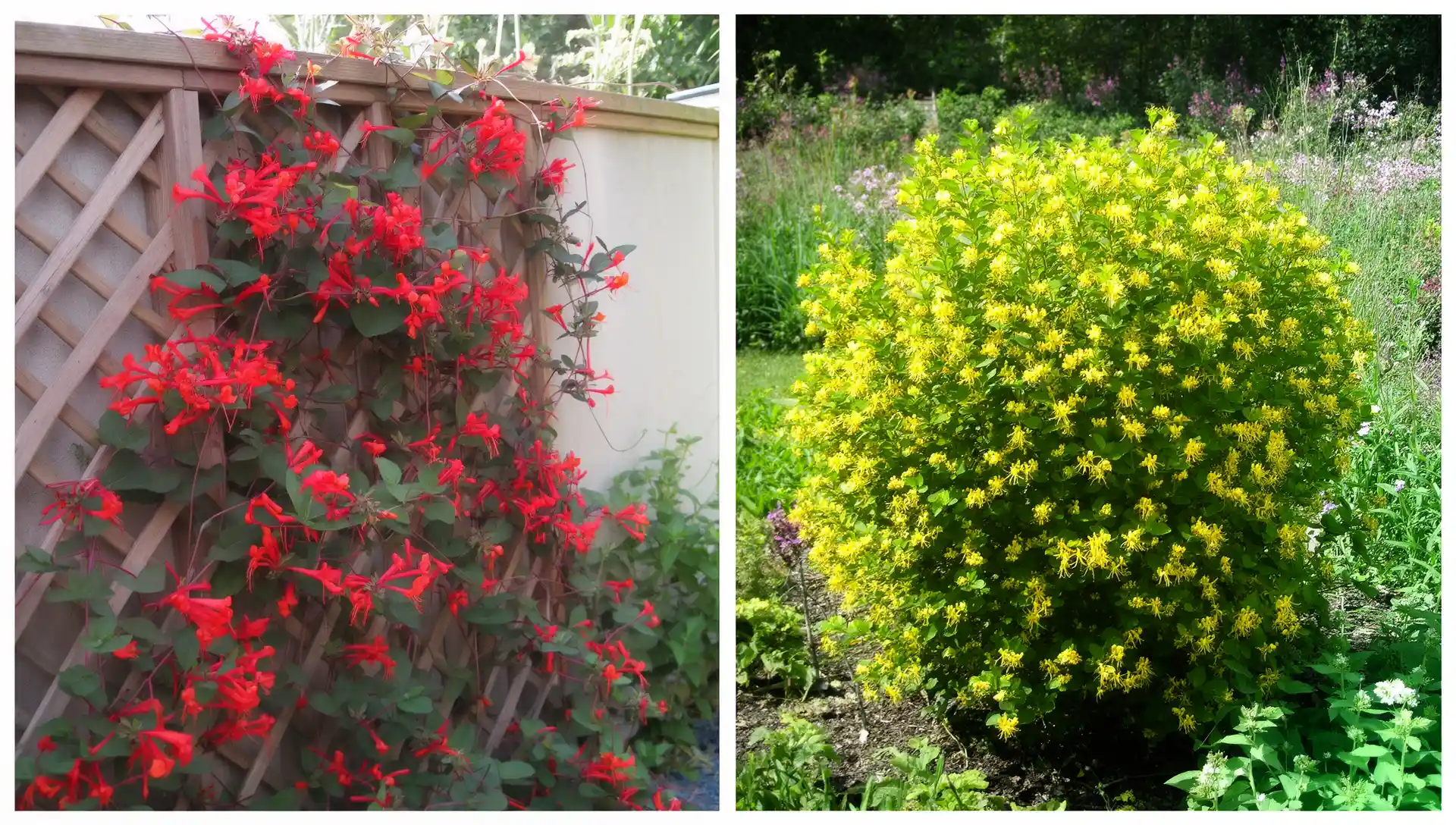
Before selecting a species, match the growth form to what your garden actually needs. Vines and shrubs serve fundamentally different purposes and the wrong form creates maintenance problems regardless of which species you choose.
| Garden Goal | Better Form | Why |
|---|---|---|
| Fence or trellis coverage | Vine | Twining habit attaches naturally to vertical structures without clips |
| Privacy screen or hedge | Shrub | Dense multi-stem branching creates year-round structure |
| Ground cover on a slope | Shrub | Spreading root system stabilizes soil; drought-tolerant options available |
| Hummingbird or pollinator garden | Vine (coral) | Tubular red flowers of L. sempervirens evolved for hummingbird pollination |
| Cold zones 3–4 | Shrub (Diervilla) | Zones 3–7; most non-invasive vines start at zones 4–5 |
| Evening fragrance garden | Vine (woodbine) | L. periclymenum intensifies fragrance after dark for moth pollination |
| Low-maintenance once established | Shrub (Diervilla) | Drought-tolerant; tolerates average to dry soil without supplemental watering |
4 Non-Invasive Honeysuckles Worth Planting
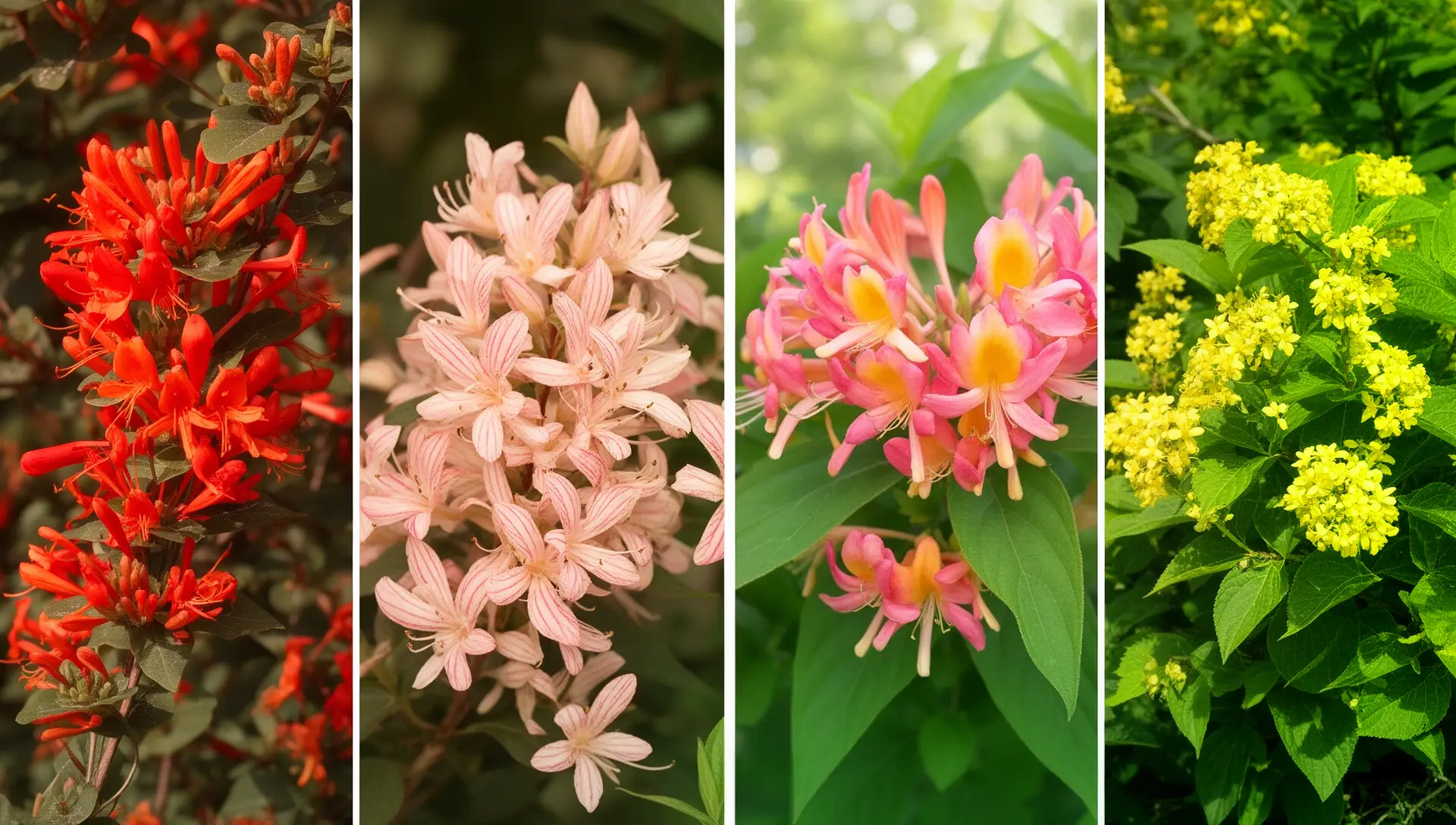
1. Coral Honeysuckle (Lonicera sempervirens) — Native Vine
Coral honeysuckle is the top recommended native vine replacement for Japanese honeysuckle, endorsed by university extension programs across the eastern US and by wildlife gardening organizations nationwide. It is native to the eastern United States, hardy in zones 4a–9b, and blooms from March through July — or nearly continuously from late spring through fall with a strong repeat-blooming cultivar.
The most important thing to know before buying: coral honeysuckle has no fragrance. The flowers evolved for hummingbird pollination, not moth pollination — hummingbirds navigate by sight and color, so no scent is required. The upside is a simple field identification rule: if a honeysuckle vine in the eastern US smells sweet, it is not coral honeysuckle. In practice, the absence of fragrance is your first confirmation you have the right plant.
Cultivar selection matters more than most guides acknowledge. ‘Major Wheeler’ cycles through flushes of reddish-orange blooms faster than the straight species and was awarded the Pennsylvania Horticultural Society Gold Medal for its performance in trials — it is the cultivar most worth seeking out for reliable repeat bloom. ‘John Clayton’ produces yellow flowers and stays more compact, making it a better fit for smaller trellises where a vigorous vine would overrun the support. ‘Flava’ (also sold as ‘Sulphurea’) offers golden-yellow blooms for gardeners who want color variation without the invasive risk of Japanese honeysuckle’s yellow phase.
All three attract hummingbirds from first bloom and serve as larval hosts for both the Spring Azure butterfly and the Snowberry Clearwing moth. Red berries ripen in fall and feed songbirds. Plant in full sun (six or more hours daily) for best bloom density; part shade is tolerated but noticeably reduces flowering. Tolerates clay and loam soils; drought-resistant once established in its second year.
If evening fragrance is your primary goal, European woodbine is the non-invasive vine to plant. The scent intensifies after dark — this is not imagination and not coincidence. Woodbine coevolved with night-flying hawk moths in its native European range; the flowers release their most concentrated fragrance during the hours those moths are active. Plant it near a seating area where you spend summer evenings and you will smell it before you see it.
Stop missing your zone's planting windows.
Select your US zone and month — get a complete checklist of what to plant, prune, feed, and protect right now.
→ View My Garden CalendarWoodbine is not native to North America but has not naturalized to invasive levels here. Hardy in zones 5a–9b, it blooms from spring through early summer with sporadic repeat bloom later in the season. The cream-white to yellow flowers carry pink or red streaks on the exterior, and the vine is a recorded host plant for the Admiral butterfly and the Twenty-plume moth.
Key cultivars: ‘Serotina’ (Late Dutch Honeysuckle) blooms into late summer with pink-flushed flowers, extending the season beyond the main spring flush. ‘Belgica’ (Early Dutch Honeysuckle) flowers heavily in late spring with red-streaked bicolored blooms that fade to cream-yellow. ‘Graham Thomas’ produces clear yellow flowers on a vigorous vine. All are intensely fragrant; fragrance peaks reliably after sundown regardless of cultivar.
3. Goldflame Honeysuckle (Lonicera × heckrottii) — Long-Blooming Hybrid Vine
Goldflame is a hybrid that produces no viable seeds, which removes the primary spread mechanism that makes other honeysuckles invasive. It is the non-invasive vine with the longest bloom window: flowers appear in early summer, peak in midsummer, and continue through fall with intermittent repeat bloom — a longer continuous season than either coral or woodbine manages.
The flower is easy to identify: rose-pink exterior petals open to a yellow interior, 1–3 inches long, with mild fragrance (significantly weaker than woodbine). Hardy in zones 5–9; prefers full sun; tolerates soil pH from 5.5 to 8, including alkaline soils that challenge other Lonicera. Deer- and rabbit-resistant — a practical advantage in rural and suburban gardens where browsing pressure is high.
One caveat: Goldflame has been flagged as invasive specifically in Illinois. If you garden in Illinois, check with your local University of Illinois Extension office before planting; the species is considered non-invasive across the rest of its range. The concern appears limited to Illinois conditions and has not been reported in neighboring states.
4. Northern Bush Honeysuckle (Diervilla lonicera) — Native Shrub
If you want a shrub with “honeysuckle” in its name and zero risk of invasiveness, Diervilla lonicera is the correct choice. It belongs to genus Diervilla, not Lonicera — a different genus entirely, which means it is not related to any of the invasive shrub honeysuckles and cannot be confused with them on the hollow-pith test: its stems are solid throughout.
The native range is broad: eastern North America from Newfoundland and Saskatchewan south to North Carolina, Tennessee, and Iowa. Hardy in zones 3–7, it fills a cold-hardiness gap that most non-invasive vines cannot cover — gardeners in zones 3 and 4 have fewer safe vine options and Diervilla gives them a native shrub alternative that is genuinely suited to northern conditions rather than marginal at them.
Mature size stays compact: 2–3 feet tall by 2–4 feet wide, suitable for borders and naturalized areas where larger shrubs would dominate the space. Yellow tubular flowers appear in June and July, providing nectar for bees, butterflies, and hummingbirds. Dry seed capsules that form after bloom are worked by songbirds through autumn and winter. Full sun to part shade; average to dry soil; drought-tolerant once established. Fall foliage turns yellow to orange and sometimes red, adding a second season of interest after the bloom period ends.
Quick Reference: Non-Invasive Honeysuckles at a Glance
| Species | Form | Zones | Fragrance | Standout Feature | Wildlife |
|---|---|---|---|---|---|
| L. sempervirens ‘Major Wheeler’ | Vine | 4–9 | None | Native; primary hummingbird vine | High — hummingbirds, butterflies, songbirds |
| L. periclymenum ‘Serotina’ | Vine | 5–9 | Intense (peaks after dark) | Best evening fragrance | Medium — moths, butterflies |
| L. × heckrottii Goldflame | Vine | 5–9 | Mild | Longest bloom season; deer-resistant | Medium — hummingbirds, butterflies |
| Diervilla lonicera | Shrub | 3–7 | None | Hardiest native; solid stems; drought-tolerant | Medium — bees, butterflies, songbirds |
Frequently Asked Questions
Is honeysuckle invasive in my state?
Japanese honeysuckle vine is prohibited in Connecticut, Illinois, Massachusetts, New Hampshire, and Vermont, and listed as a noxious weed in Florida and Indiana. Invasive shrub honeysuckles — particularly Amur — are regulated in Maryland and other mid-Atlantic and midwestern states. Your state’s department of agriculture or cooperative extension service maintains the most current list; invasive species regulations update regularly and vary by county in some states.
Does native honeysuckle smell?
Coral honeysuckle (Lonicera sempervirens) has no fragrance — its tubular flowers evolved for hummingbird pollination, which does not require scent. European woodbine (L. periclymenum) is strongly fragrant, especially after dark. If you want fragrance from a non-invasive vine, woodbine is the correct choice. The absence of scent is a useful identification signal: a sweet-smelling honeysuckle vine in the eastern US is more likely Japanese honeysuckle than any native species.
How fast does coral honeysuckle grow?
Coral honeysuckle grows at a moderate rate — roughly 3–6 feet per year with adequate sun and structural support. This is significantly slower than Japanese honeysuckle, which can put on 10–15 feet in a single season. The slower growth rate is actually useful in most garden settings: coral honeysuckle stays manageable on a fence or trellis without constant cutting back, while Japanese honeysuckle requires ongoing aggressive control to prevent it overrunning surrounding plants.
Can you eat honeysuckle berries?
Avoid eating berries from most Lonicera species. The red and black berries of Japanese honeysuckle and the red berries of coral and invasive shrub honeysuckles are all considered mildly to moderately toxic if eaten in quantity. The exception is Lonicera caerulea — the honeyberry or haskap — which produces edible blue-black berries and is grown commercially in cold climates. Do not eat berries from any honeysuckle vine or shrub unless you have positively identified the plant as L. caerulea.
Sources
- NC State Extension Gardener Plant Toolbox — Lonicera sempervirens (Coral Honeysuckle)
- University of Maryland Extension — Non-Native Invasive Honeysuckles
- Penn State Extension — Shrub Honeysuckles
- UNH Cooperative Extension — Invasive in the Spotlight: Japanese Honeysuckle
- Utah State University Extension — Vines in the Landscape: Goldflame Honeysuckle
- Rutgers NJ AES Extension — Plant This, Not That: Honeysuckle
- Missouri Botanical Garden — Diervilla lonicera (Bush Honeysuckle)
- NC State Extension Gardener Plant Toolbox — Lonicera periclymenum (Common Honeysuckle/Woodbine)


