

How to Plant Honeysuckle: Native vs. Invasive, Site Selection, and Timing for First-Year Blooms

Japanese honeysuckle is invasive in 26 states. Here’s how to pick the right species, site it correctly, and plant it for first-year blooms.
At most garden centers, the label just says “honeysuckle” — and the plant in front of you has white flowers, a sweet fragrance, and a twining habit that looks perfect for an arbor or fence. What the label often won’t tell you is whether that plant is Lonicera japonica, the Japanese species classified as invasive in 26 eastern states and prohibited from sale in Connecticut, Illinois, Massachusetts, New Hampshire, and Vermont.
That single species decision determines whether your honeysuckle becomes a summer highlight or a decade of removal work. Make it before you reach the checkout.
Not sure which species to buy? The honeysuckle types guide compares native vines and shrubs side by side — including 4 non-invasive picks with USDA zone data, fragrance notes, and wildlife value — so you can narrow the choice before you get to the nursery.
This guide covers the full process of planting honeysuckle correctly: how to identify non-invasive species at the nursery, how to choose a site that uses the plant’s woodland biology to your advantage, and step-by-step planting instructions matched to your climate zone. Container-grown plants of the right species, properly sited, can produce flowers in their first season — but only if the groundwork is right.

Three pre-planned garden beds, free
Stop staring at empty beds: printable plans with exact layouts, plant lists and planting calendars — yours free from the Garden Library.
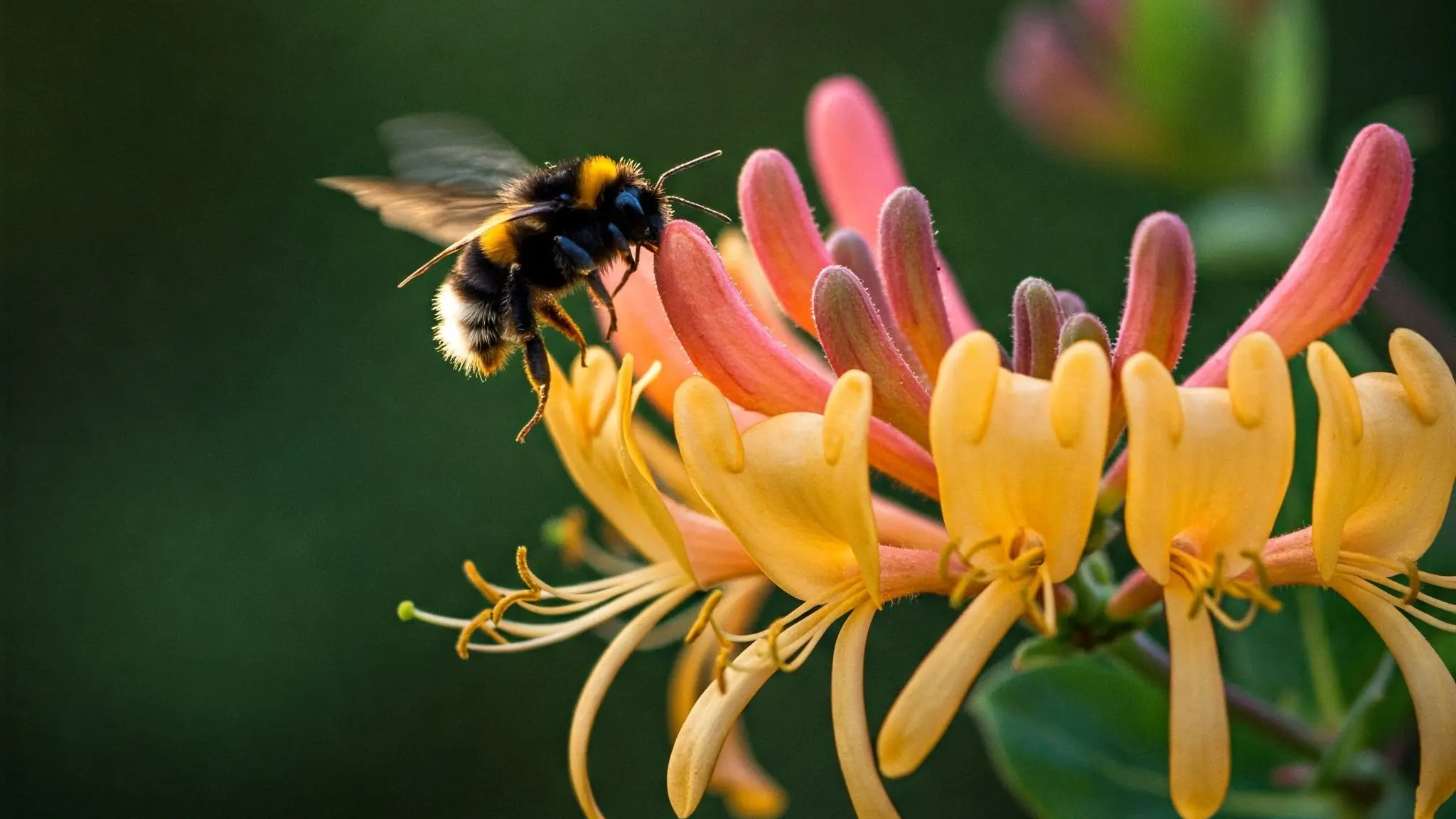
Native vs. Invasive: The Decision You Make Before You Buy
Japanese honeysuckle was introduced to Long Island in 1806 as an ornamental vine. According to UConn Extension, it now ranges from Maine to Florida and across the Midwest, spreading via aboveground runners that grow more than 10 feet per year and through seeds dispersed by birds. Illinois Extension reports that large trees in forests invaded by bush honeysuckle have been stunted by up to 40 percent — a measure of how thoroughly these plants reshape the ecosystems they enter.
At the nursery, L. japonica looks appealing precisely because of the traits that make it invasive: vigorous growth, fragrant flowers, and a willingness to climb anything. Here’s how to identify it before you buy:
| Feature | L. japonica (Japanese) — avoid | L. sempervirens (Trumpet) — safe | L. periclymenum (European) — safe |
|---|---|---|---|
| Flower color | White, aging to yellow | Scarlet to orange-red | White or pink, aging to yellow |
| Fragrance | Strongly fragrant | Not fragrant | Strongly fragrant |
| Upper leaf pairs | Separate (unfused) | Fused into a single leaf | Separate (unfused) |
| Berry color | Black | Bright red | Red |
| Stem texture | Fuzzy when young | Smooth | Smooth to lightly hairy |
| US invasive status | Invasive in 26 states | Native, non-invasive | Non-invasive in US |
The fused-leaf feature is the fastest check: on trumpet honeysuckle, the uppermost pair of leaves merges at the base into a single disc that the stem passes through. Japanese honeysuckle never does this. If you can’t examine the leaves or berries, ask the nursery staff for the full Latin name before buying any unlabeled vine.

Bush honeysuckles are a separate category worth knowing. Tartarian (L. tatarica), Amur (L. maacki), and Morrow’s (L. morrow) are invasive shrub-form honeysuckles that dominate woodland understories across the Midwest and Northeast. The easiest check: cut a stem. Invasive bush honeysuckles have hollow centers; native species have solid pith.
Which Species Is Right for Your Garden?
With invasive species ruled out, the choice narrows to three variables: your hardiness zone, whether you want fragrance, and how much space you have.
| Species / Cultivar | Zones | Fragrant? | Mature Height | Best for |
|---|---|---|---|---|
| L. sempervirens (Trumpet honeysuckle) | 4–9 | No | 10–20 ft | Hummingbirds, hot summers, native wildlife |
| ‘Major Wheeler’ (L. sempervirens) | 4–9 | No | 6–8 ft | Compact spaces, longest bloom season |
| ‘Dropmore Scarlet’ (L. sempervirens) | 3–8 | No | 10–15 ft | Cold zones (zone 3), long-season color |
| L. periclymenum (European honeysuckle) | 5–9 | Yes | 10–20 ft | Evening fragrance, moth gardens |
| ‘Scentsation’ (L. periclymenum) | 5–9 | Yes, intensely | 8–10 ft | Fragrance near seating or windows |
| ‘Peaches and Cream’ (L. periclymenum) | 5–9 | Yes | 5–6 ft | Small trellises, container growing |
Here’s the fragrance issue most guides skip: trumpet honeysuckle (L. sempervirens) has no scent. Its flowers are brilliant — hummingbirds arrive within days of the first opening — but you won’t smell them from a porch chair. If fragrance is your main goal, you need L. periclymenum. The perfume of cultivars like ‘Scentsation’ intensifies after dark and draws sphinx moths, which are worth watching on summer evenings in their own right.
For zone 3 and 4 gardens, ‘Major Wheeler’ and ‘Dropmore Scarlet’ are the most cold-hardy options. Both are L. sempervirens selections that survive harsh winters and bloom reliably. ‘Major Wheeler’ has an advantage that most competitors miss: it flowers on both old and new wood, which means a heavier bloom load and earlier recovery from any late-frost damage.
Site Selection: Sun Above, Shade Below
The guidance “full sun to partial shade” is accurate for honeysuckle but misses the more useful detail: sun on the vine, shade on the roots.
Climbing honeysuckles are woodland plants. In their natural habitat, roots sit in cool, leaf-littered forest soil while stems climb toward the canopy. That evolutionary origin produces a specific requirement that most guides mention but never explain: shaded roots stay cooler and moister, which reduces two common problems. First, heat stress on root hairs — the tiny structures responsible for water uptake — impairs the plant’s ability to supply stems with water during peak summer heat, which causes leaves to drop and flowers to abort. Second, dry roots trigger powdery mildew far more reliably than high air humidity does. The RHS specifically warns against south-facing walls for climbing honeysuckle, citing both leaf scorch and mildew risk. I’ve seen this firsthand — honeysuckle planted against a south-facing brick wall regularly collapses into powdery mildew by August, while a matched plant on the east side of the same garden stays clean all summer. The difference is root temperature and moisture, not shade on the leaves.
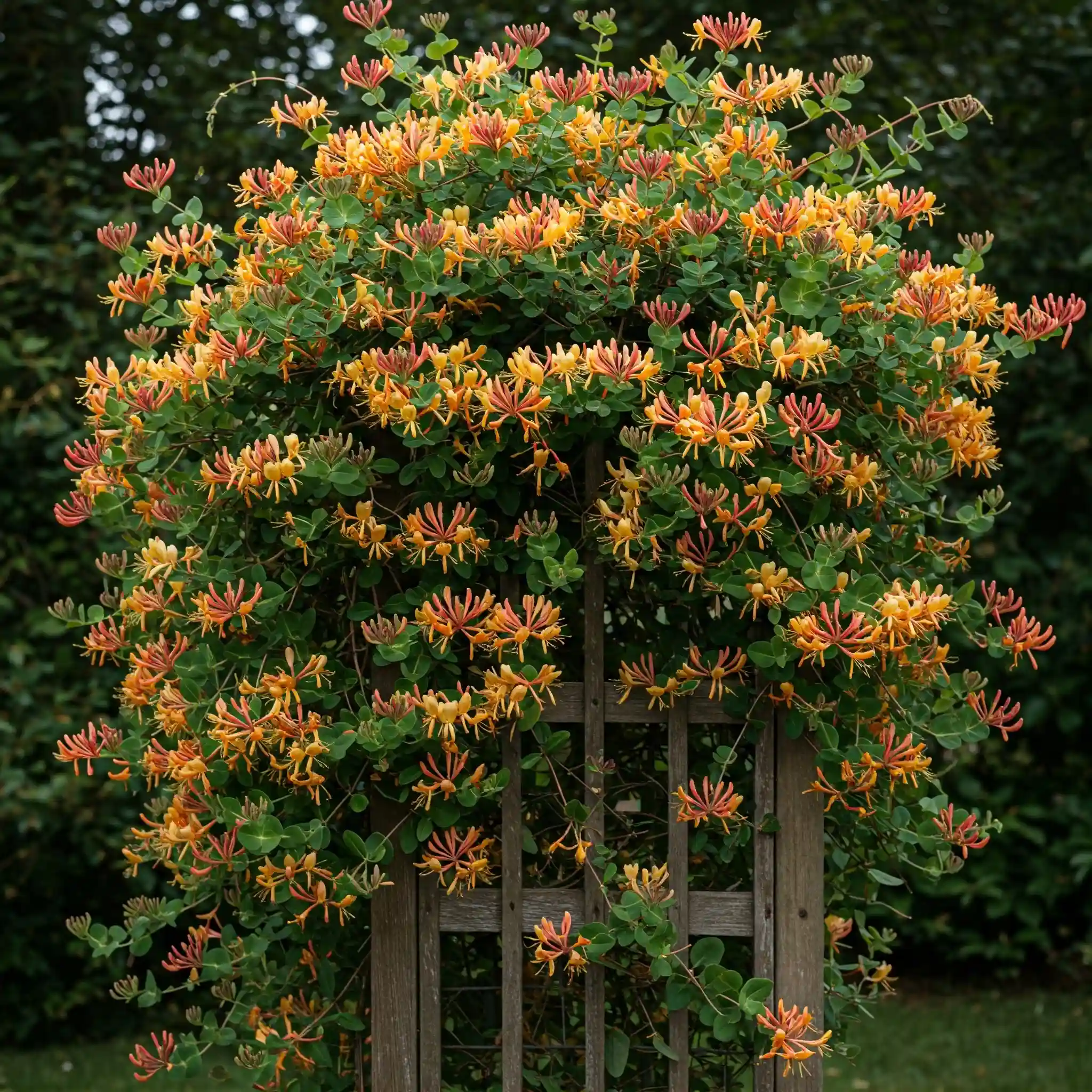
The practical setup: choose a site that gives the vine at least six hours of direct sun for flower production, then mulch the root zone or underplant with low-growing perennials to keep it cool. East-facing positions often work well — morning sun drives growth and bloom, while afternoon shade prevents heat build-up at the roots.
If fragrance is important, place L. periclymenum where you’ll actually experience it: within 10 feet of a doorway, window, or outdoor seating area. The scent travels in still air and intensifies after sundown.
Soil Preparation
Honeysuckle tolerates a wide pH range — 5.5 to 8.0 — so most established garden soils need no pH amendment. What it won’t tolerate is waterlogged roots, even briefly.
Run a basic drainage check before planting: dig a hole 12 inches deep, fill it with water, and return in an hour. Well-drained soil drops the water level at least 1 inch per hour. If the hole is still full, drainage is poor enough to be a problem — waterlogged roots develop rot within a single wet season.
For clay-heavy soil: work 2–3 inches of compost into the top 12 inches of the planting area. Even a 4–6 inch raised berm improves drainage significantly and is worth building if you’re planting against a wall where you can’t amend a wide area.
Stop missing your zone's planting windows.
Select your US zone and month — get a complete checklist of what to plant, prune, feed, and protect right now.
→ View My Garden CalendarFor sandy soil: extra compost holds moisture long enough for young roots to develop. Established honeysuckle handles dry periods well, but sandy soil dries so fast that newly planted vines can desiccate before roots reach deeper reserves.
Don’t add fertilizer to the planting hole. High nitrogen at planting stimulates leaf and stem growth at the expense of root development — exactly the opposite of what a newly planted vine needs. Compost provides enough slow-release nutrition for the first year without driving the plant toward vegetative overdrive.
Install Your Support Before You Plant
Support structures go in before the plant does. Hammering posts or anchoring wires after planting risks cutting or compacting the root ball you’ve just carefully positioned — and once roots are growing outward, disturbance sets establishment back by weeks.
Honeysuckle climbs by twining — stems spiral around any structure with enough width to grip. A flat fence face or smooth masonry won’t work; the vine needs something to wrap around. What does work:
- Horizontal wires mounted to the wall or fence, spaced 18 inches apart (the RHS-recommended interval), with at least a 2-inch gap between the wires and the surface for airflow and access
- Trellis panels with gaps no larger than 4 inches
- Pergola beams, arbors, and fences with horizontal rails
Install eye hooks or vine eyes into masonry; galvanized ring nails hold training wires into timber without corroding. Start the lowest wire at least 2 feet from the ground — this gives you a training zone for building a structural framework of lower stems before the vine runs upward.
How to Plant Honeysuckle Step by Step
Timing the planting to your zone prevents two opposite problems: cold-zone planting too early puts roots in soil that freezes before they establish; warm-zone planting too late pushes young roots into summer heat before they’re deep enough to cope.
| Zone | Spring planting window | Fall planting window |
|---|---|---|
| Zones 3–5 | Late May to mid-June (after last frost) | Not recommended — season too short |
| Zones 6–7 | Late April to early May | September to October |
| Zones 8–9 | February to March | October to November |

- Water the container the night before. A dry root ball repels water in the planting hole. Pre-watering ensures even hydration from the start.
- Dig the hole 2–3 times wider than the root ball, and the same depth. Width matters more than depth here — honeysuckle roots spread outward before they grow down, and compacted soil at the sides is what limits establishment speed.
- Position the plant 6–12 inches away from the support structure. Closer than 6 inches and the wall creates a rain shadow where irrigation rarely reaches.
- Set the root crown at or 1 inch above the surrounding soil level. Planting too deep buries the crown, which promotes rot at the stem base. If the soil will settle, plant slightly high rather than level.
- Tease apart any circling roots before backfilling. Roots that have coiled around the pot will continue spiraling in the ground, eventually girdling the plant. Gently loosen them outward with your fingers.
- Backfill with original soil mixed 1:1 with compost. Firm the soil in two or three layers to eliminate air pockets — air pockets dry out root hairs and slow establishment.
- Build a shallow water-retention berm — a low ring of soil around the hole perimeter. This directs irrigation straight to the root zone rather than running off the surface.
- Soak thoroughly. Water slowly until the berm fills twice, letting it drain between fills. This drives out remaining air pockets and saturates the root zone evenly.
- Mulch with 1–2 inches of wood chips or bark. Keep the mulch a few inches away from the stem — contact moisture at the crown is a common cause of fungal rot in young vines.
- Loosely tie the main stems to your lowest support wire using a figure-8 loop. Thread the tie in a figure-8 around both the stem and the wire so the stem is held away from the wire rather than against it. Leave enough slack to insert a finger through the loop — constricting ties cut into stems as they thicken.
First-Year Care: Water Now, Fertilize Never
A newly planted honeysuckle that puts out modest top growth in year one is doing exactly what it should. The plant is investing resources in root development — the deeper and wider the roots grow, the more flower buds the plant will support in year two and beyond. A vine that pushes 5 feet of top growth in its first summer at the expense of rooting will stall in year two’s heat.
Watering: Keep the soil consistently moist — not wet — for the first 8–12 weeks. After that, water deeply once a week during dry periods. Wilson Bros Gardens suggests avoiding daily light splashing in favor of deep, infrequent soaks; this encourages roots to grow downward rather than staying shallow where they’re vulnerable to heat and drought. Once fully established — usually after one complete growing season — honeysuckle handles moderate drought, though consistent moisture improves flower production.
Mulch maintenance: Check depth monthly through the first season and top up if it drops below 1 inch. If mulch has migrated against the stem, pull it back — sustained moisture at the crown is the most common cause of stem rot in young vines.
Powdery mildew: If white coating appears on leaves, check the root zone before reaching for a fungicide. Dry roots are the primary trigger — not ambient humidity. Water more deeply, renew mulch, and consider whether the plant is getting too much reflected heat from a nearby wall. For detailed diagnosis of honeysuckle disease and pest problems, see our guide to honeysuckle problems and how to fix them.
The Fertilizer Mistake That Stops Blooms
High-nitrogen fertilizers are the most common reason established honeysuckle produces lush leaves and few flowers — and the mechanism is straightforward.
Nitrogen drives cell division in vegetative tissue: leaves, stems, and shoots. When nitrogen is elevated, the plant routes energy toward above-ground growth rather than toward the reproductive tissue that forms flower buds. Phosphorus works the opposite way — it’s the primary driver of flower bud development and sets the balance between vegetative and reproductive growth. Overfertilizing with a balanced or high-nitrogen feed consistently produces the same result: dark green, vigorous vines with a sparse flowering display.
The practical approach:
- Year one: no fertilizer. Compost worked into the soil at planting provides adequate slow-release nutrition for root establishment.
- Year two onwards: low-nitrogen formula. Apply once in early spring using an NPK ratio like 5-10-10 or 2-10-10 — enough phosphorus to support bloom development without pushing the vine into vegetative overdrive.
- Best option: compost top-dress. Apply 2–3 inches of compost over the root zone each spring. It releases nutrients slowly, builds soil biology, and avoids the nitrogen spike that sends energy in the wrong direction.
If your established honeysuckle has flowered poorly for two or more seasons, reduce or eliminate fertilizer for a year before trying anything else. In many cases, poor flowering in established plants traces directly to overfeeding rather than cultural or environmental problems.
Seasonal Care Calendar
| Period | Task | Notes |
|---|---|---|
| February–March | Plant in zones 8–9; prune deciduous varieties if needed | Prune lightly — heavy pruning removes flower buds on old-wood bloomers like L. sempervirens |
| March–April | Feed established plants in zones 7–9 with low-N fertilizer; renew mulch | Wait until soil reaches 50°F before feeding |
| Late April–May | Plant in zones 6–7; first blooms appear on established plants | L. sempervirens blooms heavily in late spring; L. periclymenum follows |
| Late May–June | Plant in zones 3–5; tie in new stems as they grow | Water newly planted vines deeply once a week |
| July–August | Water during drought; check mulch depth | Powdery mildew risk peaks in hot, dry periods — address dry roots before treating foliage |
| September–October | Plant in zones 6–9; songbirds begin feeding on red berries | Fall planting allows 6–8 weeks of root growth before ground freezes |
| November–February | Deciduous varieties go dormant; light tidying if needed | Leave structure intact — stems support overwintering beneficial insects |
For precise pruning timing by species — including which honeysuckles bloom on old wood versus new growth and when to cut without removing next year’s flower buds — see our guide to pruning honeysuckle for better blooms.
Frequently Asked Questions
Is honeysuckle invasive in my garden?
Only if you plant Japanese honeysuckle (L. japonica) or invasive bush honeysuckle species (L. tatarica, L. maacki, L. morrow). Trumpet honeysuckle (L. sempervirens) is native to eastern North America and poses no invasive risk. European honeysuckle (L. periclymenum) is non-invasive in US gardens. Check your state’s noxious weed list if you’re unsure about a species — five states prohibit sale of L. japonica entirely.
Will honeysuckle bloom in its first year?
Container-grown plants purchased from a nursery typically arrive as 1–2-year-old plants with established wood and will produce some flowers in their first season if planted at the correct time. Cultivars that bloom on both old and new wood — like ‘Major Wheeler’ — are the safest bet for reliable first-year flowers. Bare-root plants or very small seedlings may skip year one while they establish root systems.
Why isn’t my honeysuckle flowering?
The three most common causes: fewer than four hours of direct sun per day, high-nitrogen fertilizer pushing vegetative growth at the expense of flower buds, and pruning at the wrong time (removing old wood before it produces the season’s buds). Age is rarely the issue with container-grown plants. Reduce fertilizer, check sun exposure across the full day, and confirm pruning timing against the species you have.
How fast does honeysuckle grow?
Slowly in year one — most of the growth happens underground during root establishment. Expect 2–5 feet of top growth in the first season, then 5–10+ feet per year once roots are deep. Mature vines reach 10–20 feet depending on species and support. Plants that appear to do little in year one often surge in year two once the root system is in place.
Can I grow honeysuckle in a container?
Yes — compact L. periclymenum cultivars like ‘Peaches and Cream’ and ‘Sweet Tea’ (both 5–6 feet) handle container growing well. Use a large pot (at least 15-gallon volume), a well-draining mix, and place the container where it gets morning sun. Container plants dry out faster than in-ground plantings, so check soil moisture twice a week during summer. Feed with a low-nitrogen formula in early spring and again in early summer.
For a complete step-by-step walkthrough, see growing coral honeysuckle, including cultivars, pruning timing and a no-bloom troubleshooting table.
Sources
- NC State Extension — Lonicera sempervirens (Trumpet Honeysuckle)
- UF/IFAS Gardening Solutions — Coral Honeysuckle (Lonicera sempervirens)
- NC State Extension — Lonicera periclymenum (European Honeysuckle)
- UConn Extension — Invasive Plant Factsheet: Japanese Honeysuckle
- UNH Extension — Invasive in the Spotlight: Japanese Honeysuckle
- NC State Extension — Lonicera japonica (Japanese Honeysuckle)
- Illinois Extension — Identify and Manage Invasive Bush Honeysuckle
- Morton Arboretum — Trumpet Honeysuckle
- Wilson Bros Gardens — How to Plant, Prune, Train, Fertilize and Water Honeysuckle Vines
- RHS — Climbing Honeysuckle Growing Guide
- Garden Design — Honeysuckle Vine: Growing a Non-Invasive Honeysuckle Plant


