

Goldflame, Anthony Waterer, or Bridal Wreath: How to Pick the Right Spirea for Your Garden Size and Style

Prune Bridal Wreath in March and lose your spring show — then learn which spirea fits your garden: Goldflame, Anthony Waterer, or Bridal Wreath compared.
Picking a spirea feels simple until you realize the compact gold-leafed mound in one nursery pot and the arching 8-foot cascade of white flowers in the next are completely different plants — with different size requirements, different pruning schedules, and different peak seasons.
The three most common varieties — Bridal Wreath, Goldflame, and Anthony Waterer — each solve a different garden problem. Bridal Wreath types create the most dramatic spring spectacle of any low-maintenance shrub. Goldflame delivers three-season foliage color in a 2-foot package. Anthony Waterer provides reliable summer flowers from June through August. But plant the wrong one for your space, or prune any of them at the wrong time, and you’ll wait an entire year for a show that never comes.
This guide explains the one biological difference that divides all spireas into two groups — spring bloomers and summer bloomers — then walks through each major variety so you can match the right plant to your garden’s size and style. For full planting and care basics across USDA zones, see our Spirea Growing Guide.
Regional note for SE US gardeners: Readers in Virginia, Georgia, South Carolina, Tennessee, Kentucky, and surrounding states should review the invasiveness note in the summer-blooming section before purchasing Japanese spirea cultivars.

Three pre-planned garden beds, free
Stop staring at empty beds: printable plans with exact layouts, plant lists and planting calendars — yours free from the Garden Library.
The Bloom Timing Split That Changes Everything
All spireas divide into two groups by when they bloom, and that timing determines their entire care calendar — especially when and how hard you can prune.
Spring-blooming spireas — the classic Bridal Wreath types — set their flower buds on old wood: growth the plant produced the previous summer. Prune those stems in March and you’ve removed every bud the plant spent all last season developing. Zero spring show that year [1].
Summer-blooming spireas — the mounded types like Goldflame and Anthony Waterer — bloom on new wood grown the same season. Hard pruning in late winter pushes them to produce more stems, which means more flowers [2]. This is one of the rare garden shrubs where aggressive pruning improves the display rather than delaying it.
The practical test is simple: if you’re inheriting a garden with spireas and don’t know what’s there, wait until spring. If the shrub erupts in white arching sprays before the leaves emerge, it’s a spring bloomer — leave it alone until the flowers fade. If it produces compact pink or crimson clusters on a rounded mound from June onward, it’s a summer bloomer — cut it back hard the following February.
Pruning at the wrong time is the single most common spirea mistake. Our guide to pruning shrubs explains the old-wood versus new-wood principle in detail if you want to understand why the two groups respond so differently to the same cut.
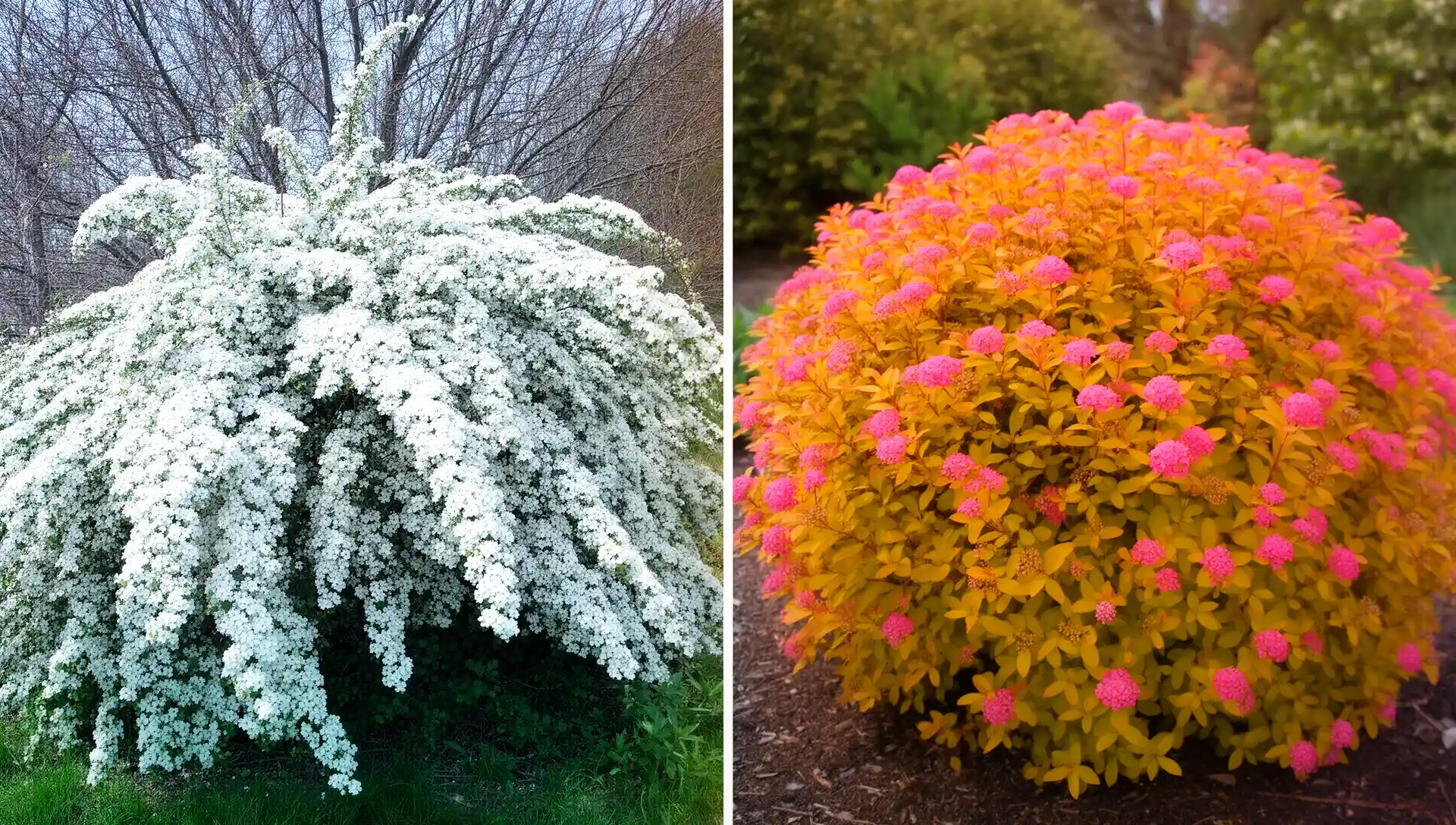
Spring-Blooming Bridal Wreath Spireas
The name “Bridal Wreath” gets applied to at least two distinct species, which creates genuine confusion at nurseries and in catalog descriptions. Understanding the difference saves you from planting an 8-foot shrub where you planned for a 5-foot one.
Spiraea prunifolia ‘Plena’ — the Original Bridal Wreath
This is the true Bridal Wreath — the plant the name was coined for. It grows 4 to 8 feet tall and equally wide with an upright, fountain-like habit [3]. The genus name Spiraea comes from the Greek word speira, meaning wreath, specifically in reference to this shrub’s flower display [3].
What makes it unmistakable is its timing: perfectly double, pompom-like white flowers appear along bare stems in early spring before a single leaf has opened [3]. The effect is dramatic — a plant that looks skeletal all winter suddenly covered in white buttons while the rest of the garden is still dormant. Foliage emerges after the blooms and develops red-orange-yellow fall color [3].
S. prunifolia handles clay soil and deer browsing, has no serious pest or disease problems, and is hardy in USDA zones 5 to 8 [3]. The double-flowered ‘Plena’ is what you’ll find in most nurseries — the single-flowered species is rarely sold commercially, which is an unusual botanical situation: the double-flowered form was documented and named before the single-flowered one [3].
Spiraea × vanhouttei — Vanhoutte Spirea
This is the plant most nurseries label “Bridal Wreath” today. It’s a hybrid cross between Spiraea trilobata and Spiraea cantoniensis, making it neither the true prunifolia nor a Japanese spirea [5]. It grows considerably larger: typically 8 feet tall with a slightly greater spread, with arching cane-like branches that sweep gracefully to the ground [5].
In spring, Vanhoutte covers its leafy branches with flat clusters of tiny white flowers so densely that the foliage nearly disappears underneath [5]. It’s cold-hardy from USDA zones 3 to 8 — considerably more cold-tolerant than S. prunifolia — and it copes with clay, drought, and intermittent neglect [5]. If you’re gardening in zones 3 or 4, Vanhoutte is the only spring-blooming Bridal Wreath type reliably hardy enough for you.
How to tell them apart in the nursery: S. prunifolia ‘Plena’ has perfectly double, button-like flowers and smaller, shinier dark green leaves. S. × vanhouttei has single white flowers in flat clusters and larger blue-green leaves with a slightly wavy edge. If the tag just says “Bridal Wreath” with no species name, you’re almost certainly getting Vanhoutte.
Pruning rule for both: Wait until the last flower fades in late spring, then cut [1][5]. Never prune in early spring — you’d be removing buds set last summer. To renew an overgrown plant, remove the oldest, thickest canes at ground level immediately after bloom; this sacrifices the least productive wood without delaying next year’s display [1].
Neither S. prunifolia nor S. × vanhouttei is listed as invasive anywhere in the United States [3][5].
Stop missing your zone's planting windows.
Select your US zone and month — get a complete checklist of what to plant, prune, feed, and protect right now.
→ View My Garden CalendarGoldflame and Anthony Waterer — Summer-Blooming Mounded Spireas
The mounded spireas stay compact (typically 2 to 3 feet tall), bloom in summer rather than spring, and — particularly in the case of Goldflame — are sometimes grown for their foliage more than their flowers.
Spiraea japonica ‘Goldflame’
Goldflame is grown first for its foliage, second for its flowers. The year-round color sequence is the design point: new spring growth emerges in shades of bronze and copper-orange, striking enough to compete with flowering perennials before a single bloom opens. By summer, rising temperatures reduce the plant’s anthocyanin production and allow the underlying chlorophyll to dominate — the leaves shift to gold and chartreuse [4]. When fall arrives and nights cool, chlorophyll breaks down and the anthocyanins surge back, returning the foliage to orange-red before leaf drop [4]. That three-season shift is unusual for a shrub this small.
The flat-topped pink flowers in June and July add color without competing with the foliage. Deadhead the spent clusters with light shearing and you’ll typically get a second flush later in summer.
Goldflame stays 2 to 3 feet tall and wide — compact enough for almost any border position [2]. It blooms on new wood, so late-winter pruning keeps the plant tight and pushes the vigorous new growth that carries the most vivid spring color. I’ve found the spring foliage color — that first flush of bronze and copper in April — more effective as a design element than the summer flowers, particularly when it’s planted next to dark-leaved shrubs like purple-leafed ninebark that intensify the contrast.
Invasiveness warning for SE US gardeners: Spiraea japonica — the species behind Goldflame, Gold Mound, Little Princess, and several other popular cultivars — is listed as invasive in Virginia, Georgia, South Carolina, Tennessee, Kentucky, and the Great Smoky Mountains of North Carolina and Tennessee [4]. It escapes gardens through aggressive self-seeding and suckering, creating dense thickets that displace native plants [4]. If you garden in these states, consult your local cooperative extension before planting. The NC State Extension Plant Toolbox recommends native alternatives including Itea virginica (Virginia sweetspire) and Fothergilla gardenii [4].
Spiraea × bumalda ‘Anthony Waterer’
Anthony Waterer is the summer-flowering choice when consistent bloom matters more than foliage interest. A cross between Spiraea albiflora and Spiraea japonica [2], it grows 2 to 3 feet tall and 3 to 5 feet wide — slightly broader than Goldflame, with a flatter spreading habit [2].
Deep rose-pink to crimson flower clusters appear from late spring through mid-summer, and deadheading after the first flush reliably extends bloom into August [2]. New spring growth comes in with reddish-purple tinting before maturing to blue-green, and fall foliage turns reddish — three seasons of color interest, though more subtle than Goldflame’s shifts [2]. Where Goldflame is primarily a foliage shrub that happens to flower, Anthony Waterer is primarily a flowering shrub.
Like Goldflame, Anthony Waterer blooms on new wood. Cut it back hard in late winter for a compact shape and the best flower production. Light shearing immediately after the first bloom flush keeps it tidy and typically triggers a second wave later in summer [2].
Both Goldflame and Anthony Waterer reliably attract butterflies from midsummer onward. If you’re building a pollinator-focused planting, they pair well with later-blooming shrubs — our notes on butterfly-friendly shrubs cover options that extend the season from August into fall.
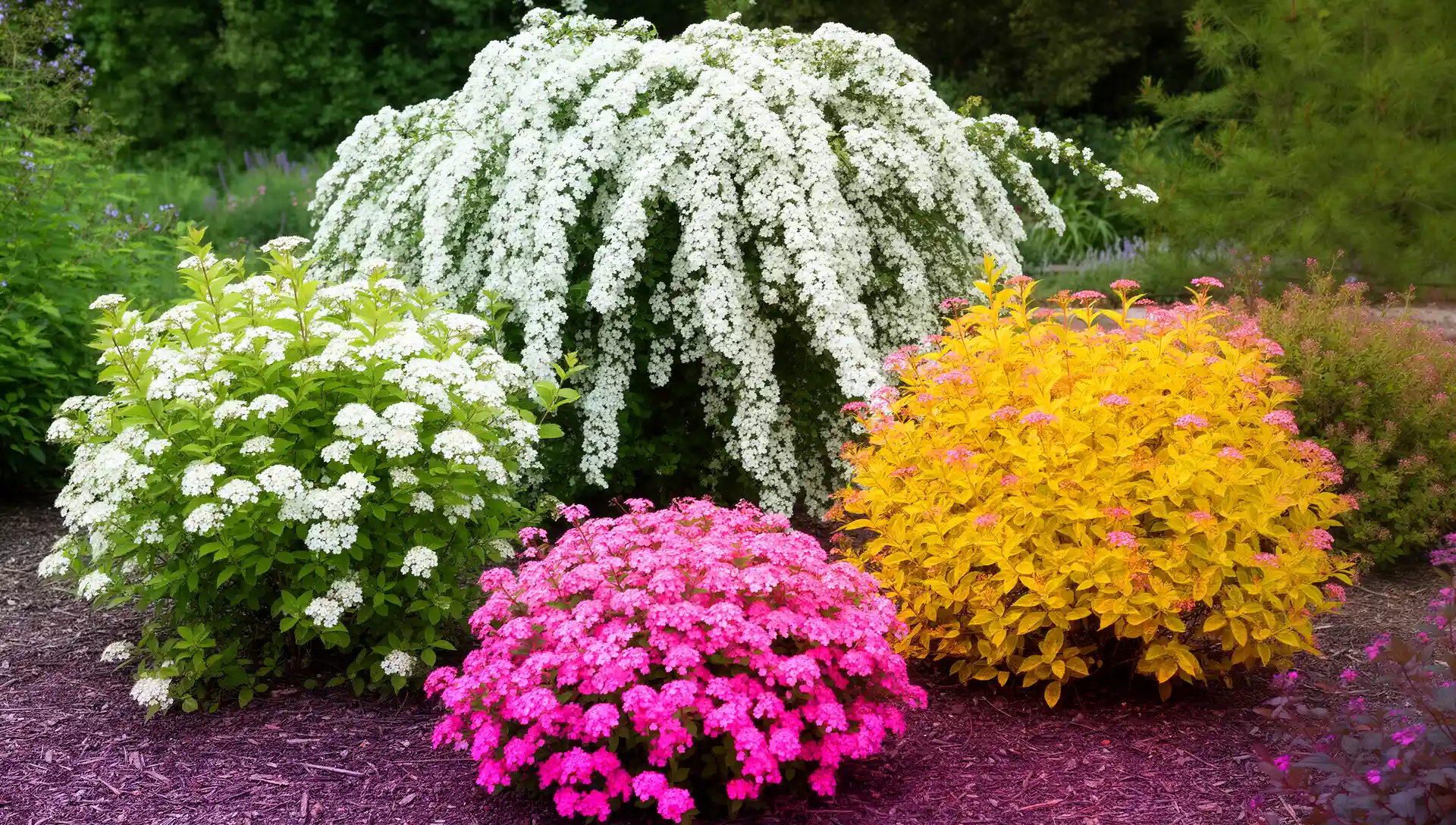
Spirea Varieties Compared at a Glance
| Variety | Bloom time | Bloom color | Mature size | Zones | Best for |
|---|---|---|---|---|---|
| S. prunifolia ‘Plena’ (Bridal Wreath) | Early spring, before leaves | White, double pompoms | 4–8 ft × 4–8 ft | 5–8 | Spring focal point; medium borders; historic look |
| S. × vanhouttei (Vanhoutte / Bridal Wreath) | Mid-spring | White, single clusters | 8 ft × 8–10 ft | 3–8 | Large specimen; hedging; cold climates (zones 3–4) |
| S. japonica ‘Goldflame’ | June–July | Pink | 2–3 ft × 2–3 ft | 4–8 * | Three-season foliage; small borders; containers |
| S. × bumalda ‘Anthony Waterer’ | Late spring–mid-summer | Deep rose-pink | 2–3 ft × 3–5 ft | 3–8 | Summer color; front borders; pollinators |
* Spiraea japonica and its cultivars are invasive in parts of the SE US — see note above.
How to Choose the Right Spirea for Your Garden
Three questions narrow the field: How much horizontal space do you have? Which season matters most to you? And do you want flowers or foliage as the main event?
By garden size
Tight space (under 6 feet wide): Skip the Bridal Wreath types. Both S. prunifolia and Vanhoutte eventually demand 6 to 10 feet of spread — the arching branches need room to reach the ground gracefully. Goldflame and Anthony Waterer, both 2 to 3 feet, fit nearly any border without crowding their neighbors and can be kept even tighter with annual winter pruning.
Medium border (6–12 feet): Anthony Waterer is a reliable anchor — wide enough to fill the space, long-blooming enough to justify prime real estate. S. prunifolia works here too if you don’t mind the height, and its fall color extends interest well past its spring bloom.
Large specimen or back-of-border: Vanhoutte Spirea. Nothing in this genus puts on a bigger spring display relative to its maintenance demands. It earns its 8-foot footprint. Pair it with late-season perennials like rudbeckia or asters that carry color through summer and fall once the spirea has finished.
By season and style priority
Spring drama: Vanhoutte Bridal Wreath for maximum scale; S. prunifolia ‘Plena’ for the most distinctive double flowers in a slightly smaller plant.
Long summer bloom: Anthony Waterer. With deadheading, it runs from June into August — a longer flowering window than most shrubs of comparable size. It’s also the better choice for cut-flower use; the flat-topped clusters last reasonably well in a vase.
Year-round foliage interest: Goldflame, specifically in zones outside the SE US. Three seasons of color change make it more of a design anchor than any other spirea of this size. The spring bronze-orange foliage is particularly effective as contrast with dark-leafed companions — purple-leafed barberry or physocarpus ‘Diabolo’ set it off well.
SE US gardens (Virginia, Georgia, South Carolina, Tennessee, Kentucky): Both Bridal Wreath types are safe choices with no invasive listing [3][5]. For compact summer bloomers, look at Itea virginica (pink summer flowers, excellent red fall color) or Fothergilla gardenii [4]. For more options among low-maintenance spireas that handle tough conditions, see our roundup of spireas that bloom generously with minimal care.
Cold climates (zones 3–4): Vanhoutte Spirea is the most reliably cold-hardy spring-blooming choice in this genus (zones 3–8). S. prunifolia is borderline in zone 4. Anthony Waterer and Goldflame extend to zone 4 but may die back to the ground in severe winters, recovering from the roots [1][2].
Three More Spireas Worth Knowing
The genus contains over 80 species [1], and a few outside the main four deserve mention.
Spiraea thunbergii — Baby’s Breath Spirea earns its common name from its unusually feathery, willow-like foliage — unlike any other spirea in texture. More importantly, it’s the first to bloom each year, typically in April [6], which makes it valuable for anchoring the early spring garden before most other shrubs wake up. It reaches 5 feet tall and wide, with fall color (yellow to orange and bronze) that’s better than most spring-blooming types [6]. The cultivar ‘Ogon’ layers golden-yellow foliage over the white spring blooms. Hardy in zones 4 to 8 [1].
‘Little Princess’ (Spiraea japonica) stays at 2 feet tall and wide — the most compact Japanese spirea readily available. It produces the same pink blooms as Goldflame without the dramatic foliage color shifts, making it the right pick for very small spaces or container planting. Note that it carries the same invasiveness caution in SE states as other S. japonica cultivars [4].
Spiraea nipponica ‘Snowmound’ fills the gap between the large Bridal Wreath types and the compact mounded types: a 5-foot rounded mound of white spring blooms with tidier form than Vanhoutte. Less common in retail than the others, but worth asking a nursery to order if you want white spring flowers at medium scale. Hardy in zones 4 to 7.
Key Takeaways
The fastest decision rule: match the plant to the season you care about most and the space you actually have.
- Spring drama, large space: Vanhoutte Bridal Wreath (zones 3–8, 8 ft × 8–10 ft)
- Spring drama, medium space: S. prunifolia ‘Plena’ (zones 5–8, 4–8 ft)
- Summer flowers, compact: Anthony Waterer (zones 3–8, 2–3 ft × 3–5 ft)
- Three-season foliage color: Goldflame (zones 4–8, 2–3 ft) — not for SE US
- Earliest spring bloom: S. thunbergii (zones 4–8, 5 ft)
Whatever variety you choose, one rule covers all of them: spring bloomers get cut after their flowers fade in late spring; summer bloomers get cut hard in late winter [1][2]. Confuse those two, and you lose a season’s display. Get it right, and spireas become among the least demanding flowering shrubs you can grow.
For soil preparation, fertilizing, and care guidance across all USDA zones, see our complete Spirea Growing Guide.
Sources
- Spirea — Clemson Cooperative Extension HGIC 1074
- Spiraea x bumalda — NC State Extension Gardener Plant Toolbox
- Spiraea prunifolia — NC State Extension Gardener Plant Toolbox
- Spiraea japonica — NC State Extension Gardener Plant Toolbox
- Spiraea × vanhouttei — NC State Extension Gardener Plant Toolbox
- Spiraea thunbergii — NC State Extension Gardener Plant Toolbox


