

Honeysuckle Problems: Aphid Colonies, Powdery Mildew Triggers and Why It Stops Flowering

Identify and fix the most common honeysuckle problems: aphids on shoot tips, powdery mildew in dry shade, failure to flower, sooty mould, and dieback — with a full diagnostic table and treatment guide.
Most honeysuckle problems trace back to just three root causes: the plant is in the wrong position, it has received too much nitrogen, or it is under water stress. Once you understand this, a list of apparently separate symptoms — aphids on shoot tips, white powder coating the leaves, a season with no flowers at all — collapses into a single diagnostic question: what is the plant’s environment doing to stress it? Fix the underlying condition and most problems resolve without ongoing chemical intervention.
This guide covers the problems most commonly encountered on Lonicera periclymenum (common honeysuckle) and closely related garden species. For information on planting, variety selection, and basic care, see the complete guide to growing honeysuckle.
Honeysuckle Problems at a Glance
| Symptom | Most Likely Cause | First Action |
|---|---|---|
| Dense dark clusters on shoot tips and buds; sticky residue; ants on stems | Aphid infestation (Aphis fabae or honeysuckle aphid) | Wait two weeks for natural predators; hose off small colonies; insecticidal soap only if severe |
| White or grey powdery coating on upper leaf surfaces | Powdery mildew (Erysiphe sp.) | Improve air circulation; apply potassium bicarbonate or neem oil spray |
| No flowers for a whole season despite healthy foliage | Wrong pruning time; too much shade; excess nitrogen | Prune only after flowering ends; reduce high-nitrogen feeds; assess shade levels |
| Black sticky or sooty coating on leaves below aphid colony | Sooty mould growing on aphid honeydew | Treat aphid infestation; wipe affected leaves with damp cloth |
| New growth distorted, curled, and crumpled | Aphid feeding damage to shoot tips | Remove aphid colonies; cut back worst-affected shoots to healthy wood |
| Leaves turning uniformly yellow | Waterlogging; nitrogen deficiency; natural leaf senescence | Improve drainage; apply balanced fertiliser in spring; check for root rot |
| Brown crispy margins on leaves | Wind scorch or drought stress | Provide wind shelter; water deeply during dry spells; mulch root zone |
| Stems dying back progressively from tip | Frost damage; fungal stem canker; scale insects | Cut back to healthy white-pith wood; check stems for scale; improve air circulation |
| Entire plant wilting despite moist soil | Root rot (waterlogged soil) or honey fungus | Lift a root section to check; improve drainage immediately; test for honey fungus |
| Pale mottled foliage; stunted growth; loose root ball | Vine weevil larval damage (mainly container plants) | Check root ball for C-shaped white larvae; apply Heterorhabditis nematodes in warm soil |
Aphids: the Most Common Honeysuckle Pest
Aphids are the pest you are most likely to encounter on garden honeysuckle in the United States. The two species most frequently responsible are the black bean aphid (Aphis fabae) and the smaller, paler honeysuckle aphid (Hyadaphis foeniculi). Both feed by piercing phloem tissue to extract plant sap, injecting saliva that disrupts cell development. This produces the characteristic distortion: new leaves curl inward and bunch together, shoot tips crumple, and flower buds may fail to open fully. [1]
Identification is straightforward. Look for dense, dark-coloured colonies — black, dark green, or dark grey — massed at the growing tips and on flower buds from late spring through summer. The insects are soft-bodied and roughly 1–2 mm long. They are usually sedentary in a feeding cluster, not crawling around. Ants running rapidly up and down the stems are a reliable early warning: they actively protect aphid colonies against predators in exchange for the sugary honeydew the aphids excrete, so ant activity on stems often means an aphid colony exists somewhere above. [1]

Three pre-planned garden beds, free
Stop staring at empty beds: printable plans with exact layouts, plant lists and planting calendars — yours free from the Garden Library.
Natural Control: Wait Before You Spray
The natural regulation of aphid populations is well established and genuinely effective in a diverse garden. Ladybug adults and larvae, lacewing larvae, parasitic wasps (Aphidius sp.), hoverfly larvae, and insectivorous birds — particularly chickadees and wrens — all prey on or parasitise aphid colonies. In a garden that supports these predators, a colony detected in late May will often be cleared or significantly reduced within two to four weeks without any intervention. [1]
The key variable is whether your garden supports predator populations. Planting umbellifers — dill, fennel, native carrot, bishop’s weed — near the honeysuckle significantly boosts local populations of parasitic wasps and hoverflies, which use their flowers as adult feeding stations. A garden set up for wildlife, with diverse plantings and undisturbed areas, will experience aphid pressure far below that of a sterile, highly maintained border. For the broader approach to achieving this, the wildlife garden guide covers the planting combinations and habitat features that make the biggest difference.
Physical and Chemical Control
If the colony is small, a forceful jet of water directed at the shoot tips will dislodge the majority of aphids. Knocked to the ground, they cannot easily climb back and many dry out before recolonising. Do this in the morning so plants dry before nightfall. Repeating for two or three consecutive days is usually sufficient to break a developing colony. [1]
If the infestation is large and two weeks of waiting has not brought sufficient natural predator activity, insecticidal soap spray is the most targeted option. Apply in the evening when pollinators are not active, coating the underside of leaves and the shoot tips thoroughly. Neem oil is an alternative that also provides residual protection against powdery mildew. Systemic insecticides are unnecessary for an aphid problem of this scale and are harmful to the beneficial insect communities — including the pollinators that visit honeysuckle flowers — that a chemical-free or low-intervention approach builds up over time. [1]
After a severe infestation, prune back the worst-affected shoot tips to clean growth below the damaged zone. This removes surviving colonies and the distorted tissue that will not recover normal function.
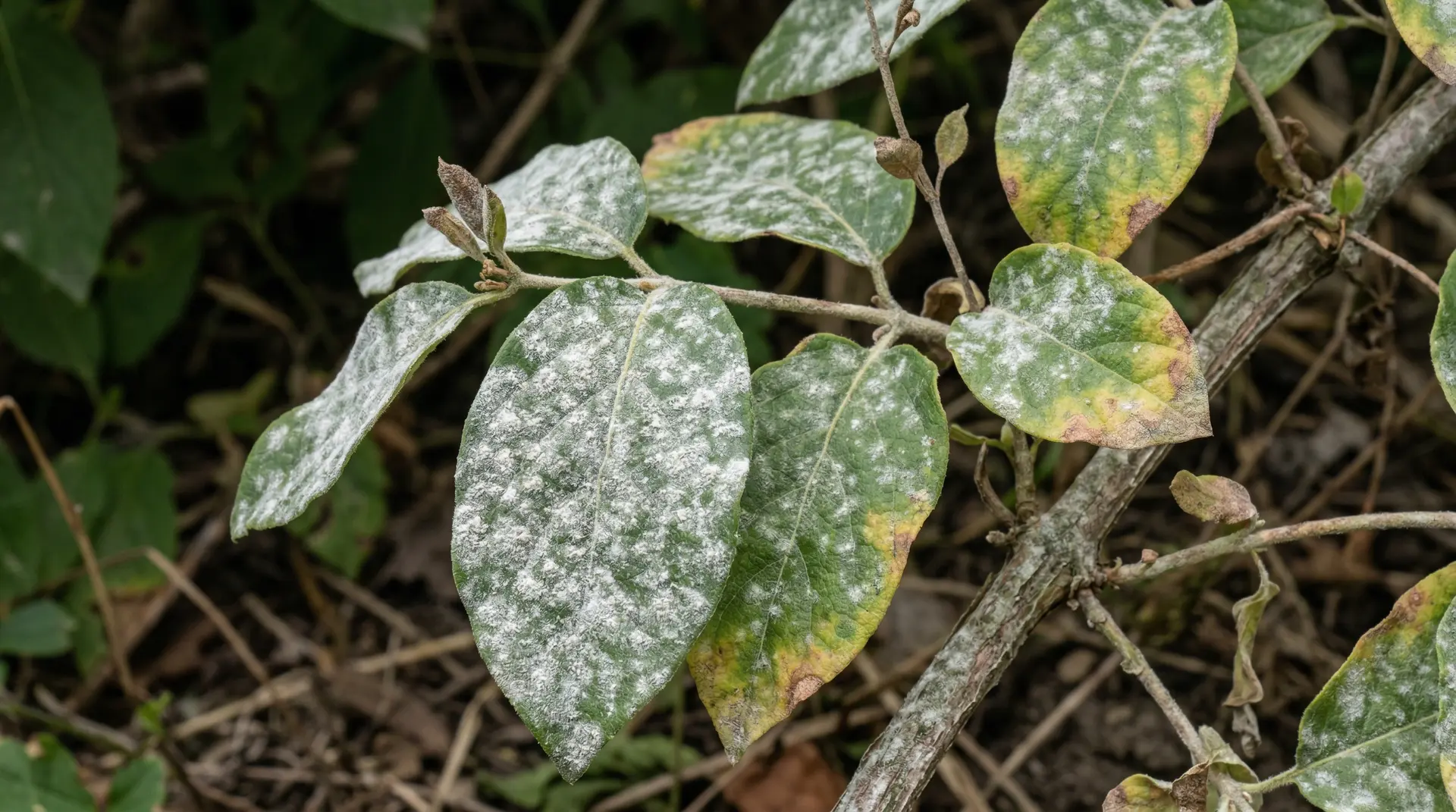
Powdery Mildew: Dry Shade and Restricted Airflow
Powdery mildew on honeysuckle appears as a white to pale grey powdery coating, initially on the upper surface of leaves and sometimes extending to stems. In severe cases the fungal growth covers the entire leaf, which turns papery and yellows before dropping. The coating is the surface mycelium of Erysiphe caprifoliacearum (specific to the honeysuckle family), a biotrophic fungus that lives on the leaf surface and sends feeding structures into the leaf cells. [2]
Unlike many fungal diseases, powdery mildew does not need wet conditions to establish. It spreads by dry, airborne spores and actually performs poorly in standing water. The conditions that favour it are warm days in the 75–85°F range, cool nights, and restricted airflow. This is precisely the microclimate found on a honeysuckle planted tight against a fence in a dry, shaded corner — which is why the disease is so strongly associated with late summer and dry shade. Water stress is the single strongest predictor of susceptibility: a drought-stressed plant with its stomata under repeated strain is significantly more vulnerable than a well-watered one. [2, 3]
Prevention
The most effective prevention is cultural rather than chemical. Plant honeysuckle with at least 18 inches of clearance from a wall or fence to allow airflow around the canopy. Ensure the root zone stays cool and consistently moist by incorporating organic matter at planting time and maintaining a 3–4 inch mulch layer over the roots, kept clear of the stem base. Water deeply during dry spells rather than relying on light surface irrigation. A plant that never becomes drought-stressed develops significantly less mildew than one that dries out repeatedly through summer. [3]
Annual pruning to open up the canopy — removing overcrowded, crossing stems and reducing the density of growth where stems bunch against a surface — improves the airflow that the disease requires to spread. This is most effective done immediately after flowering in late summer, which also serves the correct timing for avoiding flower bud removal.
Treatment
For existing mildew, potassium bicarbonate mixed at the label rate and sprayed on affected leaves changes the surface pH to a range the fungus cannot tolerate. It is effective within a few days of application and can be reapplied at weekly intervals if needed. Neem oil has a similar mechanism and some systemic activity. A home solution of one tablespoon baking soda per gallon of water with a few drops of horticultural oil is widely used and provides partial control. Remove and dispose of heavily infected leaves — do not compost them, as spores overwinter on plant debris. [2, 3]
Where a site is consistently problematic — hot, dry, and against a wall — consider replacing a susceptible cultivar with a more resistant species. Lonicera sempervirens (trumpet honeysuckle), native to the eastern United States and hardy in USDA zones 4–9, is notably mildew-resistant and produces excellent hummingbird-attracting blooms. Among climbing honeysuckles worth growing alongside other flowering climbers, see the clematis guide for a companion climber that shares similar training and support requirements. [5]
No Flowers: Diagnosing Why Your Honeysuckle Won’t Bloom
A honeysuckle with healthy foliage but no flowers is one of the most frustrating plant problems to investigate because there is no visible symptom to treat — just absence. The most common causes, in order of likelihood:
Wrong Pruning Time
This accounts for the majority of no-flower cases. Lonicera periclymenum and most ornamental honeysuckle species flower on wood grown in the previous season. Prune hard in late winter or early spring and you remove all that mature wood before it has flowered. The plant leafs out normally and grows vigorously, but with nothing left to produce buds on. The fix is straightforward: prune only immediately after the main flowering period ends, typically mid-July through August, so the plant has the rest of the growing season to produce new growth that will carry next year’s flowers. [4]
Too Much Shade
Honeysuckle needs at least a half-day of direct sun to flower reliably. A plant that received adequate light when young may gradually be shaded out as surrounding trees and shrubs mature — this is a common cause of declining flower production over several seasons. Assess how much direct sun the plant receives in June and July. If the answer is less than four hours, reduced flowering is expected and will only improve if the shade source is removed or the plant is moved.
Stop missing your zone's planting windows.
Select your US zone and month — get a complete checklist of what to plant, prune, feed, and protect right now.
→ View My Garden CalendarExcess Nitrogen
Nitrogen drives leafy growth. A honeysuckle in a lawn that is treated with high-nitrogen turf fertiliser, or mulched annually with fresh nitrogen-rich compost, will put all its energy into producing lush green shoots at the expense of flowers. If your plant produces impressive growth but no blooms, stop high-nitrogen feeds entirely. Switch to a potassium-rich fertiliser (tomato food or a bloom-booster formula) applied once in late spring; the potassium encourages flower initiation without driving excessive vegetative growth. [4]
Youth, Root Restriction, or Recent Transplant Stress
A plant in its first or second year after planting may produce little or no flower in its establishment phase — this is normal and requires patience. A container-grown honeysuckle that has become severely root-bound will also fail to flower freely. Repot into a container at least two sizes larger, improve watering consistency, and expect flowering to recover the following season. A plant moved or divided the previous year may similarly skip a season of flowering while re-establishing its root system.

Other Problems
Sooty Mould
The black, dusty coating sometimes found on honeysuckle leaves lower in the canopy is sooty mould — a group of dark fungi that grow on the honeydew excreted by aphids feeding above. The mould itself does not directly infect the plant, but a heavy coating reduces photosynthesis and persistent sooty mould indicates an ongoing aphid infestation. Treat the aphid colony; the mould will not regenerate once the honeydew source is removed. Wipe the worst-affected leaves with a damp cloth to restore photosynthetic function in the short term. [1]
Leaf Scorch
Brown, papery patches at leaf margins, typically worse on the windward side of the plant or on leaves directly adjacent to a hot wall or paving, are physical scorch damage rather than disease. The cause is either wind desiccation or heat reflection from hard surfaces drying the leaf faster than the roots can replace the moisture. Provide windbreak planting or structures on the exposed side; apply a 3–4 inch organic mulch over the root zone to maintain soil moisture; water deeply rather than lightly during dry spells.
Scale Insects
Brown soft scale and oystershell scale occasionally colonise honeysuckle stems. Look for small, oval, brownish or pale bumps attached firmly to bark that do not move when touched — these are the armoured covers of sedentary adult females. Yellowing leaves above the infestation and sticky honeydew residue are the indirect symptoms. Scrape off small colonies with a soft brush or thumbnail. For larger infestations, apply a dormant-season horticultural oil spray in late winter before buds break, when overwintering eggs are present and beneficial insects are not yet active.
Dieback from Shoot Tips
Progressive dieback moving inward from shoot tips can result from late-season frost damage (common after warm early springs that promote soft new growth before the frost risk has passed), stem-boring insects, or fungal stem canker. Cut back to healthy wood — a clean white or cream pith and firm texture confirm you have reached healthy tissue. Dispose of removed material rather than composting it. If cankers reappear persistently in the same area, the cause may be a chronic infection: improve air circulation through pruning and ensure plants are not sitting in waterlogged soil.
Timing varies by region — honeysuckle pruning: when and cut has the month-by-month schedule.
An Integrated Prevention Strategy
The practical finding from growing honeysuckle successfully is that prevention through site selection and consistent cultural practice is always more effective than treating problems once they appear. Three habits eliminate most issues:
Choose the right position from the start. Morning sun, afternoon shelter, and root-zone shade and moisture — either from a ground-level shade plant or from a deep organic mulch — create the conditions where honeysuckle is naturally vigorous and resistant. A plant in these conditions rarely develops serious mildew and flowers dependably every year.
Prune at the right time and for the right reasons. Post-flowering pruning (mid-July through August for most ornamental species) is the single most important maintenance act for a honeysuckle. It simultaneously ensures next year’s flowering wood is not removed, opens up the canopy to reduce mildew pressure, and allows you to remove any scale or canker-affected wood before it spreads.
Build the predator community that manages aphids for you. Companion planting with umbellifers and native flowering plants supports the parasitic wasps, lacewings, and hoverflies that regulate aphid colonies. The approach mirrors what happens in naturally diverse plantings: the companion planting guide covers the specific combinations that work in practice. Avoiding broad-spectrum insecticides preserves the predator community year after year. [4]
Honeysuckle grown this way — right position, correctly timed pruning, soil moisture maintained, predator community supported — is a largely trouble-free plant. The problems in this guide are encountered mainly where one or more of these conditions is missing.
Frequently Asked Questions
Why does my honeysuckle have sticky leaves?
Sticky leaves on honeysuckle are almost always caused by aphid honeydew — the sugary waste product excreted by colonies feeding on shoot tips above. Check the newest growth and shoot tips for dense insect clusters. Treat the aphid infestation and the stickiness resolves as rain washes the residue from the leaves.
Can powdery mildew kill honeysuckle?
Severe mildew can defoliate a plant by late summer, reducing its ability to build energy reserves before winter and making it more susceptible to frost injury. It rarely kills an established plant outright. Improving conditions — better airflow, consistent soil moisture, opening up the canopy — prevents the disease from reaching defoliating severity.
My honeysuckle flowered last year but has no flowers this year. What changed?
The most likely cause is pruning at the wrong time — either a spring cut that removed last year’s flowering wood before it could bloom, or a hard renovation pruning that set the plant back significantly. A second possibility is a late frost that caught and killed the buds after an unusually warm early spring. Review your pruning timing and check whether any frost events coincided with bud emergence. If neither applies, assess shade levels — a nearby tree that has filled in over one season can be enough to suppress flowering.
Why does my honeysuckle lose its leaves in summer?
If the leaf drop is accompanied by a white powdery coating on remaining leaves, powdery mildew is the cause. If leaves are yellowing then dropping without a powdery coating, the causes to investigate in order are overwatering or waterlogged soil, drought stress (wilting before drop, dry root zone), or a fungal leaf spot disease. Uniform yellowing of the oldest lower leaves in late summer is natural senescence and requires no action.
Is it safe to treat aphids with neem oil near pollinators?
Apply neem oil only in the evening, after pollinators are no longer foraging, and avoid spraying open flowers entirely. Neem has a short residual period and presents minimal risk to pollinators when used this way. The same timing rule applies to insecticidal soap. Broad-spectrum insecticides should never be used on or near a flowering honeysuckle — the flowers are actively visited by bumblebees, sphinx moths, and hummingbirds throughout the summer, and any residual toxicity in the flowers causes significant collateral harm.
Sources
- RHS. Aphids — Identification, Biology, and Control. Royal Horticultural Society.
- RHS. Powdery Mildews — Causes, Symptoms, and Management. Royal Horticultural Society.
- University of Minnesota Extension. Powdery Mildew of Trees and Shrubs. UMN Extension.
- BBC Gardeners’ World. Lonicera periclymenum (Honeysuckle) — Plant Profile and Growing Guide.
- NC State Extension. Lonicera — Plant Facts. North Carolina State University.


