

Growing Rosemary in Zone 3: Which Hardy Varieties Survive Winter — and Exactly When to Plant Them

Zone 3 rosemary is a container herb — no variety survives -30°F outdoors. Learn which cold-hardy cultivars to pick, exact planting dates (May 15 transplant, September bring-in), and the indoor winter care protocols that keep plants alive.
Zone 3 has a dirty little secret when it comes to rosemary: even the hardiest variety ever developed, the legendary ‘Arp’, survives only to about -10°F. Zone 3 minimums sit at -30°F to -40°F. That’s a 20-degree gap that no amount of mulching or sheltering will close. If you’ve lost rosemary over winter and blamed yourself, stop — you were fighting physics, not skill.
The good news: thousands of zone 3 gardeners grow fresh rosemary every single year. They do it with containers, a clear calendar, and an indoor care system that sidesteps the three mistakes that kill most plants over winter. This guide gives you all three.
Why Zone 3 Winters Kill Rosemary
Standard rosemary is winter-hardy in USDA Zones 8–10, surviving temperatures down to about 15–23°F [2]. When temperatures drop below that threshold, two mechanisms destroy the plant simultaneously.
The first is cellular ice damage. When temperatures plunge, water inside plant cells freezes and expands, physically rupturing cell walls the same way a frozen pipe bursts [4]. The damage is irreversible — once a cell wall breaks, no amount of warming restores it. This is why a rosemary plant that looks fine on a mild January day can be entirely dead by March after a -20°F cold snap.

Skip the guesswork — get a pre-planned 4×8 kitchen garden bed
Free printable planting plan: what goes where, when to plant it, and how to keep it alive. Plus two bonus flower bed plans.
The second is wind desiccation, and it’s equally lethal. Rosemary keeps its foliage all winter, which means it’s constantly losing moisture through its needles. When the ground freezes solid, roots can’t absorb replacement water. The plant literally desiccates from the inside out while frozen solid [4]. This is the same mechanism that scorches evergreen needles in late winter — and it’s why even the hardiest rosemary varieties planted in sheltered spots will die when zone 3 temperatures arrive.
The verdict from Northern Gardener, the Minnesota-based publication covering zone 3–4 gardening for decades: rosemary simply doesn’t overwinter in zones 3 or 4 [9]. That’s not pessimism — it’s the starting point for a strategy that actually works.
The Cold-Hardy Varieties: Which Ones to Choose
If no variety survives zone 3 outdoors, does variety selection even matter? Yes — significantly. Cold-hardy cultivars handle temperature fluctuations better, recover faster from stress, and perform more reliably when grown in containers that move between climates. For zone 3 container growing, these four are worth knowing:
| Variety | Lowest Temp Rated | Height | Flavor/Character | Best for Zone 3 |
|---|---|---|---|---|
| Arp | -10°F (Zone 6a) | Up to 4 ft | Lemony, gray-green needles, bright blue flowers | Best all-around; handles cold stress best |
| Madalene Hill | 0°F (Zone 7) | 36–40 inches | Strong classic rosemary flavor, light blue flowers | Excellent flavor; second choice after Arp |
| Athens Blue Spire | -5°F to -10°F | ~3 ft, upright | Traditional flavor, tidy growth habit | Good for smaller containers |
| Common/Tuscan Blue | ~15–20°F (Zone 8) | 3–6 ft | Classic flavor, widely available | Fine for container use; no cold-stress advantage |
Arp is the clear choice for zone 3 containers. It was selected specifically for cold resilience, and while it won’t survive outdoors, it handles the stress of moving between cold storage and warm summer conditions better than standard varieties [5]. Madalene Hill — sometimes sold as Hill’s Hardy — is an excellent alternative with stronger classic rosemary flavor if you can find it at a nursery [5].
One practical note: in many zone 3 garden centers, you’ll simply find “rosemary” with no cultivar name. That’s fine for the container approach. The cold-tolerance advantage of Arp matters more if you’re attempting marginal-zone outdoor overwintering (zones 6–7), which isn’t the zone 3 strategy anyway.
The Container-First Strategy: Why In-Ground Doesn’t Work
Every piece of advice for zone 3 rosemary converges on a single rule: grow in a container from day one. Don’t plant in the ground and plan to dig it up in fall — rosemary doesn’t transplant well once established, and digging damages the root system right before the most stressful period of the year [9].
The container approach gives you full control. You can move the plant to the optimal outdoor microclimate in summer, then bring it indoors before the first frost in fall. This is exactly how most successful rosemary growers in Minnesota and North Dakota handle it, according to NDSU Extension [1]. For related tips on growing mint in zone 3, which follows a similar container logic for tender herbs, the principle is the same.
The container also lets you optimize soil and drainage in a way that ground planting can’t. Rosemary needs fast-draining soil — sitting in waterlogged ground kills it faster than cold does [3].
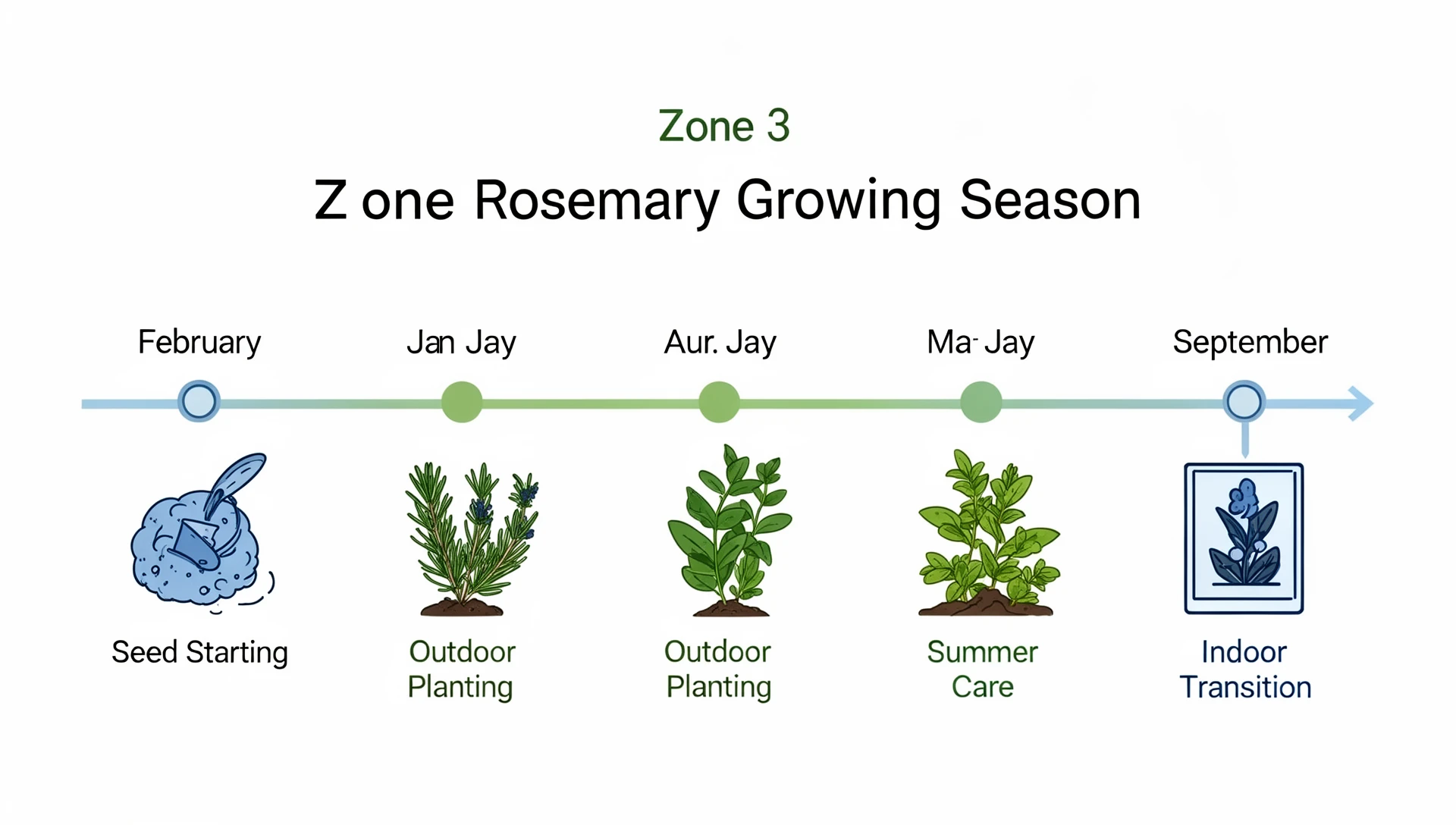
Zone 3 Rosemary Planting Calendar
Zone 3’s last spring frost averages around May 15, with the first fall frost arriving around September 15 — giving roughly 120 frost-free days [6]. Here’s the full calendar built around those dates:
| Date | Action | Notes |
|---|---|---|
| Feb 15 – Mar 1 | Start from seed indoors (optional) | Germination is slow and unreliable; buying transplants in May is faster and more reliable [6] |
| Late April – May 10 | Buy transplants from garden center | Look for Arp or Madalene Hill; any labeled rosemary works for container method |
| After May 15 | Move container outdoors | After last frost; harden off over 7–10 days by starting with 1–2 hours outside and increasing daily [1] |
| May – August | Outdoor summer growing | Full sun, water when top 1–2 inches dry; light pruning to shape |
| Late August – Sept 1 | Begin indoor transition | Pot up by Labor Day — 2–3 weeks before first frost gives the plant time to adapt [8] |
| Sept 15 | Average first fall frost | Plant must already be indoors or protected |
| Sept – May | Indoor winter care | South window + grow light; water sparingly; see section below |
One timing note worth emphasizing: don’t wait until the first frost warning to bring rosemary inside. Moving a plant from summer temperatures directly into a heated house causes shock. Bringing it in two to three weeks early, when outdoor nights are still in the 40s°F, lets it adjust gradually [8].
Container Setup and Soil
Rosemary’s native Mediterranean habitat is rocky, alkaline, and almost never waterlogged. The closer you can approximate that indoors and out, the better your results.
Container specs: Use a pot at least 12 inches in diameter and 6–8 inches deep [1]. Clay or terracotta pots are better than plastic for rosemary — they breathe, allowing the soil to dry faster, which prevents the root rot that kills more container rosemary than cold does [2]. Make sure there’s a drainage hole.
Soil: Standard potting mix holds too much moisture. Mix in about 30% perlite, or use a cactus/succulent blend. Target pH of 6.5–7.0 [2]. Avoid any mix that feels heavy or clumping — if it doesn’t drain quickly, the roots will rot. For more on best soil for herbs grown in containers, the principles apply directly to rosemary.
Location outdoors: Full sun, south or west-facing aspect, sheltered from strong wind. Rosemary needs at least 6–8 hours of direct sun daily to thrive [2]. Against a south-facing wall, it gets both sun and reflected heat — the ideal zone 3 summer microclimate.
Stop missing your zone's planting windows.
Select your US zone and month — get a complete checklist of what to plant, prune, feed, and protect right now.
→ View My Garden CalendarSummer Outdoor Care
Once outside after May 15, rosemary is low-maintenance. Water when the top 1–2 inches of soil are dry — roughly every 7–10 days in typical zone 3 summer weather, more often during heat waves [1]. Container plants dry out faster than in-ground plants, so check weekly rather than relying on a fixed schedule.
Fertilize lightly once in early June and again in July with a balanced, slow-release granular fertilizer. Rosemary doesn’t need heavy feeding — lean soil actually intensifies the essential oils that give it flavor [2].
Prune lightly through summer to encourage bushy, compact growth. Clip the growing tips by a few inches, but never cut back into the woody brown stems below the green growth. Rosemary doesn’t regenerate from old wood the way lavender does — hard pruning into bare wood usually kills the branch. For more about growing rosemary for maximum production, including pruning timing through the seasons, see our complete rosemary growing guide.
Moving Indoors: The Pre-Frost Transition
The window between late August and early September is the most important two weeks of the zone 3 rosemary calendar. Get this transition wrong, and you’ll be fighting the plant all winter.
Before bringing the plant inside, do three things:
- Inspect for pests. Spider mites, aphids, and whitefly on an outdoor plant become a much bigger problem indoors. Check the undersides of leaves and treat anything you find before the plant comes inside.
- Prune back by about one-third. This reduces the plant’s water demand during the stress of adjustment and produces a more compact shape for indoor growing.
- Let the soil dry thoroughly. Bring the plant in with dry — not bone-dry, but not wet — soil. Moving a wet-rooted plant into lower light and lower air movement is the recipe for root rot.
Place the plant in its intended indoor spot and leave it there. Rosemary doesn’t respond well to being moved around once it’s adjusted. Consistent location matters more than finding the absolute perfect window [8].
Indoor Winter Care: The Three Things That Kill Rosemary Inside
Most zone 3 gardeners who lose rosemary over winter don’t lose it to cold — they lose it indoors. Understanding the three specific failure points makes the difference.
1. Insufficient light. Central heating aside, the biggest indoor challenge for rosemary is light. A south-facing window provides the best natural light, but on a typical overcast January day in Minnesota or North Dakota, it’s not enough on its own. Add a grow light set to run 12 hours daily, positioned 6–8 inches above the plant. Without adequate light, rosemary stretches weakly, becomes susceptible to powdery mildew, and gradually declines [2]. This is what A Way to Garden describes as “cool sunshine” — the rarest indoor condition in a heated home [8].
2. Overwatering. In winter, with low light and cool temperatures, rosemary barely drinks. Water only when the top 2 inches of soil are completely dry — typically every 10–14 days. The gravel-in-the-drainage-pan method helps: add a layer of small stones to your drainage tray, set the pot on top, and keep water in the tray below the pot’s base. The water evaporates upward around the foliage without ever touching the roots [7]. Root rot from overwatering is the single most common cause of indoor rosemary death [3].
3. Humidity management. Central heating strips indoor air to 20–30% relative humidity — well below the 50% that rosemary prefers. Rosemary is what growers sometimes call an “upside-down plant”: it prefers to absorb moisture through its foliage rather than its roots, an adaptation to its native Mediterranean sea-spray environment [7]. The solution isn’t to mist the leaves directly (wet foliage invites powdery mildew), but to raise ambient humidity around the plant using the pebble-tray method above, or by placing a small humidifier nearby.
For air circulation — which prevents powdery mildew — run a small fan near the plant for a few hours daily. The Mediterranean coast is windy; stagnant indoor air is one more way the indoor environment diverges from what rosemary evolved for.
Target indoor temperatures of 50–65°F. Cooler is better — a 55°F spare room or cool basement near a south window often produces better winter results than a warm living room, because lower temperatures slow the plant’s metabolism and reduce its light demand [3]. If the plant starts looking tired indoors, moving it somewhere cooler often helps more than adding fertilizer.
For a full breakdown of what goes wrong with rosemary plants — indoors and out — see our guide to rosemary problems and fixes. If you’re planning to grow rosemary primarily as an indoor herb year-round, our rosemary indoor growing guide covers lighting and humidity setups in more detail.
Key Takeaways for Zone 3 Rosemary
- No rosemary variety survives zone 3 winters outdoors — the gap between even the hardiest cultivars and zone 3 minimum temperatures is too large to bridge with mulch or shelter.
- ‘Arp’ is the best choice for containers because its cold-stress tolerance makes the spring-to-fall-to-indoor transitions smoother.
- Plant out after May 15; bring indoors by Labor Day — two to three weeks before the September 15 first frost average.
- Containers with clay pots, fast-draining soil (pH 6.5–7.0), and drainage holes are the non-negotiable foundation.
- Indoors: south window plus grow light, water every 10–14 days, gravel drainage tray, small fan for air movement, target 50–65°F.
Frequently Asked Questions
Can I grow rosemary in the ground in zone 3?
No. Zone 3 minimum temperatures (-30°F to -40°F) are far below the hardiness limit of even the most cold-tolerant varieties. In-ground plants will die. The only viable approach is containers that come indoors each fall.
What’s the best rosemary variety for zone 3?
‘Arp’ is the top choice — it handles cold stress and temperature fluctuations better than standard varieties, making the container-to-indoor transition more reliable. ‘Madalene Hill’ is a strong alternative with excellent classic flavor.
How often do I water rosemary indoors in winter?
Every 10–14 days is a safe starting point. Always check the top 2 inches of soil first — if it’s still moist, wait. Overwatering is the most common cause of winter rosemary death [3].
Why is my indoor rosemary turning brown and dropping needles?
The two most likely causes are overwatering (root rot) or insufficient light. Check the roots — if they’re dark and mushy, root rot has set in. If the soil is dry and the needles are dropping from the interior of the plant, low light is likely the issue. See our full rosemary troubleshooting guide for diagnosis by symptom.
Sources
- “Field to Fork: Rosemary” — NDSU Agriculture Extension (ndsu.edu/agriculture/extension/publications/field-fork-rosemary)
- “Herb Garden Plants: Rosemary” — Penn State Extension
- “Rosemary, An Herb for All Seasons” — Nebraska Extension, Lancaster County (lancaster.unl.edu/rosemary-herb-all-seasons-0/)
- “Cold Damage” — Clemson Cooperative Extension HGIC
- “The Best Cold Hardy Rosemary Varieties” — Gardener’s Path (gardenerspath.com/plants/herbs/cold-hardy-rosemary/)
- “Rosemary Zone Planting Guide” — Bonnie Plants (bonnieplants.com/blogs/planting-guides/rosemary-zone-planting-guide)
- “The Secret to Keeping Rosemary Alive Indoors” — Tenth Acre Farm (tenthacrefarm.com/growing-rosemary-indoors/)
- “Overwintering Rosemary Indoors and Out” — A Way to Garden (awaytogarden.com/overwintering-rosemary-indoors-and-out/)
- “Meet the Herbs: Rosemary” — Northern Gardener (northerngardener.org/meet-the-herbs-rosemary/)


