

Forsythia Won’t Bloom? The Wrong-Time Pruning Mistake Costs You a Full Year of Flowers

Wrong-time pruning costs you a full year of forsythia flowers. Diagnose your specific bloom failure cause—pruning, frost, or age—with extension-backed fixes.
Why Forsythia Blooms on Old Wood—the Mechanism Behind Every Mistake
Before diagnosing your forsythia, you need to understand one biological fact that explains every cause on this list: forsythia sets its flower buds on the previous year’s stems—what horticulturists call “old wood.”
Flower buds begin forming by early summer, on the new stems your plant produced right after it finished blooming that spring. Those buds sit on the canes through summer, harden as the shrub goes dormant in fall, survive (or don’t) through winter, and open the following March or April. The entire bloom cycle is essentially a 12-month relay race. Anything that removes or kills those buds between early summer and flowering time means zero flowers—regardless of how healthy the rest of the plant looks.

This is the mechanism behind the most common complaint: a forsythia covered in healthy green leaves but not a single yellow flower. The plant is fine. The buds aren’t—and one of the five causes below is why.
5 Causes of Forsythia Bloom Failure, Ranked by Frequency
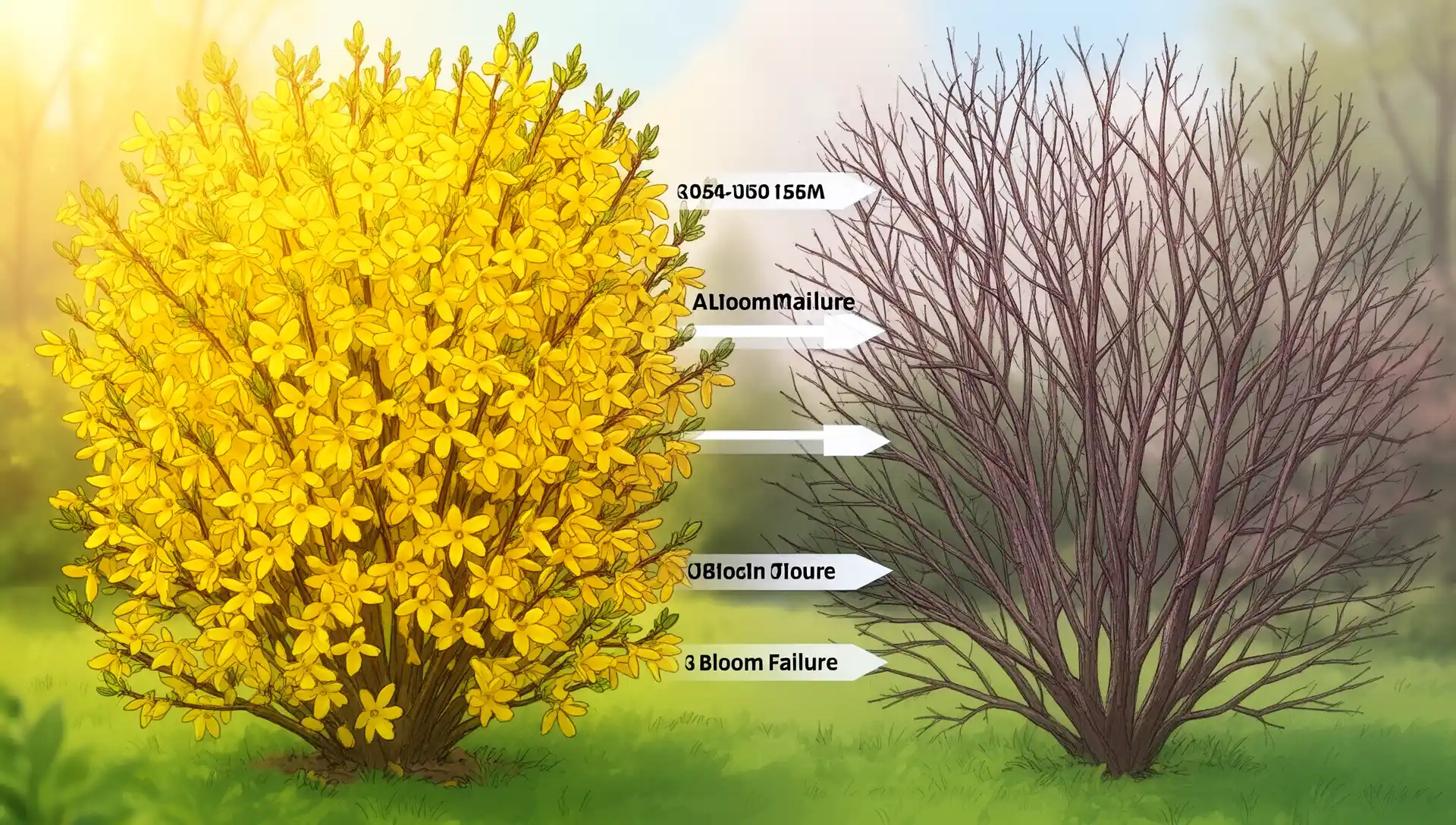
Check the symptom column first. Most bloom problems can be diagnosed in under two minutes without touching the plant.
| What you see | Most likely cause | Quick fix |
|---|---|---|
| Leafy all over, no flowers anywhere; pruned in summer or fall last year | Wrong-time pruning (#1 most common) | Prune immediately after bloom next spring only |
| Flowers only near the ground, bare or sporadic above knee height | Frost-killed buds above the snowline | Swap to a bud-hardy cultivar for zones 3–5 |
| Brown or black unopened flower buds visible in early spring | Winter injury | No fix this season; see variety table below |
| Correct pruning, but fewer flowers each year as nearby trees grow | Shade creeping in | Prune overhead trees or relocate shrub |
| Dense green growth, vigorous stems, almost no flowers, near fertilized lawn | Excess nitrogen | Stop fertilizing; avoid high-N lawn products near roots |
| Flowers only at branch tips; bare lower canes; bloomed poorly for 3+ years | Old age / leggy plant | Three-year rejuvenation or total reset (see below) |
In most gardens, wrong-time pruning is responsible. Frost damage follows closely in zones 3–5. Shade, nitrogen, and age are less common but often the culprit when pruning timing is already correct.
Cause #1: Wrong-Time Pruning—the Most Preventable Bloom Killer
Forsythia’s old-wood flowering cycle makes pruning timing uniquely unforgiving. Flower buds begin forming on current-season stems by early summer, and by mid-July that bud development is well underway. Any pruning after mid-July—through summer, fall, or winter—removes stem sections that were already carrying next year’s flowers.
This is why the mistake looks so harmless when you make it. You trim your forsythia in August to keep it tidy. The shrub looks perfectly healthy afterward. New shoots appear by fall. But the stems you removed were holding buds set for the following spring. Come bloom time, you get a wall of green and nothing else—and no obvious explanation because the plant is clearly alive and vigorous.
The problem is most severe when forsythia is grown as a formal hedge. Hedge trimmers cut all new tip growth, which is precisely where flower buds concentrate. A tightly sheared forsythia hedge will almost never bloom well, no matter how healthy the plant is otherwise. According to Illinois Extension, the better approach is to thin the plant by removing the oldest stems at ground level rather than shearing the exterior.
The correct pruning window
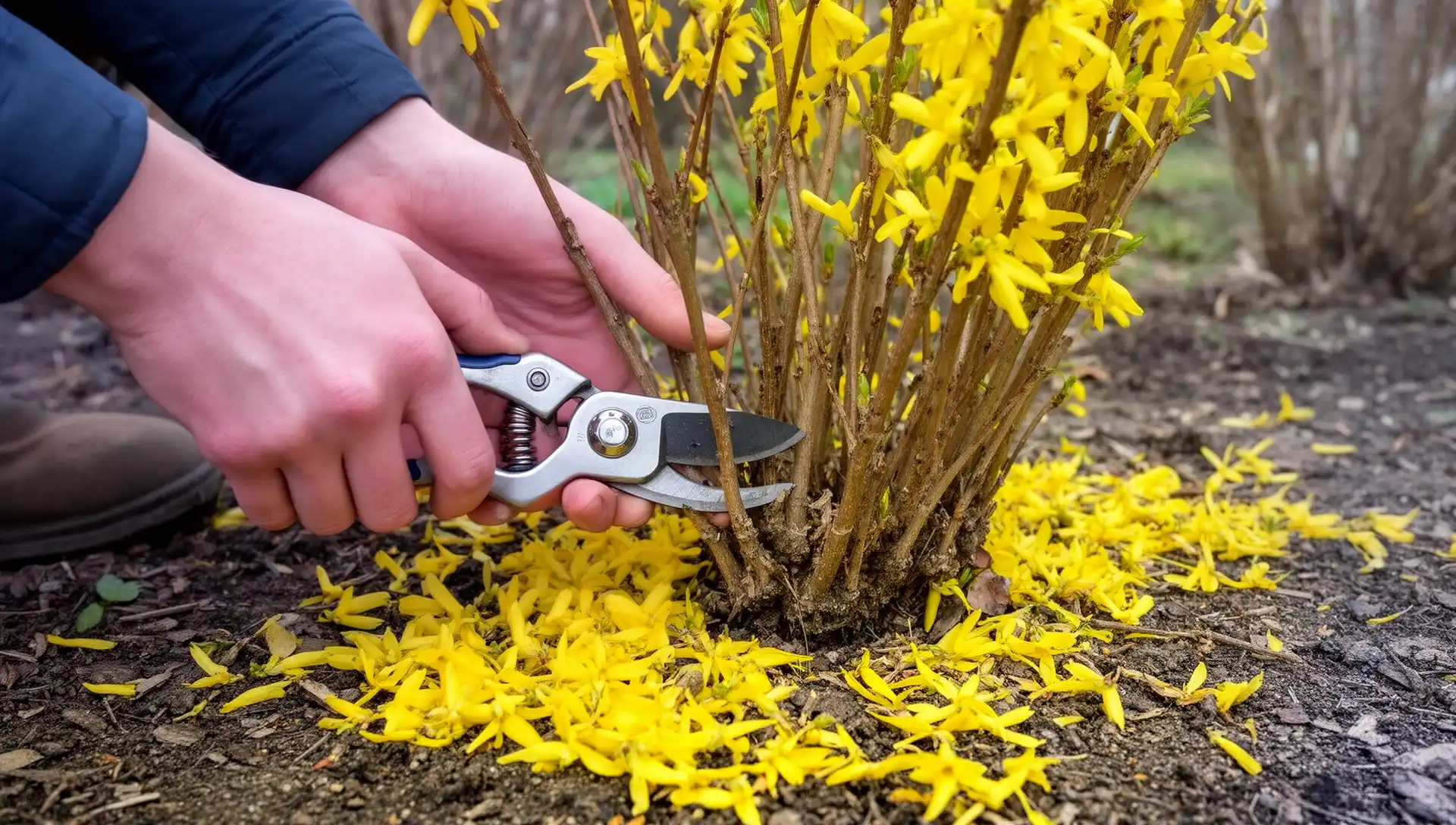
Prune forsythia immediately after it finishes flowering in spring—typically late April to mid-May in most of the US. Iowa State Extension is direct about this: “forsythias should be pruned immediately after flowering.” UNH Extension adds the hard deadline: all pruning must be completed before mid-July, as the plant is actively setting buds from that point onward.
That gives you a window of roughly six to eight weeks after the last flower drops. After mid-July, every cut you make is a bloom you’re removing from next spring’s display.
How to prune correctly
For an established forsythia that already blooms well, post-bloom maintenance is simple:
- Remove one-quarter to one-third of the oldest, thickest canes at ground level immediately after flowering
- Leave younger, smoother-barked stems intact—these carry the densest flower bud load
- Never shear the entire plant into a rounded or boxed shape
- Use hand pruners for stems under half an inch in diameter; loppers for stems under one inch; a pruning saw for anything larger
If you pruned at the wrong time this year, there’s no fix for this season—the buds are gone. But if you prune correctly starting immediately after next spring’s bloom, you’ll have a full display the spring after that.
This is the most common scenario I see when gardeners ask why their forsythia let them down: a well-intentioned August tidy-up that silently removed every bud for next May. The shrub never shows any obvious sign of distress—it just skips its spring show.
Cause #2: Frost-Killed Flower Buds
Here’s the detail that trips up most gardeners: forsythia stems and leaf buds are cold-hardy to zone 3, which is why the plant itself survives brutal winters without damage. But the flower buds are a completely different story. They’re the most temperature-sensitive part of the above-ground plant, and many popular cultivars lose their buds at temperatures that are routine across the northern US.


The standard benchmark for commonly sold cultivars like ‘Lynwood Gold’ and ‘Spring Glory’ is -10°F for flower buds. Iowa regularly records colder temperatures, and both cultivars consistently fail to bloom in those conditions. Meanwhile, the stems and leaves survive perfectly—which is why so many gardeners in zones 3–5 assume their forsythia is thriving right up until May, when it emerges with no flowers again.
UNH Extension research adds another layer: bud cold hardiness isn’t fixed. If January is unusually mild and the plant begins to come out of deep dormancy, the flower buds lose the full hardening they built through fall. A return to -10°F in February can then kill buds that would have survived had the warm stretch not occurred. This explains why some years bring beautiful bloom and other years none, even on the same plant in the same location.
How to diagnose frost damage
Two diagnostic signals make frost injury easy to confirm without a specialist:
- The snowline halo: If your forsythia produces flowers only on low branches near the ground while canes above knee height are bare or nearly bare, you’re looking at winter injury rather than pruning error. Snow insulated the lower buds through the critical cold period while above-snowline buds were exposed and killed. University of Minnesota Extension specifically identifies this pattern as a diagnostic marker for winter injury.
- Brown or black flower buds: Cut a few unopened buds from the upper branches in early spring. If the interior is brown or black rather than pale green or yellow, the buds are winter-killed.
The fix: variety upgrade
There’s no in-season recovery from frost-killed buds. For zones 3–5, the lasting fix is replacing non-hardy cultivars with bud-hardy varieties—see the variety table below. For zones 6–8 where late-season frosts after a mild January are the issue, burlap-wrapping smaller plants and watering during dry winter periods (hydrated plants hold cold hardening better) can provide some protection, but variety selection is still the most reliable long-term solution.
Causes #3–5: Shade, Nitrogen, and Buried Crown
Too much shade
Forsythia needs a minimum of six hours of direct sunlight to bloom reliably. This isn’t usually a problem at planting time—it becomes one as surrounding trees and shrubs grow and cast progressively more shade. A forsythia that bloomed well for years and is slowly producing fewer flowers each season, despite correct pruning, is worth checking for shade encroachment. The fix is either opening the canopy above the plant or, if the shade is permanent, relocating the forsythia to a sunnier spot.
Excess nitrogen
Nitrogen drives vegetative growth—stems and leaves—at the expense of flowers. A forsythia planted next to a regularly fertilized lawn is receiving significant nitrogen runoff. The result is a dense, vigorous, brilliantly green shrub that channels energy into stems rather than flower bud production. Mature forsythia needs no supplemental fertilizer in most garden soils. If you’ve been feeding it, or if lawn fertilizer washes onto its root zone, stop. Bone meal (a phosphorus source) can help redirect energy toward flowering, but removing the excess nitrogen source is the real solution.
Buried crown
The junction between the roots and stems—the crown—should sit at or just above soil level. Heavy mulching year after year, or soil settling over time, can bury the crown and gradually suppress flowering. Keep mulch pulled back one to two inches from the base of the stems to ensure the crown stays visible and unobstructed.
Rejuvenating an Old, Leggy Forsythia
If your forsythia hasn’t bloomed well for three or more years, produces flowers only at the very tips of long bare canes, and has the general appearance of a tangle rather than a flowering shrub, age is likely the issue alongside accumulated neglect. Old forsythia canes—identifiable by their thick diameter, rough or peeling bark, and gray-brown color—produce very few flower buds. Flowering concentrates on young, flexible, smoother-barked wood. When old canes crowd out young growth, the bloom potential collapses.
You have two approaches depending on how far gone the shrub is.
The three-year renewal method
This approach spaces the shock across three growing seasons, keeping the plant functional during renovation:
Stop missing your zone's planting windows.
Select your US zone and month — get a complete checklist of what to plant, prune, feed, and protect right now.
→ View My Garden Calendar- Year 1 (immediately after bloom): Remove one-third of the oldest, thickest canes to ground level
- Year 2 (after bloom): Remove half of the remaining old canes to ground level
- Year 3 (after bloom): Remove the last of the old canes
After three years, you have an entirely young-caned shrub with full bloom potential. This method works best when the plant still blooms to some degree and you want to maintain its screening or landscape function during the process.
Complete reset
For a forsythia that is completely flowerless and beyond gradual renovation, cut the entire plant to six to twelve inches above ground immediately after the last expected bloom date. You’ll sacrifice one to two seasons of flowers but end up with a fully rejuvenated shrub. UW-Madison Extension notes that severe cutback allows recovery within two years. This total reset is also worth considering before investing in a new variety—a fully cut-back forsythia in good sun, pruned correctly, often blooms vigorously once new wood matures.
Cold-Hardy Varieties That Actually Bloom in Zones 3–5
For gardeners in cold climates, the lasting fix for recurring frost-killed buds isn’t cultural management—it’s choosing a cultivar bred for bud hardiness. The following varieties have been evaluated by Iowa State, UW-Madison, and Illinois Extension for verified bud hardiness.
| Cultivar | Bud hardiness | Height | Best use |
|---|---|---|---|
| Meadowlark | -35°F (zone 3) | 13–15 ft | Large screens; most cold-hardy widely available |
| New Hampshire Gold | -33°F (zone 3) | 5 ft | Compact; excellent hardiness; less common in trade |
| Northern Gold | -30°F (zone 4) | 6–8 ft | Reliable medium shrub for zones 4–5 |
| Northern Sun | -30°F (zone 4) | 6–8 ft | Widely available; good choice for zones 4–5 |
| Sunrise | -20°F (zone 4–5) | 5–6 ft | Dense, compact; performs in zones 4–5 |
| Gold Tide | -15°F (zone 5) | 2–3 ft | Groundcover form; slopes and borders |
| Lynwood Gold | -10°F (zone 6) | 8–10 ft | Zones 6–8 only; unreliable in colder zones |
| Spring Glory | -10°F (zone 6) | 6–8 ft | Zones 6–8 only; avoid zones 3–5 |
If you’re in zones 3–5, Meadowlark and New Hampshire Gold offer the most reliable bud hardiness at -33°F or below. Lynwood Gold—by far the most widely sold forsythia at garden centers—was bred for ornamental appeal and performs beautifully in zones 6–8. In zones 3–5, it almost never blooms consistently. You may simply be growing the wrong plant for your climate.
For full care guidance, variety selection by USDA zone, and soil preparation details, see our forsythia growing guide. The same old-wood pruning rule applies to other early spring shrubs—lilacs and weigela lose their spring flowers for the exact same reason when pruned in summer.

Frequently Asked Questions
When exactly should I prune forsythia?
Immediately after flowering ends in spring—typically late April to mid-May in most US zones. The hard cutoff is mid-July. Any pruning after that date removes buds already set for the following spring.
My forsythia blooms on one side but not the other. Why?
The most likely explanation is the snowline effect: the blooming side had deeper snow cover through winter, which insulated those buds from the killing cold. Check whether a fence, wall, or drift pattern would create that difference. If snow cover is equal, uneven shade from a structure or tree is the second most likely cause.
Can I hard-prune forsythia in late winter before it blooms?
Yes, but you forfeit this year’s flowers. Late-winter hard pruning is only worthwhile if you’re completely resetting an overgrown plant or establishing a new shape. The plant will recover and bloom in subsequent years if pruning then shifts to the correct post-bloom window.
Why did my forsythia bloom in fall?
An unseasonable warm spell triggered dormant buds to open out of season. The plant burned buds it had set aside for spring. There’s no fix in the moment, and it won’t repeat unless weather conditions are similar the following fall. Those individual buds won’t reopen in spring.
How long before a rejuvenated forsythia blooms again?
One to two years, depending on the method. Three-year gradual renewal keeps some blooms through the process; a complete ground-level cutback sacrifices one to two full seasons before normal flowering resumes.
For more on how to get the most from this shrub—including companion planting and cut-flower use—visit the forsythia uses and benefits guide.
Sources
- Illinois Extension. “Help! My Forsythia Isn’t Blooming Like It Used To.” https://extension.illinois.edu/blogs/good-growing/2025-03-28-help-my-forsythia-isnt-blooming-it-used
- University of Maine Cooperative Extension. “Why Did My Forsythias Not Bloom This Spring?” https://extension.umaine.edu/gardening/2023/06/09/why-did-my-forsyntias-not-bloom-this-spring/
- Iowa State University Extension. “My Forsythia Shrubs Are Vigorous and Healthy, But Don’t Bloom Well.” https://yardandgarden.extension.iastate.edu/faq/my-forsythia-shrubs-are-vigorous-and-healthy-dont-bloom-well-why
- University of Minnesota Extension. “Forsythia: No Flowers.” https://apps.extension.umn.edu/garden/diagnose/plant/deciduous/forsythia/noflowers.html
- UNH Extension. “Where Are the Blooms? Forsythia, Peaches, Cherries, and Plums.” https://extension.unh.edu/blog/2023/05/where-are-blooms-forsythia-peaches-cherries-plums
- UNH Extension. “When and How Do You Prune an Overgrown Forsythia?” https://extension.unh.edu/blog/2020/02/when-how-do-you-prune-overgrown-forsythia
- Iowa State University Extension. “Growing Forsythias in the Home Landscape.” https://yardandgarden.extension.iastate.edu/how-to/growing-forsythias-home-landscape
- University of Wisconsin-Madison Extension. “Forsythia (Forsythia spp.).” https://hort.extension.wisc.edu/articles/forsythia-forsythia-spp/


