

Spirea Growing Guide: Bridal Wreath vs Japanese Spirea — Pruning Times, Sizes and Best Uses

Learn how to grow spirea shrubs: cultivar selection, spring vs. summer blooming types, pruning timing, pest control, propagation, and companion planting for continuous season colour.
Origin, Species & Types
When you walk through a garden centre in spring, you’ll likely spot spireas with small white flowers cascading down arching branches, next to more compact spireas with deep pink blooms held upright. They look related — and they are — but they flower on a fundamentally different schedule. Understanding this difference is the single decision that determines whether you get a year of blooms or a season with no flowers.

The Spiraea genus includes nearly 100 species of shrubs in the rose family (Rosaceae), native to the temperate regions of Asia and Europe, with the greatest diversity in Japan and China [1]. The name comes from the Greek word “speira,” meaning “wreath,” a reference to how the tiny individual flowers cluster densely into rounded or pyramidal flower heads that look almost like garlands [2].

These are ancient garden plants. Medieval European monks grew spirea in monastery gardens for its beauty and medicinal properties; Victorian gardeners adored them for their graceful spring displays. Today, spirea remains one of the easiest, most reliable shrubs for temperate gardens.
Two types dominate commercial horticulture:
Spring bloomers (also called “old wood” bloomers) flower on branches that grew last year. They produce their flower buds in late spring and early summer, right after they finish blooming. This is why they must be pruned immediately after flowering — pruning later (winter or early spring) removes the branches carrying next year’s buds. Varieties like Vanhoutte spirea and Bridal Wreath are spring bloomers.
Summer bloomers (also called “new wood” bloomers) flower on stems that grow THIS season. They don’t set buds until spring, so you can prune them hard while dormant in February or March without sacrificing bloom. Modern Japanese spirea hybrids like ‘Anthony Waterer’ and ‘Gold Flame’ are summer bloomers.
This one distinction — old wood vs. new wood — drives every care decision you’ll make for the next decade. Keep it in mind.
Cultivar Selection Matrix
Walking into a nursery with just “I want a spirea” is like saying “I want a dinner.” You need to know what you’re actually looking for, and that starts with understanding what each main type offers.

Spring-Blooming Spireas (Old Wood)
Vanhoutte Spirea (Bridal Wreath) — This is arguably the most recognizable spirea in gardens, and for good reason. Spiraea × vanhouettei grows 4 to 6 feet tall with an arching, vase-like form. In April and May, it becomes a fountain of tiny white flowers so dense they nearly hide the foliage [1]. It’s impressive as a specimen plant or informal hedge, and its graceful branching structure adds winter interest even after bloom fades. Zones 4–8.
Birchleaf Spirea — This species offers something spring bloomers rarely deliver: interesting foliage. Blue-green leaves persist through summer and turn reddish-bronze in fall, giving the plant multi-season colour. The white spring flowers are almost secondary to the foliage display. Reaches 6–8 feet tall. Zones 2–7, making it extremely cold-hardy [2].
Why choose spring bloomers? If you want a larger structural plant (4–8 feet) with graceful arching branches and a significant spring flower show, spring bloomers deliver. The downside: they have no further bloom after May, and they must be pruned at a specific window (immediately post-bloom) or you lose next year’s flowers.
Summer-Blooming Spireas (New Wood)
Japanese Spirea (‘Little Princess’) — The dwarf option. This compact cultivar reaches only 2 feet tall and equally wide, making it perfect for borders, small gardens, and containers. Light pink flowers bloom from early summer through fall if deadheaded. Extremely cold-hardy. Foliage is fine and delicate.
Japanese Spirea (‘Gold Flame’) — This is the showstopper for foliage interest. New leaves emerge in red-orange, mature to golden-yellow by mid-season, then deepen to orange-red in fall — all while sporting tiny pink flowers. It tolerates heat well, making it a good choice for southern gardens. Reaches 3–4 feet. The trick is giving it full sun; shade mutes the foliage colour.
Bumalda Hybrid (‘Anthony Waterer’) — Carmine-red flowers in flat-topped clusters sit above blue-green foliage from June through September. This hybrid grows to 3–4 feet and has an upright, compact form. It’s a workhorse in the garden — hardy, reliable, and long-blooming.


Why choose summer bloomers? If you want a compact shrub (2–4 feet) with continuous bloom from summer through fall and interesting foliage, summer bloomers excel. You can prune hard in early spring without worrying about losing flowers. Many modern hybrids offer foliage interest (gold, red, variegated), which extends their ornamental value.
| Need | Best Choice | Why |
|---|---|---|
| Large structural shrub, spectacular spring bloom | Spring bloomer (Vanhoutte, Birchleaf) | 4–8 ft, impressive form, spring focal point |
| Compact, border, continuous summer colour | Summer bloomer (Little Princess, Gold Flame) | 2–4 ft, rebloom with deadheading, foliage interest |
| Multi-season interest | Gold Flame or Birchleaf | Foliage colour from leaf-out through frost |
With the right cultivar chosen, the next step is making sure your garden offers what spirea needs to thrive.
Planting & Growing Conditions
Spireas aren’t picky, but they do have preferences — and honouring them from the start prevents years of frustration.

Sunlight: Full sun is the baseline. Spirea wants at least 6 hours of direct sunlight daily. This is non-negotiable for flower production and foliage colour (especially important for ‘Gold Flame’, which turns olive-green in shade). In partial shade, spirea still grows but flowers sparsely and foliage colour dulls.
Hardiness zones: Most cultivars are hardy in USDA zones 4–8. Birchleaf spirea extends down to zone 2. Japanese spirea varieties are generally zones 4–9. Check your cultivar’s tag or ask at purchase [2].
Soil: Here’s where spireas are genuinely low-maintenance. They tolerate nearly any soil type — clay, loam, sandy — as long as one condition is met: it drains well. Spirea resents waterlogged roots. If your garden has heavy clay that stays soggy after rain, amend with compost before planting, or choose a raised bed location. pH can range from acidic to slightly alkaline; spireas don’t demand the coddling that ericaceous plants (blueberries, rhododendrons) require [3].
Watering: At planting, keep the soil moist (not soggy) for the first growing season as roots establish. Once established, spirea is drought-tolerant and needs supplemental water only during extended dry spells (more than 3 weeks without rain in peak summer). A 2–3 inch mulch layer around the base conserves soil moisture, regulates temperature swings, and suppresses weeds [3]. Pull mulch back 6 inches from the stem to prevent rot.
Planting timing: Spring or fall are both acceptable. Spring planting gives the plant the entire growing season to establish roots before winter stress. Fall planting (in cool climates, September–October) lets roots settle in during dormancy, and the plant awakens with established root systems in spring. Avoid planting in heat of summer or during active bloom.
I’ve noticed spirea planted on the shaded north side of a fence stays lush green all season, while a ‘Gold Flame’ on the south-facing border turns that brilliant golden-red by mid-June — light really drives the show. Plant accordingly.
With the right location and soil prepared, the next question is pruning — and this is where most spireas go wrong.
Stop missing your zone's planting windows.
Select your US zone and month — get a complete checklist of what to plant, prune, feed, and protect right now.
→ View My Garden CalendarPruning Explained — The Bud-Set Mechanism
Here’s the single piece of knowledge that separates gardeners who get spirea right from those who accidentally cut off a year of flowers.

Spirea pruning isn’t complex, but it’s entirely dependent on understanding when your shrub decides where to flower. And that timing is different for spring bloomers and summer bloomers.
How Spring Bloomers Set Buds (Old Wood)
Spring-blooming spireas like Vanhouette and Birchleaf have a specific lifecycle:
1. Last year’s growth carries this year’s flowers. The branches that grew in summer and fall of last year have visible flower buds on them all through winter. These buds are set. They’re waiting for spring warmth to open.
2. Flowers bloom (April–May). The buds swell, open, and create that spectacular spring display.
3. Immediately after bloom fades (May–June), the plant transitions to bud-setting for next year. Within weeks of finishing its flowers, the plant begins setting buds on the NEW stems that grew this spring. These new stems, grown in May and June, will carry next year’s flowers.
4. If you prune in February or March, you’re cutting off those branches carrying the buds set last year. Result: attractive foliage, zero flowers for the next 12 months. The plant will recover and eventually flower again, but you’ve wasted a year.
5. If you prune immediately after bloom ends (May–June), you cut at the perfect moment — after this year’s flowers are done but before the plant has invested heavily in new growth. The plant still gets the whole summer to build stems for next year’s blooms. You get flowers next spring.
The rule: Prune spring bloomers right after they finish flowering, ideally within 2 weeks. May or early June is the target window [3].
How Summer Bloomers Set Buds (New Wood)
Summer-blooming spireas like ‘Anthony Waterer’ and ‘Gold Flame’ operate on a different timeline:
1. No buds are set in advance. Unlike spring bloomers, summer bloomers don’t have pre-formed flower buds waiting in winter.
2. You can prune hard in February or March while the plant is dormant. You can cut these shrubs back by half or even more — it won’t sacrifice bloom because the buds don’t exist yet. There’s nothing to cut off.
3. Warm spring weather triggers new stem growth, and buds form on this new growth. The flowers appear on stems that grew THIS spring and early summer.
4. Summer bloomers often rebloom if you deadhead. Because they keep setting buds on new growth all season, removing spent flowers triggers the plant to produce more stems and more buds. This is why summer bloomers often flower from June through September [3].
The rule: Prune summer bloomers in late winter to early spring, before growth starts. You can be aggressive. The plant will thank you with vigorous new stems carrying abundant blooms.
Pruning Technique (Both Types)
Annual pruning keeps spirea looking tidy and flowering abundantly:
1. Remove dead or damaged branches any time you see them. Broken branches won’t recover; they’re just taking energy.
2. Light shaping: Using hand pruners, cut the tips of stems back to just above a healthy leaf bud. You’re removing maybe the top 4–6 inches of stem, tightening the plant’s shape without gutting it. Do this after bloom for spring types, before growth for summer types.
3. Renewal pruning (every 3–4 years): Cut one-third of the oldest, thickest canes all the way to ground level. This encourages the plant to produce vigorous young stems from the base, renewing the entire shrub. It looks drastic in year 1, but by year 2 the plant is bushier and more floriferous than before.
Never use hedge shears on spirea. You’ll create a blocky, unnatural shape and stress the plant. Hand pruning takes 15 minutes and looks infinitely better.
The mechanisms are clear now. But spirea’s ease comes with a small cost: pests do notice these shrubs.
Pests & Integrated Control
Spirea is hardy and low-maintenance, but a few insects consistently target it. The good news: all are manageable with a pest-control hierarchy: cultural methods first, IPM second, chemicals last.

Spirea Aphids (Aphis citricola)
What to look for: Soft-bodied insects, usually green or yellow, clustering on undersides of new growth in spring. Leaves yellow, wilt, or curl. Sticky honeydew (aphid waste) coats leaves, and black sooty mold may follow [5].
Why they target spirea: Tender new spring growth is a buffet; aphids use piercing-sucking mouthparts to extract sap [5].
Control hierarchy:
1. Tier 1 (Cultural/Water): A forceful spray from the hose 2–3 times per week dislodges aphids and disrupts colonies. This works surprisingly well and is completely pesticide-free [5]. Repeat for 2–3 weeks if needed.
2. Tier 2 (IPM): If water spray isn’t controlling them, spray insecticidal soap or horticultural oil (neem, mineral, or petroleum-based). These disrupt the insect’s cell membranes and have low mammalian toxicity. Spray in early morning or evening, not in full sun [5]. Meanwhile, natural enemies like ladybugs, lacewings, and hover flies often move in and suppress populations [5].
3. Tier 3 (Chemical): If Tier 1 and 2 fail (rare), use a labeled insecticide like spinosad or pyrethrin. Always follow label directions.
When to monitor: April–June is peak aphid season. After mid-June, populations usually crash as natural enemies take over.
Spider Mites (Twospotted Mite)
What to look for: Tiny insects (1/50 inch) with a dark spot on each side, light green or yellow. Fine webbing on leaf undersides. Stippling (tiny yellow dots) on leaves. In severe cases, leaves turn brown and drop [6].
Why they target spirea: Spirea’s fine foliage and preference for sun make it attractive to spider mites. They thrive in hot, dry conditions [6].
Control hierarchy:
1. Tier 1 (Cultural): Increase humidity and spray with water. Spider mites prefer dry conditions; regular water spray disrupts webbing and mites. Mist the plant 2–3 times per week in hot months [6].
2. Tier 2 (IPM): Spray horticultural oil or insecticidal soap in early morning or evening. Predatory mites can be introduced as biological control if populations are severe [6].
3. Tier 3 (Chemical): Miticide or sulfur dust (check labels for spirea safety).
When to monitor: June–September is peak spider mite season, especially in hot or dry gardens.
Other Occasional Pests
Japanese beetles: Hand-pick in early morning when they’re sluggish, before they fly away. Drop into soapy water. Do this in June–July when active.
Scale insects: Horticultural oil spray in late winter (dormancy) smothers overwintering scales. Most common in humid climates.
Damage threshold: Spirea is tough. Light to moderate aphid or mite damage won’t kill the plant. Aim to keep populations low, not eradicated — natural enemies need pests to sustain themselves.
With pests managed, if you want to expand your spirea collection, propagation is surprisingly straightforward.
Propagation — Softwood & Hardwood Cuttings
One of the joys of spirea is how easily it propagates. Many gardeners find themselves multiplying a favourite cultivar and filling entire borders with it. Propagation works from either new (softwood) or mature (hardwood) stem cuttings [7].
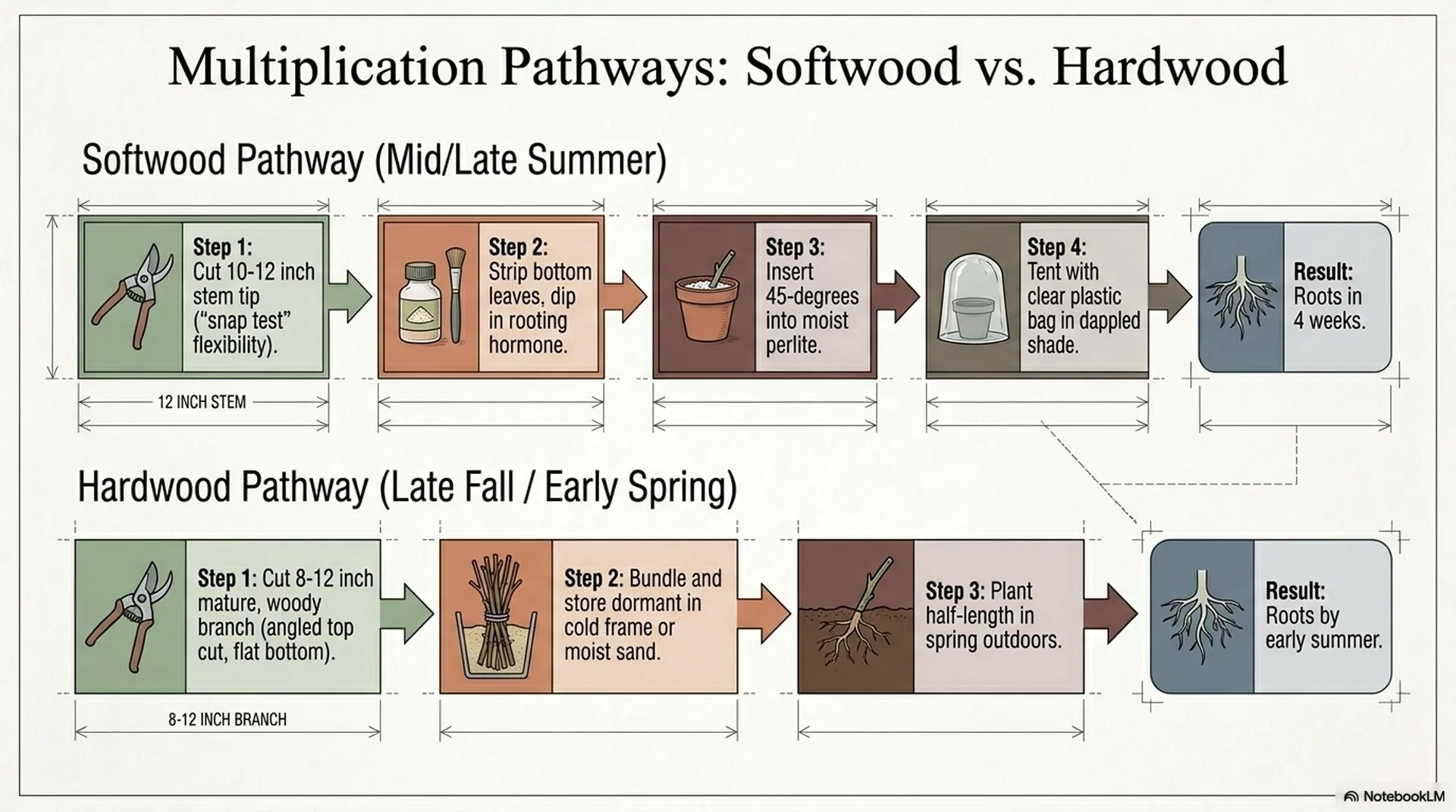
Softwood Cuttings (Summer)
Softwood cuttings have the highest success rate and are the method to use if you want quick results.
Timing: Mid to late summer, typically June through August, when new stems are flexible enough to bend but snap if you flex them hard (that “snap” indicates the right stage) [7].
Technique:
1. Cut a 10–12 inch stem tip, including 4–6 leaves
2. Remove the bottom 4–6 inches of leaves, leaving only the top cluster
3. Dip the cut end in powdered rooting hormone and gently tap off excess
4. Fill a pot (4–6 inch) with moist rooting medium (perlite, peat mix, or coco coir)
5. Insert the cutting at a 45-degree angle, burying the bottom 2–3 inches
6. Place 4–5 cuttings around the inside edge of the pot (efficient use of space)
7. Tent the pot with a clear plastic bag, seal it loosely with a rubber band, and place in dappled shade
8. Check weekly; the medium should be moist but not waterlogged
9. Within 4 weeks, gently tug the cutting; if you feel resistance, roots are forming [7]. New foliage growth is the clearest sign of success.
Result: By mid-autumn, rooted cuttings can be potted into regular soil and overwintered indoors or in a cold frame, then planted out in spring.
Hardwood Cuttings (Fall or Early Spring)
Hardwood cuttings are easier in some ways — no plastic tent needed, less finicky about humidity — but take longer.
Timing: Late fall after the first hard frost, or early spring (dormancy), typically November–March depending on your climate [7].
Technique:
1. Cut 8–12 inch sections from mature (thicker, woody) branches
2. Make the top cut just above a bud (angled, so water runs off) and the bottom cut just below a bud (flat)
3. Bundle 5–10 cuttings with a label and mist them; store in a cold frame, plastic bag in a garage, or buried in moist sand/mulch in a sheltered spot
4. In spring, plant cuttings half their length into rooting medium outdoors or in a cold frame (shaded, moist)
5. By early summer, roots develop and new foliage emerges
Propagation notes: Spirea roots so readily that even beginners succeed. Many gardeners save a few cuttings each summer as insurance against winter loss or to share with friends. The only requirement is patience — resist the urge to disturb the cutting or check for roots constantly. Once you see new foliage, it’s working.
Propagation is most useful for favourite cultivars. Once your spirea is established, consider how it pairs with other shrubs in your landscape.
Companion Planting for Bloom Sequencing
Spirea is beautiful solo, but it’s powerful when paired with other shrubs that fill the gaps its bloom schedule leaves.

The Bloom Sequencing Principle
A garden with only spirea blooming in spring will look bare from June onward. The design solution is choosing companions that flower when spirea doesn’t — creating continuous colour from spring through fall [8].
Spirea + Hydrangea Partnership
This is the classic pairing for good reason.
Timeline: Spirea flowers in May, peaking by late May and fading by early June. Just as spirea blooms fade, hydrangea buds are swelling. Hydrangea takes over with bloom from July through October (even into November in mild climates) [8].
Colour harmony: Most spring-blooming spireas are white. Pair with panicle hydrangeas in white, blush, or blush-to-rose gradations for soft cohesion. Or create contrast: white spirea with blue or pink mophead hydrangeas.
Care alignment: Both need full sun (6+ hours), moist-but-not-soggy soil, and moderate moisture — they’re compatible. Both are hardy and low-maintenance [8].
Result: A 15-foot mixed border with three Vanhouette spireas and three ‘Pinky Winky’ panicle hydrangeas blooms spectacularly from May through October. It’s the backbone of a low-maintenance landscape.
Spirea + Weigela Partnership
Weigela flowers slightly later than spirea, creating an extended bloom window.
Timeline: Spirea finishes in late May; weigela peaks in June–July. There’s slight overlap, so you get both in colour simultaneously for 2–3 weeks [8].
Colour: Spireas are often white or pale pink; many weigelas are deep pink to red. The contrast is striking.
Habit: Both are deciduous shrubs with similar hardiness (zones 4–8) and care needs (full sun, well-drained soil, moderate water). Weigela has a slightly coarser texture than spirea’s fine foliage, so the textural contrast adds visual interest year-round.
Extending Further: The Pollinator Trio
Add Korean spirea or Butterfly spirea (S. japonica) if you want to attract pollinators and extend the season further. These are summer bloomers with smaller flowers that bloom for months, attracting bees and butterflies [8].
Underplanting
At the base of spirea-hydrangea-weigela shrub borders, plant shade-tolerant groundcovers like Ajuga, Liriope, or creeping thyme. These tie the shrubs together visually and fill space that would otherwise look bare in early spring.
A complete border design:
- Back row (4–6 ft): 2–3 Vanhouette spirea and 2 panicle hydrangeas
- Middle row (2–3 ft): 1–2 weigela or Korean spirea
- Front row (ground level): Liriope or Ajuga carpet
This gives you spring white (spirea), early-summer contrast (weigela), summer-fall colour (hydrangea), and year-round foliage texture. With proper pollinator plantings, you’ll notice bees and butterflies from May onward.
Now, to keep all these plants thriving through the seasons, a simple calendar prevents confusion.
Month-by-Month Care Calendar
February–March: Dormant Pruning Window
- Summer bloomers: Prune hard now. Cut back by up to half. Remove dead wood. Reshape.
- Spring bloomers: Do NOT prune. Wait until after bloom.
- Check for winter damage and remove broken branches.
- If using pre-emergent for weeds, apply before soil warms.
April–May: Spring Bloom Window
- Monitor spring bloomers as they flower.
- Deadhead spent flowers if desired — prolongs visual appeal.
- Watch for early-season aphids on new growth. Water spray at first sign.
Late May–Early June: Post-Bloom Pruning (Spring Bloomers)
- Spring bloomers: Prune immediately after flowers fade. Reshape, remove dead wood, thin old canes.
- Refresh mulch if compressed or depleted.
June–July: Peak Growth & Propagation
- Softwood cuttings: Take 10–12 inch cuttings from new growth; propagate in moist medium under humidity.
- Monitor for spider mites in hot, dry weather. Increase water spray frequency if stippling appears.
- Deadhead summer bloomers to encourage rebloom.
August: Continued Bloom & Pest Watch
- Summer bloomers should be flowering. Deadhead for ongoing bloom through September.
- Spider mites peak in August heat. Mist foliage regularly to disrupt webbing.
- Softwood cuttings should be rooting. Watch for new foliage growth.
- Water deeply during drought (less than 1 inch rain per week).
September–October: Fall Transition
- Stop deadheading to allow seed set and avoid stimulating tender new growth pre-frost.
- Reduce watering unless drought persists; plants are hardening off for winter.
- No pruning in fall — promotes soft growth vulnerable to frost damage.
- Hardwood cuttings: Collect mature cuttings for winter storage or immediate potting.
- Check mulch is not piled against the stem.
November–December: Dormancy & Planning
- Remove fallen leaves if disease is a concern; otherwise leave them for mulch and insect shelter.
- Mulch refresh: Add 2–3 inches of fresh mulch around plants (pulling back from stem).
- Plan additions: Order next year’s cultivars or cuttings.
This rhythm keeps spirea thriving year-round with minimal intervention — mostly water, occasional pruning, and pest monitoring when populations peak.


Conclusion
Spirea’s reputation for ease isn’t accidental. These shrubs are nearly foolproof if you understand one principle: the distinction between old-wood and new-wood flowering. Know which type you’ve planted, prune at the right window, and you’ll have years of reliable blooms.
Beyond that single critical knowledge, spirea asks for little: full sun, well-drained soil, moderate water, and annual pruning. Pests are manageable with water spray or mild soap. Propagation is effortless — many gardeners find themselves multiplying a favourite cultivar and creating shrub borders almost by accident.
The real magic happens when you pair spirea with companions that fill its seasonal gaps. A spring-blooming spirea with a summer-blooming hydrangea and weigela creates a continuous flower show from May through October — the backbone of a low-maintenance, high-impact landscape. Underplant with groundcovers, monitor for aphids and spider mites, and you have a design that thrives for decades.
Next steps: This week, choose whether you want a large spring bloomer (Vanhoutte, Birchleaf) or a compact summer bloomer (Gold Flame, Little Princess, Anthony Waterer). Look for the “old wood” or “new wood” label at the nursery, or ask a staff member. Once your spirea is planted and established, save a few softwood cuttings — within a season, you’ll have extra plants. Then consider adding hydrangea or weigela nearby for season-long colour.
Spirea’s 100-year history in gardens exists for a reason: it works. Plant it with intention, and it will reward you reliably for a decade or more.

Sources
[1] Britannica — Spirea: Overview
[2] National Garden Bureau — Year of the Spirea
[3] Gardener’s Path — How and When to Prune Spirea
[4] University of Kentucky — Common Insect Pests of Spirea
[5] K-State Extension — Spirea Aphid Control
[6] Clemson Extension — Integrated Pest Management for Spider Mites
