

How to Grow a Coconut Palm: 3 to 6 Months to Sprout, a One-Year Food Reserve That Can Mask a Low-Light Pot Palm, and Why UF/IFAS Stops at Zone 10b

A sprouted coconut palm draws on its nut for about a year. Get the 3-to-6-month sprouting method, the zone 10b cutoff, and a symptom table for pot palms.
A coconut palm sprouts from a whole nut in 3 to 6 months, draws on the nut’s stored nutrients during its first year, and needs the freeze-free climate of USDA zone 10b or warmer to survive outdoors. The University of Florida (UF/IFAS) says to plant coconut palms only in zones 10b–11, and its Nassau County office says the palm would not even survive, let alone produce nuts, in zones 8b–9a.
That first-year food supply is why the sprouted nuts sold in pots at garden centers look fine for months and then fail. Below: the zone and temperature limits, a sprouting method that follows the Hawaii and Florida extension sheets, an honest look at what the evidence says about growing one indoors, a symptom table, and the timeline to a first harvest. If you are choosing a palm for a cooler spot, the guide to 19 Florida palms matched to USDA zone lists hardier options.
Will a coconut palm survive where you live?
Only in a frost-free climate: UF/IFAS plants coconut in zones 10b–11 only. USDA zones are 10°F bands split into 5°F half-zones, so by that arithmetic zone 10b works out to average yearly lows of 35–40°F. The zone number understates the risk, because a coconut is hurt by cold well above freezing.
| Temperature | What happens to a coconut palm | Source |
|---|---|---|
| 72°F average winter minimum | The climate coconuts are best suited to, per the literature an extension agent cites | UF/IFAS Charlotte County |
| Up to about 50°F | Chilling injury is possible, “occasionally as high as 50°F” | UF/IFAS cold-damage sheet |
| One night at 45°F after weeks of 70°F nights | May cause leaf-tissue death; gradual cooling over weeks may cause none | UF/IFAS cold-damage sheet |
| 32°F | Palm can be killed or injured | UF/IFAS Charlotte County |
| Low to mid 30s°F for days | Soft, sunken, reddish patches on the trunk; the crown can wilt and collapse about three months later from rot | UF/IFAS cold-damage sheet |
The takeaway: the number that matters is how warm your coldest nights are and how fast they cool, not just your zone label. A palm used to 70°F nights is hurt more by a sudden 45°F night than one that cooled gradually.

Three pre-planned garden beds, free
Stop staring at empty beds: printable plans with exact layouts, plant lists and planting calendars — yours free from the Garden Library.
Ralph Mitchell, the UF/IFAS Charlotte County agent, learned this the hard way. Local box-store garden centers sold coconut palms, so Mitchell bought one, planted it in 2001, covered it through a light freeze, and lost it to a second, heavier freeze within a week. The summary in the Charlotte County extension post: coastal zone 10a is marginal, the interior at zone 9b is too cold, and zone 10b is “elusive at best” outside Miami-Dade and south. A few palms survive in warm microclimates, including one tucked against a house, but Mitchell calls the palm marginal at best away from the coast.
In Hawaii, the University of Hawaii extension notes that when the soil is loose and rainfall sufficient, fallen nuts often germinate and grow right where they land.
How do you sprout a coconut from a whole nut?
Pick a fallen, husk-on nut that sloshes when shaken, soak it two to three days, half-bury it in a warm, well-drained spot, and wait. The University of Hawaii (CTAHR) fact sheet Coconut Palms from Seed says a nut germinates in three months under ideal conditions and up to six otherwise. Here is the method it describes, with UF/IFAS where the two agree.
- Choose the nut. Pick one with water sloshing inside; both UF/IFAS and CTAHR use that test. CTAHR specifies a fallen nut and says to leave the husk on.
- Soak it in a pail of water for two to three days before planting.
- Set it in a container at least 10 inches deep, wide enough to hold the nut, filled with well-drained potting mix. In a pot, CTAHR sets the nut with the pointed end down and the end that was attached to the tree up, with about a third of the nut above the soil. In the ground, both sheets lay it on its side with roughly the lower third buried (CTAHR) or covered in mulch or sand with a third above ground (UF/IFAS).
- Keep it warm: CTAHR wants a spot that never falls below 70°F and is often above 80°F. UF/IFAS says germination is best in high temperatures.
- Keep it moist but not wet. CTAHR adds that as long as the soil drains well, it is difficult to give a germinating nut too much water.
- Wait. Roots push out through the husk first, then a sharp green spear emerges from the end that was attached to the tree. The first leaves are undivided; the feathery fronds come later.

Orientation advice differs slightly between sources (upright in a pot, on its side in the ground, and a peer-reviewed paper says long angular nuts should sit on their broadest face, the position they land in naturally). What every source shares is the husk left on, about a third of the nut above the surface, and warmth.
Why does a coconut take months to sprout?
Because the slow start is part of the design: the thick, fibrous husk that lets a nut float is the same husk that delays germination. In a 2012 paper in AoB Plants, Hugh Harries reports that wild-type nuts take 60 to 220 days to reach 90% germination, while thin-husked domestic types need 30 to 140 days and often start sprouting while still on the palm. He also notes that seedlings do not survive immersion in sea water, so a nut that crosses a stretch of ocean has to germinate late. A UK school science resource puts the drifting time at up to 120 days afloat, a figure I could not trace to a primary paper, so treat it as approximate.
This also explains the advice to leave the husk on. Some online guides tell you to strip it with a knife; the extension sheet starts from a whole, fallen nut. I found no extension guidance on the husk-stripped coconuts sold in supermarkets, so I would not expect the protocol above to transfer to them.
Why do the potted “houseplant” coconuts struggle indoors?
A coconut palm wants full sun, constant warmth, and humid air, while the nut’s stored nutrients support it only through its first year. UF/IFAS says the palm requires full sunlight and lists spider mites among its usual pests. CTAHR says that during the first year of growth the plant absorbs nutrients stored in the nut, and only later responds to fertilizer like any other plant.
Garden writer Larry Hodgson describes the product directly: box stores and garden centers sell a freshly germinated baby coconut, huge nut still visible, packed tightly into a small pot with roots already poking out of the drainage holes. Hodgson’s verdict in “Possibly the World’s Worst Houseplant” is that it is almost impossible to grow indoors and will likely survive only a few months. The two sources disagree, and the gap is informative.
| Source | Indoor outlook | Conditions it assumes |
|---|---|---|
| University of Hawaii (CTAHR), 1996 | A container palm reaches about 5 ft and survives roughly 5 years in the same container | Warm place, never below 70°F and often above 80°F; well-drained mix; kept moist |
| Laidback Gardener (Hodgson), 2014 | “Almost impossible”; will likely last only a few months | Says it needs very intense light, high humidity, and temperatures above 75°F all year |
| UF/IFAS Gardening Solutions | No indoor guidance; palm needs full sun, prone to spider mites | Outdoor planting, zones 10b–11 |
The takeaway: I found no study that measures how long store-bought potted coconut palms live, so any “dies within X years” number is an estimate. My reading is that the two views fit together once you compare conditions: CTAHR assumes a consistently warm spot, while Hodgson assumes an ordinary home cannot supply the light, humidity and heat.
My inference, not a measured result: because the nut feeds the seedling for about a year, a palm in too little light can look healthy until the reserve runs out, then decline over the following months. If you buy a sprouted nut in a pot, judge it by whether new leaves keep coming after the first year, not by how it looks in month three.
If you try anyway, give it your brightest window, keep nights at or above CTAHR’s 70°F floor, repot into a deeper container as soon as roots show at the drainage holes, and plan for the day it outgrows the room. The indoor palm growing guide covers species that tolerate living rooms for decades, and Hodgson’s own advice is to pick one of those instead.
What is wrong with my coconut palm?
Match the symptom to the table; most problems in a young coconut are cold, a nutrient shortage, or pests. For other palm problems see the indoor palm problems guide.
| Symptom | Likely cause | What to do |
|---|---|---|
| Reddish blotches on young leaves | Mild chilling injury | Move to a warmer spot; keep nights above 70°F |
| Dead leaflets across mid and lower leaves, leaf stems and newest leaves still alive | Cold night (chilling injury) | Wait for warm weather and trim only dead tissue; routine palm fertilizer reduced chilling damage in UF/IFAS trials |
| Brown tips on the oldest leaves only | Potassium deficiency, which UF/IFAS says is almost ubiquitous in Florida palms | Apply a palm-specific fertilizer 3–4 times a year (UF/IFAS) |
| Soft, sunken reddish patches on the trunk, then a wilting crown | Prolonged cold plus secondary rot | Pull the spear leaf: if it resists, the growing point may have survived; see the UF/IFAS cold-damage sheet |
| Premature nut drop with water-soaked, discolored stem ends; yellowing; blackened flower stalks | Lethal yellowing (outdoor palms, South Florida) | Call your county extension office; infected palms are removed |
| Premature nut drop, stem ends clean | Boron deficiency (UF/IFAS PP-222) | Soil test and a palm nutrition program |
| Dark brown, dying new fronds | Bud rot | Remove severely affected palms; UF/IFAS lists phosphorous-acid products such as fosetyl-Al for prevention, per label |
| Fine stippling or webbing on fronds | Spider mites | Raise humidity and wash the fronds (general practice); ask your extension office about treatment |
| Roots circling out of drainage holes | Pot-bound | Move to a larger, deeper container |
One point worth knowing: CTAHR says it is hard to over-water a germinating nut as long as the soil drains well, so if a nut rots, suspect drainage or cold before blaming the watering schedule.
How long until a coconut palm produces coconuts?
Expect roughly five to seven years to a first ripe nut, and about 20 years to full production. UF/IFAS says flowering starts after four to six years and each fruit takes a year to develop, which is where my arithmetic range comes from; CTAHR says the trunk forms in about five years, the nut reaches full size in six months and is ripe in nine.
Stop missing your zone's planting windows.
Select your US zone and month — get a complete checklist of what to plant, prune, feed, and protect right now.
→ View My Garden Calendar| Stage | Timing | Source |
|---|---|---|
| Sprouts from the nut | 3 months in ideal conditions, up to 6 | CTAHR |
| Ready to plant outdoors | About 6 months old | UF/IFAS |
| Trunk forms; flower clusters begin | About 5 years (CTAHR); flowering after 4–6 years (UF/IFAS) | CTAHR, UF/IFAS |
| Fruit grows to full size, then ripens | 6 months, then fully ripe at 9 (CTAHR); “a year to develop” (UF/IFAS) | CTAHR, UF/IFAS |
| Full production | About 20 years; 50–200 fruits per palm per year (UF/IFAS) | UF/IFAS |
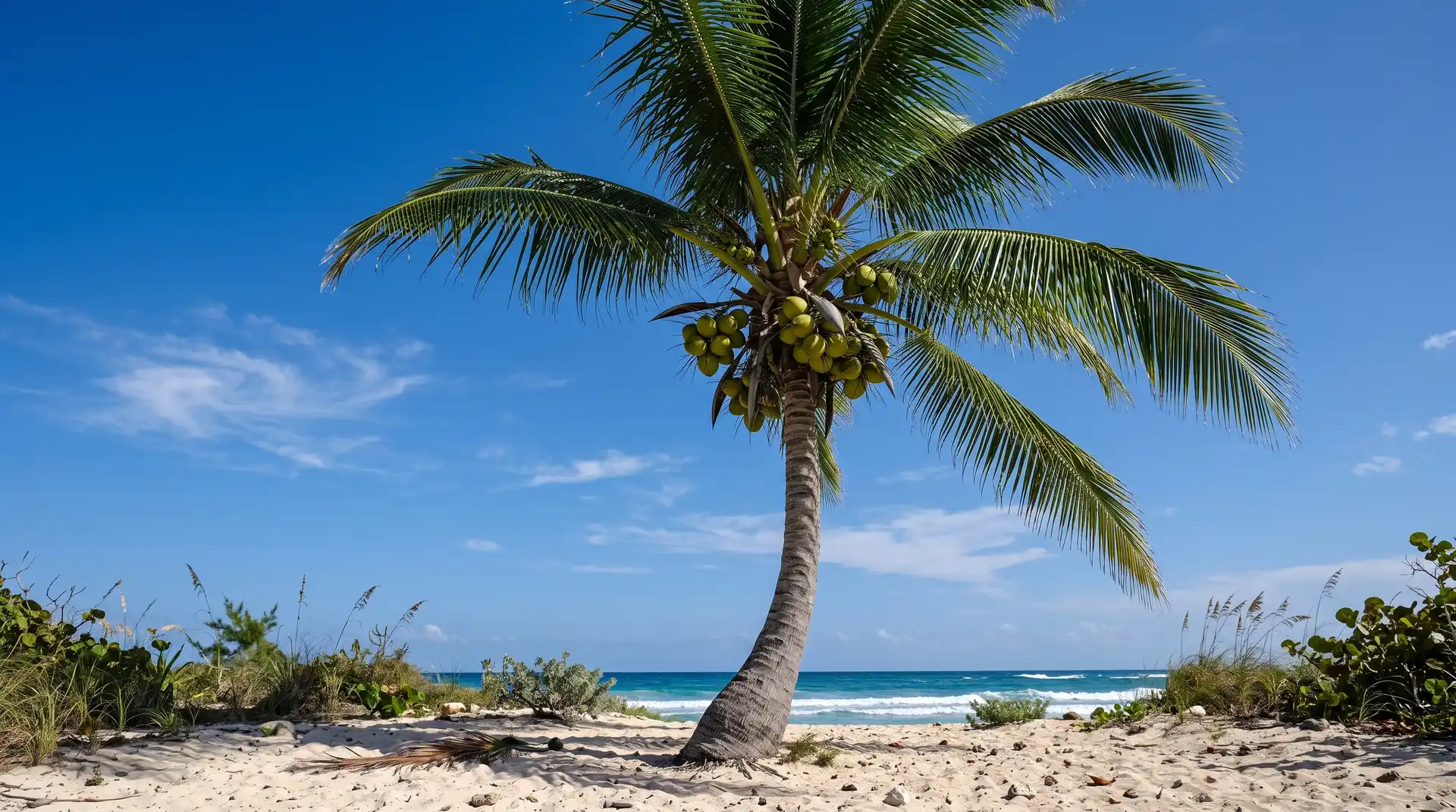
Sources differ on yield: CTAHR describes a healthy tree producing about 50 nuts a year, while UF/IFAS gives 50–200 at full production. CTAHR also says many immature fruits drop a few weeks after flowering, as part of the normal cycle. The nut itself is botanically a drupe, covered in our coconut nut-or-fruit explainer. For other palms that fruit in the US, see 8 palm trees that produce edible fruit, including the date palm, which needs dry summers instead of frost-free winters.
Which coconut palm should you plant, and what kills it?
Malayan Dwarf and Maypan are the usual lethal-yellowing-tolerant choices in South Florida, but the tolerance is only partial. UF/IFAS names four cultivars: ‘Jamaican Tall’ (crooked trunk, swollen base), ‘Malayan Dwarf’ (narrow, straight trunk, smaller), ‘Panama Tall’, and the hybrid ‘Maypan’.
Lethal yellowing is a phytoplasma spread by a planthopper. It was historically limited to the southern third of Florida until it turned up in Sarasota and Manatee counties in 2007 and Indian River County in 2012. The UF/IFAS publication PP-222 says Malayan Dwarf and Maypan showed acceptable resistance in most areas, but recent losses reached 70% and 83% at localized southeastern Florida sites and 95–99% in Jamaica, which casts doubt on that resistance. Management is trunk injections of oxytetracycline every four months and removal of palms with more than 25% leaf discoloration or a dead bud.
Two more planting rules from the extension sources:
- Planting depth and spacing: set container-grown palms so the root-shoot junction sits about an inch below the soil surface, water about an inch a week through year one, and allow 18 to 30 feet between palms. Tall types can reach 80 feet or more.
- Invasive status: UF/IFAS rates coconut invasive in South Florida, and the conditions on planting it target fallen fruit reaching waterways connected to open water (floating is how the species spreads naturally): keep it away from canals and natural areas, keep fallen fruit out of waterways, and put unwanted fruit in yard waste.
Fertilizer also helps at the cold edge. The UF/IFAS cold-damage sheet cites Broschat’s 2010 finding that coconut palms fertilized routinely with a palm fertilizer had significantly less chilling necrosis than unfertilized ones.
Coconut palm questions, answered
Can you grow a coconut palm indoors?
For a while, with strong light and constant warmth. Hawaii extension says a pot-grown coconut can reach about 5 feet and last roughly 5 years in the same container at 70°F or warmer; a garden writer reports store-bought ones often fail within months in ordinary homes.
How long does a coconut take to sprout?
About three months in ideal conditions and up to six, according to the University of Hawaii extension sheet.
Can you plant a grocery-store coconut?
The extension method starts from a fallen, husk-on nut that sloshes. I found no extension guidance on the husk-stripped coconuts sold in supermarkets, so results are uncertain.
What is the minimum temperature for a coconut palm?
The palm can be killed or injured at 32°F, and chilling injury is possible at up to about 50°F, depending on how fast the temperature drops.
How long until a coconut palm produces coconuts?
Flowering starts after four to six years, fruit takes 9–12 months to ripen, and full production takes about 20 years.
Can a coconut palm grow in zone 9?
UF/IFAS says plant only in zones 10b–11. Its county offices report that interior zone 9b is too cold, and a few palms survive in rare warm microclimates.
Sources
- University of Florida IFAS Extension. Coconut Palm. Gardening Solutions, Palms and Cycads (cited above)
- College of Tropical Agriculture and Human Resources, University of Hawaii at Manoa. Coconut Palms from Seed. Cooperative Extension fact sheet, December 1996
- Mitchell, R.E. Can you grow a coconut palm in Charlotte County? UF/IFAS Extension Charlotte County, 2018 (cited above)
- UF/IFAS Extension Nassau County. Q: Can we grow coconut palms here? 2017
- Broschat, T.K. Cold Damage on Palms (ENH-92, archival copy). UF/IFAS Extension
- Bahder, B.W. and Helmick, E.E. Lethal Yellowing (LY) of Palm (PP-222, revised December 2024). UF/IFAS Extension
- Harries, H.C. Germination rate is the significant characteristic determining coconut palm diversity. AoB Plants 2012:pls045 (cited above)
- Hodgson, L. Possibly the World’s Worst Houseplant. Laidback Gardener, 2014 (cited above)
- Science and Plants for Schools. Adaptation, evolution and the physics of coconuts
- USDA Agricultural Research Service. Plant Hardiness Zone Map: How to Use the Maps


