

Gardening Myths Debunked: 20 Common Tips That Are Wrong, Outdated or Proven to Backfire

Discover the gardening myths that are wasting your time and money. From Epsom salt to drainage gravel, here’s what science actually says about the ten most common misconceptions in the garden.

Gardening advice travels fast and scrutiny travels slowly. A tip your grandmother swore by, a forum thread from 2008, a YouTube video with three million views — all of them carry equal weight in the garden centre car park, and almost none of them come with sources. The result is that some of the most widely repeated gardening practices are either ineffective, counterproductive, or based on a complete misunderstanding of plant biology.
This article works through ten of the most persistent gardening myths, explains the mechanism behind why the myth exists, and gives you the evidence-based alternative. Not every myth is completely false — some contain a kernel of truth that got stretched beyond recognition — so where the reality is nuanced, the nuance is explained. The goal is not to shame anyone for following conventional wisdom, but to help you spend less time on things that don’t work and more time on things that do.
| Myth | Verdict |
|---|---|
| Epsom salt is a miracle plant tonic | Mostly false — useful only in confirmed Mg deficiency |
| Gravel in pots improves drainage | False — creates a perched water table that worsens drainage |
| Coffee grounds acidify soil | Mostly false — spent grounds are near neutral pH |
| Companion planting repels all pests | Nuanced — some pairings proven, most anecdotal |
| Water plants every day in summer | False — deep, infrequent watering produces stronger plants |
| Pruning wounds need sealant | False — sealants slow callus formation and trap disease |
| More fertilizer equals more growth | False — excess causes root burn and nutrient lock-out |
| Never water plants at midday | Mostly false — morning is ideal, midday is acceptable |
| Beer traps are the best slug control | False — iron phosphate pellets are far more effective |
| Sand fixes clay soil drainage | False — small additions can create a concrete-like mixture |
Myth 1: Epsom Salt Is a Miracle Plant Tonic
The claim: dissolve a tablespoon of Epsom salt in a gallon of water and use it as a foliar spray or soil drench. It cures yellow leaves, prevents blossom end rot in tomatoes, makes roses bloom more prolifically, and generally transforms struggling plants into thriving ones.
The reality: Epsom salt is magnesium sulfate (MgSO₄). Magnesium is a genuine plant macronutrient — it sits at the centre of every chlorophyll molecule and plays a central role in phosphate transport — so a confirmed magnesium deficiency will indeed cause yellowing between the leaf veins (interveinal chlorosis). In those specific cases, Epsom salt works. The problem is that genuine magnesium deficiency is far less common than the gardening internet suggests. According to North Dakota State University Extension, most garden soils contain adequate magnesium, and adding more where it isn’t needed provides no benefit and can displace other nutrients through competitive ion uptake.

Three pre-planned garden beds, free
Stop staring at empty beds: printable plans with exact layouts, plant lists and planting calendars — yours free from the Garden Library.
The blossom end rot claim is the most damaging version of this myth. Blossom end rot in tomatoes, peppers, and squash is caused by calcium deficiency in the developing fruit — not magnesium deficiency. Adding Epsom salt (magnesium) when calcium is the limiting factor makes the problem worse: magnesium ions (Mg²⁺) compete with calcium ions (Ca²⁺) at root uptake sites, so applying Epsom salt to a plant suffering from blossom end rot actively reduces calcium uptake and deepens the deficiency causing the problem.
Mechanism: Magnesium, calcium, and potassium share the same transport pathways at root uptake sites. When one is applied in excess, it competes with the others for absorption. Over-applying any one of these three cations causes imbalance across all three — which is why soil testing before adding any amendment is always the correct first step.
What actually works: test your soil before adding any amendments. If magnesium is genuinely deficient, Epsom salt is a legitimate fix. For blossom end rot specifically, maintain consistent soil moisture (calcium moves to fruit via the water stream — irregular watering cuts that supply), and consider a dilute foliar calcium spray if the problem is severe. For long-term soil health, rich organic compost provides balanced nutrition across all elements simultaneously.

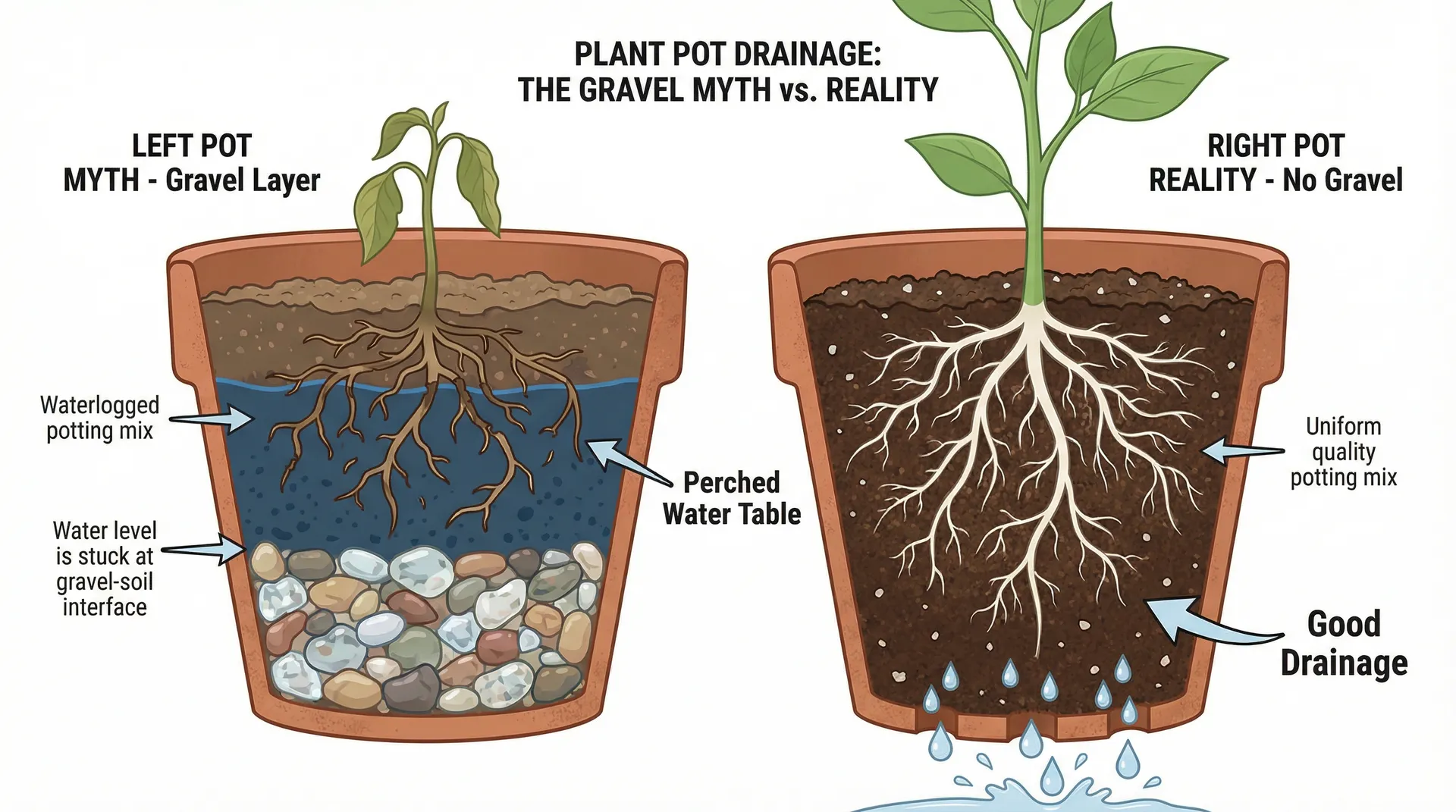
Myth 2: Gravel at the Bottom of Pots Improves Drainage
The claim: a layer of pebbles, gravel, or broken pottery at the base of a container creates a drainage zone that keeps roots from sitting in water and prevents waterlogging.
The reality: this is one of the most counterintuitive facts in horticulture, because the myth is so physically plausible that it feels correct even after you understand why it isn’t. UC Agriculture and Natural Resources has documented the mechanism clearly: water does not move freely from a fine-textured growing medium to a coarse-textured one. Capillary tension holds water in fine pore spaces until those pores are completely saturated. The result is a perched water table — a zone of saturation that sits directly above the gravel layer rather than draining through it.
In a pot without gravel, the saturation zone forms from the drainage holes upward until gravity overcomes capillary tension and water exits freely. In a pot with a gravel layer, that saturation zone is raised by exactly the depth of the gravel — meaning the roots at the base of the potting mix sit in waterlogged conditions for longer, not shorter, than they would without gravel. The addition makes drainage worse, not better.
Mechanism: the physics here is the same principle that keeps fine sand wet long after coarse gravel has drained. At the interface between two textures, water must overcome the surface tension holding it in the finer pores before it can enter the coarser medium. Until every fine pore is filled, water does not cross that boundary.
What actually works: use a high-quality potting mix with adequate porosity (look for mixes containing perlite or bark fines), ensure your pot has sufficient drainage holes of adequate size, and if your potting mix has compacted over time, repot with fresh mix rather than adding a gravel layer. For plants that need exceptional drainage — cacti, succulents, alpines — mix perlite or coarse horticultural grit directly into the potting medium at a 1:3 or 1:4 ratio rather than layering it underneath.
Myth 3: Coffee Grounds Acidify Your Soil and Fertilize Plants
The claim: used coffee grounds are slightly acidic, so sprinkling them around acid-loving plants like blueberries, rhododendrons, and azaleas lowers soil pH and improves growth. As a bonus, they’re rich in nitrogen and act as a free fertilizer.
The reality: fresh, unused coffee grounds have a pH of around 6.0 to 6.5 — mildly acidic, but significantly less so than brewed coffee (typically pH 4.5 to 5.0). By the time coffee has brewed and the grounds spent, most of the acidic compounds have been extracted into the liquid. University of Minnesota Extension research confirms that spent coffee grounds are nearly pH neutral, ranging from 6.5 to 6.8. Applied to soil, they are unlikely to shift pH in any meaningful way.
The nitrogen content is real but modest and slow-releasing — around 2% nitrogen by weight — and the high carbon content means the C:N ratio is too wide for quick fertilization. Applied thickly, coffee grounds can form a water-repellent crust that prevents rainfall from penetrating the soil surface, and can create habitat for mould. They are best used in small quantities mixed into a compost pile, where they contribute carbon and nitrogen to the composting process.
What actually works: to genuinely lower soil pH for acid-loving plants, use elemental sulfur (slow, long-lasting), fertilisers formulated for ericaceous plants, or acidic mulches such as composted pine bark or pine needles. For building fertility more broadly, nothing beats well-made compost — see our step-by-step how to make compost guide to get started with a system that actually works.
Myth 4: Companion Planting Always Repels Pests
The claim: plant basil next to tomatoes to repel aphids and whitefly; surround your vegetables with marigolds and nothing will touch them; grow nasturtiums and your entire kitchen garden becomes pest-free.
The reality: companion planting sits in an awkward middle ground between genuine horticultural science and garden folklore. The University of Illinois Extension published an honest assessment of the evidence, concluding that most specific companion planting recommendations are anecdotal — passed down through gardening tradition without peer-reviewed backing. Some pairings, however, do have real research support and are worth using.
Stop guessing your soil pH.
Enter your soil type and test reading — get exact lime or sulfur rates for your plants in seconds.
→ Calculate Soil NeedsFrench marigolds (Tagetes patula) genuinely suppress soil nematodes through the release of alpha-terthienyl, a compound toxic to nematode larvae — but this effect requires dense planting over multiple seasons and works below ground, not above it. Nasturtiums work as trap crops for black aphids, which prefer nasturtiums to beans — but the strategy brings aphids into the garden, not away from it, and only works if you then monitor and remove the infested nasturtium growth. Basil and tomatoes may grow well together for microclimate reasons, but the pest-repelling mechanism claimed for this pairing has never been demonstrated in controlled trials.
What actually works: focus on proven combinations and use companion planting as part of an integrated pest management approach rather than a standalone solution. Physical barriers, crop rotation, and encouraging beneficial insects provide more reliable protection than plant pairings alone. Our companion planting guide covers which combinations the evidence supports and how to make the most of them.
Myth 5: You Should Water Plants Every Day in Summer
The claim: hot weather means plants need water every single day. Miss a day and they’ll suffer.
The reality: overwatering is the single most common cause of houseplant death and a significant contributor to problems in garden beds and containers. Most plants — including the majority of vegetables and ornamentals — thrive on deep, infrequent watering rather than shallow daily doses. The reason is rooted in how plants develop their root systems.
When the top layer of soil is kept consistently moist through daily watering, roots have no reason to grow deeper. When soil is allowed to partially dry between waterings, roots follow moisture downward, creating a deep, resilient root system that anchors plants well and accesses water and nutrients in a much larger soil volume. Daily shallow watering does the opposite: it encourages roots to cluster near the surface, where they are vulnerable to heat, drought, and compaction. It also keeps surface moisture high, which creates ideal conditions for fungal disease and slug activity.
There are exceptions — newly planted seedlings, containers in direct sun, and plants in free-draining sandy soil — but for most established garden plants and even most houseplants, less frequent and more thorough watering produces consistently better results than daily light watering.
What actually works: push a finger 1 to 2 inches into the soil and water deeply when the top inch or two is dry, allowing water to penetrate to the full root zone. Apply a 3-inch layer of organic mulch to reduce surface evaporation and extend the interval between waterings significantly. Our complete mulching guide covers the best materials and application methods for every garden type.
Myth 6: Fresh Pruning Cuts Need Wound Paint or Sealant
The claim: after removing a branch, apply bituminous wound paint or pruning sealant to the cut surface to seal out disease and prevent decay.
The reality: this practice has been standard horticultural advice for decades, but the research has decisively moved against it. Trees have evolved a sophisticated wound response system called CODIT — Compartmentalization of Decay in Trees — in which specialised cells around the wound site form chemical and structural barriers that wall off the damaged tissue and prevent the spread of decay into healthy wood. This process begins within hours of a clean cut and works most effectively when the wound surface can dry and receive air circulation.
Wound sealants interfere directly with this process. By keeping the cut surface moist and preventing air circulation, they create the anaerobic, humid conditions that wood-rotting fungi prefer. Research conducted over several decades has consistently shown that sealed wounds compartmentalise decay more slowly and develop internal rot more frequently than unsealed wounds left to callus naturally. The sealant that was supposed to protect the tree is the thing making the problem worse.
What actually works: make clean cuts with sharp, disinfected tools (wipe blades with 70% isopropyl alcohol between plants). Cut to just outside the branch collar — the swollen ridge where the branch meets the trunk — without leaving a stub. For most deciduous trees and shrubs, prune during dormancy when wound response is fastest and disease pressure is lowest. Leave cuts unsealed and let the tree do its own healing.
Myth 7: More Fertilizer Means Faster, Better Growth
The claim: if a little fertilizer is good, more must be better. Double the dose for double the growth.
The reality: excess fertilizer causes more damage in home gardens than almost any other input. Plants absorb nutrients through osmosis, a process that depends on the concentration of solutes outside the root being lower than inside. When fertilizer concentration in the soil solution becomes too high, osmotic pressure reverses: water is drawn out of root cells rather than into them, producing the characteristic brown, scorched leaf edges and tip dieback of fertilizer burn. The roots themselves can be damaged or killed, and recovery is slow.
Beyond burn, excess nitrogen promotes rapid, soft vegetative growth at the expense of flowering and fruiting. A tomato plant over-fertilised with nitrogen will produce abundant dark green foliage with very little fruit. Excess potassium and phosphorus accumulate in soil and lock out other nutrients by competing for the same uptake pathways — a common cause of iron and zinc deficiency in heavily fertilised kitchen gardens.
What actually works: follow product label rates precisely — they are calculated for a reason. Match fertilizer type to growth stage: high-nitrogen formulations for leafy vegetative growth, lower-nitrogen, higher-phosphorus and potassium feeds for flowering and fruiting. Better still, build long-term soil health through organic matter, which releases nutrients slowly and in proportion to plant demand, with almost no risk of burn or accumulation. Our guide on how to make compost shows you the most cost-effective way to build soil fertility sustainably.
Myth 8: Never Water Plants in the Middle of the Day
The claim: watering in hot sun causes water droplets to act as magnifying lenses on leaf surfaces, burning holes in the foliage. Only ever water in the morning or evening.
The reality: the burning-lens mechanism has been investigated scientifically and found to be largely theoretical rather than practically significant for most garden plants. While it is physically possible under very specific conditions — smooth, waxy, hair-free leaf surfaces; extremely bright sunlight; large, stable droplets — real garden leaves are textured enough to prevent the stable droplet formation required to focus light to a damaging degree. Studies examining leaf burn under realistic watering conditions have not found meaningful evidence of burn caused by overhead irrigation during daylight hours.
What is true is that morning watering is the best practice — not because of leaf burn risk, but because foliage can dry fully during the day, reducing the period leaves spend wet and therefore reducing fungal disease pressure. Evening watering is the worst option: wet foliage overnight in warm conditions is ideal for powdery mildew, botrytis, and other fungal diseases. Midday watering is not the most efficient (some water is lost to surface evaporation) but it does not burn leaves, and it is far better than skipping a watering altogether when plants need water.
What actually works: water in the morning whenever possible. If that is not practical, midday is acceptable for most plants. Avoid evening overhead watering for plants susceptible to fungal disease. Use drip irrigation or soaker hoses to deliver water to the root zone and keep foliage dry regardless of the time of day.
Myth 9: Beer Traps Are the Most Effective Slug Control
The claim: bury a shallow container of beer in the garden with the rim at soil level. Slugs are attracted to the yeast, crawl in, and drown. Problem solved.
The reality: beer traps work — slugs are genuinely attracted to fermenting yeast — but they are significantly less effective than alternatives and come with practical drawbacks rarely mentioned in the same breath. Beer traps need refreshing every one to two days, attract slugs from neighbouring gardens (increasing overall slug pressure in your plot), require regular disposal of drowned slugs, and only intercept a fraction of the local population.
Iron phosphate pellets (sold under various brand names including Sluggo and Ferrozan) are the current gold standard for slug control. They break down into iron and phosphate — both components of standard fertilizer — making them safe for wildlife, pets, and soil organisms. Slugs that ingest iron phosphate stop feeding within hours and die within days, but they withdraw underground to do so. Many gardeners conclude the pellets are not working because there are no dead slugs to find on the surface, when in fact the treatment is highly effective.
What actually works: iron phosphate pellets applied thinly around vulnerable plants, refreshed after heavy rain. Encouraging natural predators — hedgehogs, ground beetles, frogs, thrushes — by providing habitat and avoiding chemical pesticides. Physical copper tape barriers have mixed evidence and are most reliable on individual pots and raised beds with no gaps in coverage.
Bonus Myth: Adding Sand Improves Clay Soil Drainage
The claim: clay soil drains poorly because the particles are too fine. Adding coarse sand opens up the structure and fixes drainage.
The reality: this is one of the most counterproductive gardening mistakes you can make, because the result is worse than either starting material alone. To genuinely improve clay drainage through sand addition, you need enough sand to change the overall texture of the soil — roughly 50% by volume or more. Adding small or moderate amounts of sand to clay fills the spaces between clay particles without creating new drainage pathways, resulting in a denser, harder mixture that can become almost concrete-like when it dries. The more you add without crossing the threshold where sand becomes the dominant matrix, the worse the problem gets.
What actually works: organic matter is the correct solution for clay soil. Compost improves drainage and structure by creating aggregates — larger particles of clay bound together by fungal hyphae and organic compounds — that create macropores for water movement. Apply 3 to 4 inches of compost annually and work it into the top 6 to 8 inches. Within two to three seasons, even heavy clay becomes workable. For extreme situations, raised beds with imported soil are more practical than trying to transform the existing soil quickly.
Frequently Asked Questions
Does baking soda work as a garden fungicide?
Baking soda (sodium bicarbonate) raises pH on leaf surfaces, creating a less hospitable environment for some fungal pathogens. It has a measurable effect on powdery mildew when applied preventatively, but limited efficacy against established infections. It should not be applied to soil regularly — it raises soil pH and can cause sodium accumulation over time. Potassium bicarbonate is a more effective and less problematic alternative, commercially available as a registered biopesticide.
Is organic fertilizer always better than synthetic?
Not universally. Organic fertilisers release nutrients slowly as they are broken down by soil microbes, supporting long-term soil health and reducing run-off risk. Synthetic fertilisers are more immediately available and useful when rapid correction of a confirmed deficiency is needed. The right choice depends on your soil, your plants, and your goals. A soil test tells you what is actually needed before you spend money on either option.
Should I fertilize when transplanting seedlings?
Generally not with high-nitrogen fertilizer at planting time. Freshly transplanted seedlings need to establish their root systems before receiving heavy feeding. High fertilizer concentrations at transplant can stress roots before they have recovered from the move. A dilute liquid seaweed or mycorrhizal inoculant at planting supports root establishment; leave general feeding until plants show active growth, typically two to four weeks after transplanting.
Can I compost diseased plants?
It depends on the disease and the temperature your compost pile reaches. A hot compost pile that consistently reaches 140 to 160°F (60–71°C) will kill most pathogens and fungal spores. A cold, passive pile will not. As a general rule, avoid composting plants infected with persistent soil-borne pathogens like clubroot, onion white rot, or Fusarium unless you can guarantee sustained high pile temperatures. Blight-affected tomato foliage is borderline — safe in a reliably hot pile, risky in a cool one.
Does talking to plants actually help them grow?
There is some genuine science here: plants respond to vibrations, and sound waves do create vibrations that some studies suggest can influence germination and early growth. The effect, while statistically real in some trials, is small and inconsistent across species and conditions. The more significant mechanism is probably that gardeners who talk to their plants pay closer attention to them — catching problems earlier, watering more consistently, and noticing stress signs before they become serious. The habit of attention matters more than the conversation itself.
Sources
- North Dakota State University Extension. “The Epsom Salt Myth.” ndsu.edu
- UC Agriculture and Natural Resources. “Adding gravel to your planting container does not improve drainage.” ucanr.edu
- University of Minnesota Extension. “Coffee grounds, eggshells and Epsom salts in the home garden.” extension.umn.edu
- University of Illinois Extension. “Companion Planting: Anecdotal or Tried and Tested?” extension.illinois.edu
- University of Maryland Extension. “Organic Matter and Soil Amendments.” extension.umd.edu
- Royal Horticultural Society. “Mulch.” rhs.org.uk


