

The Mulching Guide: Best Type, Right Depth and When to Apply for Every Soil Type

A comprehensive mulching guide covering the best mulch types for every situation, how deep to apply mulch, when to mulch in spring and autumn, and the common mistakes that undermine all the benefits.
Of all the tasks on a gardener’s seasonal to-do list, mulching delivers the highest return on effort. Two hours spent laying mulch in early spring saves four or more hours of weeding, watering, and replanting across the rest of the season — and that is a conservative estimate. A correctly mulched border suppresses weed germination by up to 90%, reduces soil moisture loss by 20–30%, and insulates roots from temperature extremes, all while slowly improving soil structure as organic mulches break down. This guide covers every aspect of mulching: which type to choose for each situation, how deep to apply it, when to mulch, and the mistakes that undo all the benefits.
Why Mulch? The Case in Numbers
Mulching is often described as beneficial without explaining the mechanisms behind it. Understanding why it works makes it far easier to apply it correctly in different garden situations.
Moisture Retention
Bare soil loses water rapidly through surface evaporation — a process that accelerates on sunny or windy days. A 2–3 inch mulch layer acts as a physical barrier that dramatically slows this process. University of California Agriculture and Natural Resources trials show that mulched garden beds require 30–50% less supplemental watering than unmulched beds across a growing season. This is especially significant in summer heat and during drought restrictions. Paired with a good garden watering strategy, mulching can halve your irrigation costs and time.
Weed Suppression
Weed seeds require light to germinate. A sufficient depth of mulch creates a physical barrier that blocks light from reaching the soil surface. Research from Penn State Extension and Cornell Cooperative Extension consistently shows that 2–3 inches of organic mulch reduces weed germination by 70–90% compared to bare soil. The weed seeds are still present in the soil, but without light, the vast majority cannot germinate. The weeds that do appear through mulch are easier to remove — their roots are in loose, moist mulch rather than compacted earth.

Three pre-planned garden beds, free
Stop staring at empty beds: printable plans with exact layouts, plant lists and planting calendars — yours free from the Garden Library.
Temperature Regulation
Mulch insulates soil against temperature extremes in both directions. In summer, it keeps soil cooler by blocking direct sunlight on the surface — bare soil in direct sun can reach temperatures that inhibit root function and damage shallow-rooted plants. In winter, mulch slows the freeze-thaw cycling that causes frost heave, where repeated freezing and thawing pushes shallow-rooted plants partially out of the ground. The Morton Arboretum notes that a 3–4 inch mulch layer can moderate soil temperature swings by 10°F or more in climate extremes.
Soil Improvement
This benefit applies only to organic mulches, but it is significant. As bark chips, compost, leaf mould, and similar materials break down, they feed soil biology, improve soil structure, and gradually increase organic matter content. Earthworms are more active and numerous in mulched beds. The improved soil structure means better drainage in clay soils and better moisture retention in sandy soils — mulch corrects in both directions over time.
Aesthetics
A clean, consistent mulch layer gives borders a unified, finished appearance year-round. It ties together mixed plantings that might otherwise look patchy in spring or autumn, and the dark contrast of bark chip makes foliage and flower colour stand out more strongly.
Types of Organic Mulch: Which to Use Where
The choice of organic mulch should be matched to the plants you are growing and the job you need the mulch to do. Here is a comparison of the most commonly available options:
| Mulch Type | Longevity | Best For | Notes |
|---|---|---|---|
| Bark chips | 2–3 years | Shrub borders, mixed beds, paths | Slow to break down; excellent weed suppression; does not tie up nitrogen as it breaks down (unlike fresh wood chip) |
| Compost | 1 year | Vegetable beds, annual borders | Best soil improver of all organic mulches; breaks down quickly; apply 2–3 inches and top up annually |
| Leaf mould | 1–2 years | Shade beds, woodland plantings | Gentle, slightly acidic; excellent for ferns, hostas, astilbes; free if you compost your own leaves |
| Straw | 6–12 months | Vegetable beds, strawberry rows | Cheap and effective; temporary; can harbour slugs in wet conditions; use barley or wheat straw, not hay (which contains seeds) |
| Grass clippings | A few months | Vegetable beds (thin layer) | Free; apply max 1 inch at a time — thick layers mat and go anaerobic, causing nitrogen burn and foul smell |
| Wood chip | 1–2 years | Paths, playground areas, around trees | Cheaper than bark; can temporarily tie up soil nitrogen as it decomposes — do not dig it in; fine on the surface |
| Pine needles (pine straw) | 1–2 years | Acid-loving plants: blueberries, azaleas, rhododendrons | Slightly acidic; knits together well on slopes; widely used in the Southeast US |

Types of Inorganic Mulch: When to Use Them
Inorganic mulches do not break down and do not improve soil, but they are the right choice in specific situations — particularly for plants that need excellent drainage and suffer in moisture-retaining organic mulch.
Gravel and Stone Chips
Gravel is the correct mulch for Mediterranean and dry-garden plants including lavender, thyme, rosemary, agapanthus, cistus, and sedum. These plants evolved on rocky, free-draining hillsides where their crowns are never in contact with moist organic material. Organic bark mulch around lavender causes crown rot — the same moisture that benefits a rose will kill a lavender. Use a 1–2 inch layer of pea gravel or decorative stone chips. Gravel allows rain to pass straight through, reflects heat upward from the soil surface (beneficial for heat-lovers), and does not provide a habitat for fungal pathogens. It is permanent — a one-time application that does not need topping up annually.
Slate Chips
Decorative alternative to gravel; good drainage properties; tends toward slight acidity over time. Works well in contemporary garden designs and around ornamental grasses. More expensive than standard gravel but long-lasting and visually striking.
Landscape Fabric
Landscape fabric (weed-suppressing membrane) is frequently used incorrectly and causes long-term problems. The correct use is as a temporary weed barrier under gravel or stone chip in low-maintenance areas. Do not use landscape fabric under organic mulch — it prevents the mulch from improving the soil, eventually becomes colonised by weeds growing into the decaying fabric surface, and is extremely difficult to remove once established. Cornell Cooperative Extension advises that landscape fabric used under organic mulch creates worse long-term weed problems than no barrier at all.
Rubber Mulch
Not recommended. Rubber mulch (typically made from shredded tyres) does not break down and does not improve soil. Research published by Penn State Extension and Missouri Botanical Garden has raised concerns about leaching of heavy metals and volatile organic compounds into soil over time. It persists indefinitely, is difficult to remove, and provides no ecological benefit. It is not appropriate for food gardens.
How Deep to Apply Mulch
Mulch depth is where most gardeners either under-deliver (too thin to suppress weeds) or make costly mistakes (too deep, or piled against plant stems).
Recommended Depths
- Most garden borders (shrubs, perennials, roses): 2–3 inches
- Heavy weed suppression (neglected beds, establishing new plantings): 4–6 inches of bark chip
- Vegetable beds (between rows): 2–3 inches of compost or straw
- Around trees: 3–4 inches, extending to the drip line where possible
- Mediterranean plants: 1–2 inches of gravel only
The Most Common Mulching Mistake: Volcano Mulching
The single most damaging mulching error is piling mulch against the crown, stem, or trunk of plants — the so-called “mulch volcano” seen around tree trunks across many parks and gardens. This creates continuous moisture contact between wet organic material and plant bark or crown tissue. The result is collar rot or crown rot: a fungal infection that girdles and kills the plant. The Penn State Extension’s urban forestry department estimates that mulch volcanoes kill tens of thousands of established trees annually across North America — trees that would otherwise live for decades.
The correct rule is simple: always leave a 2–4 inch gap between the mulch and any plant crown, stem, or trunk. The mulch should taper away from the plant, not build up toward it. Around trees, picture a flat doughnut — mulch in the ring, clear space at the centre. The soil immediately around the trunk needs to breathe and drain freely.
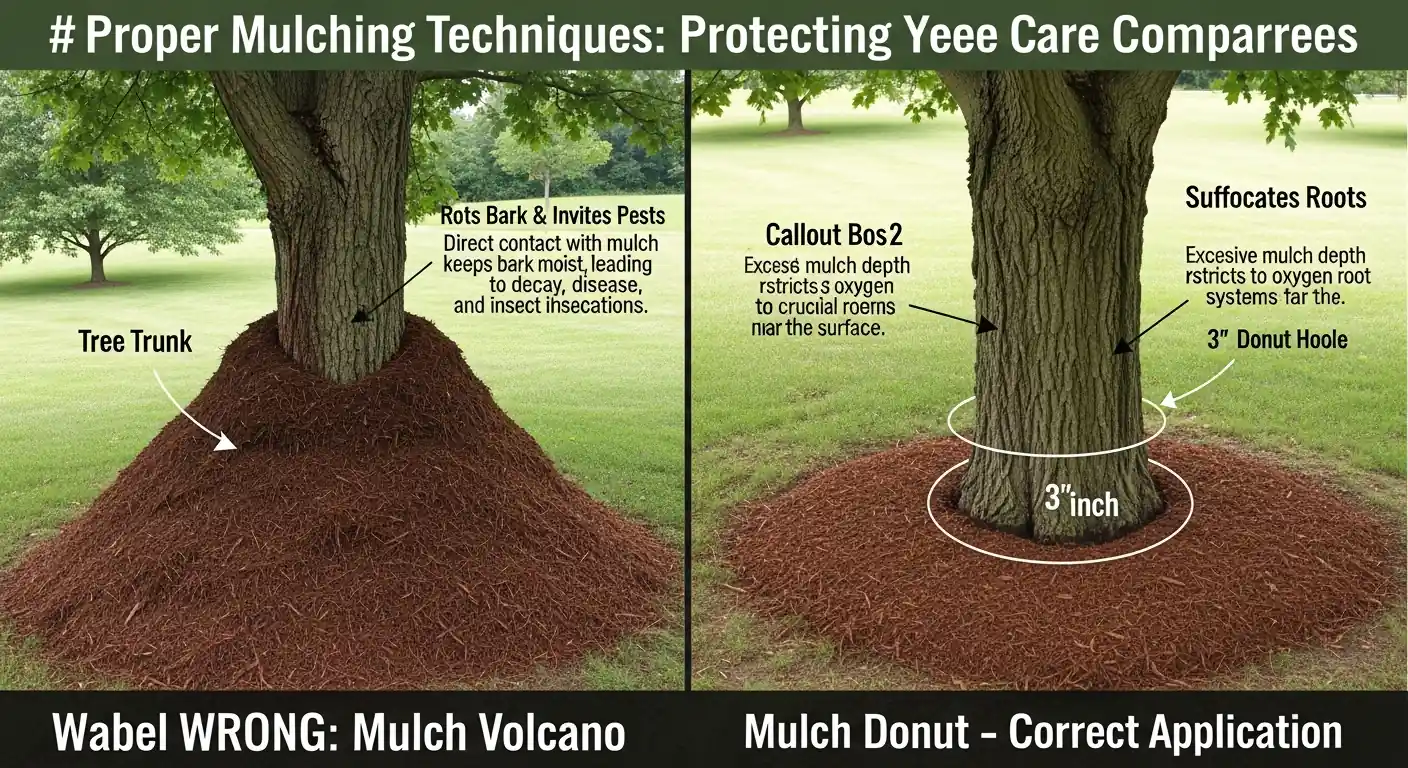
This same principle applies to perennials, roses, and newly planted shrubs. The crown of the plant — where roots meet shoots at soil level — must remain uncovered and dry. Mulch the surrounding soil, not the plant itself.
When to Mulch
The timing of mulching affects how well it works. The goal is to trap good conditions in, not bad conditions.
Stop missing your zone's planting windows.
Select your US zone and month — get a complete checklist of what to plant, prune, feed, and protect right now.
→ View My Garden CalendarSpring Mulching (Primary Application)
The optimal spring mulching window is after the soil has warmed above 50°F but before weed seeds begin germinating — typically March through April in USDA Zones 5–7, and late February to March in Zones 8–9. If you mulch too early over cold soil, you insulate the cold in and slow soil warming, which delays plant emergence and root activity. Wait until daytime temperatures are consistently above 50°F at soil level.
Spring is also the moment when annual weeds like chickweed and groundsel are beginning to germinate. Getting mulch down before this germination window closes is what delivers the 70–90% weed suppression figure — mulching in May, after weeds are already established, reduces but does not eliminate the weed population.
Autumn Mulching (Protective Application)
Apply a second mulch layer in October through November — after cutting back perennials but before the ground freezes. This protects shallow roots from frost heave, insulates marginally hardy plants like agapanthus and slightly tender salvias, and suppresses the cool-season weed flush (hairy bittercress, annual meadow grass) that germinates in autumn. This is the mulching window covered in the October garden jobs checklist. Apply 2–3 inches of bark chip or, for more tender crowns, a 4–6 inch layer of loose leaf mould or straw that can be removed in spring.
Summer Top-Up
If your spring mulch has broken down significantly by mid-summer — particularly fast-decomposing compost on vegetable beds — top up to 2 inches in July before the hottest weather. This is less critical than the spring application but helps in drought conditions.
When Not to Mulch
- Frozen ground: Mulch over frozen soil traps cold rather than warmth — wait for the thaw
- Waterlogged soil: Mulching saturated soil traps excess moisture and promotes anaerobic conditions and root disease; address drainage first
- Around lavender and Mediterranean plants: Do not use organic mulch at any time of year — use gravel as a permanent surface mulch
- New seedlings: Do not mulch directly over newly germinated seedlings; mulch around them once they are established
Mulching Different Plant Types
Different plants have different requirements. Here is a quick reference guide:
| Plant Type | Best Mulch | Depth | Key Rule |
|---|---|---|---|
| Roses | Compost or bark chip | 3 inches | Keep 2 inches from crown; apply in spring after pruning |
| Lavender & Mediterranean | Gravel or slate chip | 1–2 inches | Never use organic mulch — causes crown rot |
| Trees (established) | Wood chip or bark | 3–4 inches | Leave 4 inch gap at trunk base; extend to drip line |
| Vegetable beds | Compost or straw between rows | 2–3 inches | Straw between strawberry rows keeps fruit clean |
| Shade beds (hostas, ferns) | Leaf mould | 2–3 inches | Gentle, slightly acidic; excellent for woodland species |
| Bulbs | Compost | 2 inches | Apply after planting, not over emerging shoots |
| Newly planted perennials | Bark chip | 2 inches | Mulch immediately after planting to lock in moisture |
| Acid-loving plants (blueberries, rhododendrons) | Pine needles or ericaceous compost | 2–3 inches | Slightly acidic mulches help maintain low soil pH |
| Fruit trees | Wood chip | 3–4 inches | Mulch under canopy but not against trunk; suppresses grass competition that reduces yields |
When designing plant groupings with mulching in mind, it is worth noting that good companion planting often makes mulching easier: growing low ground cover plants as living mulch between taller species reduces the need for applied mulch while maximising ground cover.
How Much Mulch to Order
Ordering too little means a thin, ineffective layer; ordering too much wastes money and creates disposal problems. Use this calculation:
The Formula
- Measure your bed area in square feet (length × width for rectangular beds; estimate for irregular shapes)
- Choose your target depth in inches (typically 3 inches)
- Multiply: area (sq ft) × depth (in) ÷ 324 = cubic yards needed
- Add 10% for settling and irregular coverage
Worked Examples
- 100 sq ft bed at 3 inches: 100 × 3 ÷ 324 = 0.93 cubic yards (order 1 cubic yard)
- 200 sq ft bed at 3 inches: 200 × 3 ÷ 324 = 1.85 cubic yards (order 2 cubic yards)
- 500 sq ft bed at 3 inches: 500 × 3 ÷ 324 = 4.63 cubic yards (order 5 cubic yards)
Bag vs. Bulk Delivery
Bagged mulch from garden centres typically comes in 2 cubic foot bags. One cubic yard equals 13.5 bags. For beds smaller than 2 cubic yards, bags are convenient. For larger areas, bulk delivery by the yard is significantly cheaper — typically 40–60% less per cubic yard than bagged product. Most landscape suppliers deliver a minimum of 2–3 cubic yards.
Frequently Asked Questions
Can you mulch too much?
Yes. More than 4 inches of organic mulch on established beds can create a barrier so thick that rainwater runs off the surface rather than penetrating to the soil. Extremely deep mulch also prevents air exchange at the soil surface and can create anaerobic conditions. Stick to 2–3 inches for most situations and 4–6 inches only when heavy weed suppression is the priority.
Is bark mulch bad for plants?
Correctly applied bark chip is excellent for most garden plants. The concern about bark mulch “robbing nitrogen” from soil applies to fresh wood chip that is dug into soil — the decomposing wood does temporarily tie up soil nitrogen. Surface-applied bark chip does not cause this problem to any significant degree. The nutrient exchange happens at the very surface, not in the root zone.
When should I mulch in spring?
After the soil temperature reaches 50°F (usually March–April in Zones 5–7) but before weed seeds begin germinating. In most of the US, this is a 2–4 week window between late winter soil warming and spring weed germination. Getting mulch down in this window delivers maximum weed suppression for the season.
What is a mulch volcano and why is it harmful?
A mulch volcano is the practice of piling mulch in a cone or mound directly against a tree trunk — a mistake seen frequently in landscaped car parks and commercial plantings. The continuous moisture contact between wet organic mulch and tree bark creates ideal conditions for collar rot and bark-boring insects. Over 2–5 years, collar rot can completely girdle a tree, cutting off the flow of water and nutrients between roots and canopy. Always leave a 2–4 inch gap between mulch and trunk.
What is the best mulch for a vegetable garden?
Compost is the best all-round vegetable garden mulch — it improves soil, retains moisture, and feeds worms. Straw is the best choice for pathways between rows and under strawberries (it keeps fruit clean and dry). Avoid bark chip in vegetable beds — it breaks down slowly, contributes nothing nutritionally, and is difficult to work around when planting successions.
Should I remove old mulch before adding new?
In most cases, no. If your existing mulch layer has broken down to less than 1 inch of material, simply top it up. If the old layer is matted, compacted, or shows signs of fungal growth, rake it lightly to break it up before adding fresh material. Only remove mulch entirely if it has been contaminated by disease (e.g., persistent Phytophthora root rot in the bed) or if you need to fully prepare the soil for a new planting.
Sources
- University of California Agriculture and Natural Resources — Mulches for the Home Landscape (UC ANR Publication 8364)
- Penn State Extension — Mulching Landscape Trees
- Missouri Botanical Garden — Mulching (Gardening Help)
- Royal Horticultural Society — Mulching
- Cornell Cooperative Extension — Mulches for the Home Landscape
- Morton Arboretum — Mulch (Plant Clinic)


