

Is Your Plant Root Bound? 7 Signs to Check and the 3-Step Fix That Saves Compacted Roots

Root bound plants show 7 clear warning signs before they decline. Learn to diagnose severity in 3 levels, repot correctly, and discover which plants actually prefer a tight pot.
Your plant is wilting, but the soil feels bone dry two days after you watered it. The leaves are yellowing at the bottom. You tried fertilizing last week — no difference. The problem is not with your care routine. It is what is happening underground, inside the pot.
When a plant runs out of room for its roots, everything downstream suffers. Water drains before roots can absorb it. Oxygen-starved roots can no longer move nutrients efficiently. And because these symptoms mirror drought stress or nutrient deficiency, root-bound conditions go undiagnosed for months — sometimes years — while the plant slowly declines.
The good news: it is fixable. This guide covers seven clear warning signs, a simple severity test, which plants actually prefer being snug, and a three-step fix that addresses the root cause rather than the symptoms.
What ‘Root Bound’ Actually Means — and Why It Hurts
‘Root bound’ (also called ‘pot bound’) describes a container plant whose roots have filled the available growing space, displacing most of the potting mix in the process. When the root mass occupies the majority of container volume, several problems cascade simultaneously.

Three pre-planned garden beds, free
Stop staring at empty beds: printable plans with exact layouts, plant lists and planting calendars — yours free from the Garden Library.
Soil is displaced, oxygen drops. Roots need oxygen as much as they need water. Healthy potting mix holds air pockets that roots move through. When roots crowd out that mix, the root zone becomes compacted and oxygen levels fall. Roots shift toward anaerobic respiration — a less efficient metabolic pathway. Nutrient uptake slows, and potassium transport, which depends on active, energy-requiring mechanisms at the root surface, becomes compromised. Research confirms that potassium content in plant tissues can drop by more than a third under hypoxic root conditions.
Circling roots become girdling roots. As roots hit the container wall, they turn and begin spiraling. In the short term, this is just inefficient root architecture. Over time, those circling roots press against the stem and compress the plant’s vascular tissue — the xylem that carries water upward from roots, and the phloem that carries photosynthates back down. According to Iowa State Extension, this compression disrupts carbohydrate transport and weakens the plant’s vascular connections. Circling roots do not self-correct once established.
Water moves through without being absorbed. A root-bound root ball becomes hydrophobic. Water follows the path of least resistance — down through the gap between the root mass and the pot wall — without penetrating the center where roots need it most. The plant receives less water per watering session even as rapid drainage suggests it was well-irrigated. The University of Maryland Extension describes this as ‘a mass of impenetrable roots’ that prevents normal absorption.
7 Signs Your Plant Is Root Bound
Spotting root-bound conditions early means fixing the problem before it triggers secondary issues like pest vulnerability or chronic nutrient deficiency.
1. Roots growing out of drainage holes. The most visible sign. Roots extending below the drainage holes have run out of vertical space. Do not simply trim these roots — drainage-hole growth indicates significant compaction throughout the root ball, not just at the base.
2. Roots visible at the soil surface. When roots appear above the potting mix or grow over the pot rim, the interior is already full. This is often paired with the soil surface becoming dome-shaped as the expanding root mass pushes upward.
3. Water runs straight through the pot. Pour water in and it drains within seconds — the pot seems to empty faster than it fills. Root-bound plants develop a compacted root mass that water channels around rather than soaking into. You may notice the center of the root ball remains dry even after thorough watering.
4. Soil dries out within 24 to 48 hours. Between waterings, the root ball dries unusually fast. This happens because very little soil remains to hold moisture — most of the container volume is roots. Tracking how quickly the top inch of soil dries is a practical early-warning indicator; if you are watering houseplants more than twice a week in a standard pot, check the roots.
5. Stunted or stopped growth during the growing season. If your plant produced no new leaves — or noticeably smaller growth — between March and September, the root system may be the constraint. Roots hitting the container wall signal to the plant that space is limited, and above-ground growth slows accordingly. This sign is especially diagnostic in spring, when even slow-growing plants typically push some new growth.
6. New leaves noticeably smaller than mature leaves. Not just slow growth — miniaturized growth. When a new leaf emerges at half the size of the mature leaves already on the plant, the roots cannot supply sufficient water and nutrients to support normal leaf development. NC State Cooperative Extension identifies leaves ‘thinner than normal’ as a diagnostic flag for root-bound conditions.
7. Yellowing and browning of older leaves. Leaves at the base and interior of the plant begin yellowing and dropping. This is frequently misidentified as a watering or fertilizer problem. Fertilizing a root-bound plant will not fix it, because the nutrient pathway is compromised at the root level, not the soil level. The University of Maryland Extension specifically notes ‘tip dieback or marginal necrosis’ — browning at leaf edges and tips — as a pot-bound symptom that mimics drought stress.
How Severe Is It? A Simple Three-Level Test
Not every root-bound condition calls for emergency repotting. Diagnosing severity determines whether you act now, plan for spring, or simply monitor.
Remove the plant from its pot to assess accurately. Tip the pot sideways, support the base of the plant with one hand, and ease the pot off rather than pulling by the stem. If the root ball is stuck, run a thin blade around the inside edge or squeeze the sides of a plastic pot.
| Severity | What you see | What it means | Response |
|---|---|---|---|
| Mild | A few roots visible at drainage holes; soil still present throughout the root ball | Plant is outgrowing the pot but not yet stressed | Plan to repot within the next growing season |
| Moderate | Dense white root mat around the edges; roots spiraling visibly; some soil displaced | Active root-bound stress; water and nutrient uptake compromised | Repot this growing season — do not wait |
| Severe | Root mass holds its shape when removed; almost no soil visible; pot may be deforming | Immediate intervention needed regardless of season | Repot now |
If roots are soft, brown, or emit a musty smell, the problem is root rot rather than root bound — or both together. Root rot is treated differently: cut back to healthy white tissue before any repotting, and allow the root system to dry slightly before introducing fresh potting mix. If you are working to revive a dying houseplant, inspect the root ball carefully to distinguish between the two conditions before acting.
Stop buying the wrong pot size.
Enter plant type and growth goal — get exact pot diameter, depth, and volume before you spend a cent.
→ Find the Right PotThe Plants That Actually Like Being Root Bound
Not all tight pots are bad news. A subset of houseplants performs better with snug root quarters — up to a point — and treating them the same as tropical foliage plants does them a disservice.
Orchids (especially Phalaenopsis). Orchids are epiphytes in the wild, anchoring to tree bark and absorbing moisture from humid air rather than soil. Their roots are adapted to grip hard surfaces with good airspace around them. West Virginia University Extension notes that orchids ‘require specialized pots with drainage holes for air circulation, as they are epiphytes needing oxygen at roots.’ A small, clear plastic pot that allows roots to be visible and air to circulate closely mimics their natural environment. Overcrowding becomes a problem only when the bark or moss medium can no longer hold any moisture at all.
Spider plants, peace lilies, and African violets. These three tolerate tight root conditions well and occasionally flower more readily when mildly root-bound — mild root stress appears to redirect energy from vegetative growth toward reproduction. They remain comfortable in a snug pot significantly longer than most tropical foliage plants, but the same threshold applies: when the container can no longer hold water adequately between waterings, the tolerance window is over.
Succulents and cacti. These plants prefer snug containers because extra potting mix stays wet long after the plant has drawn from it. A proportionally small pot relative to the plant’s size reduces moisture risk. For succulents, ‘root bound’ becomes a problem considerably later than for tropical species — typically only when roots begin visibly deforming the container or pushing out of drainage holes.

The break point for all of these plants is the same: once the root mass can no longer hold adequate moisture between waterings, or once roots are actively deforming the container, the comfortable snug has become damaging tight. Even the most root-tolerant species eventually needs either repotting or root pruning.
The 3-Step Fix: How to Repot a Root Bound Plant
The best time to repot is spring through early summer, when plants are entering active growth and establish quickly in fresh potting mix, according to Illinois Extension. In a severe case — root mass deforming the pot, almost no soil visible — repot immediately regardless of season.
Step 1: Remove and assess the root ball. Water the plant 24 hours before repotting — a hydrated root ball holds together better and is easier to work with. Tip the pot sideways, support the base of the plant with one hand, and ease the container off. If the root ball is firmly stuck, run a thin blade around the inside edge of the pot. Once the root ball is out, examine it. Look for: spiraling or circling roots at the perimeter, dead or mushy brown roots (cut these back to healthy white tissue), and the overall ratio of roots to soil. If less than 20 percent of the root ball is visible soil, treat this as a severe case.
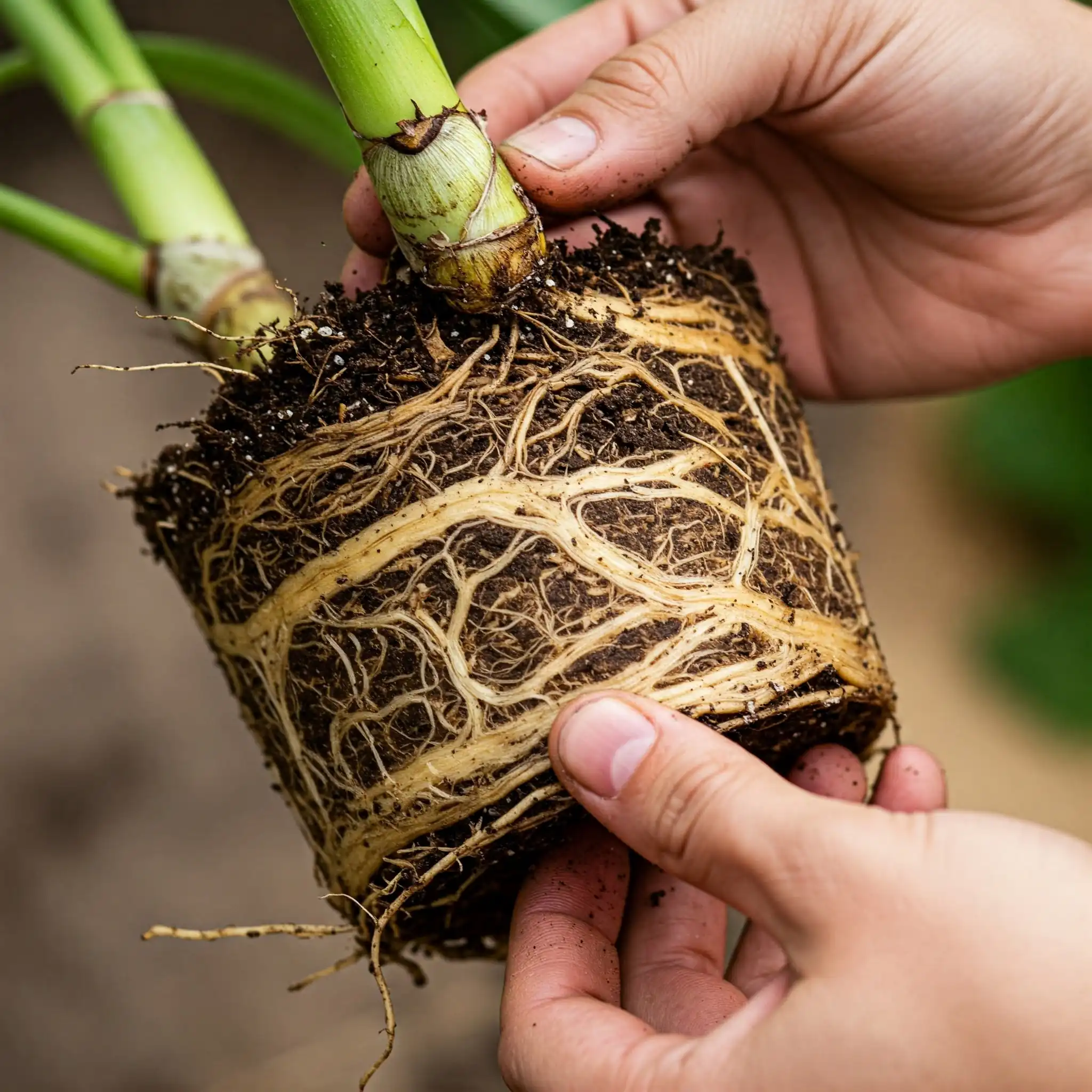
Step 2: Loosen roots, remove damaged tissue, and cut circling roots. This is where most gardeners hold back unnecessarily. Root pruning here is not harmful — Penn State Extension confirms that container plants retain their complete root system through this process, unlike bare-root transplants, and that ‘cut roots regenerate quickly.’ Use clean, sharp scissors, a knife, or a hori hori tool. Work through the outer inch of the root mass, teasing out or cutting circling roots. NC State Cooperative Extension confirms that removing up to one-third of the total root mass is safe for severely root-bound plants. Trim any visibly dead, brown, or soft roots back to healthy tissue.
Step 3: Repot in a correctly sized container with fresh potting mix. Add a layer of fresh potting mix suited to your plant type to the base of the new container. Set the plant at the same depth it grew in the old pot — Illinois Extension flags maintaining the original planting depth as a frequently overlooked step. Backfill around the root ball with fresh mix, firm gently without compacting, and water thoroughly until drainage runs from the base.
Hold off on fertilizing for four to six weeks after repotting. The fresh mix provides adequate nutrients for this period, and feeding too early risks fertilizer burn on the tender new root tips regenerating into the new soil.
Root Pruning: When You Cannot — or Do Not Want to — Go Bigger
If your plant is already in a large statement pot that works well in your space, or if you want to keep a specimen at its current size, root pruning lets you address root-bound conditions without changing containers.
The technique: remove the plant, take a sharp clean knife, and slice approximately 2 to 3 centimeters off the entire outer surface of the root ball — top, sides, and bottom. West Virginia University Extension recommends pruning approximately one-third of the old root mass in severely bound specimens; for less severe cases, the outer 1 to 2 centimeters is sufficient. Return the plant to the same pot with fresh potting mix filling the gap you have created around the pruned root ball.
After root pruning, the plant is in mild transplant shock — it now has a smaller root system supporting the same amount of foliage. For the first two to three weeks, keep it out of direct sun, do not fertilize, and water slightly less than normal. New root growth typically begins within two weeks and the plant returns to normal care once new foliage emerges.
Root pruning can be repeated every two to three years as maintenance, effectively keeping the same container suitable indefinitely.
Why Going Too Big Backfires — Choosing the Right Pot Size
The instinctive response to a cramped root ball is choosing the largest pot available. Resist this. An oversized pot creates a different but equally serious problem.
When a small root system sits inside a large volume of potting mix, the soil at the outer edges and base stays wet long after the plant has drawn what it needs from the root zone. That persistent moisture creates ideal conditions for root rot — and root rot produces symptoms almost identical to root bound conditions: wilting, yellowing, and slow growth. West Virginia University Extension is explicit: ‘extra soil can cause extra moisture, leading to root rot.’
The standard guidance: for pots under 10 inches, go up by 1 to 2 inches in diameter. For larger containers, a 2 to 3 inch increase is appropriate. Only for severely root-bound plants in large containers (12 inches or more) does a 3 to 4 inch increase make sense. Our container size guide covers pot dimensions by plant category if you are starting from scratch or choosing between container types.
Refreshing the potting mix at repotting time matters separately from the pot size decision. Old potting mix becomes compacted and loses its structure over time, which means root-bound conditions develop faster in subsequent years even after correct repotting. Always use fresh mix, not the old soil from the previous container.
Prevention: Staying Ahead of Root Bound Problems
The average tropical houseplant outgrows its container every one to two years. Faster-growing species — pothos, philodendrons, peace lilies — may need attention annually. Slow-growing species — ZZ plants, snake plants, most cacti — may be comfortable for three to four years.
Build a simple annual spring check into your routine. Before the growing season accelerates, tip each potted plant briefly out of its container. If you see a solid mass of white roots with little visible soil, repot that plant. If roots are present but soil is still visible and the root ball breaks apart easily, return the plant to its pot and check again next spring.
Two practices reduce how quickly root-bound conditions develop:
Refresh the top layer each spring. Even when a full repot is not needed, scrape out the top inch of compacted or salt-crusted potting mix and replace with fresh mix. This restores some structure to the root zone without the disruption of full repotting and is a simple annual maintenance step that extends the time between repots.
Use air-pruning containers for collections you manage regularly. These perforated containers cause root tips to air-prune naturally when they reach the container edge — the root tip dries and dies, prompting the plant to produce multiple lateral roots instead of one circling root. Penn State Extension identifies air-pruning containers as an effective preventive measure, avoiding the circling root architecture that eventually becomes girdling. Some containers are also treated with copper hydroxide (SpinOut), which chemically discourages root tips from circling the interior wall.
If a plant has been in the same container for more than three years without any root management, conduct a root inspection before adding fertilizer or changing the care routine. A root-bound plant will not respond to corrective feeding the way a healthy plant would — the constraint is structural, not nutritional. Consulting the broader guide to common container gardening mistakes can help you identify whether other pot-related issues are compounding the root-bound condition.
Frequently Asked Questions
How long does a plant take to recover after repotting?
Most plants show visible recovery within two to four weeks — new root growth in fresh potting mix begins within the first week, and new foliage typically emerges within two to four weeks. Full establishment, where the plant performs as well as or better than before, takes one to three months depending on species and severity.
Can a root bound plant die?
Yes, though it is rarely rapid. Severe root-bound conditions that restrict water and nutrient uptake long-term lead to chronic stress, reduced disease resistance, and eventual decline. The larger risk from advanced root-bound conditions is girdling root formation — circling roots that compress the plant’s vascular tissue cause irreversible damage and shorten the plant’s lifespan.
Should I fertilize immediately after repotting?
No. Fresh potting mix contains nutrients adequate for the first four to six weeks. Fertilizing too soon risks burning the new root tips regenerating into fresh soil. Once you see new foliage emerging — a reliable sign the root system has begun establishing — resume a normal fertilizing schedule.
Is it better to repot or root prune a severely root bound plant?
For most houseplants, repotting is simpler and causes less short-term stress, because the plant gains new root volume rather than losing it. Root pruning is the better choice when you want to maintain the current pot, keep the plant at its current size, or when the plant is already in its ideal container for the space. Both fix the underlying problem.
What is the difference between root bound and root rot?
Root bound means roots have outgrown the container — they are white, firm, and healthy but overcrowded. Root rot means roots have been damaged by excess moisture — they appear brown or black, feel soft or slimy, and smell musty. Both produce similar surface symptoms (wilting, yellowing), but the fixes are opposite: root bound plants need repotting or root pruning, while root rot plants need damaged root removal and drier conditions. If you see both when inspecting the root ball, address the rot first.
Sources
- University of Maryland Extension — Pot-Bound Indoor Plants
- NC State Cooperative Extension — Root-Bound Plants
- Illinois Extension / UIUC — Repotting Houseplants
- Penn State Extension — Container Grown Trees and Shrubs: Fix Those Roots Before You Plant
- Iowa State Extension — All About Stem Girdling Roots
- West Virginia University Extension — Common Houseplant Care


