

Why Your Lilac Refuses to Bloom: 7 Root Causes and the Fix for Each One

7 causes of a non-blooming lilac — wrong pruning time, late frost, chill hours, nitrogen, and more — each with the specific fix that actually matches it.
Lilacs are one of those shrubs that seem like they should take care of themselves — plant them, water occasionally, and enjoy the flowers every spring. When a lilac refuses to bloom, most gardeners are genuinely baffled: the plant looks healthy, it has been growing for years, and nothing obvious has changed. But something has.
The seven causes below cover the full range of what stops lilacs from flowering, from a mistake made last August to a climate condition you cannot change. Most cases come down to one of three fixable problems: pruning at the wrong time, not enough sunlight, or nitrogen from a nearby lawn redirecting the plant’s energy into leaves. Work through the diagnostic table first to find your situation before reading any further.
One important thing to know: a non-blooming lilac is almost never a sick lilac. The plant is typically fine — it is a timing or conditions issue, not a health emergency. With the right diagnosis, most gardeners see flowers return within one or two seasons.
Quick Diagnosis: What’s Stopping Your Lilac from Blooming?
| What you’re seeing | Most likely cause | Jump to |
|---|---|---|
| Never bloomed since planting | Too young, or pruned at the wrong time | Reasons 1 or 3 |
| Used to bloom every year — suddenly stopped | Late frost damage or pruning timing changed | Reasons 1 or 5 |
| Buds appear in spring, then turn brown and shriveled | Late spring frost killed the buds | Reason 5 |
| Blooms only at the very top of the bush | Overgrown — needs rejuvenation | Reason 7 |
| Lush green growth but zero flowers | Too much nitrogen | Reason 4 |
| Sparse blooms despite looking healthy | Not enough sunlight | Reason 2 |
| Growing in zone 8 or warmer, has never bloomed | Not enough winter chill hours | Reason 6 |
Reason 1: You Pruned at the Wrong Time
This is the most common reason lilacs fail to bloom, and it catches gardeners off guard every year because the plant looks completely normal afterward.

Three pre-planned garden beds, free
Stop staring at empty beds: printable plans with exact layouts, plant lists and planting calendars — yours free from the Garden Library.
Lilacs bloom on old wood. The flower buds that will open next April are actually formed on this year’s new growth, right after the current spring’s bloom fades. By midsummer, those buds are sitting fully formed on the stems, quietly overwintering. Prune in August, September, October, or even early spring — and you cut them off. The plant looks fine. It just has nothing left to open.
The pruning window is narrow: immediately after the flowers fade, within two to four weeks of the last bloom. That is it. Miss that window, and the right move is to do nothing — skip pruning entirely this year and wait for next spring’s flush. According to University of Maine Cooperative Extension, even light pruning in mid-to-late summer removes the developing flower buds that would have bloomed the following spring.
Common pruning mistakes that kill next year’s flowers:
- Cleaning up the shrub during fall garden tidy-up (October–November)
- Shearing or shaping it in late winter before spring growth starts
- Giving it a hard cut in summer to reduce its size
- Deadheading spent flowers but accidentally snapping off the new buds forming just below
How to identify flower buds before pruning: look at stems from this year’s growth. Flower buds are plump, rounded, and noticeably larger than leaf buds. Leaf buds are smaller, pointed, and sit tight against the stem. Clusters of large, round buds mean flowers waiting to happen — do not touch them.
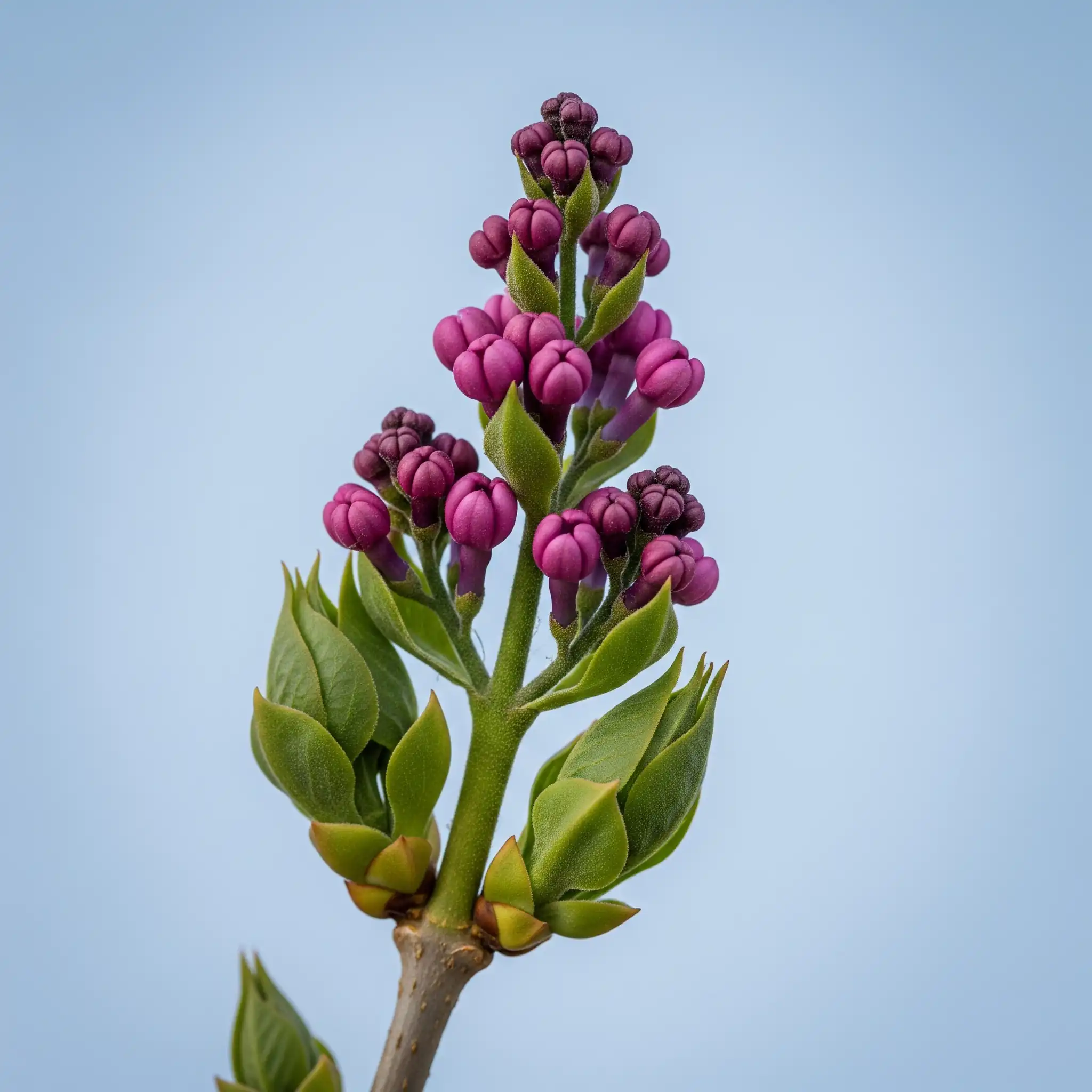
The fix: Mark your calendar the moment the last bloom fades. That is your two-to-four-week window for any pruning. If you missed it this year, skip pruning entirely and wait for next spring. One correctly timed season is usually enough to turn a non-blooming lilac around.
Reason 2: Your Lilac Is Not Getting Enough Sunlight

Lilacs are sun-hungry. Six hours of direct sun is the minimum — eight or more is better. Below six hours, photosynthetic output drops below the threshold needed to produce the sugars that drive flower bud formation. The plant stays alive and may even look vigorous, but it defaults to vegetative maintenance rather than reproduction.
The sneaky version of this problem: your lilac used to bloom fine, and now it does not. You have not moved it. What has changed is that the oak tree next to it has grown 10 feet taller over the past decade, and the shade has gradually deepened. This is one of the most common causes of sudden bloom decline in established lilacs.
Count the hours of actual direct sun hitting your lilac’s main canopy from morning to evening. Afternoon sun, especially between noon and 4 p.m., is more photosynthetically productive than morning light. If neighboring trees, fences, or structures are blocking that peak window, you have found your problem.
The fix: If a neighboring tree is shading your lilac, prune it hard in late winter before it leafs out, opening the canopy above. If shade comes from a structure, consider relocating the lilac to a sunnier spot — best done in early spring or fall while dormant.

Younger plants (under five years old) handle transplanting well. Dig a wide rootball, replant immediately into a hole twice as wide, water deeply, and mulch 2–3 inches around the root zone keeping mulch away from the trunk. Expect one to two years of recovery before full blooming resumes. Our guide on how much sun lilacs need covers this in detail, including which cultivars tolerate partial shade better than others.
Reason 3: The Plant Is Still Too Young
Common lilacs (Syringa vulgaris) need time before they will bloom — more time than most people expect. Iowa State Extension puts the typical wait at five or more years from planting before reliable flowering under good growing conditions. In poor soil, deep shade, or after transplanting stress, it can stretch longer.
This is the easiest cause to overlook. You are doing everything right. The plant is healthy, growing vigorously, throwing out new shoots each season. It simply has not hit its productive age yet.
The biology behind this: according to Nebraska Extension, lilac wood needs to reach at least three years of maturity before it can carry flower buds. A newly planted shrub is not just ‘too young’ in terms of calendar age — the wood itself is not structurally ready. Even when the plant is five years old, only stems that are three or more years old will produce flowers. Before that threshold, the plant’s resources go toward establishing a root system capable of supporting long-term growth, as UMN Extension notes.
How to tell if this is your situation:
Stop missing your zone's planting windows.
Select your US zone and month — get a complete checklist of what to plant, prune, feed, and protect right now.
→ View My Garden Calendar- The plant is under five years old and has never bloomed
- It is growing vigorously with healthy foliage and no obvious problems
- No other cause — shade, pruning, nitrogen — applies
The fix: Wait. A healthy young lilac will bloom on its own schedule. Consistent care — at least six hours of sun, well-drained soil, minimal fertilizer — is all it needs. If you cannot wait five years, consider these faster-blooming alternatives that typically flower within one to two years of planting:
- Miss Kim lilac (Syringa pubescens ‘Miss Kim’): compact, fragrant, blooms early
- Bloomerang lilac (Syringa ‘Penda’): reblooms in late summer, very fast to first flower
- Preston lilacs (Syringa x prestoniae): bloom in years one to two, extremely cold-hardy to zone 2
Reason 4: Too Much Nitrogen Is Pushing Leaves Over Flowers
Nitrogen is the growth nutrient. It directly stimulates cell division and drives the production of leaves, stems, and green tissue. Feed your lilac a nitrogen-heavy fertilizer — or let it sit near a lawn that gets regular high-nitrogen applications — and you are sending the plant a clear signal: grow vegetatively. The hormonal cues that trigger flower bud initiation get drowned out.
The result is a bush that looks spectacularly healthy. Deep green leaves, vigorous new stems, rapid growth season after season. And not a single flower.
The silent version of this problem is lawn fertilizer runoff. Many gardeners never directly fertilize the lilac but have it planted near a lawn that receives standard fertilizer three or four times per season. Lilac roots extend well beyond the shrub’s edge — often reaching into that fertilized zone without anyone realizing it. According to UMN Extension, using lawn fertilizers near lilacs is one of the most reliable ways to suppress flowering while making the plant look incredibly healthy.
Signs that nitrogen is the problem:
- Unusually fast, lush vegetative growth each season
- Leaves are very dark green — darker than surrounding plants
- No flowers, or flowering numbers declining steadily year over year
- The lilac sits at the edge of, or within, a regularly fertilized lawn
The fix:
- Stop all fertilizer applications in the area from the trunk out to the drip line (the edge of the canopy)
- If lawn fertilizer is the source, create a mulched bed extending 2–3 feet beyond the drip line — this separates the root zone from the fertilized lawn area
- Plant nitrogen-hungry annuals like marigolds or zinnias near the root zone to draw down excess nitrogen faster
- If you do fertilize, use a balanced formula (5-10-10) in early spring only — the higher phosphorus supports flower development over vegetative growth
It can take a full growing season or two for excess nitrogen to clear from the soil. Soil pH matters here too: pH below 6.5 locks out calcium and magnesium that lilacs need for strong flower formation. Our lilac soil guide covers pH testing and amendment in detail.
Reason 5: A Late Spring Frost Killed the Buds
This is the most underdiagnosed cause of sudden bloom failure in established lilacs — the one that catches experienced gardeners by surprise. Your lilac did everything right. You pruned correctly last year. It has been blooming for a decade. And then one spring it simply does not flower. You saw the buds swelling in April. And then nothing.
What happened: a late frost hit after the buds had already begun to wake up.
Here is the biology of it. Lilac flower buds spend winter in a hardened dormant state — they can withstand temperatures of -40°F without damage in that condition. But once a warm spell in late March or early April triggers them to begin swelling and emerging from dormancy, the internal cell tissue becomes far more frost-sensitive. At that expanded-bud stage, temperatures dropping to 27°F or below can kill the cells inside the bud. Externally, the buds look brown and shriveled rather than green and plump. No cells = no flowers. Chicago Botanic Garden notes that early-blooming lilac varieties are especially susceptible, as they break dormancy faster and have less buffer against a returning cold snap.
I have watched this happen in a zone 5 garden after a 70°F week in late March: buds that were plump and green one day were brown and dead four days later after a 24°F night. The plant itself was perfectly fine — it was only the exposed bud tissue that paid the price.
How to tell if late frost is your cause:
- The lilac bloomed reliably in previous years
- You remember an unusually warm stretch in late winter or early spring, followed by a hard freeze
- Buds that were visibly swelling in early April are now brown and did not open
- Leaf buds opened fine — only the flower buds failed
The good news: frost damage is cosmetic for the season. The plant’s long-term health is unaffected, and blooms should return to normal the following spring — provided the same pattern does not repeat.
The fix if late frosts are common in your area:
- Watch the forecast in March and April. If temperatures below 28°F are predicted and your buds are already swelling, drape the shrub with frost cloth or burlap
- Never use plastic sheeting — it transfers cold directly to bud tissue and can make damage worse
- Water around the root zone before the freeze — wet soil retains significantly more heat overnight than dry soil
Reason 6: Your Climate Does Not Give Lilacs Enough Winter Cold
Standard lilacs — particularly Syringa vulgaris and its hybrids — evolved in cold continental climates. They require approximately 2,000 hours below 45°F during winter dormancy to fully develop the hormonal signals needed for spring bloom. This is called a chilling requirement, and it works similarly to the vernalization process in fruit trees: without that accumulated cold, the buds never receive the trigger to open.
This is why lilacs are reliably listed as USDA zones 3–7 plants. In zone 8 and warmer — much of the South, Southern California, and the Pacific Northwest’s milder stretches — standard cultivars often produce beautiful foliage and zero flowers. The winters simply do not get cold enough, long enough.
If this is your situation, you will typically see:
- A well-established, healthy-looking shrub that has never flowered
- No issues with pruning, sunlight, or fertilizer
- A USDA hardiness zone of 8 or warmer
- Mild winters with few consistently cold nights
The fix is cultivar selection. Low-chill varieties bred specifically for warm climates can bloom with far fewer chill hours:
- Descanso hybrids (‘Lavender Lady’, ‘Blue Skies’, ‘Chiffon’): bred in Southern California specifically for low-chill conditions, suitable for zones 8–9
- Cutleaf lilac (Syringa x laciniata): more heat-tolerant than common lilac, suitable for warmer zones
- Miss Kim (Syringa pubescens): requires fewer chill hours than S. vulgaris
Reason 7: The Shrub Is Overgrown and Running on Empty
A lilac that has never been pruned will, over 15 to 20 years, become a mass of thick, woody stems with blooms pushed to the very top and outer edges. This is not a disease or deficiency — it is the natural aging pattern of an unmanaged shrub.
Here is what happens mechanically. Only stems that are three years old or younger carry flower buds. Stems older than that are productive wood in structural terms — they support the canopy — but they no longer initiate new flower buds. When most of the shrub’s interior is decade-old timber with no young growth, there is simply very little left to bloom. The plant may look impressive in terms of size, but it is running on the productive capacity of a narrow outer ring of younger wood. Nebraska Extension notes that common lilacs can reach 15 to 20 feet in height when left unmanaged, and at that scale the interior is almost entirely unproductive.
Signs your lilac needs rejuvenation:
- Flowers appear only at the tips and outer periphery, not throughout the shrub
- Lots of bare, thick, gray-brown stems visible in the interior
- The shrub is 15 or more years old and has never been properly pruned
- Increasing sucker production from the base — the plant is attempting self-renewal
You have two options, both from Nebraska Extension’s rejuvenation guidance:
Option 1 — Gradual rejuvenation (recommended): Each spring, immediately after bloom, cut one-third of the thickest, oldest stems down to ground level. Repeat annually for three years. By year four, the entire shrub has been renewed while you still enjoyed flowers throughout the process.
Option 2 — Hard renovation: Cut the entire plant back to 6–8 inches from the ground in late winter (March–April). New growth will be vigorous, but expect no blooms for three to five years while replacement wood reaches the three-year maturity threshold for flowering.
The gradual method is almost always preferable unless the shrub is so deteriorated that even the outer third would produce negligible flowers.
A note on grafted lilacs: many commercially sold lilacs are grafted onto a rootstock. If yours is grafted, the suckers emerging from the base are often from that rootstock — a different, often non-ornamental species. These rootstock suckers almost never bloom, and they compete with the productive upper portion of the plant. Remove them by tearing rather than cutting at soil level — tearing discourages regrowth more effectively than a clean cut.
When Will My Lilac Bloom Again?
Recovery time varies a lot by cause. Here is a realistic timeline for each situation:
| Cause | When to expect blooms back |
|---|---|
| Wrong pruning time (single season) | Following spring, if you prune correctly this year |
| Shade from neighboring tree (tree pruned) | One season after opening up the canopy |
| Plant too young | One to three more years depending on cultivar |
| Excess nitrogen | One to two seasons after stopping fertilization |
| Late spring frost | Following spring (long-term health unaffected) |
| Insufficient chill hours — standard cultivar | Never reliably — switch to a low-chill variety |
| Overgrown — gradual rejuvenation | Blooms maintained throughout the 3-year process |
| Overgrown — hard renovation cut | Three to five years after cutting back |
Frequently Asked Questions
Why did my lilac bloom last year but not this year?
The two most common causes of sudden bloom failure in a previously reliable lilac are late spring frost damage and incorrect pruning timing. If there was an unusually warm stretch in March or April followed by a hard freeze, frost likely killed the swelling buds — the plant will recover fully next season. If someone pruned the shrub after mid-summer, the developing flower buds for this spring were removed. Either way, correctly timed care this year should restore normal blooming next spring.
Do lilacs bloom every year?
Healthy, properly cared-for lilacs bloom reliably every spring without exception. They are not like some perennials that skip years. Consistent annual blooming requires three things: pruning immediately after bloom ends (within two to four weeks), at least six hours of direct daily sun, and avoiding high-nitrogen fertilizers. Get those three factors right and a well-established lilac will flower every year.
Should I deadhead my lilac?
Yes — and timing matters. Remove spent flower clusters within two weeks of the bloom fading. This redirects the plant’s energy from seed production back into general growth and helps set up a strong following season. This window also overlaps with the safe pruning window, so handle any light shaping at the same time. Snap or cut the old flower clusters at their base, being careful not to damage the new growth buds forming just below them — those are next year’s flowers.
Which lilac variety blooms the fastest after planting?
Miss Kim lilac (Syringa pubescens ‘Miss Kim’) and Bloomerang lilac (Syringa ‘Penda’) typically produce their first blooms within one to two years of planting, compared to five or more years for standard common lilac. Preston lilacs bloom within two years and are among the hardiest options for cold climates (to zone 2). For gardeners in zones 8 or 9, the Descanso hybrids — ‘Lavender Lady’ and ‘Blue Skies’ — are the best bet, bred specifically to bloom with fewer chill hours than standard S. vulgaris.
Sources
- University of Maine Cooperative Extension — Why Lilacs Don’t Bloom
- Illinois Extension (UIUC) — Help! My Lilac Didn’t Bloom
- UMN Extension — Growing Lilacs for Minnesota Landscapes
- Iowa State Extension Yard and Garden — Can I Do Anything to Encourage the Lilac to Flower?
- Chicago Botanic Garden — Lack of Flowers on Lilacs
- Nebraska Extension (Lancaster County) — Pruning Lilacs
- Nebraska Extension (Lancaster County) — Rejuvenating Older Lilacs
- Gardening Know How — Lilac Winter Care and Frost Protection


