

Read Your Hygrometer Like a Pro: Exact Humidity Targets for Every Plant Family in Your Home

Stop guessing at humidity. Learn exact hygrometer placement, calibration, and per-plant-family targets so your readings translate into healthier houseplants.
Why Humidity Is the Most Misunderstood Houseplant Variable
Temperature and light get all the attention. Humidity sits quietly in the background — and that is exactly why so many houseplants develop crispy leaf tips, stunted new growth, and a general look of defeat that no amount of watering fixes.
The problem is not just that humidity matters. It is that most growers have no idea what the humidity actually is in the spot where their plants live. A number on a hygrometer means nothing if the device is sitting in the wrong place, drifting out of calibration, or measuring a reading that has no connection to the microclimate around your leaves.
This guide closes that gap. You will learn which hygrometer type gives you accurate readings, where exactly to position it, how to check whether it is telling the truth, and what specific humidity range each plant family actually needs — with the biological reason behind each target, not just a number to chase.
What Humidity Does at Leaf Level: The Mechanism That Changes Everything
Before you place a single hygrometer, it helps to understand what you are actually measuring and why it matters to your plants.

Three pre-planned garden beds, free
Stop staring at empty beds: printable plans with exact layouts, plant lists and planting calendars — yours free from the Garden Library.
Every leaf surface is dotted with thousands of microscopic openings called stomata. These pores are how plants breathe in carbon dioxide and release oxygen. But they are also the primary exit point for water vapor — a process called transpiration. According to peer-reviewed research published in Plant, Cell and Environment, the interior of a healthy leaf is maintained at close to 100% relative humidity. The air just outside the leaf is almost always drier. That difference in water vapor concentration drives a constant outward flow of moisture through every open stomata.
When the air around your plant drops to 20 or 30% relative humidity — which is exactly what happens in a centrally heated home during winter — that gradient becomes extreme. According to Nebraska Extension, plants respond by attempting to close their stomata, limiting the moisture loss. But the guard cells that control stomatal aperture are themselves dependent on internal water pressure. In severely dry air, they lose turgor before they can close completely, leaving the plant in an unwinnable loop: losing water faster than it can absorb it through the roots.
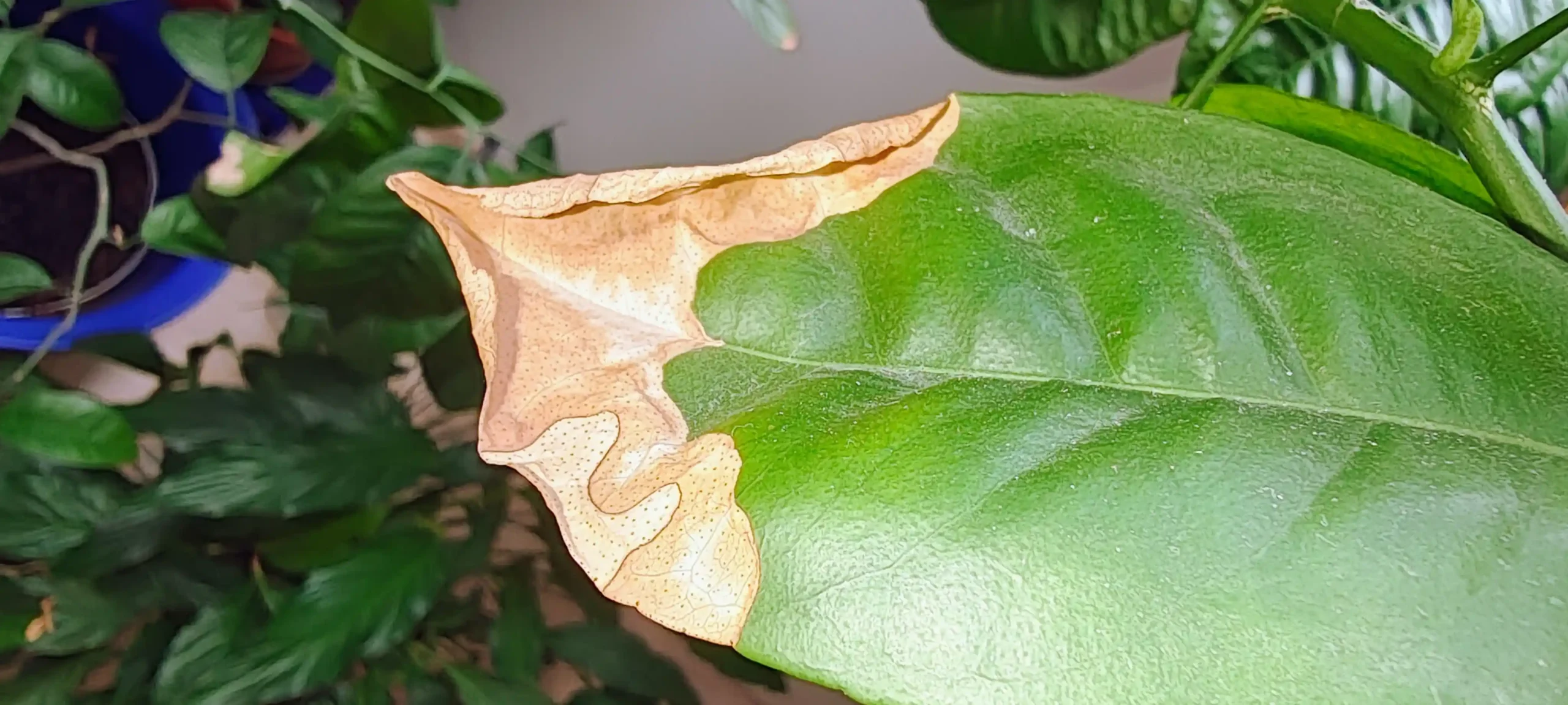
The leaf tips and margins crisp first because those thin-walled cells at the edge of the leaf have the smallest water reserve. The moment their turgor pressure drops, they desiccate and turn brown. No amount of watering corrects this — the damage is atmospheric, not a root problem.
The practical implication: your hygrometer is not measuring air quality or comfort. It is measuring the rate of water stress your plant is experiencing right now. That reframe changes everything about how you interpret and act on the number you see.
Choosing the Right Hygrometer for Houseplant Use
Not all hygrometers are equal, and the difference in accuracy is significant enough to make the wrong choice genuinely misleading.
Digital Hygrometers (Recommended)
Digital hygrometers use a capacitive or resistive electronic sensor to measure the electrical change that occurs as humidity changes. Most consumer models are accurate to ±1-2% relative humidity, respond quickly to changes, and combine temperature readings in a single display. For houseplant monitoring, where knowing whether you are at 45% or 55% genuinely changes what you need to do, that precision matters.
Entry-level digital hygrometers cost under $15 and are sold at most garden centers and online. Look for a model that displays both humidity and temperature, and ideally one with a min/max memory function so you can see the overnight low and daytime peak without watching it constantly.
Analog Hygrometers (Acceptable for General Monitoring)
Analog models use a mechanical spring or a bundle of human hair that physically expands and contracts as humidity changes, moving a needle across a dial. They need no batteries and are simple to read, but their accuracy is only ±5% — and they drift over time, sometimes significantly. An analog hygrometer that reads 45% may actually be measuring 50% or 40%, and you would not know without comparing it to a verified source.
If you only want a rough sense of whether a room is very dry or adequately humid, an analog dial is sufficient. For targeted plant care decisions, go digital.
Smart WiFi Sensors (Best for Serious Growers)
WiFi-enabled sensors like the Govee H5179 or similar log temperature and humidity continuously, send data to your phone, and trigger alerts when readings drop below a threshold you set. The American Orchid Society specifically recommends these for growers who want to track patterns over days or weeks, identify when nighttime heating causes overnight humidity crashes, and compare readings across multiple rooms simultaneously.
If you have a grow space, a dedicated plant room, or a collection of high-humidity tropicals like orchids or ferns, a smart sensor replaces guesswork with data. For a single shelf of mixed houseplants, a $10 digital unit does the job.
Exact Humidity Targets by Plant Family
Most general guides say ‘aim for 40-60%’ and leave it there. That range covers the middle ground but misses the plants on either end — the high-humidity tropicals that are chronically stressed at 45%, and the succulents and cacti that actively dislike anything above 50%.
The targets below are drawn from Nebraska Extension, UNH Extension, and the Colorado State PlantTalk series. The ‘why’ behind each range reflects the plant family’s origin climate and leaf structure.
| Plant Family | Target RH | Why This Range | Low-Humidity Warning Signs |
|---|---|---|---|
| Ferns, calathea, nerve plants, peace lily | 50-70% | Native to rainforest understory. Thin leaves with abundant stomata lose water rapidly in dry air. | Crispy brown margins, curling fronds, yellowing and leaf drop |
| Orchids (most epiphytes) | 50-70% daytime, up to 70% at night | Originate from cloud forest or tropical canopy. Velamen roots on epiphytes absorb atmospheric moisture directly. | Wrinkled or shriveled pseudobulbs, aerial roots turning grey and brittle |
| Monstera, pothos, philodendron, anthurium | 40-60% | Tropical but more adaptable. Thicker leaves and larger water reserves buffer moderate dryness. | Slow growth, brown leaf tips, occasional leaf curl during heating season |
| Chinese evergreen, cast iron plant, dracaena | 30-50% | Adapted to variable tropical climates including dry seasons. Thick cuticle reduces water loss. | These are forgiving. Only extended exposure below 25% causes visible damage. |
| Succulents and cacti | 10-40% | Native to arid regions. Modified stomata (CAM photosynthesis) only open at night, minimizing daytime water loss. | Root rot and stem softening from excess moisture if kept too humid |
Note that the target ranges for high-humidity plants and succulents do not overlap. If you grow both groups, you cannot optimize for both in the same spot without grouping them separately.
Stop missing your zone's planting windows.
Select your US zone and month — get a complete checklist of what to plant, prune, feed, and protect right now.
→ View My Garden CalendarWhere to Place Your Hygrometer for Accurate Readings
Placement is where most readings go wrong. A hygrometer positioned incorrectly does not give you bad data about the room — it gives you accurate data about a specific location that has nothing to do with where your plants live. That distinction matters.
The Four Placement Rules
Place it at leaf height. Humidity is not uniform from floor to ceiling. Warm air near the ceiling is drier; cooler air near the floor can be slightly more humid. Your hygrometer should be at the same height as the majority of your plant’s foliage — on the shelf beside a plant, not on the wall above it.
Keep it away from airflow sources. Heating vents, air conditioning registers, fans, and drafty windows all distort readings. A vent pumping dry heated air into a room can make a single hygrometer read 15-20% lower than the rest of the space actually is. Keep the device at least three feet from any active air source.
Avoid direct sun and windows. Direct sunlight warms the sensor, which lowers the relative humidity reading artificially. Morning light from an east-facing window is enough to skew an analog hygrometer meaningfully.
Allow stabilization time. After moving a hygrometer to a new location, wait 15-30 minutes before reading it. The sensor needs time to equilibrate to the local conditions. A digital unit moved from a cold windowsill to a warm shelf will display a transitional reading for the first few minutes that reflects neither location accurately.
Mapping Multiple Zones
If you have plants in different rooms, do not assume the humidity is consistent. The bathroom may read 60% on a shower day and drop to 45% an hour after you leave. The kitchen reads higher near the sink but drier near the oven. The living room next to a south-facing window may be significantly drier than a shaded bedroom.
Spend a week moving a single hygrometer around your home, checking each location at the same time of day. You will likely find 10-20% variation between rooms — and that information changes where you place humidity-sensitive plants. For a more detailed look at managing environmental variables across your home, see our guide on controlling humidity, temperature, and airflow for healthy plants.
Reading the Number: What Each Range Actually Means
You’ve positioned the hygrometer correctly and given it time to stabilize. Here is how to interpret what you see.
| RH Reading | What It Means | Who Struggles | Immediate Action |
|---|---|---|---|
| Below 25% | Dangerously dry — comparable to a desert during heating season | All tropical houseplants, even tough ones | Humidifier required; grouping alone is not enough |
| 25-40% | Dry — typical of a centrally heated home in winter | Ferns, calathea, orchids, peace lily | Act now for humidity-sensitive plants; monitor tough varieties |
| 40-55% | Acceptable to comfortable for most houseplants | Humidity-loving tropicals may still show edge browning | No urgent action; optimize grouping for sensitive plants |
| 55-70% | Ideal range — comfortable for humans and plants alike | Succulents may develop fungal issues if airflow is poor | Maintain; check sensitive plant placement |
| 70-85% | High — excellent for tropical collections, risky for mixed groupings | Succulents, cacti, most Mediterranean herbs | Improve airflow; separate humidity-loving from dry-preferring plants |
| Above 85% | Danger zone for fungal disease. The American Orchid Society notes this threshold triggers Botrytis and other foliar pathogens. | All plants — the risk shifts from dryness to disease | Ventilate immediately; check for condensation on leaves and soil surface |
Seasonal Interpretation
Readings do not exist in isolation — context matters. A reading of 35% in January, in a house with gas heating, is expected and tells you to run a humidifier. The same reading in July, with windows open, is unusual and warrants investigation (a gas leak or a particularly dry heat wave can both cause it).
Pennsylvania State Extension data shows that winter heating is the single biggest driver of low indoor humidity, with readings routinely dropping below 30% in centrally heated homes. Tropical plants in zones where outdoor winter temperatures fall below freezing are exposed to this annually. Understanding that the problem is seasonal and predictable helps you prepare — rather than scramble — when it arrives.
Is Your Hygrometer Accurate? How to Check Without Special Equipment
Hygrometers drift. Digital sensors are stable for 1-2 years under typical home conditions; analog models can drift meaningfully in months. A hygrometer that reads 10% low will make you think your plants are fine when they are not, and a hygrometer reading 10% high will make you think you need to increase humidity when you are already at an adequate level.
The salt calibration test requires only a small sealed bag, a bottle cap, table salt, and water.
- Fill a bottle cap with table salt. Add just enough water to make a thick slurry — the salt should not dissolve completely.
- Place the hygrometer and the salt-filled cap inside a zip-lock bag. Seal it.
- Leave the sealed bag at room temperature for 6-8 hours, out of direct sunlight.
- Read the hygrometer without opening the bag. At 68-77°F, a salt slurry equilibrates to exactly 75% relative humidity.
- If your hygrometer reads within ±3% of 75%, it is accurate. If it reads 65% or 85%, it is drifting and needs either calibration (many digital units have a calibration button) or replacement.
Run this check when you first buy a new hygrometer, then annually. If a reading suddenly seems out of character with how your plants are responding, run it immediately — sensor failure usually manifests as a stuck reading that never varies, or a reading that is consistently 10%+ higher or lower than a second verified hygrometer placed nearby.
Troubleshooting Inaccurate or Confusing Readings
Sometimes the number seems wrong. Your plants have crispy tips but the hygrometer says 60%. Or the reading swings wildly through the day. Use this table to diagnose what is actually happening.
| Symptom | Likely Cause | Fix |
|---|---|---|
| Reading jumps 10%+ within an hour | Device is near a vent, door, or window — measuring airflow fluctuations, not stable ambient humidity | Move hygrometer at least 3 feet from any air source |
| Reading stays stuck at one number for days | Sensor failure — capacitive sensors can fail in a fixed state | Check with salt test; replace if reading doesn’t move even when you breathe on it |
| Plants have crispy tips but reading says 55-60% | Hygrometer is measuring the room’s average, not the microclimate at leaf level; or it is drifting high | Move hygrometer closer to affected leaves; run salt calibration test |
| Reading always seems very high (70%+) even in dry weather | Near an aquarium, fish tank, large water feature, or open pot of water | Reposition; you may need two hygrometers if the tank and plants share space |
| Two hygrometers in the same spot disagree by 15%+ | One or both are drifting out of calibration | Salt test both; discard or calibrate the outlier |
| Morning reading is 20% lower than afternoon | Normal heating cycle — as the house warms up, the same absolute moisture content produces lower RH in warmer air | No action needed; design your humidity strategy around the worst reading (morning) |
Acting on Your Readings: What to Do Next
A hygrometer is only as useful as the decisions it informs. Here is a clear action framework based on what you see.
If the Reading Is Too Low
The most effective single intervention is a small cool-mist humidifier placed within two to three feet of your plants. Run it for several hours daily, especially in the morning when indoor RH is at its lowest. According to UNH Extension, a portable humidifier targeted at your plant area produces reliably better results than any passive method.
Grouping plants together helps too. Each plant releases water vapor through transpiration, and a cluster of plants creates a local microclimate several percentage points more humid than the surrounding room — though the effect scales with how many plants you group and how low-airflow the spot is. For more specific techniques, our guide to increasing humidity for indoor plants covers nine practical approaches in detail.
Two common recommendations that Penn State Extension has found largely ineffective: daily misting (the humidity boost lasts only minutes before the water evaporates) and pebble trays (moisture evaporates into the whole room rather than concentrating around your plants). Both are better than nothing but should not be your primary strategy if your reading is below 40%.
If the Reading Is Too High
High humidity above 75% is less commonly discussed but genuinely problematic. Fungal pathogens including Botrytis, powdery mildew, and various root rots proliferate above 85% RH, and even prolonged exposure in the 75-85% range with poor airflow invites problems — particularly for plants sitting in wet soil.
Open windows when outdoor humidity is lower than indoor (this is often the case in winter). Run a fan on low to improve air circulation without dropping humidity dramatically. Check that pots are not sitting in water and that drainage is working correctly — stagnant water under pots is a humidity amplifier in a small space. If you grow moisture-loving ferns or calathea alongside succulents, physically separate them so you can manage the environments independently.
When to Stop Worrying
Mild seasonal swings are normal and most houseplants adapt to gradual changes. If your reading drops from 55% in summer to 45% in winter, that is not an emergency — it is a signal to check in on your most sensitive plants and possibly run a humidifier a few hours a day. Plants that are otherwise well-watered, correctly lit, and properly potted are more resilient to humidity variation than articles often suggest.
If a plant is consistently struggling and you have confirmed the humidity is adequate, look elsewhere. Watering frequency, drainage, soil composition, and light are all more common culprits than humidity. Our guide on how to revive a dying houseplant walks through a full diagnostic sequence.
Frequently Asked Questions
What is the best hygrometer for houseplants?
A basic digital hygrometer accurate to ±2% is the right choice for most growers. It should display both temperature and humidity, and a min/max memory function is helpful for catching overnight lows. Expect to spend $10-20. Smart WiFi sensors are worth the upgrade if you have a dedicated plant room or a collection of orchids and tropical ferns where consistent humidity is critical.
Where exactly should I place my hygrometer?
Position it at the same height as your plant’s leaves, away from vents, radiators, air conditioning, direct sun, and open windows. Allow 15-30 minutes after moving it before taking a reading. For a general-purpose houseplant shelf, the center of the shelf at plant height is ideal. For hanging plants, position the hygrometer at foliage level, not at shelf height below.
Can humidity be too high for indoor plants?
Yes. Above 85% relative humidity, fungal pathogens like Botrytis become a real risk, particularly if airflow is poor. Succulents and cacti are at risk of root rot at sustained humidity above 50%, especially if the soil also stays moist. If your reading is consistently above 75%, improve airflow and check that no open water sources — aquariums, pots without drainage holes — are inflating the reading artificially.
How do I know if my hygrometer is accurate?
Use the salt calibration test: place the hygrometer in a sealed bag with a small cap of saturated salt slurry (table salt and just enough water to make a thick paste) for 6-8 hours at room temperature. The equilibrium humidity is 75%. If your reading is within 3% of that figure, the unit is accurate. If it reads 65% or 85%, it has drifted and needs calibration or replacement.
Do I need more than one hygrometer?
If you grow plants in multiple rooms or on multiple shelves with different conditions, yes. A hygrometer in the living room tells you nothing reliable about the humidity level in a bedroom grow space or a basement corner. Two or three low-cost digital units are more useful than one expensive sensor. Use one as your ‘reference’ unit (check it with the salt test first) and compare the others to it for relative accuracy.
Does grouping plants together actually raise humidity?
Yes, but moderately. Each plant releases water vapor through transpiration, and a dense cluster creates a local microclimate a few percentage points more humid than the surrounding room. The effect is real but limited — grouping is a useful supplement to a humidifier, not a replacement for one when your reading is below 40%. For a deeper look at how Monstera and other large-leaf tropicals benefit from humidity techniques, including the use of LECA pebbles, see our article on Monstera humidity with LECA pebbles.
Key Takeaways
A hygrometer is only useful when placed correctly, checked for calibration, and interpreted against the needs of specific plants — not a generic ‘aim for 50%’ target that ignores the real variation across plant families. Place it at leaf height, away from air sources. Run the salt test once a year. Use the plant family table to set real targets for what is living on your shelves. And when the number is off, use the troubleshooting table before assuming the worst.
The biggest shift in thinking: the hygrometer is not measuring how comfortable your room feels. It is measuring the rate of water stress your plants are managing right now. Once that clicks, the number on the screen becomes genuinely actionable.
Sources
- Penn State Extension — Humidity and Houseplants
- Nebraska Extension (UNL) — Success with Houseplants: Humidity
- UNH Extension — How Can I Increase the Humidity Indoors for My Houseplants?
- Colorado State PlantTalk #1317 — Houseplants: Temperature and Humidity
- PMC / Plant, Cell and Environment — Stomatal Response to Humidity
- American Orchid Society — Humidity and Vapor Pressure Deficit


