

The 3 Climate Factors That Make or Break Your Plants (And How to Control Every One)

Learn how humidity, temperature, and airflow interact to drive plant health — with specific targets, what really works, and a diagnostic table to identify the problem.
How Humidity, Temperature, and Airflow Work as a System
Most plant problems get blamed on watering. But in indoor environments, the bigger culprits are usually invisible: the air around your plant is too dry, too stagnant, too hot near a vent, or swinging between extremes every time you turn the heat on.
These three factors — humidity, temperature, and airflow — don’t operate independently. Humidity and temperature are linked through a concept called vapor pressure deficit (VPD): what matters isn’t just how much moisture is in the air, but how much moisture the air wants to pull from your plant at that temperature. Warm air can hold far more water vapor than cool air, which means warm dry air draws moisture out of leaves much faster than cool dry air at the same relative humidity reading.
Here’s a practical example: 75°F at 50% humidity creates a moderate moisture gradient from leaf to air. Raise the temperature to 85°F at the same 50% humidity and the gradient steepens significantly — the same plant transpires much faster, potentially faster than roots can replace the water. That’s why moving a plant from a cool bedroom to a sunny kitchen window can cause wilting even though the humidity hasn’t changed.
Airflow connects to both factors: gentle air movement replaces the humid, CO2-depleted layer that forms directly against leaf surfaces, improving both gas exchange and disease resistance. Direct strong airflow does the opposite — it forces rapid moisture loss and desiccates leaf edges.

Three pre-planned garden beds, free
Stop staring at empty beds: printable plans with exact layouts, plant lists and planting calendars — yours free from the Garden Library.
Understanding the interactions between these three factors is what separates gardeners who consistently keep plants healthy from those who replace the same species every few months.
Humidity: What Your Plants Actually Need

Plants evolved to manage water loss through tiny pores called stomata, primarily on leaf undersides. These open to allow CO2 in for photosynthesis and release water vapor as a byproduct — a process called transpiration. According to NC State Extension, roughly 90% of all water absorbed by a plant’s roots exits through this process. When the air around your plant is very dry, the moisture gradient from leaf to atmosphere steepens and water exits faster than roots can replace it.
When that happens, guard cells on each stoma detect the water deficit and close the pore — cutting off CO2 intake and slowing photosynthesis. The plant stops growing and starts conserving. That’s the mechanism behind the drooping, browning, and slow growth you see in chronically dry conditions.
Target humidity ranges vary significantly by plant origin [1][4]:
| Plant Group | Preferred RH | Minimum Tolerated | Examples |
|---|---|---|---|
| High-humidity tropicals | 60–80% | 50% | Calathea, ferns, some orchids |
| Common foliage plants | 40–60% | 30% | Pothos, philodendron, peace lily |
| Intermediate plants | 30–50% | 20% | Snake plant, ZZ plant, spider plant |
| Succulents and cacti | 10–30% | 10% | Echeveria, barrel cactus, aloe |
The problem is that most US homes run at 30–50% RH during summer and drop well below 30% during winter heating season — sometimes below 20% in heated rooms during cold snaps [2]. That’s comfortable enough for humans and succulents, but it puts tropical foliage plants under continuous low-grade stress.
A basic digital hygrometer costs $10–$15 and gives you an immediate picture of where you stand. Don’t guess — the symptom overlap between low humidity, root problems, and overwatering makes guessing expensive.
How to Actually Increase Humidity — What Works, What Doesn’t
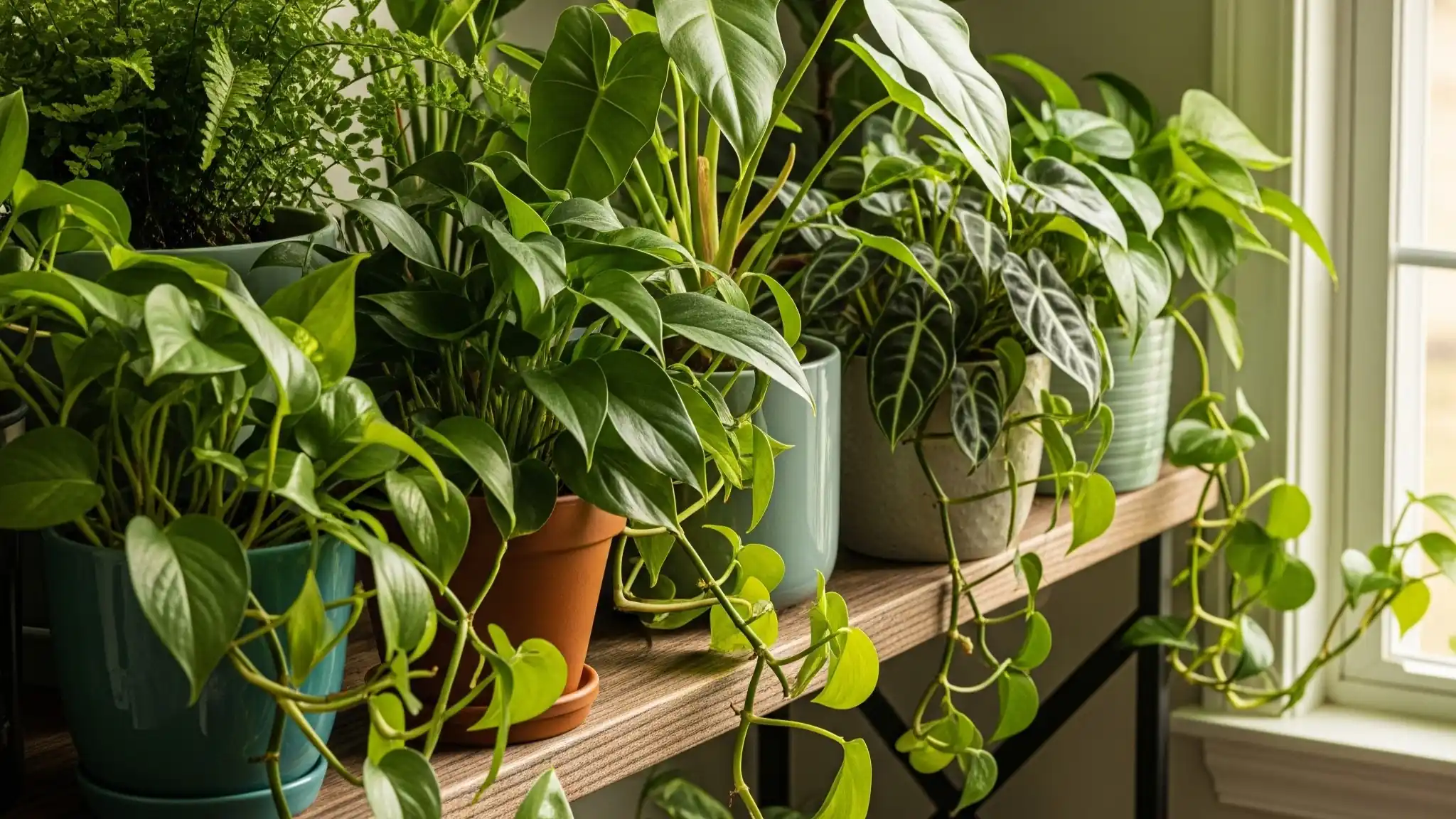
Let’s start with what doesn’t work, because two of the most commonly recommended methods are largely ineffective — and one of them creates new problems.
Misting: Misting sprays water on leaf surfaces, and the humidity it adds to the air dissipates within minutes as the water evaporates [2]. To maintain a meaningful humidity increase through misting alone, you’d need to mist every few minutes, all day. That’s not practical. Worse, water sitting on leaf surfaces overnight creates the warm, wet conditions that fungal pathogens need to germinate — particularly botrytis and powdery mildew. Avoid misting entirely on plants with fuzzy or velvety leaves like African violets [1].
Pebble trays: A shallow tray of water and gravel under the pot does add some moisture to the immediate area, but far less than most guides suggest. Testing by orchid growers found humidity at 1.5 inches above a pebble tray was only about 3% higher than the rest of the room — dropping to 2% at 4 inches and essentially zero at 1 foot. Evaporated water disperses into the entire room rather than concentrating around the plant [2]. Pebble trays are worth using as a microclimate boost for a single sensitive plant sitting on a heat vent, but don’t expect them to change your room’s ambient humidity.
Here’s what actually works, ranked by effectiveness:
- A humidifier — by far the most reliable method. Size it to the room: small ultrasonic or evaporative units handle a single room well, whole-house attachments raise all rooms together. Clean the reservoir weekly; standing water breeds bacteria and mold that get misted into the air around your plants.
- Grouping plants together — each plant transpires, releasing moisture through its leaves. Five or more plants grouped creates a measurable localized humid microclimate that benefits the whole group [2][5]. This is free and works well for a collection in a dry room.
- Glass or terrarium enclosures — for moisture-demanding plants like ferns, maidenhair, and some calathea, a glass cloche or sealed terrarium recycles the plant’s own transpiration back into the immediate growing environment [2]. This can raise local humidity to 70%+ even in a dry room.
- Move to naturally humid rooms — bathrooms with regular shower use and kitchens with cooking moisture run 10–15% higher RH than other rooms. This costs nothing and makes a real difference if the plant tolerates the light conditions.
When Humidity Is Too High
High humidity becomes a problem faster than most growers expect, especially in still air. Above 70% RH with little air movement, the humid boundary layer on leaf surfaces stays wet long enough for fungal spores to germinate. Powdery mildew peaks when nights are cool and humid [8]; botrytis (gray mold) is most destructive when humidity exceeds 85% with poor ventilation.
High humidity also drives fungus gnats — the small flies that breed in moist soil. You’ll often see them appear after weeks of misting or in groupings of plants near a humidifier that’s set too high. Check out our guide on dealing with fungus gnats in houseplants if you’re already seeing them.
The fix for high humidity is ventilation first, dehumidifier second. Increasing airflow disrupts the moisture layer on leaf surfaces without changing the room’s overall RH reading significantly. This is less disruptive to other plants in the room that may need humidity. If you regularly run above 70% and can’t improve ventilation, a small dehumidifier will bring conditions into the safer range.
One important note: spider mites thrive in low humidity, not high. If you’re seeing fine webbing on leaf undersides, the solution is to raise RH — not lower it — while also treating the infestation directly.
Stop missing your zone's planting windows.
Select your US zone and month — get a complete checklist of what to plant, prune, feed, and protect right now.
→ View My Garden CalendarTemperature: The Ranges That Drive Growth
Temperature affects every plant process: photosynthesis rate, transpiration speed, enzyme activity, and root water absorption. Most common houseplants come from tropical or subtropical regions and are calibrated for a fairly narrow range.
The University of Maryland Extension and Texas A&M AgriLife both place optimal temperature ranges at [1][3]:
- Foliage plants (pothos, philodendron, monstera, most aroids): 70–80°F daytime, 60–68°F nighttime
- Flowering plants (peace lily, African violet, cyclamen): 70–80°F daytime, 55–60°F nighttime
The night temperature drop isn’t just a preference — it’s a mechanism. Cooler nights slow the plant’s metabolic rate, reducing the carbohydrates burned in respiration and leaving more available for root development, flower development, and secondary growth. For flowering plants specifically, that cooler night temperature is what intensifies flower color and extends blooms. A warm-at-night cyclamen will produce fewer, paler flowers than one kept at 58°F overnight [1][3].
Colorado State Extension uses a slightly broader categorization that’s useful for matching plants to rooms [4]:
| Category | Daytime Range | Examples |
|---|---|---|
| Cool-preferring | 40–60°F | Cyclamen, some succulents, cool-season herbs (parsley, cilantro) |
| Intermediate | 60–75°F | Most common houseplants, snake plant, ZZ, pothos |
| Warm-preferring | 75°F+ | Tropical aroids, calathea, most orchids |
Most homes stay in the intermediate range naturally — the challenge is the fluctuations that occur near problem locations.
Temperature Threats You Might Not Be Thinking About
Steady temperatures at the right level rarely cause problems. The damage comes from specific locations that create micro-environments your plants weren’t designed for.
Heating and cooling vents: Forced air from HVAC vents combines three stresses — rapid temperature change, very low relative humidity (heated air is especially dry), and direct high-velocity airflow. Plants placed within 2–3 feet of a vent show brown leaf tips and edges as the leaf tissue loses water faster than roots can supply it [4]. Move these plants or block the vent with a deflector.
Cold window glass in winter: The glass surface of a window in January can be 20–30°F colder than the room air in northern climates. Leaves touching or close to cold glass experience localized cell damage — you’ll see it as darkened, water-soaked patches that turn black or brown within a day or two. Most tropical plants should be 6+ inches from exterior windows between December and February in USDA zones 5 and colder.
Drafts near doors: Ficus and indoor citrus species are particularly sensitive to sudden temperature changes. Placing either near a frequently-opened exterior door subjects them to repeated cold pulses, which causes healthy green leaves to drop suddenly — not yellowing first, just falling off [from cold draft research]. Move them to an interior wall.
Grow lights: If you use grow lights, account for the heat they add at canopy level. LED panels run cooler than HID lights but still add 8–15°F at close range. Measure canopy temperature at peak hours, not just ambient room temperature.
Airflow: The Factor Most Indoor Gardeners Overlook
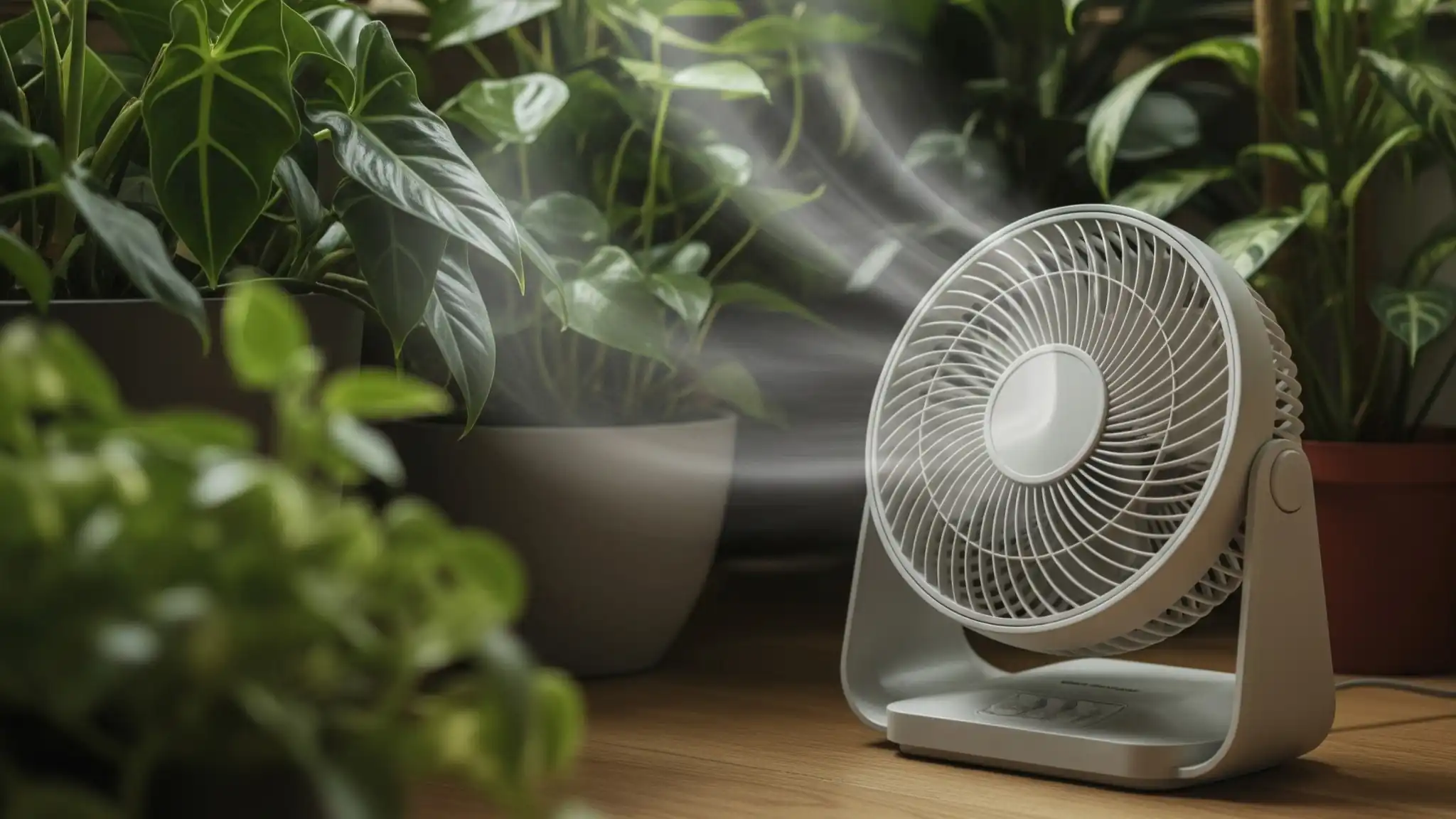
Every plant you grow outdoors experiences near-constant, gentle air movement. Your indoor plants usually experience none. That difference matters more than most guides acknowledge.
Gentle airflow — roughly the feeling of a light breeze, around 0.2–0.5 meters per second — does several things simultaneously:
Breaks up the boundary layer: Still air immediately against a leaf becomes depleted in CO2 as the leaf photosynthesizes, and enriched in humidity as the leaf transpires. Moving air replaces this stagnant layer with fresh CO2 and removes the humidity accumulation, improving both photosynthesis efficiency and moisture balance [6].
Prevents fungal disease: Powdery mildew and botrytis don’t need wet leaves to establish — they need a humid microclimate on the leaf surface. Airflow prevents that microclimate from forming. University of Minnesota Extension notes that powdery mildew is most severe on plants in shaded areas with poor air movement, and recommends spacing and pruning specifically to increase airflow [8].
Strengthens stems through thigmomorphogenesis: When plants experience mild mechanical stress from moving air, they respond by building thicker cell walls and denser vascular tissue. This is the same process that makes outdoor plants sturdier than their coddled greenhouse equivalents. Indoor plants grown in completely still air tend to be spindly and top-heavy; the same plant grown with a gentle breeze develops shorter internodes and sturdier stems.
Distributes temperature: Hot air rises and cool air pools near the floor. In a room without air movement, plants on shelves near the ceiling experience significantly warmer, drier conditions than plants at floor level. Even a ceiling fan on low eliminates most of this stratification.
Setting Up Good Airflow Indoors
You don’t need a complex setup. The goal is gentle, consistent air movement that reaches all your plants — not a wind tunnel that targets one spot.
Small oscillating fan: A clip-on or desktop fan on its lowest setting, placed to the side of your plant collection (not aimed directly at it), creates the kind of intermittent airflow that mimics a mild indoor breeze. Oscillating is preferable to stationary — the sweeping motion distributes airflow across a wider area instead of focusing on one spot that will dry out faster than the rest.
Open windows: Even 20–30 minutes of open windows daily refreshes CO2 and drops humidity during summer. In winter, crack a window on the opposite side of the room from your plants — cold air entry near plants is a temperature threat, but fresh air exchange in the room benefits everyone.
Spacing: This is the most underrated airflow tool. Pots touching each other or foliage overlapping creates still, humid pockets between plants. A 4–6 inch gap between containers allows air to circulate freely through the collection.
Ceiling fan in summer: On counterclockwise rotation (pushing air downward), a ceiling fan on low keeps air moving throughout the room without creating the direct, high-velocity airflow that desiccates leaves.
For outdoor plants in sheltered beds: Natural wind handles airflow — but in protected corners or against walls, prune lower leaves from crowded shrubs and perennials to open the canopy base to air movement. This is particularly important for roses, dahlias, and zucchini, which are all highly susceptible to mildew in still, humid conditions.
Diagnosing the Problem: What Your Plant Is Telling You
The tricky part is that many environmental stress symptoms look similar from a distance. This table works through the most common presentations:
| Symptom | Most Likely Factor | Confirming Sign | First Fix |
|---|---|---|---|
| Brown tips and leaf edges | Low humidity or heating vent | RH below 30%; plant near HVAC vent | Move away from vent; run humidifier |
| Sudden green leaf drop (no yellowing) | Temperature fluctuation (cold draft) | Plant near door, drafty window, or exterior wall | Relocate to interior wall away from drafts |
| Pale, spindly growth between nodes | Temperature too low or light shortage amplified by cool temps | Room below 60°F or plant in cold corner | Move to warmer spot; check light levels |
| White powdery coating on leaves | Fungal (poor airflow + high RH at night) | Still air; humid evenings; crowded conditions | Increase spacing; add fan; reduce evening misting |
| Mushy stems or crown rot | High humidity combined with poor airflow and overwatering | RH above 70%; no air movement; soggy soil | Add fan; reduce watering; improve drainage |
| Crispy edges on otherwise healthy leaves | Direct strong airflow or dry heat | Fan pointing directly at plant; near hot air vent | Reposition fan to side; redirect vent |
| Fine webbing on leaf undersides | Low humidity (favors spider mites) | RH below 35%; visible mites with magnification | Raise RH; treat infestation with neem oil |
| Dark, water-soaked patches that turn black | Cold temperature damage (window glass or draft) | Near exterior window in winter; patches near edge closest to glass | Move 6+ inches from window; insulate against glass |
Frequently Asked Questions
What humidity level do most houseplants need?
Most common foliage houseplants — pothos, philodendron, snake plant — do fine at 40–60% RH. High-humidity tropicals like calathea, maidenhair fern, and nerve plant need 60–80%. Most US homes run 30–50% in summer and can drop below 20% during winter heating season, so a humidifier often makes a real difference for tropical collections.
Is misting actually bad for plants?
Misting doesn’t raise ambient humidity meaningfully — the effect dissipates in minutes. What it does is wet leaf surfaces, which is harmless if leaves dry quickly in a well-ventilated space but problematic in still air or on fuzzy-leafed plants where water sits in the leaf texture overnight. If you’re misting purely for humidity, switch to grouping plants or using a humidifier instead.
How do I tell if my plant is suffering from low humidity versus cold drafts?
Location is the quickest diagnostic. If the plant is near a heating vent, cold window, or exterior door, temperature fluctuation is the first thing to rule out. If it’s in a stable interior spot with no nearby air sources, low humidity is more likely. Brown-tipped leaves near a vent almost always trace back to forced-air dryness; sudden green leaf drop (no prior yellowing) almost always traces to cold shock.
Do all indoor plants need the same night temperature?
No. Foliage plants like pothos and monstera are comfortable at 60–68°F overnight. Flowering plants — cyclamen, peace lily, African violet — prefer cooler nights in the 55–60°F range, which is what intensifies their flower color and extends bloom duration. Cacti and succulents actually benefit from significant temperature drops at night and in winter, which mimics the desert conditions they evolved in.
Getting Your Environment Right: The Short Version
Start with a hygrometer — a $10–$15 investment that makes everything else measurable. In most US homes, humidity is the biggest gap from what plants need: the quickest upgrade is a humidifier for tropical collections, or grouping plants if you’d rather not add a device.
Temperature is usually in range unless your plants are near vents, cold windows, or exterior doors — those three locations account for the majority of temperature-related plant problems indoors. Fix placement before adjusting anything else.
Airflow gets overlooked because it’s invisible. A small oscillating fan on the lowest setting, a few inches of spacing between pots, and periodic window ventilation cover the basics for most indoor collections without adding complexity.
If your plant is already struggling, the diagnostic table above should point you toward the most likely culprit. For more serious decline, our guide on how to revive a dying houseplant covers the full recovery process.
Sources
- Temperature and Humidity for Indoor Plants — University of Maryland Extension
- Humidity and Houseplants — Penn State Extension
- Light, Temperature and Humidity — Texas A&M AgriLife Extension
- Houseplants: Temperature & Humidity — Colorado State University PlantTalk
- Success with Houseplants – Humidity — Nebraska Extension (Lancaster County)
- Transpiration – Factors Affecting Rates — University of Nebraska (PASSEL)
- Botany — NC State Extension Gardener Handbook
- Powdery Mildew in the Flower Garden — University of Minnesota Extension


