

A Handbook for Garden Design and Layout for Novices

Basic Garden Planning: Layout and Design for Beginners
Looking out into an empty backyard can be absolutely horrible as well as exciting. It is a blank canvas of possibilities, a mute promise of future beauty. Where, therefore, do you start to leave the first impression? The reality of a patch of grass, a tangle of weeds, or a muddy building site can rapidly overpower the dream of a rich, beautiful garden full of scent.
TL;DR: Your 3-Step Garden Design Plan
- Step 1: Be a Detective (Observe Your Space). Before you do anything, spend time observing your yard.
- Map the Sun: Note where you have full sun (6+ hours), partial sun, and full shade at different times of the day. This is the most critical piece of information for choosing plants.
- Watch the Water: See where water puddles after rain. This identifies areas with poor drainage.
- Check the Views: Identify the good views you want to enhance and the bad views (neighbor’s trash cans, utility boxes) you want to screen.
- Step 2: Define the Job (Plan for Your Lifestyle). Decide what you want to do in your garden. Make a wish list. Do you need:
- A patio for dining?
- An open lawn for kids or pets?
- A vegetable patch?
- A quiet reading nook?
- A cutting garden for flowers?
- Step 3: Sketch it Out (Create a Plan). You don’t need to be an artist.
- Draw a “Bubble Diagram”: On a rough sketch of your yard, draw circles (“bubbles”) for each activity from your wish list, placing them in the most logical spots (e.g., “Dining Bubble” near the kitchen door, “Veggie Patch Bubble” in the sunniest zone).
- Define the “Bones”: Firm up the shapes of your bubbles into hardscape elements like patios, paths, and garden beds.
- Layer the Plants: Plan your garden beds in three layers: 1. Backbone (tallest trees/shrubs in the back for structure and screening), 2. Body (medium-sized perennials and shrubs in the middle for color and interest), and 3. Shoes (short groundcovers and edging plants in the front to soften edges).
Every gardener has experienced this mixed-feeling of aspiration and fear. It is the paralysis of the blank page. Though the dread of making a permanent or expensive error might be paralyzing, you want to produce something amazing.
What if I told you, nevertheless, that good garden design is not about having a secret ability, artistic background, or large budget? What if I told you it just requires three straightforward, rational actions? Good garden design is a process of carefully evaluating your area, precisely identifying its use, and using a few fundamental design ideas to realize your goal.
This book serves as your framework. From a state of overwhelm to one of confident creation, this straightforward, methodical approach will enable you. It will enable you to design a strategy that transforms that vacant space into a highly personal, beautiful, and useful outdoor refuge.

Three pre-planned garden beds, free
Stop staring at empty beds: printable plans with exact layouts, plant lists and planting calendars — yours free from the Garden Library.
All set to grab pencil and paper and start building your own little oasis? Let’s start now.
Learning to Read Your Landscape Before You Dig a Single Hole
The most important phase of the procedure is this one, which eager newcomers most usually overlook. You have to become a detective before you purchase one plant or lift one shovel. Your goal is to learn about and see the special narrative of your yard. Simply watch your space for at least a week, preferably across several seasons if you have the leisure.
Learning to be a Sun Mapper
Not distributed uniformly, sunlight is the lifeblood of a garden. You should know when and where it falls. Take a notebook and, on a sunny day, draw your yard four times: nine AM, twelve PM, three PM, and five PM. Mark where the sun is shining straight and where the shadows fall. This will highlight the “light zones” in your yard. Where is the full, blazing sun your future lavender and tomatoes will flourish from? Where is the soft morning sun ideal for delicate hydrangeas withering in afternoon heat? An perfect location for a calm hosta and fern garden is the deep, continuous shadow created under that large maple tree. The single most crucial piece of information you will gather is this sun chart.
Know Your Ground:
After a lot of rain, go for a walk. From where does the water come? Where does it settle for hours and puddle? Although it would be a bad fit for a patio, that soggy section would be ideal for a rain garden loaded with moisture-loving plants. Exist severe hills or moderate slopes? Although a slope can be difficult, it also presents amazing chances for terraced garden beds. Working with nature rather than against it depends on an awareness of the topography and water flow of your land.

Evaluate Your Opinions—Good and Bad.
Your garden exists from your house, not in a vacuum. Sit at your back door, sofa in your living room, and kitchen window. Look at what you find. Choose the magnificent sights you wish to protect or even frame with your plantings—perhaps a view of the sunset or a stunning distant tree. Just as critical, find the not-so-beautiful views you wish to screen—that of your neighbor’s garbage cans, a crowded street, or an ugly utility box. With a well placed hedge, trellis, or small tree, your garden design can elegantly address these issues.
You might also find jewel tone design helpful here.
Create a list of current assets.
With what already do you have to work from? Exists a lovely mature tree fit for the center of a shade garden? Is there a sunny area against the home that reflects heat, a character-filled fence, or a lovely old stone wall? These present qualities are gifts rather than challenges. From inception, they offer structure, character, and a feeling of history that can take years to build. Make sure your design honors and includes them.
What is the job of Your Garden? From Playground to Calm Retreat
Knowing your canvas will help you to pick what you wish to paint on it. Though a beautiful garden is great, a masterwork is a garden that also fits your way of life. This is dream and list-making stage.
Function First; Form Second
Consider what activities you wish to engage in before considering what plants you would like. Once more grab your notebook and create a “wish list.” Get ambitious! How would you dream about using this area? Does one need:
You might also find all white garden helpful here.
- a large patio or deck for outside meals and friend entertainment?
- a secure, open grassy area for pets and children to run across and explore?
- An efficient raised bed sequence or a veggie patch?
- A softly swinging hammock or a calm, secluded spot set aside for a reading nook?
- A colorful cutting garden bursting with flowers for all summer long fresh bouquets?
- Easy, sensible, well-lit routes from the driveway to the rear door with groceries?
Selecting a Style (Generally)
Although the word “style” can be frightening, avoid being mired in exacting standards. Here the aim is to just identify a broad direction that seems appropriate for you. Consider the general emotion you wish to produce.
Formal versus informal is the most fundamental stylistic decision. Do you enjoy the traditional, tidy look of straight lines, flawless symmetry, and well clipped hedges? That adopts a formal approach. Alternatively would you want the smooth, gentle appearance of curved lines, soft, flowing edges, and a more laid-back, naturalistic feel? That reflects an informal approach.
Style Motivation: What would “you”? Is it the wild, romantic, closely packed appearance of a classic Cottage Garden? The clean lines, strong materials, and understated feel of a Modern Garden? Alternatively the peaceful, naturalistic, and serene atmosphere of a Woodland Garden under shade? Selecting a broad style will enable you to later on make coherent decisions concerning your materials and plants.
You might also find front garden design helpful here.
Stop building garden beds by guesswork.
Drag and drop plants into your raised bed grid — see companion pairs, spacing, and full layout before you dig.
→ Plan My Garden LayoutPutting Pencil to Paper: A Basic Framework for Your Garden Masterpiece
You have seen, dreamed, and now it is time to produce. Here we synthesize your wish list with your site research to produce a realistic, achievable plan. You are not have to be artistic. Just a basic sketch would suffice.
First step: design your “Bubble Diagram”.
Professional landscape designers employ this basic but quite effective method. Roughly sketch the contours of your yard, including your house and any current additions you are preserving. Now, for every functional area you want, sketch crude circles or “bubbles” using your “wish list.” Concern yourself not with exact details or faultless forms. Consider flow and logic alone here.
Should the “Dining Bubble” be conveniently close to the rear entrance so as to access the kitchen? Yes. If the “Veggie Patch Bubble” falls into the full-sun zone you noted on your sun map? Absolutely. Should the “Quiet Reading Nook Bubble” be placed apart from the “Kids’ Play Bubble,” in a remote corner? Most likely a brilliant concept. This exercise lets you arrange activities in the most sensible places before deciding on anything permanent.
Second step: specify the “bones”—hardscape elements.
Your garden’s permanent, non-living components—the walks, patios, decks, fences, arbors, raised beds—are its “bones.” This is the hardscaping; it offers the necessary framework for your garden, which will be seen all year round even in the dead of winter.
Starting with your bubble diagram as a guide, begin to give those bubbles more exact forms. Create paths to link the areas. Draw in the lines for your walkways; will they be formally straight or softly curved and informal? Clearly define the form of your deck or patio. This is the stage where your garden finds its basic, underlying framework.
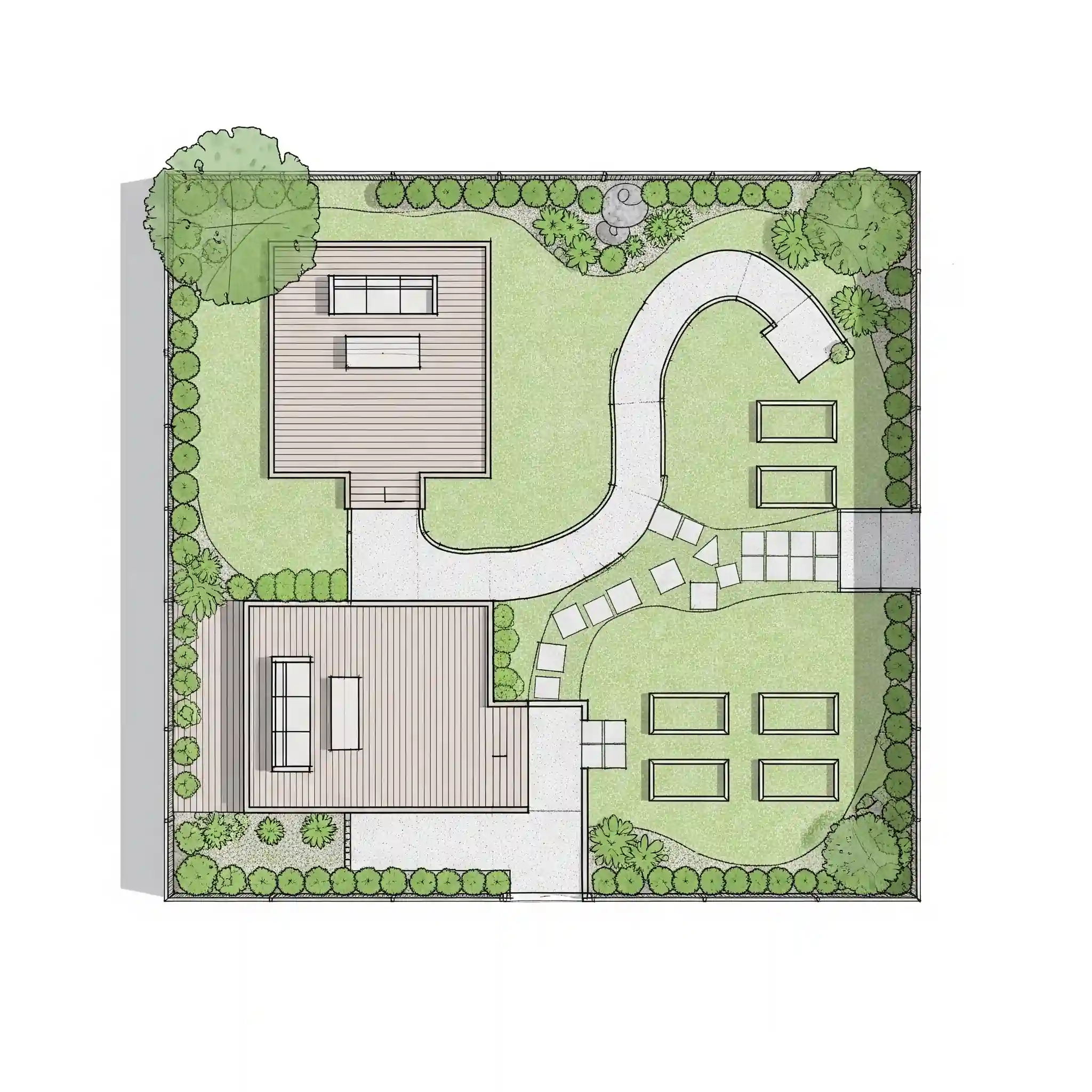
Third step is layering the “Flesh” (softscaping/plants).
It’s time to add the “flesh,” the live, breathing plants, once the bones are set. Planting in layers by height is the most basic idea behind attractive design. See it like organizing a group for a class photo. To ensure everyone could be seen, you positioned the smallest people in the front and the tallest people in the rear. Garden beds produce a lush, full look exactly the same manner.
- First layer: the “Backbone” (Trees and Large Shrubs). Nestled in the rear of the boundary, these are the highest elements. They are employed for structure, height, screening those awful viewpoints we discussed, and setting the scene for all else. (For instance, crabapple trees, oakleaf hydrangeas, viburnums).
- Second layer: The “Body” (medium-shrubs and perennials). Your garden bed’s major, middle layer is this one. These are the workhorses supplying most of the color, texture, and seasonal interest. Examples are coneflower, salvia, peony, ornamental grass.
- Third layer: the “Shoes,” groundcovers and edging plants. Right in the front of the border, these are the shortest plants. Their responsibilities include gradually spreading over walls, softening the rough edges of walks and patios, controlling weeds, and giving the whole composition a polished, finished aspect. (For instance: Lady’s Mantle, Sedum, Creeping Thyme, Heuchera).

Finishing Notes: Advice on Improving Your Design
You have a clear strategy now. These basic “secret weapons” created by designers will transform good to great.
Establishing a focal point
A garden shares with every good room a focal point. This one, arresting detail is meant to purposefully grab the eye and convey arrival or destination. It might be a gorgeous urn, a little bubbling water feature, a specimen tree with distinctive bark (like a Paperbark Maple), or a vibrantly colored Adirondack chair at the end of a trail. It provides the eye somewhere to relax and lends intentionality to the design.

Repetition
Repeat a major plant, color, or shape in multiple locations throughout the garden to establish a sense of calm, rhythm, and cohesiveness as well as to make your design seem deliberate rather than random. Planting three separate groupings of the same decorative grass spaced along a long border is significantly more strong and calming to the eye than planting one here, and another single, different plant there. Repetition keeps the whole picture together.

Thinking in Threes (and Fives, and Sevens)
Nature seldom plants in neat, even numbers. Arranging perennials or small shrubs in odd-numbered groupings (3, 5, 7) seems more natural and aesthetically pleasant than planting in couples or straight lines of four. Your plantings will look more professionally designed and lush right away using this basic trick.
Finish
Garden design is not about learning difficult Latin names or relying just on natural artistic ability. It is a deliberate process. It’s about being a good observer, designing for your actual lifestyle, and using a few basic, layered techniques to produce a home that is both beautiful and especially yours. Though you now have a clear, reasonable foundation to tackle any empty space with confidence and inventiveness, the fear of the blank canvas is genuine.
This post on Basic Garden Planning: Layout and Design for Beginners will provide you with the tools to start designing a beautiful garden rather than just fantasize about one.
Frequently asked questions
I have a rather little garden. Can I apply these ideas still?
Perfect! Actually, in a compact area where every piece is clear-cut and must count, these ideas are even more crucial. A little garden might seem bigger, more lush, and more useful depending on good planning. Emphasize creative ideas include vertical gardening with trellises, selecting dwarf plants, and making sure every single element—from a path to a pot—has a clear and defined use.
In garden design, what most mistakes novices make?
Ignoring the planning stage completely is the most often made error. Using the “impulse buy” strategy, one visits a nursery, purchases a selection of aesthetically pleasing individual plants that fit that day, and then brings them home and dots them throughout the yard without any idea for where they should go or, more importantly, how big they will finally grow. This results in a disorganized, jagged appearance and, ultimately, plants inappropriate for their needs (sun-lovers in shadow, etc.).
With what color palette should I design my garden?
Designers often utilize a basic approach whereby they begin with two or three colors they enjoy. For a strong, high-energy style, pick complementary colors—that is, those opposite each other on the color wheel—purple and yellow. For a more calm and harmonic sense, you might also use complementary colors—that is, those that run adjacent on the wheel—blue, purple, and pink. Remember too that green is a color! A smart approach to add interest that lasts all season is using plants with varying tones of leaves, from chartreuse to deep blue-green.
Should I divide my garden or plan and install it all at once?
Although most experts would advise having a master design for the entire garden so you know how the several areas would finally interact with one another, you should really apply it in stages over time. This helps the project to be physically and financially more under control. Start with the “bones”—that is, as if building a patio or excavating the major garden beds. You can concentrate on tree and shrub planting in the next season. You can fill in the perennials the season following that. Gardening is a trip, not a race.


