

Spotted Waxy Bumps on Your Plants? How to Identify and Eliminate Scale Insects

Learn to identify scale insects by type, detect the crawler window, and eliminate infestations with the right treatment at the right time — indoors and out.
You notice small, waxy bumps on a plant stem — brown, tan, or off-white, fixed in place. When you press one with a fingernail, it either smears (soft scale) or pops off as a hollow shell (armored scale). Either way, that single detail tells you more about how to treat the infestation than anything else.
Scale insects are among the trickiest garden pests because they hide in plain sight, rarely move, and have a biology that makes most treatments useless unless you act at exactly the right moment. There are over 8,000 scale species worldwide, and more than 25 are established in UK gardens alone. In North America, they infest everything from potted orchids to mature oak trees.
This guide walks you through identification, life cycle timing, and treatment — including when not to treat, which is the mistake most gardeners make.
Hard Scale vs. Soft Scale: The Distinction That Drives Every Treatment Decision
Scale insects split into two families with fundamentally different biologies — and that difference determines which treatments work and when.

Three pre-planned garden beds, free
Stop staring at empty beds: printable plans with exact layouts, plant lists and planting calendars — yours free from the Garden Library.

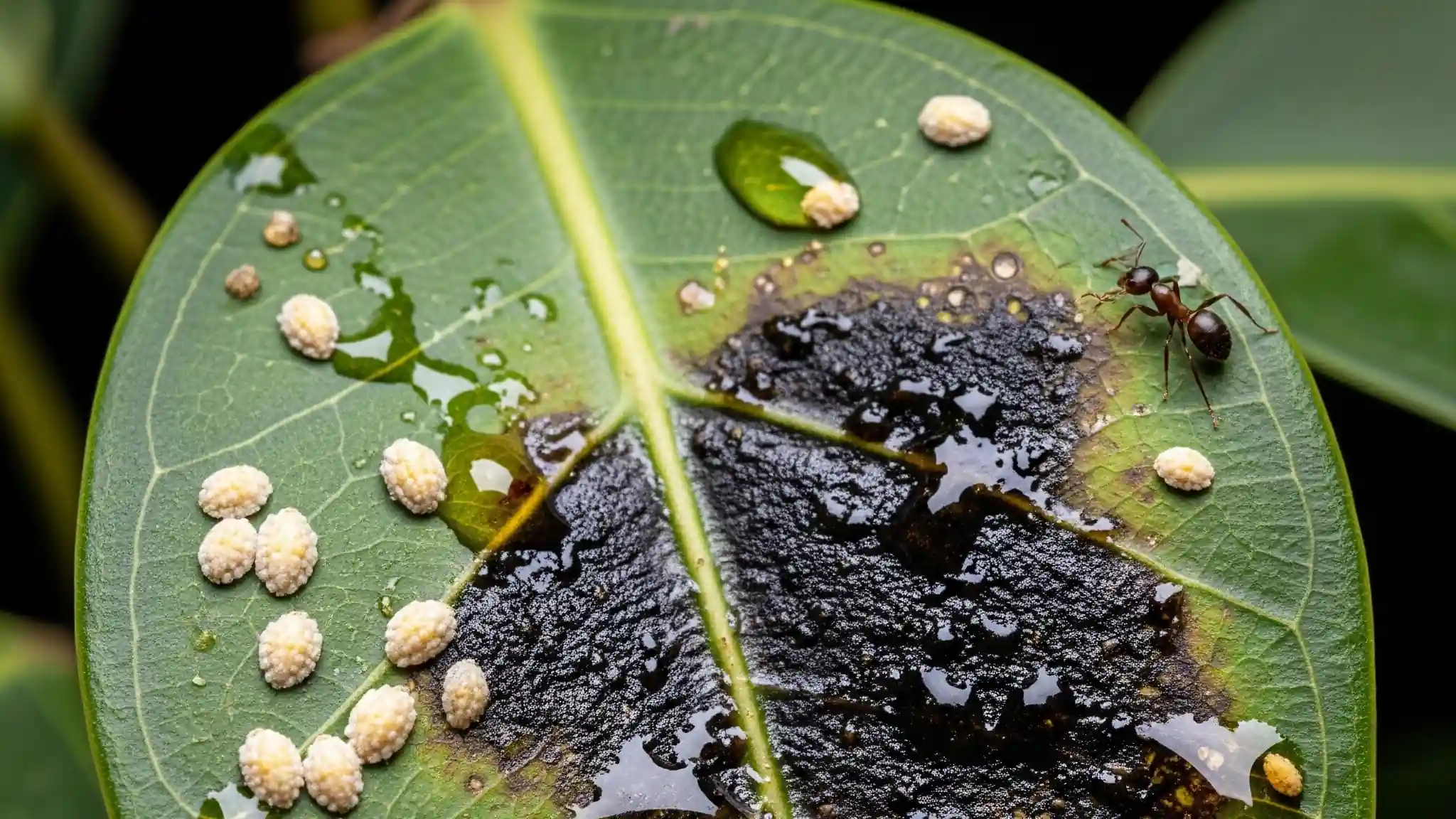
Soft scales (family Coccidae) have a leathery, flexible wax covering that remains permanently attached to their bodies. They range from 1/8 to 1/4 inch long, often dome-shaped, and many resemble miniature tortoise shells. The critical identifier: soft scales produce honeydew — a sticky, sugary excretion that drips onto leaves below and quickly develops a coating of black sooty mold. If you see sticky leaves with dark patches directly under a pest cluster, you are dealing with soft scale. According to the University of Maryland Extension, soft scales feed by piercing phloem tissue and siphoning plant fluids; they retain their legs even as adults and can move slowly when disturbed.
Armored (hard) scales (family Diaspididae) are smaller — typically 1/16 to 1/8 inch — and their protective shell is a rigid, waxy armor that sits over the insect but is not attached to it. When you pry off the shell, the insect body falls away separately. Armored scales do not produce honeydew. They feed on individual plant cells rather than phloem sap, and their feeding directly kills cells, which is why UMN Extension notes that armored scales cause more direct plant injury than soft scales. Because they lack the honeydew signal, armored infestations are often detected later — only when leaf yellowing or branch dieback becomes obvious.
One more distinction matters for treatment timing: soft scales typically complete one generation per year outdoors, while armored scales can cycle through multiple generations, keeping pressure on plants throughout the growing season.
7 Common Scale Species and the Plants They Target
Knowing the species narrows down host plant risk and confirms treatment timing. These are the most frequently encountered in North American and UK gardens:
| Species | Type | Appearance | Primary Hosts |
|---|---|---|---|
| Brown Soft Scale (Coccus hesperidum) | Soft | Oval, tan to light brown, 3/16″ long | Orchids, ferns, citrus, pothos, 400+ genera |
| Cottony Maple Scale | Soft | Brown body, distinctive white cottony egg sac | Maple, honeylocust, dogwood, linden |
| Magnolia Scale | Soft | Large (up to 1/2″), pink-brown, waxy bloom | Magnolia exclusively |
| Oystershell Scale | Armored | Gray-brown, oyster shell shape, 1/8″ | Ash, lilac, dogwood, apple, willow |
| Euonymus Scale | Armored | Males white elongated, females brown; heavy colonies | Euonymus, pachysandra, bittersweet |
| San Jose Scale | Armored | Circular, gray, 1/16″; red-orange beneath | Apple, pear, peach, cherry, ornamental trees |
| Fern Scale (Pinnaspis aspidistrae) | Armored | Females brown pear-shaped; males white, create ‘snowy flocking’ | African violets, palms, aglaonema, 139+ genera |
How to Identify Scale Insects: Symptoms and Diagnostic Table
Scale infestations announce themselves through a predictable sequence of symptoms that escalate from subtle to severe. Most gardeners miss the early signs because scale insects blend into bark and stem tissue almost perfectly — armored scales in particular often match the color of the surface they colonize.
Start by running your fingers along stems and the undersides of leaves. Scale feels like a roughened, scabby texture rather than the smooth surface of healthy plant tissue. Use a hand lens: if the bumps have a symmetrical, shell-like structure with a defined edge, they are scale — not a lenticel, bark nodule, or disease lesion.
Use this diagnostic table to confirm what you are seeing:
| Symptom | Cause | What It Means |
|---|---|---|
| Sticky film on leaves or furniture below plant | Honeydew from soft scale feeding | Soft scale infestation; check stems directly above sticky areas |
| Black powdery coating on upper leaf surface | Sooty mold colonizing honeydew | Active soft scale; mold is secondary — treat the scale to stop mold |
| Yellowing leaves with no watering or nutrient explanation | Phloem disruption (soft) or cell death (armored) | Moderate to heavy infestation; inspect stems and leaf veins closely |
| Brown or tan crusty bumps on stems or twigs | Mature armored scale shells | Established armored scale colony; check for crawlers in spring |
| Ants on plant stems in large numbers | Ants farming honeydew from soft scale | Soft scale almost certainly present; ants actively protect scale from predators |
| Branch dieback or wilting despite adequate water | Severe scale feeding blocks nutrient flow | Heavy infestation — prune affected branches and treat immediately |
| ‘Snowy flocking’ on fern fronds or houseplant leaves | White male fern scale covers | Fern scale (Pinnaspis aspidistrae) — common on indoor plants |
| Reduced new growth in spring | Overwintering armored scale depleted stored energy | Check twigs for flat, gray or brown shells from previous season |
The Life Cycle: Why Crawlers Are Your Only Reliable Treatment Window

Scale insects develop through three stages: eggs, crawlers (mobile nymphs), and adults. The adult female you can see on your plant is already protected by her waxy armor — contact sprays slide off or cannot penetrate it. This is why timing matters more than product choice.
Here is how the cycle works, and where the window opens:
Eggs: Females lay eggs beneath their protective covering or within cottony wax secretions. A single female can produce hundreds of eggs over 3-4 weeks before she dies.
Crawlers: When eggs hatch, the nymphs are called crawlers because they are the only stage with functioning legs. They actively move across plant surfaces searching for a feeding site, and they are the only stage that spreads infestations to new plants. Crucially, they have no protective shell yet. This makes crawlers highly vulnerable to contact insecticides, horticultural oils, and insecticidal soaps — treatments that are nearly useless against armored adults.
Settlement and shell development: Once a crawler finds a feeding site and inserts its mouthparts, it begins secreting the wax shell and loses its legs within days. From this point on, it is essentially stationary and increasingly protected. Any contact spray applied after shell formation provides minimal benefit.
The crawler window typically lasts 2-4 weeks. For outdoor armored scales, this usually falls in spring as temperatures warm and new leaves emerge — Clemson HGIC describes it as the period ‘when new leaves begin to expand.’ Soft scales vary more by species. Greenhouse and indoor species breed continuously year-round, so crawlers can appear at any time according to the RHS.
How to detect crawlers: They are tiny — often under 1mm — and mobile, which is the paradox: the most vulnerable stage is the hardest to see. Two detection methods work reliably:
Stop missing your zone's planting windows.
Select your US zone and month — get a complete checklist of what to plant, prune, feed, and protect right now.
→ View My Garden Calendar- Double-sided tape: Wrap a narrow band of clear double-sided tape around an infested stem, sticky side out. Check after 48 hours. Caught crawlers appear as tiny reddish or yellowish specks. UMN Extension recommends this for confirming when crawlers are active before applying treatment.
- White paper test: Hold a sheet of white paper beneath infested branches and shake the plant gently. Crawlers drop onto the paper and move slowly enough to identify.
How to Get Rid of Scale Insects: Step-by-Step Treatment Methods
Treatment success depends on matching method to life stage. Here is the complete sequence:
Step 1 — Physical removal (all stages). For small infestations or containerized plants, manually scrape adults off with a soft-bristled toothbrush, a cotton swab dipped in 70% isopropyl alcohol, or a fingernail. The alcohol penetrates and desiccates the scale body. Do not use ethanol or methanol — they absorb into plant tissue and cause damage. Dispose of removed scale in soapy water, not on the ground. I find this approach most satisfying on orchid canes — 20 minutes with a swab removes scale more completely than any spray and lets you confirm the infestation extent at the same time.
Step 2 — Prune heavily infested stems. If a branch carries dense scale colonies, removing it eliminates hundreds of potential egg-layers before they cycle again. Cut at least 2 inches below the infestation into clean wood and dispose of cuttings in sealed bags.
Step 3 — Apply horticultural oil at the crawler stage. This is the most effective contact treatment. Horticultural oil works by plugging the spiracles (breathing pores) through which scale insects respire — it suffocates them rather than poisoning them. Iowa State University Extension specifies a safe application window of 40-90°F; outside this range, oil can damage foliage. Mix at 1% dilution during the growing season (per UMD Extension) and ensure thorough coverage of stems, bark, and leaf undersides where crawlers settle. You will need at least two applications, 10-14 days apart, to catch any late-hatching crawlers. For more on application technique, see our guide on using neem oil safely and effectively.
Step 4 — Insecticidal soap as a complement. Insecticidal soap works the same way as oil — contact-only, effective on crawlers, not adults — and is less likely to cause phytotoxicity on sensitive plants. It breaks down quickly (no residual), so timing to crawler emergence is equally critical. Our insecticidal soap guide covers dilution rates and safe plant lists.
Step 5 — Systemic insecticides for severe infestations. When contact methods fail or infestations are heavy on large shrubs or trees, soil-applied systemic insecticides (imidacloprid or dinotefuran) move through the plant’s vascular system and kill scale at any life stage — including adults — by contaminating the sap they feed on. Clemson HGIC recommends combining soil-applied dinotefuran with an oil spray for particularly heavy armored scale infestations. However, systemics carry important restrictions — see the next section.
Sooty mold: Once you eliminate the scale, honeydew production stops and sooty mold stops spreading. Existing mold can be wiped from leaves with a damp cloth or rinsed off with water. It will not disappear instantly but should fade within a few weeks as the leaf surface weathers. If mold persists, the scale infestation has not been fully controlled — check again for living insects. You can read more about sooty mold and other secondary infections in our guide to preventing and treating fungal infections.
When NOT to Treat: The Mistakes That Make Infestations Worse
Over-treating is as common a problem as under-treating. Three scenarios consistently backfire:
Applying horticultural oil outside the temperature window. Oil applied above 90°F or when plants are drought-stressed causes phytotoxicity — scorching that looks worse than the pest damage. Iowa State University Extension identifies specific sensitive plants: Japanese maple, red maple, sugar maple, redbud, beech, and evergreens with waxy blue foliage (blue juniper, blue spruce). If these plants have heavy scale infestations, use insecticidal soap instead, or time oil applications to cooler early-morning temperatures.
Applying systemic insecticides when plants are in flower. Imidacloprid and dinotefuran translocate into pollen and nectar. Applied to a flowering plant, they reach pollinators. UMN Extension specifically flags linden, crabapple, and other bee-attractive trees — apply systemics only after flowering ends. This aligns with broader integrated pest management principles covered in our IPM guide.
Treating adults with contact sprays and calling it done. If you spray during the dormant season or at the wrong point in the cycle, the only thing you accomplish is eliminating the natural predators that would otherwise help you. Broad-spectrum contact insecticides (pyrethroids, carbaryl) kill parasitic wasps and lady beetles that prey on scale — removing your biological allies while barely touching the protected adults. Reserve broad-spectrum treatments for crawler-stage applications only.
When to tolerate rather than treat: The RHS takes a pragmatic position that most US gardening sources skip: healthy plants can tolerate light scale populations. A few brown bumps on a vigorous shrub that shows no symptoms — no yellowing, no sooty mold, no stunted growth — may not warrant treatment. Natural predators frequently bring small infestations under control without intervention. Monitor for 2-3 weeks before treating; if the population is stable and the plant looks healthy, let the predators work.
Indoor Houseplant Treatment: What Changes
Scale on houseplants requires a different approach because the indoor environment removes both the natural predator pressure and the seasonal timing cues that define outdoor treatment windows.
Brown Soft Scale (Coccus hesperidum) is the most common indoor species — the University of Maryland Extension reports it infests over 400 plant genera and is especially prevalent on orchids, citrus, ferns, and pothos. Because indoor scale breeds continuously (no winter dormancy), you can encounter crawlers at any time of year.
Practical steps for houseplant scale:
- Quarantine new plants for 3 weeks before placing them near established plants. Scale crawlers travel on clothing and air currents over short distances.
- Manual removal first: For small infestations, dab each scale with a cotton swab soaked in 70% isopropyl alcohol. This is often sufficient and avoids any risk of plant damage from sprays.
- Use indoor-labeled horticultural oil or insecticidal soap: Many outdoor pesticide formulations are not approved for indoor use. Check the label. Ferns are particularly sensitive — test on a single frond and wait 72 hours before treating the whole plant.
- Systemic options: Imidacloprid granules or soil drenches are available for non-edible houseplants and provide longer residual control. Do not use on edible plants.
- When to discard: If a small pot plant has scale on every stem and the roots are weakened, it is usually faster and cheaper to discard it than to treat it. Scale can transfer from heavily infested plants even after treatment if any egg masses survive.
Scale insects and mealybugs are closely related and often confused — mealybugs are covered in white waxy filaments and move visibly when disturbed, while scale is stationary and shell-covered. Both respond to similar treatments.
Biological Controls: Natural Enemies That Do the Work for You
Scale insects have a large suite of natural enemies, and preserving them is often more effective than any spray program for established gardens.
Key predators:
- Parasitic wasps (particularly Aphytis and Encarsia species) lay eggs inside scale bodies; the hatching larvae consume the scale from inside. These small wasps are highly host-specific and pose no risk to other insects or plants.
- Lady beetles: Chilocorus species are specialized armored scale predators; Hyperaspis species target soft scales. Adults pierce the scale covering and consume the insect body; larvae consume eggs and crawlers.
- Lacewing larvae: Effective against crawlers specifically, consuming 200-600 scale insects during their 2-3 week development period.
- Steinernema feltiae nematodes: Available commercially in the UK for soft scale on indoor and greenhouse plants. The RHS lists this as an approved biological control for soft scale, though it notes caution regarding potential non-target impacts.
One practical note: ants actively protect scale from predators by attacking and driving away lady beetles and parasitic wasps. If you see ants clustering on infested branches, apply a sticky barrier (such as Tanglefoot) around the base of the stem to exclude them. Eliminating ant access can allow natural predator populations to recover and suppress scale on their own.
Prevention: Stopping Scale Before It Starts
Scale insects exploit two entry points: stressed plants and new plant material. Closing both reduces the risk substantially.
Keep plants vigorous. Scale infestations are worse on plants under drought stress, nutrient deficiency, or crowding. A plant with adequate irrigation, appropriate fertilization, and good air circulation around stems is far less vulnerable. Clemson HGIC emphasizes this: proper mulching, irrigation, and avoiding stress are the foundation of scale prevention.
Inspect new plants before purchase and at arrival. Check stems and leaf undersides for waxy bumps, sticky residue, and sooty mold. Quarantine all new plants for at least 3 weeks before integration, whether indoors or outdoors.
Dormant oil applications. An annual dormant oil spray in late March or early April (before bud break) kills overwintering scale eggs and early-stage crawlers before they establish. Iowa State University Extension recommends applying as close to bud break as possible — not in warm February spells when insects are not actively respiring. This single preventive application dramatically reduces summer scale pressure on trees, shrubs, and roses.
Avoid excess nitrogen fertilizer. Lush, soft new growth is more attractive to crawlers than the tougher, slower-growing tissue produced by moderate fertility. Over-fertilized plants tend to host larger scale populations.
Frequently Asked Questions
Can scale insects spread between plants?
Yes — crawlers move on their own over short distances and spread on clothing, tools, and air currents. They are the primary dispersal stage. Quarantine new plants and avoid moving infested material near clean plants.
How long does it take to get rid of scale?
Expect 4-8 weeks for a managed infestation to show clear improvement, with 2-3 treatment applications targeting crawlers. Large trees with heavy armored scale infestations may take a full growing season plus dormant oil treatment the following spring before pressure drops to tolerable levels.
Can I use neem oil on scale insects?
Yes. Neem oil works as a contact oil (suffocating crawlers) and also contains azadirachtin, which disrupts molting in nymphs. It is most effective at the crawler stage. Apply at the labeled rate (typically 2 teaspoons per quart of water with a few drops of liquid dish soap as an emulsifier) and maintain the 40-90°F application window. See our neem oil vs insecticidal soap comparison for help choosing between them.
Is scale dangerous to people or pets?
Scale insects pose no direct risk to people or pets. Honeydew may attract insects like wasps and ants, and sooty mold is unsightly, but neither is harmful beyond the cosmetic impact on plants.
My plant still has black mold after treatment. Did the treatment fail?
Not necessarily. Sooty mold is already present on the leaf surface when you treat — it does not disappear immediately even after the scale is eliminated, because the mold itself is still physically attached. Once honeydew stops being produced, the mold stops spreading and eventually weathers off over several weeks. If new black deposits continue appearing on leaves, the scale infestation is still active and needs another treatment pass.
Sources
- University of Maryland Extension — Introduction to Scale Insects
- University of Minnesota Extension — Scale Insects on Trees and Shrubs
- Iowa State University Extension — Scale Insects
- Clemson Cooperative Extension HGIC — Armored Scale Insects
- Royal Horticultural Society — Scale Insects: Identification and Control
- University of Maryland Extension — Scale Insects on Indoor Plants
- Iowa State University Extension — Horticultural Oil Sprays


