

How to Find Mealybugs Hiding on Your Plants — and Eliminate Every One

Most mealybug treatments fail because they miss where pests hide. Find every hiding spot — including roots — and the staged treatment plan that works.
Run a flashlight along the base of your plant’s stems. If you spot anything that looks like white powdery lint packed into the crevices where leaves meet the stem, you’ve found a mealybug colony. Most gardeners see this and immediately reach for a spray. Most of those sprays fail, because the colony visible in the leaf axil is rarely the whole problem.
Mealybugs hide in more than a dozen distinct locations on a plant. Some infestations establish entirely underground. Others spread through a collection because ants actively carry the mobile nymph stage from plant to plant. And the most popular systemic insecticide sold for houseplant use — imidacloprid — consistently underperforms on mealybugs, for reasons that come down to basic chemistry.

This guide walks you through the complete inspection process, explains the biology that determines which treatments work, and gives you a triage framework based on infestation severity. Sources include NC State Extension, the Royal Horticultural Society, Michigan State University Extension, and peer-reviewed research on biological control. For a broader look at garden pest identification, our 30-insect pest identification guide covers the full range of common threats.
Recognizing Mealybugs: What You’re Actually Looking At
The white coating that makes mealybugs instantly recognizable is not the insect itself — it’s armor. Adult female mealybugs are soft-bodied, oval, up to 4mm long, and covered in a white waxy secretion that serves two purposes: it prevents the insect from drying out and it repels water-based contact insecticides [1]. The wax beads off most sprays without penetrating, which is why treating a visible colony and seeing it re-emerge three weeks later is so common.
Beneath the wax, the bodies are typically pale pink or yellow. The colony edges are fringed with short waxy filaments, giving the mass a fluffy, cotton-like appearance. North American gardens and households are home to several species [1]:
- Citrus mealybug (Planococcus citri) — the most common indoor species; up to 3mm; females lay 300–600 eggs each
- Longtailed mealybug (Pseudococcus longispinus) — identified by tail filaments as long as its body; favors dracaena; heavy infestations cause wilting
- Striped mealybug (Ferrisia virgata) — two dark stripes running the length of its back; commonly found on outdoor azaleas and hollies
- Root mealybugs (Rhizoecus spp.) — subterranean; covered in detail below
One stage looks nothing like the rest: the first-instar nymph, called a crawler, is yellow to orange, highly mobile, and completely unprotected by wax. Most gardeners scanning for white fluff miss them entirely — but crawlers are the stage that determines whether a treatment program succeeds or fails.
Where Mealybugs Hide: The Complete Inspection Guide
Mealybugs don’t distribute evenly across a plant. They seek the most sheltered microenvironments available, which means the visible colonies on outer surfaces are often the satellite population — the main infestation is deeper in.
Above-ground locations to check, in priority order:
- Leaf axils — where a leaf meets the stem. The enclosed crevice provides physical shelter and proximity to the phloem for feeding. Start every inspection here.
- Stem joints and growing tips — new, soft tissue at each node. Check every node along the stem, not just the shoot tips.
- Crown and base — the junction between soil and stem, where humidity tends to be higher and visibility lowest.
- Undersides of leaves — especially along the midrib and major veins, where the surface texture anchors egg sacs.
Orchid-specific locations: Phalaenopsis and other orchids are particularly vulnerable. Mealybugs colonize aerial roots, inside pseudobulb sheaths, along the flower spike, and between tightly overlapping leaves. Lifting each bract takes 30 seconds — skip it and a colony tucked inside the sheath can persist through months of surface treatment.
Succulent rosettes: In Echeveria, Haworthia, and similar species, the tight leaf-packing creates ideal shelter near the rosette center. Use a flashlight and gently separate the outer leaves to inspect the core.
Follow the sooty mold trail: Black or dark gray patches appearing on leaves that were previously clean are caused by sooty mold fungus colonizing mealybug honeydew that dripped below [2]. Follow the trail upward — the source colony is somewhere above the affected leaves.
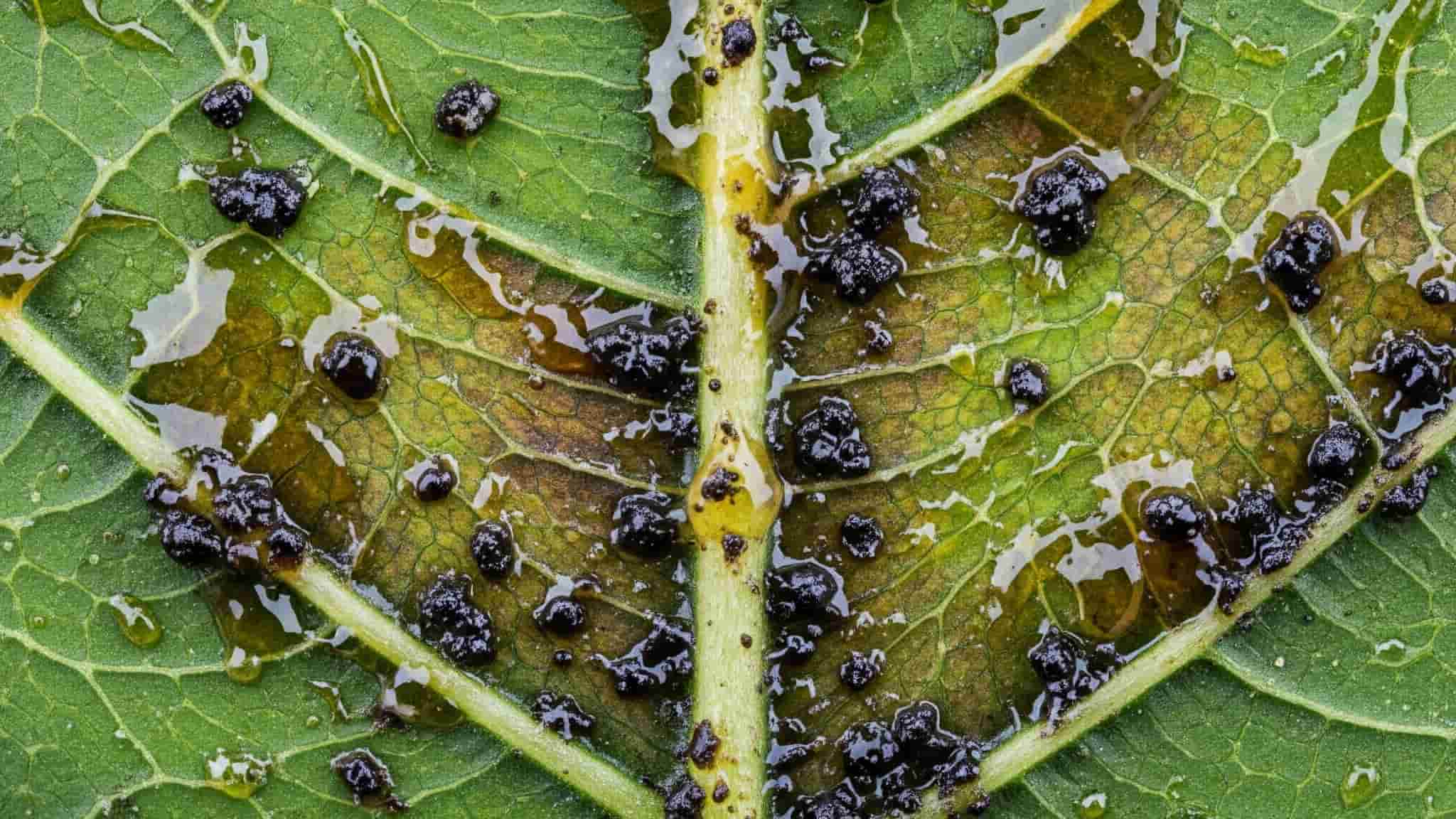
Inspect healthy plants monthly; weekly if you’ve had a previous infestation. A 10x hand lens distinguishes mealybug colonies from lint, residue, or benign fungal specks immediately.
Root Mealybugs: The Infestation You Won’t See
Root mealybugs break every rule that applies to their above-ground relatives. They can’t be spotted during routine visual inspection. They cause damage that mimics drought stress and overwatering simultaneously. And surface spray programs never reach them.
Root mealybugs belong to the genus Rhizoecus — four species are common in North America: R. falcifer, R. americanus, R. hibisci, and R. pritchardi [4]. Unlike glasshouse species, they are smaller (1/16 to 1/8 inch), bluish-white with a powdery white bloom, and adapted to underground life with short antennae and minimal eyes [4].


Symptom pattern: Plants with root mealybugs typically present as chronically underperforming despite correct care — leaves yellow or wilt even with appropriate watering, growth stalls, and fertilizer seems to have no effect. These symptoms match a dozen other problems, which is why root mealybugs often go undiagnosed for months.
The drainage hole check: When you water a heavily infested plant, root mealybugs sometimes crawl out through the drainage holes to escape the disturbance. NC State Extension notes this as a useful diagnostic observation [4]. Check the drainage tray after watering before emptying it.
The unpotting check: Gently slide the plant out of its pot and examine the root zone directly. Root mealybug infestation appears as white waxy residue concentrated around roots, often forming patches at root tips and along the root ball surface. The soil itself may show a slight bluish tint from accumulated wax [4].
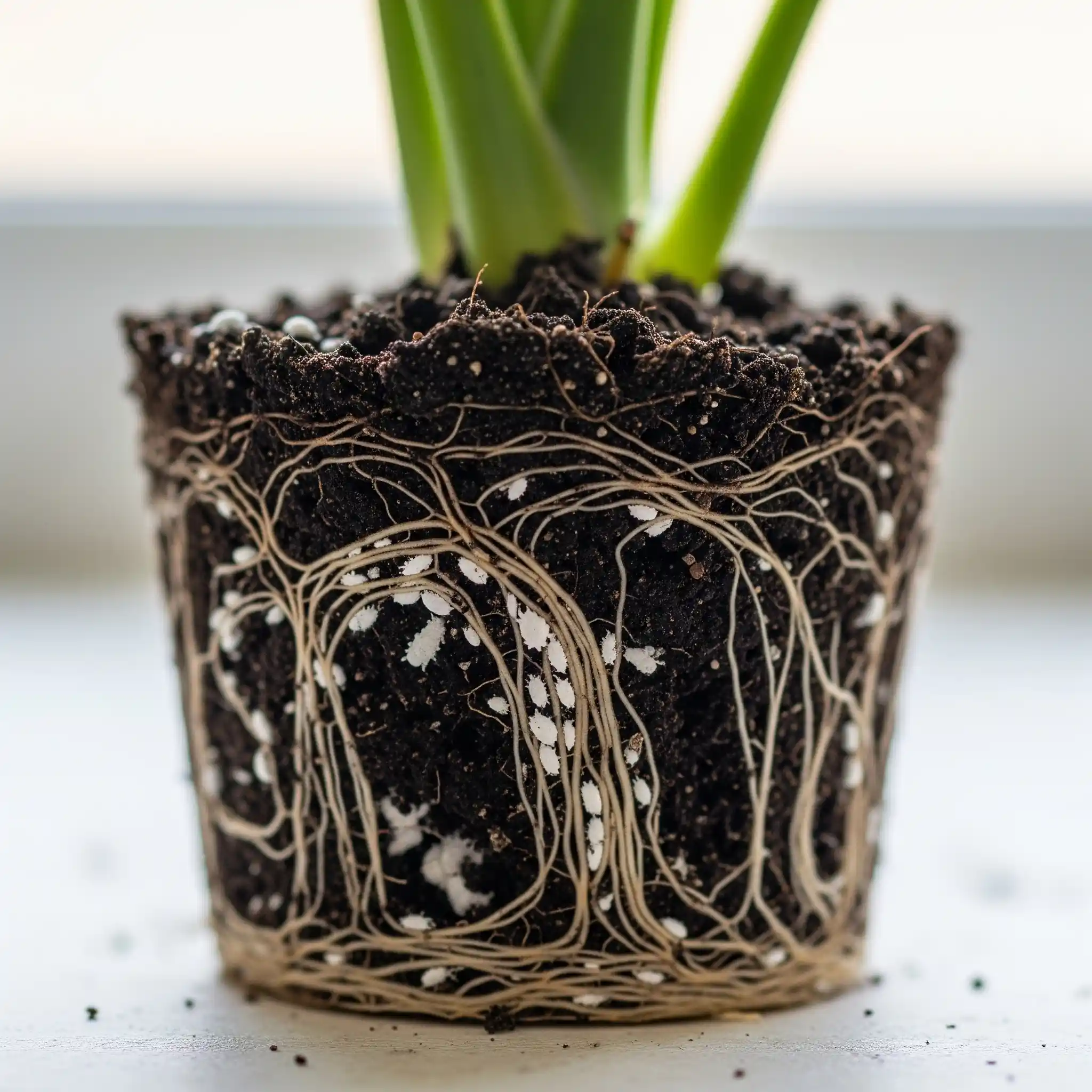
Plants most at risk: African violets are particularly susceptible. Also commonly affected: queen palm, majesty palm, fishtail palm, hibiscus, chrysanthemum, iris, gladiolus, bamboo, and ornamental grasses [4]. For anyone growing African violets indoors, a routine root-zone check every 6–12 months is a practical precaution.
Mealybug Diagnostic Table: Signs, Severity, and First Response
| Symptom | What It Means | Urgency | First Action |
|---|---|---|---|
| White cottony fluff in leaf axils or stem joints | Active colony established | Moderate | Isolate plant; manual removal with alcohol swab |
| Sticky sheen on leaves or surface below plant | Honeydew dripping from above | Moderate | Inspect stems and undersides above affected area |
| Black sooty mold patches on leaves | Established honeydew deposit; active infestation somewhere above | Moderate–High | Trace and treat the source above the mold |
| Stunted or distorted new growth | Feeding damage at growing tips | High | Full inspection; begin spray program |
| Wilting despite correct watering | Possible root mealybug infestation | High | Drainage hole check; unpot for root inspection |
| White powdery coating on soil surface | Root mealybug infestation likely | High | Unpot; apply systemic insecticide; repot in sterile mix |
| Small yellow-orange mobile insects on stems | Crawlers actively dispersing — peak spread phase | Very High | Immediate isolation and spray program |
| Ants repeatedly climbing plant stems | Ants farming honeydew-producers; mealybugs likely present | High | Identify sap-feeder; manage ants before using biocontrols |
| White waxy residue on roots during repotting | Confirmed root mealybug infestation | High | Systemic treatment; fresh sterile potting mix |
The Mealybug Lifecycle: Why Your First Treatment Usually Fails
Most gardeners expect one spray to solve the problem. The mealybug lifecycle explains why that expectation is always wrong.
Egg stage: Females lay 200–600 eggs in a waxy egg sac attached to plant material [1]. The sac’s coating protects eggs from most contact insecticides. Sprays applied to a visible colony kill exposed adults and nymphs but leave the egg sac intact.
Crawler stage: Newly hatched first-instar nymphs — called crawlers — are yellow to orange, unprotected by wax, and highly mobile. This is the vulnerability window. Michigan State University Extension confirms that nymphs at this stage are most susceptible to insecticides precisely because they haven’t yet formed their waxy covering [5]. The problem: crawlers settle down and begin wax production within a few days of hatching.
Nymph stages 2–4: As nymphs develop through subsequent instars, their waxy layer thickens progressively. By the third instar, contact insecticide efficacy has declined substantially.
Adult female: Fully waxy, stationary, and feeding on plant phloem. One critical detail here: egg-laying females stop feeding while depositing their eggs [3]. Systemic insecticides make plant sap toxic to feeding insects — but a non-feeding female isn’t consuming any sap, so she survives the treatment window.
Overlapping generations: Under warm indoor conditions, mealybugs complete a generation every 6–10 weeks [1]. Multiple generations overlap continuously, meaning a plant always contains a mix of eggs, crawlers, nymphs, and adults simultaneously. This is why treatment programs need to run for 8–12 weeks with repeated applications — you’re targeting each generation as it cycles through the vulnerable crawler stage.
Stop buying the wrong pot size.
Enter plant type and growth goal — get exact pot diameter, depth, and volume before you spend a cent.
→ Find the Right PotThe ant factor: Outdoors and in conservatories, ants actively farm mealybugs for their honeydew. They carry crawlers to new plants, tend the colonies, and aggressively drive away biological control agents including Cryptolaemus ladybirds and parasitic wasps. No biocontrol program will work while ants are defending the mealybug population. If you see ants repeatedly climbing a plant, they’re protecting a pest colony — manage the ants before introducing any beneficial insects.
Treatment Triage: Match Your Response to Severity
Before reaching for any product, assess scale. Over-treating — especially with broad-spectrum insecticides — eliminates the natural enemies that otherwise suppress future populations.
Mild infestation (1–2 plants, small isolated colonies):
- Manually remove visible colonies with a cotton swab dipped in 70% isopropyl alcohol
- Isolate the affected plant from the rest of your collection immediately
- Inspect all neighboring plants for crawlers
- Monitor weekly for 6–8 weeks
- If colonies re-establish, escalate to a spray program
Moderate infestation (spreading across multiple plants, colonies throughout a single plant):
- Begin a spray program with insecticidal soap or neem oil, applied weekly or bi-weekly
- Ensure full coverage: leaf axils, stem joints, crown, undersides of leaves
- Consider biological controls (Cryptolaemus ladybird) if you’re growing indoors without pollinators at risk
- Run the program for 8–12 weeks minimum
Severe infestation (plant-wide, root zone affected, visible plant decline):
- Assess whether the plant is worth saving versus disposal
- For root-affected plants: unpot, wash roots under running water, repot in fresh sterile mix, apply systemic insecticide
- For aerial infestations at this scale: choose thiamethoxam or dinotefuran over imidacloprid (see next section)
- Dispose of heavily infested material in sealed bags — not in compost
How Each Treatment Method Works — and Where Each Fails
Rubbing Alcohol (70% Isopropyl)
Applied with a cotton swab, rubbing alcohol kills mealybugs by dissolving their waxy protective coating, causing rapid dehydration. The counterintuitive finding: 70% concentration outperforms higher concentrations because the added water slows evaporation, extending contact time before the solution dries. University extension guidance consistently recommends 70% isopropyl as the standard working concentration for contact mealybug control.
For whole-plant application, dilute to 10–25% alcohol-to-water to reduce phytotoxicity. Ferns, succulents with fine leaves, and any plant already under drought stress can scorch at higher concentrations. Reapply weekly — alcohol leaves no residual protection and must contact each insect directly.
Insecticidal Soap
Commercially available insecticidal soaps use potassium salts of fatty acids to disrupt insect cell membranes and remove the protective waxes that cover insects, resulting in dehydration [7]. They perform best against crawlers and young nymphs before the waxy layer builds — a well-timed application during crawler emergence can be highly effective.
Apply at 2.5–5 tablespoons per gallon of water. Clemson Cooperative Extension recommends early morning or late afternoon applications to avoid heat-amplified phytotoxicity [7]. Repeat every 4–7 days. Hard water reduces effectiveness — use filtered or rainwater if your tap water is alkaline. Sensitive plants to test first: begonias, fuchsias, and geraniums. For a full breakdown, see our guide to insecticidal soap for garden pest control.
Neem Oil
Neem works through two separate mechanisms: the active compound azadirachtin disrupts mealybug feeding, molting, and reproduction; the oil component physically smothers crawlers and egg sacs. It’s most effective as a preventive measure or for early-stage treatment — the oil can’t penetrate heavy waxy deposits on established adult colonies. Mix at label rates (typically 2–4 tablespoons per gallon with a few drops of dish soap as emulsifier) and apply in the evening to reduce phytotoxicity risk. For a direct comparison with insecticidal soap, see our neem oil vs. insecticidal soap guide.
Systemic Insecticides — The Solubility Data
Research published by Greenhouse Product News tested five systemic insecticides against citrus mealybug [3]. The results came down to water solubility — how efficiently a compound moves through the plant’s xylem to reach feeding insects:
| Active Ingredient | Water Solubility | Mortality at 21–28 Days |
|---|---|---|
| Dinotefuran | 39,000 ppm | >60% |
| Thiamethoxam | 4,100 ppm | >60% |
| Imidacloprid | 510 ppm | Substantially lower |
| Azadirachtin | Very low | <30% |
| Spirotetramat | 29 ppm | <30% |
Imidacloprid’s lower water solubility explains its reputation for disappointment against mealybugs, despite being the most widely sold systemic houseplant insecticide. Applications made July through September perform significantly better than spring applications — higher summer light intensity drives transpiration, which moves the active compound through plant tissue more efficiently [3].
Two important limitations apply to all systemics: egg-laying females stop feeding while depositing eggs, so they survive treatment during that phase [3]. And outdoor applications to flowering plants — or plants that will be moved outdoors — should be avoided because neonicotinoid compounds reach nectar and pollen and pose serious risk to pollinators.
Biological Controls
The mealybug destroyer (Cryptolaemus montrouzieri) is a ladybird beetle whose larvae and adults feed on all mealybug life stages. Available from biological control suppliers, it performs best in enclosed environments (greenhouses, conservatories, indoor growing rooms) where it can establish. The RHS recommends it for UK gardeners from May to September when temperatures are adequate [2]. One important identification warning: the Cryptolaemus larva looks almost identical to a large mealybug — do not remove it by mistake.
Don’t combine Cryptolaemus with green lacewing releases simultaneously. A peer-reviewed study in PMC found intraguild predation — the two species attacking each other — in 76% of interactions [6]. The lacewing larvae dominated most confrontations, particularly third-instar larvae. When adequate prey was available, this predation dropped significantly — but in a newly treated, low-pest environment, releasing both agents at once is counterproductive. Choose one, or use them in sequence [6].
Parasitic wasps in the Leptomastix and Leptomastidea genera provide effective control at lower population levels and work well to prevent re-establishment after initial populations are reduced by other means [2].
When NOT to Treat
Leave it alone if: A vigorous, well-established plant has one or two small colonies with no sign of spreading. The RHS notes that plants can tolerate some level of mealybug pressure [2], and a healthy plant with active natural predators in the garden will often suppress low populations without intervention. Overreacting to a handful of insects eliminates the beneficial predators already present.
Skip systemic neonicotinoids if: The plant is currently in flower, will be moved outdoors during bee activity, or is located near flowering plants bees are visiting. Even soil-applied granules reach nectar as the plant transports the compound through its vascular system.
Don’t combine Cryptolaemus and lacewings simultaneously. The intraguild predation data is clear [6] — releasing both in the same window dilutes the effectiveness of both agents. Pick one predator type per treatment cycle.
Don’t spray contact insecticides and release biocontrols in the same week. Insecticidal soap and neem oil are non-selective — they will kill beneficial insects as readily as mealybugs. Wait at least two to three weeks after the last spray before introducing Cryptolaemus or parasitic wasps.
Avoid broad-spectrum synthetic pyrethroids as a first response. These non-selective insecticides reduce the natural enemy populations that otherwise suppress mealybug rebound after the chemical residue fades — often leaving a worse infestation in the next generation than you started with. Reserve pyrethroids for situations where other options have genuinely failed.
Prevention and Long-Term Management
Quarantine every new plant. The RHS recommends at least one month of isolation for any plant arriving from a nursery, garden center, or another collection [2]. MSU Extension adds that inspection should focus specifically on growing tips and stem-leaf junctions — the primary mealybug hiding sites [5]. Keep a record of what you found, when, and what product you used; patterns become visible over time.
Manage nitrogen fertilization. Soft, sappy tissue produced by excess nitrogen fertilizing provides easy feeding access and richer nutrition for mealybugs. Balanced fertilization produces harder cell walls. This doesn’t mean withholding fertilizer — it means not over-applying, especially to indoor plants with lower light levels that can’t use excess nitrogen productively.
Control ants before deploying biocontrols outdoors. Apply ant bait at the base of pots or around outdoor containers before releasing Cryptolaemus or parasitic wasps. Ant bait placed in early spring works best — colonies are small and workers are actively foraging. With ant pressure managed, biocontrol agents can establish and work without interference.
Keep yellow sticky cards around plants as presence detectors, not severity indicators. MSU Extension notes that adult male mealybugs rarely fly enough to make sticky card counts a reliable measure of population levels [5]. Sticky cards tell you mealybugs are present — they won’t tell you how serious the infestation is.
Inspect monthly and catch crawlers early. Find crawlers before they settle and form colonies, and a single alcohol swab session resolves the problem. Find an established colony with multiple egg sacs and you’re looking at a 12-week treatment program. For an integrated approach combining these methods strategically, our integrated pest management guide covers the full IPM framework.
The Two-Step Approach That Works
Mealybug control fails when the inspection is incomplete and the treatment doesn’t match what you’ve found. Miss root mealybugs and you’re treating only the visible fraction of the infestation. Skip the lifecycle biology and you’re confused when the colony reappears three weeks after you cleared it.
The approach that works is also the least dramatic: inspect thoroughly (including roots on high-risk plants), triage severity before choosing a product, and run whatever program you choose for 8–12 weeks to catch every overlapping generation.
For moderate to severe infestations requiring systemic treatment, the solubility data points toward dinotefuran or thiamethoxam over imidacloprid — and summer applications outperform spring ones. For mild cases, a bottle of 70% isopropyl alcohol and a pack of cotton swabs is genuinely all you need. Match the tool to what you’ve actually found.

Sources
- NC State Extension — Mealybugs
- Royal Horticultural Society — Mealybug (Glasshouse)
- Greenhouse Product News — Mealybugs and Systemic Insecticides
- NC State Extension — Root Mealybugs
- Michigan State University Extension — Mealybug Management in Greenhouses
- PMC — Intraguild Interactions between Cryptolaemus montrouzieri and Chrysoperla carnea
- Clemson Cooperative Extension HGIC — Insecticidal Soaps for Garden Pest Control


