

Red Banana Trees Need 10–15 Months to Flower, but 28°F Can Freeze Them to the Ground — Which US Zones Deliver Fruit?

A red banana plant needs 10–15 months to flower, and 28°F can freeze it to the ground. See which US zones, 9b to 11, can really fruit one.
A red banana plant needs 10 to 15 months to push up its flower stalk and another 80 to 180 days to fill and ripen the bunch. A night below 28°F can freeze it to the ground somewhere in the middle. Those are UF/IFAS Extension’s numbers, and they’re why “hardy in zones 9–11” on a nursery tag promises more than the climate delivers.
Here’s the short version. Zone 10b and warmer gets a red banana through that window in a normal winter. Zone 10a usually does, if you give it a warm wall. Zone 9b is a gamble that depends on how mild the winter turns out, and zone 9a and colder won’t fruit one outdoors without winter shelter. That zone verdict is our reading of the extension thresholds against the USDA temperature bands, not something an extension service has published, so the sections below show the arithmetic and let you check it against your own coldest nights.
What a “red banana tree” actually is
It isn’t a tree. Texas A&M AgriLife Extension calls banana a tropical herbaceous plant: an underground corm topped by a “trunk” made of tightly packed leaf sheaths, which UF/IFAS calls a pseudostem. For freezes, that split decides everything. The pseudostem is above ground and freezes. The rhizome underneath is the part that can regrow.
Sellers list the red-skinned fruiting type as Red Dacca (Logee’s, Daleys Fruit) or Red Cuban (Chestnut Hill Tree Farm). UF/IFAS puts “Red,” “Cuban Red,” and “Red Jamaican” on a single row of its cultivar table, in the Cavendish subgroup of the AAA (triploid) bananas, rated “fair” for cold tolerance and resistant to Panama disease. Seller naming is loose, so treat the names as overlapping rather than guaranteed identical.

Three pre-planned garden beds, free
Stop staring at empty beds: printable plans with exact layouts, plant lists and planting calendars — yours free from the Garden Library.
The “fair” rating is the useful part, because it kills a common assumption that a red banana is a fussier tropical than the yellow one at the grocery store. UF/IFAS gives Dwarf Cavendish and Grand Nain the same “fair” rating, Giant Cavendish and Williams a slightly better “fair to good,” and Gros Michel “poor.” Red bananas aren’t hardier than Cavendish, but they aren’t touchier either, so every cold threshold below applies to both.
One shopping warning: a red or maroon-blotched banana isn’t automatically a red-fruited one. Texas A&M’s fact sheet mentions a mottled, red-leafed ornamental banana sold in the nursery trade, which is a different plant from the red-skinned Dacca type. Check that the tag names a fruiting cultivar.
The clock: 10 to 15 months to flower, then 80 to 180 days to harvest
A red banana plant flowers 10 to 15 months after planting, and the bunch then needs 80 to 180 days to be ready to cut. UF/IFAS puts the whole trip from a small sucker to harvest at 9 to 20 months, and Texas A&M gives the same 10 to 15 months counted from the day a new sucker emerges.
| Stage | Figure | What moves it |
|---|---|---|
| Planting to flower stalk (“shooting”) | 10–15 months; 26–32 leaves produced by then | Variety and how much cool or cold weather the plant gets |
| Shooting to harvest | 80–180 days | Temperature, cultivar, soil moisture, care |
| Small sucker to harvest, end to end | 9–20 months | Temperature, cultivar, care |
| Large healthy suckers, good care | Fruit matures 10–24 months after planting | Sucker size, watering, feeding, weeding |
| First bunch from a planted rhizome | Later and smaller than normal | Mat is still building up |
The takeaway: plan on well over a year from planting to the first bunch even in a good climate, and treat the 9-month end of the range as a best case.
Why so long? The plant has to build 26 to 32 leaves before the flower stalk rises through the middle of the pseudostem, and leaf production runs on heat. UF/IFAS says shoot growth is best at 78–82°F, slows below 60°F, and stops at 50°F. A cool week doesn’t just pause the clock, it stops the leaf count. That’s why the same cultivar can flower close to the 10-month end in a hot, frost-free place and take much longer where winters are cool.
The temperature ladder: where a red banana slows, chokes, and freezes
The line that ends a red banana plant’s season is 28°F, but the line that ruins a crop is 60°F. UF/IFAS lays out the whole ladder:
| Temperature | What UF/IFAS reports | What it means for you |
|---|---|---|
| 84–86°F | Fruit growth is best | A hot late summer fills a bunch fastest |
| 78–82°F | Shoot growth is best | The leaf count builds fastest here |
| Below 60°F | Growth slows. Chilling injury starts: “choking” (flower stalk or bunch fails to emerge), dull yellow or greenish-gray ripening fruit, distorted fruit, more rot | A cool snap during shooting or fruit fill can ruin the crop while the plant still looks healthy |
| 50°F | Growth stops | Every night in the 40s adds days to the clock |
| 32°F or below | Chilling and irreversible freeze damage: water-soaked look, then browning and death of leaves, pseudostem, and fruit | Leaves go first, and any bunch on the plant is lost |
| Below 28°F | May kill the plant to the ground; new growth usually sprouts from the rhizome when warm weather returns | This season’s pseudostem is gone, but the rhizome can regrow |
That table changes how you read your zone. The 28°F line decides whether the plant survives, and the 60°F line decides whether it fruits. A site that never freezes but spends January in the 50s will keep a red banana alive and still stretch the time to flowering.
Regrowth is the part gardeners hope for. Texas A&M reports that unprotected, well-established plants in South Texas regrew after the 1983 and 1989 freezes, with some exceptions. Neither Texas A&M nor UF/IFAS says whether a plant that regrows from the ground flowers the same season, and UF/IFAS does say fruit from planted rhizomes comes later and the first bunch is smaller. We’d plan on the regrowth starting a fresh 10-to-15-month count.
Which US zones can give a red banana that long?
Zone 10b and warmer clears the 28°F line in a normal winter, 10a usually does, 9b straddles it, and 9a doesn’t. The bands below are the USDA’s average annual extreme minimum temperatures for 1991–2020.
| Zone | Average coldest night | Against the 28°F and 32°F lines | Red banana verdict |
|---|---|---|---|
| 9a | 20–25°F | Well under 28°F in an average winter | Top growth killed most winters; fruit only from a pot you bring indoors, or in a freak mild year |
| 9b | 25–30°F | Straddles 28°F | Gamble: fruit in mild winters at a warm, protected spot with the base banked or mulched |
| 10a | 30–35°F | Above 28°F on average; at or under 32°F in the colder part of the band | Usually works; expect leaf burn in cold winters while the pseudostem often survives |
| 10b | 35–40°F | Above freezing in an average winter | Reliable; the delay comes from nights below 60°F |
| 11a | 40–45°F | Freeze-free in an average winter | Reliable |
In plain terms, the dividing line for a ground-planted red banana runs through zone 9b, with 10a the first band where the average winter stays above the 28°F kill line.

Two cautions before you pick a row. First, that number is an average. The USDA says its designations “do not reflect the coldest it has ever been or ever will be at a specific location,” so some winters will land below your band. The 2023 map also moved about half the country up a half zone from the 2012 edition, so a zone on an old plant tag may be a half step off. Second, a town’s zone isn’t your yard’s zone. UF/IFAS says to plant in the warmest part of the yard that doesn’t flood after summer rain, and Texas A&M points to the south or southeast side of the house.
Texas A&M calls the lower Rio Grande Valley the best area in Texas for bananas, and our guide to growing bananas in Texas goes region by region. If you garden in zone 9, our zone 9 banana guide covers which varieties fruit and which just thrive, and the zone 8 guide explains where a banana plant is a summer ornamental rather than a fruit tree.
Count back from your first freeze
Take the date your first 32°F night usually arrives and subtract 80 to 180 days: that’s the latest date the flower stalk can emerge and still ripen a bunch before it freezes. If your average first 32°F night is December 15, the cautious deadline is about June 18 and the best-case deadline is about September 26. Fruit growth peaks at 84–86°F, so a bunch filling through a cooling October will likely run toward the long end of UF/IFAS’s range.
Then count back again. The flower stalk comes 10 to 15 months after planting, so a plant that has to shoot by mid-June needs to go in between about March and August of the year before. This is our arithmetic from the UF/IFAS figures, not a published planting rule. It also shows why the first winter is the filter: a spring-planted sucker in 9b or 10a has to get through a winter and then flower in the following summer.
Stop missing your zone's planting windows.
Select your US zone and month — get a complete checklist of what to plant, prune, feed, and protect right now.
→ View My Garden Calendar| When | What to do | Why |
|---|---|---|
| Spring, year one (after the last freeze) | Plant a large sword sucker in the warmest spot; mulch 2–6 inches deep | UF/IFAS prefers large sword suckers; water suckers make weak plants with less fruit |
| Summer, year one | Water and feed regularly; block wind | The plant is building toward 26–32 leaves, and Texas A&M lists wind tattering as the most common problem in South Texas |
| Late fall, year one | Bank soil or mulch around the base before the first forecast freeze | Texas A&M says banking protects the underground buds so the plant can regrow |
| Winter | If you wrap the pseudostem, follow the straw, plastic, and burlap method in the next section | It’s aimed at keeping the plant alive, not at guaranteeing fruit |
| Spring, year two | Keep a staggered mat and watch for regrowth after a hard freeze | UF/IFAS maintains 3 to 4 pseudostems of different ages: one fruiting, one half to two-thirds its size, and one or two sword suckers |
| Summer to fall, year two | Flower stalk emerges; bunch fills over 80–180 days | Warm nights above 60°F avoid choking and chilled fruit |
| Harvest | Cut when the fingers are plump, then cut the mother plant at ground level | Texas A&M says a fruited pseudostem never produces again |
Feeding schedules differ by climate. UF/IFAS’s South Florida schedule feeds every 4 to 8 weeks through the year, while Chestnut Hill Tree Farm, a nursery, warns against fall feeding because late growth gets damaged by early frost. In a frost-prone yard, we’d stop feeding by late summer.
How to cheat the clock outside zone 10a
You can’t add warm months, but you can stop losing them. Four options, with the strength of the evidence for each:
Pick the warmest spot. Both UF/IFAS and Texas A&M say this, and it’s the cheapest fix. A south or southeast wall can be the difference between a band-9b yard and a band-10a one.
Bank or wrap the base. Texas A&M recommends banking soil around the trunk just before a forecast cold spell so the underground buds survive. The New York Botanical Garden describes a heavier method for tall bananas: remove the leaves after a light frost, keep the pseudostem, mulch the base, wrap the pseudostem in straw to a 12-inch barrier tied with twine, cover it with plastic, then burlap. These are sources about keeping a banana alive. We found no source reporting fruit yields from a protected Red Dacca, so treat them as insurance for the rhizome, not a promise of a crop.
Grow it in a pot and bring it in. Logee’s sells Red Dacca as a fruiting container plant at 5–8 feet tall and lists 60 as its minimum indoor temperature (no unit given, but it lines up with the 60°F slowdown line). Chestnut Hill says it thrives in pots and suits gardeners who overwinter it indoors. Neither gives a time to fruit for a potted plant. Our reading: the same 10-to-15-month clock applies, minus every week the plant spends below 60°F, so an unheated garage pauses growth rather than banking it.
Treat it as an ornamental. Texas A&M’s Leon County slides note that bananas grown for ornament are replaced each spring, and Daleys Fruit mentions an attractive red hue on the pseudostems. If you only want the look, that’s the low-risk route. If you want fruit in a cold zone, a hardier banana is a better bet: our guide to a cold-hardy banana plant for freezing winters explains why hardy ornamentals rarely give edible fruit, and our Blue Java ‘Ice Cream’ banana article covers a cold-tolerant fruiting type that still needs 15 to 24 months to bloom.
Nursery-tag claims versus extension sources
Nursery listings agree on “zones 9–11” and disagree on almost everything else. The table compares what three sellers say with what the extension sources support.
| Claim | Seen at | What the extension sources say |
|---|---|---|
| Grows in zones 9–11 | Logee’s, Chestnut Hill | Survival and fruiting are different tests. Zone 9a averages 20–25°F, well under the 28°F kill line |
| Fruit 12–24 months after planting (Daleys says 2–3 years) | Chestnut Hill, Daleys | Fits UF/IFAS’s 9–20 and 10–24 month ranges; the spread exists because temperature moves it |
| “Cold-tolerant banana for containers,” no temperature given | Chestnut Hill | UF/IFAS rates the red types “fair,” the same as Dwarf Cavendish; nothing we found puts them ahead |
| 8–15 ft tall, or 5–8 ft in a container, or 2–3 m maximum | Chestnut Hill, Logee’s, Daleys | The listings disagree, and Daleys gives 4–5 m in its own text. Pot size and climate decide |
Is a red banana worth the wait?
In the one head-to-head lab comparison we could open, red bananas tested higher in polyphenols and sugar than Cavendish, and vitamin C was a tie. The difference won’t change anything you do in the garden, but it’s the only measured comparison behind the “red bananas are better for you” claim.
| Measure | Red Dacca | Cavendish | Latundan |
|---|---|---|---|
| Total phenols (mg GAE per g) | 1.07 | 0.94 | 0.96 |
| Vitamin C (mg per g) | 0.95 | 1.01 | 0.96 |
| Sugar (g per 100 g) | 19.50 | 17.87 | 18.52 |
These figures come from a 2016 paper in Scientifica comparing three banana cultivars. The paper reports Red Dacca’s phenol content as significantly higher, finds no significant vitamin C difference, and gives sugar in different units in its text and its table. It didn’t measure carotenoids or minerals, so we can’t confirm the popular beta-carotene claim for red bananas.
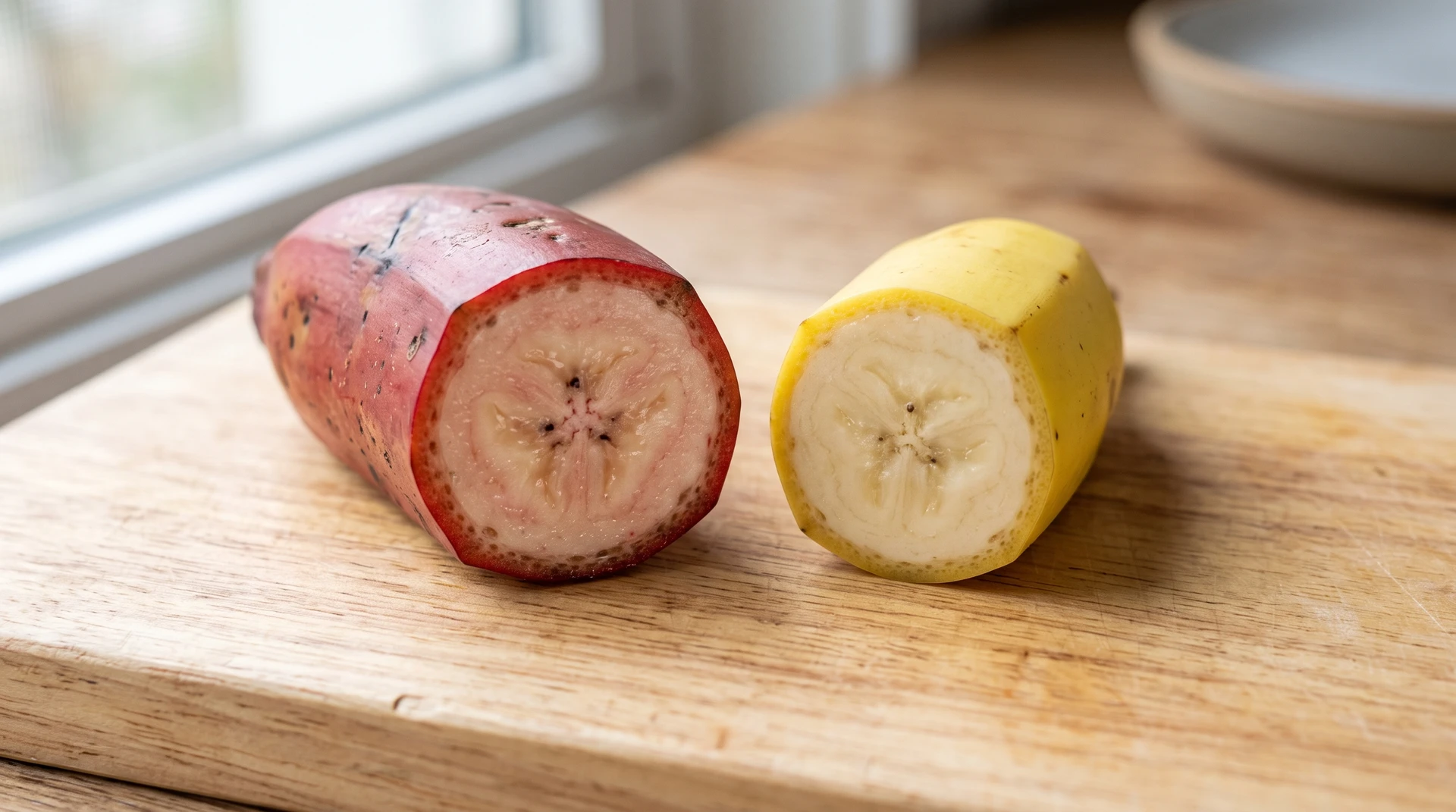
Taste is subjective, and every description we found comes from a seller. Daleys Fruit calls the flavor sweet and creamy, sometimes with berry overtones. Logee’s describes short, plump, reddish-purple fruit with creamy to light pink flesh, sweeter than yellow bananas and with a slightly longer shelf life, best eaten slightly soft.
Harvest by plumpness, not by color. UF/IFAS says to cut bunches when the fingers are plump and the edges have smoothed out, 7 to 14 days before they would ripen on the plant. The usual “wait for yellow” cue obviously doesn’t work on a maroon peel. Don’t refrigerate the bananas before they ripen, since UF/IFAS says that causes chilling injury, with failed or poor ripening and a bad flavor. A typical bunch weighs 25 to 40 pounds per pseudostem according to UF/IFAS, though that figure covers bananas in general and isn’t specific to red types.
Why a red banana plant isn’t fruiting
Most failures trace back to the temperature ladder or to the planting stock. The table matches each symptom to its documented cause.
| Symptom | Likely cause | Fix |
|---|---|---|
| Flower stalk stuck inside the top of the pseudostem | “Choking” from chilling below 60°F, or from drought stress | Keep nights above 60°F while it shoots; water in dry spells |
| Healthy leaves, no flower after two seasons | A freeze killed the pseudostem and the 10–15 month count restarted, or the plant hasn’t made its 26–32 leaves | Count from when the current pseudostem emerged, not from planting day |
| Ripening fruit looks dull yellow or greenish-gray, or the bunch is misshapen | Chilling injury during fruit fill | Time shooting for warm months; use the first-freeze count-back |
| First bunch is small | Normal for a planted rhizome | Let the mat build up and keep a staggered set of suckers |
| Weak plant with broad-leafed, loosely attached suckers and little fruit | Water suckers used as planting stock | Replant with large, healthy sword suckers |
| Leaves shredded | Wind; mild shredding may be beneficial, heavy shredding is not | Windbreak or a spot on the sheltered side of a wall |
| Yellowing, declining plant on a sprinkler timer | Too much water, too often, causing root rot | Water by need and plant where the soil drains |
| Bananas won’t ripen properly after picking | Refrigerated before ripening | Ripen at room temperature in a shaded, cool spot |
Frequently Asked Questions
Is a red banana tree actually a tree?
No. Texas A&M AgriLife Extension calls banana a tropical herbaceous plant, and the “trunk” is a pseudostem made of tightly packed leaf sheaths. It fruits once, then the fruited pseudostem is cut down and a sucker from the rhizome takes over.
Can I grow a red banana in zone 9?
You can grow one, but fruiting is a gamble. Zone 9b’s average coldest night of 25–30°F straddles the 28°F line that can kill the plant to the ground, and zone 9a averages 20–25°F. A warm wall, a banked base, and a mild winter are what get a bunch.
How long does a red banana plant take to fruit?
The flower stalk emerges 10 to 15 months after planting, and the bunch needs another 80 to 180 days to harvest. UF/IFAS’s end-to-end range from a small sucker is 9 to 20 months, and it can be longer in cool conditions.
Will a red banana plant survive a freeze?
The rhizome often will, the pseudostem often won’t. Below 28°F the top can be killed to the ground, and new growth usually sprouts from the rhizome when warm weather returns. That regrowth restarts the road to a bunch rather than rescuing the current one.
Can I grow a red banana in a pot and bring it indoors?
Nurseries sell it that way, with Logee’s listing 5–8 feet in a container. Keep it above 60°F, since UF/IFAS says growth slows below that line, and expect the same 10-to-15-month clock.
Do red bananas taste different from yellow ones?
Sellers describe them as sweeter and creamy, sometimes with berry overtones. A 2016 lab comparison found higher sugar and polyphenols in Red Dacca than in Cavendish, but taste is subjective and that is a single small comparison.
The Bottom Line
A red banana is a 10-to-15-month commitment before it even flowers, and 28°F is the line that can send the plant back to the rhizome. In zone 10b and warmer you can plant one and expect fruit. In 10a, pick a warm wall. In 9b, treat it as an experiment with a mild-winter payoff, and in 9a or colder, grow it in a pot or enjoy it as a foliage plant.
Sources
- Crane, J.H. and Balerdi, C.F. Banana Growing in the Florida Home Landscape (HS10/MG040). UF/IFAS Extension
- Texas A&M AgriLife Extension. Banana fact sheet. Aggie Horticulture
- Texas A&M AgriLife Extension, Leon County. Banana (slide presentation), 2020
- USDA Agricultural Research Service. USDA Unveils Updated Plant Hardiness Zone Map, 2023
- USDA Agricultural Research Service. How to Use the Maps. USDA Plant Hardiness Zone Map
- Green Acres Nursery & Supply. USDA Plant Hardiness Zones: average annual extreme minimum temperature 1991–2020 (handout hosted by UC ANR)
- Antioxidant and Antihyperglycemic Properties of Three Banana Cultivars (Musa spp.). Scientifica (Cairo), 2016
- Uyterhoeven, S. Still Going Bananas. New York Botanical Garden, 2014
- Logee’s. Banana Plant ‘Red Dacca’ (Musa acuminata) product page (logees.com/banana-plant-red-dacca.html, viewed 19 October 2026; the site rate-limits automated link checkers)
- Chestnut Hill Tree Farm. Red Cuban Banana product page (chestnuthilltreefarm.com/shop/red-cuban-banana, viewed 19 October 2026; the site blocks automated link checkers)
- Daleys Fruit. Banana – Red Dacca (Musa acuminata) plant profile


