Jalapeño Peppers: Cutting Water Lowered Heat in a California Trial, and Corking Doesn’t Predict It

Cutting water lowered jalapeño heat in a California field trial. See what cultivar, red ripeness and corking really do to Scoville, and what to try instead.
A jalapeño’s heat is set first by its cultivar and only then nudged by how you grow it. Published figures run from about 1,080 Scoville heat units (SHU) for the deliberately mild TAM II to about 20,000 for Grande, according to an America’s Test Kitchen report drawing on New Mexico State University’s Stephanie Walker. The tricks gardeners swap to get hotter fruit have a much patchier record. Cutting water raised capsaicin in one cultivar in a pot study, changed nothing in another, and lowered Scoville in the one jalapeño field trial we could find. Red fruit were hotter than green in some cultivars and milder in others. And the Chile Pepper Institute says the tan stretch lines on the skin, called corking, have no bearing on heat.
This guide grades each claim by the evidence behind it, shows the yield you pay for each one, and ends with a plan for growing the heat you actually want. Where a result comes from a different pepper than a jalapeño, the text says so.
| Common advice | What the evidence shows | Verdict |
|---|---|---|
| Pick a hot cultivar | Cultivar sets the range; stress cannot lift a low-heat genotype into a hot one (NMSU) | Strong |
| Cut back water to stress the plant | Up in one cultivar in one pot study, no change in another, lower SHU and lower yield in a jalapeño field trial | Mixed, with a real cost |
| Let fruit turn red | More capsaicin in red jalapeños ripened in storage; in 14 other cultivars it rose in 7 and fell in 7 | Depends on cultivar |
| Use less nitrogen | Reduced nitrogen gave the highest SHU in the jalapeño field trial; higher nitrogen lowered it | Plausible, one trial |
| Look for corking lines | Cosmetic and genetic, linked to moisture and temperature swings; no evidence it tracks heat | Not supported |
The takeaway in one sentence: choose the cultivar for the heat you want, keep the watering even, and treat everything else as a small adjustment you should test on your own plants.
What sets a jalapeño’s heat: cultivar first, weather second
Heat comes from capsaicinoids, and the two main ones, capsaicin and dihydrocapsaicin, account for about 80% of the total in peppers, according to Sung and colleagues. New Mexico State University’s extension guide on measuring chile heat states that heat is “the result of two factors: the plant’s genetics and the interaction of the plant with the environment.” The guide then spells out both directions. A mild cultivar becomes hotter under any stress in the field. A relatively hot cultivar grown in optimal conditions becomes only moderately hot. And a plant that genetically produces low-heat fruit “will not produce hot chile peppers even when grown in a stressed environment.”

Three pre-planned garden beds, free
Stop staring at empty beds: printable plans with exact layouts, plant lists and planting calendars — yours free from the Garden Library.
That last sentence is the one most growing tips skip. It means a store-bought TAM II-type transplant has a ceiling, and no watering schedule lifts it past that ceiling. Walker told America’s Test Kitchen that breeders at Texas A&M, NMSU and the seed companies began selecting for milder jalapeños between the mid-1980s and mid-1990s. The report’s examples are TAM II at about 1,080 SHU and Grande at about 20,000.
Colorado State University’s Food Source Information page gives the commonly quoted jalapeño range as 2,500 to 10,000 SHU and add that the Scoville scale “is not precise.” The same page places capsaicin in glands between the placenta and the inner wall of the fruit, with the highest concentration near the seeds. In practice the burn sits in the white ribs around the seeds, which is why scraping them out is the fastest way to cool a jalapeño down. For how that range stacks up against a neighbouring pepper, see our jalapeño versus serrano comparison.
Environment matters because the plant builds capsaicinoids in the placenta through the phenylpropanoid pathway, and enzymes in that pathway respond to conditions. A 2005 study in Botanical Bulletin of Academia Sinica tracked those enzymes in potted hot peppers. It also recorded the other half of the story: an enzyme called peroxidase breaks capsaicin down again, and its activity rose around the time concentrations started to fall. In its main cultivar, capsaicin peaked about 30 to 40 days after flowering and then declined. Keep that rise-and-fall shape in mind for the ripeness section, because it is the reason “the longer you wait, the hotter it gets” is not a safe rule.
Does cutting water make jalapeños hotter?
Sometimes in a pot, not in the one jalapeño field trial we found. The idea is old and has a mechanism behind it: in the Taiwanese pot study, a water-deficit schedule raised the activity of the capsaicin-building enzymes in one cultivar and produced fruit with a heavier share of placenta. But the three studies below, taken together, do not support a promise that less water means more heat.
| Study | Plants and setting | Water treatment | Effect on heat | Effect on fruit |
|---|---|---|---|---|
| UC Cooperative Extension and a Morgan Hill, California grower, 2010 (conference abstract) | Jalapeño, field | Irrigation cut off two weeks before harvest | Lower SHU and capsaicin than the control | Lower yield, smaller fruit |
| Sung et al., 2005 | Three non-jalapeño hot peppers, pots, greenhouse | Watered only after leaves wilted, about every 3 days, versus once or twice a day | One cultivar up to 3.84 times the control’s placenta capsaicin; another no difference until day 50; a third lower then higher | Lighter fruit in all three cultivars |
| Jinagool and Arom, 2023 | Two C. annuum and one C. frutescens, pots | 80%, 60% and 40% of maximum soil water-holding capacity | No significant change at 80% or 60%; 40% left too little fruit to test | Fewer, smaller fruit at 60% and 40% |
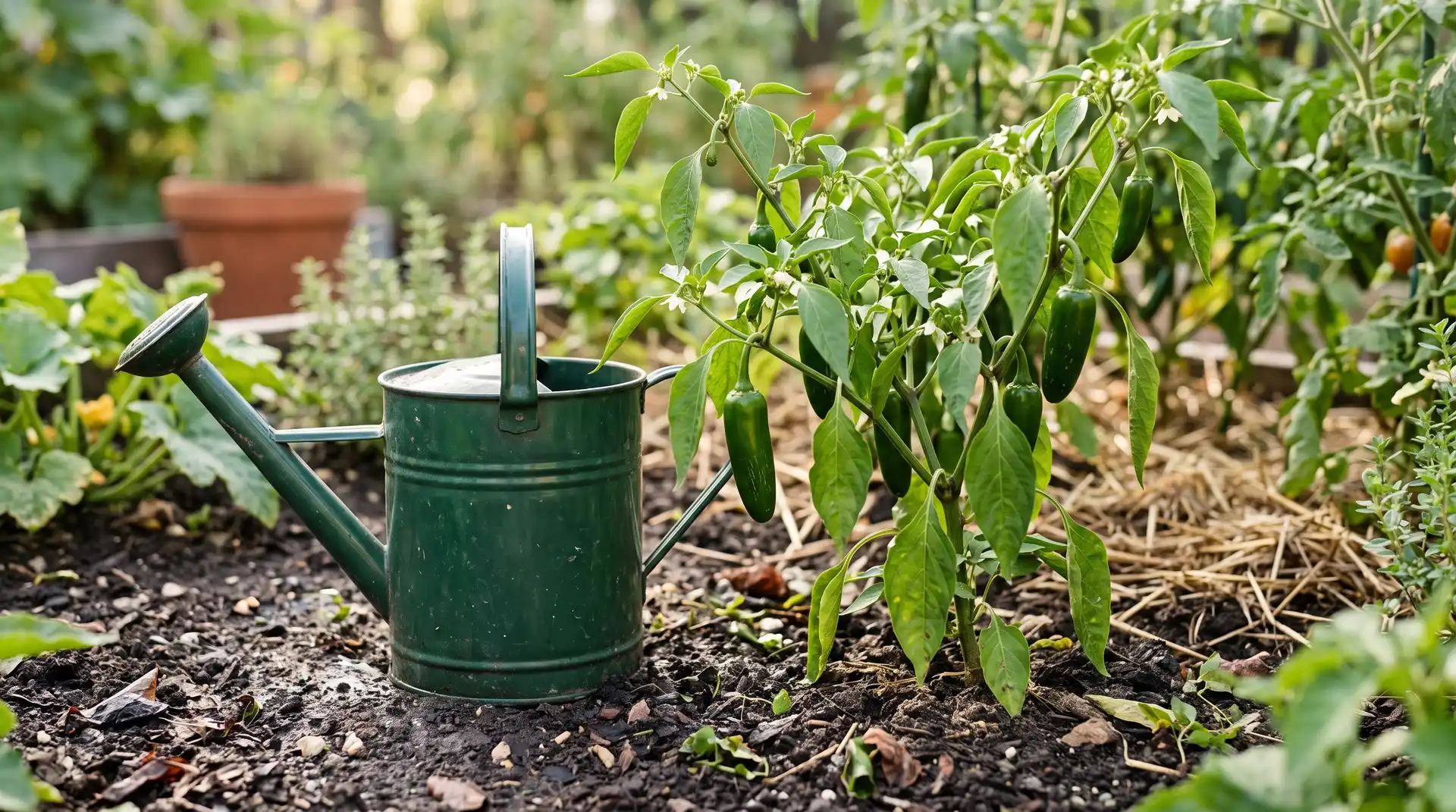
The jalapeño result is the most relevant and the least detailed. The 2011 ASHS conference abstract compared normal practice with a 50% nitrogen fluctuation, a low-water treatment (irrigation cut off two weeks before harvest) and added sea salt, across two harvests in September and October 2010. Treatments with adequate water out-yielded the cut-off, and fruit size fell as water input fell. On heat, reduced nitrogen produced the highest SHU, while salt, higher nitrogen and reduced water all landed below the control. The combination of water cut-off and higher nitrogen gave the lowest capsaicin of any treatment.
Read that with the right caution. It is an abstract from one grower’s field over one season, not a replicated multi-year study. A two-week cut-off before harvest is also a different stress from the mild, post-flowering dry-down most guides describe. What it does show is that a jalapeño field can lose both yield and heat when you pull water, which is the opposite of the headline claim.
The pot studies add a second problem: they measure capsaicin concentration, not the capsaicin a plant delivers. Jinagool and Arom note that when water restriction cut dry fruit yield, capsaicin yield per plant fell considerably, even where concentration held steady. You can end up with fewer peppers that are not reliably hotter. And the University of California’s Marin Master Gardeners warn that “water stress causes blossoms and developing fruit to drop,” while recommending “moderate, even watering.” Texas A&M’s jalapeño guide lists a water demand of 25 to 30 inches over the season and asks for irrigation applied uniformly.
One more claim from the original pitch deserves a straight answer: “without losing flavor.” We found no study that measured flavor, sweetness or aroma in water-stressed jalapeños, so nobody can promise it.
If you still want to test it, test it properly
Because the evidence is mixed, the sensible move is a split test on your own plants rather than a season-long gamble. Grow two plants of the same cultivar, side by side, in the same soil. Water both evenly until fruit are well set. Then let one dry slightly deeper between waterings, never to the point of wilt or flower drop, and keep the other steady. Pick fruit of the same size and colour from both on the same day, wear gloves, and taste a thin sliver of rib from each. Write down what you find. One season of that tells you more about your soil, climate and cultivar than any general rule, and the cost of being wrong is a few peppers, not a crop.
Are red jalapeños hotter than green ones?
Red jalapeños are fully ripe fruit of the same variety, not a different one, and whether they are hotter depends on the cultivar. The evidence for “red is hotter” in jalapeños comes from a single storage study. Mendoza-Sánchez and colleagues harvested jalapeños at full size and bright green, kept them at 25°C, and watched them turn red between day 15 and day 20. They report that “the capsaicin in green state was lower than that found for the red state,” and the red fruit also scored higher on a radical-scavenging antioxidant test (58% versus 19%). The catch is that the fruit ripened off the plant, so this is not a test of leaving fruit on the plant longer. The same paper notes that capsaicinoid content tends to fall as fruit senesce.
The wider picture is a coin toss. A 2019 Colorado State study in Antioxidants measured capsaicin at green and red or yellow stages in 18 cultivars, none of them jalapeños. Four had no detectable capsaicin. Of the other 14, capsaicin rose with ripening in seven and fell in seven. Five of each group were flagged as statistically different between stages, so those swings were distinguishable from noise. NuMex Joe E. Parker went from 99 to 177 µg/g and CSU RLC from 162 to 522, while Anaheim 118 dropped from 484 to 235 and Fresno from 848 to 735.
| Cultivar | Green (µg/g capsaicin) | Red or yellow (µg/g) | Direction |
|---|---|---|---|
| CSU RLC | 162 | 522 | Up |
| NuMex Joe E. Parker | 99 | 177 | Up |
| Habanero | 3,636 | 4,820 | Up |
| Fresno | 848 | 735 | Down |
| Anaheim 118 | 484 | 235 | Down |
| NuMex Big Jim | 398 | 222 | Down |
The honest reading: ripeness can raise heat, can lower it, and in a given jalapeño cultivar you will not know which until you taste. Since capsaicin builds, peaks and then degrades inside each fruit, a pepper left far past its peak can also lose some of what it gained. Our habanero growing guide describes the same peak-then-decline curve for the hotter species, and the table’s habanero row shows why no jalapeño trick closes that gap: its green fruit carried 3,636 µg/g of capsaicin, more than four times the highest green-stage figure (867) among the 13 C. annuum cultivars.
The price of waiting for red
Red also costs you fruit. The Marin Master Gardeners list 8 to 10 weeks for peppers to ripen fully and point out that “ripening keeps the plant from setting new fruit,” so growers who want volume often pick green. Colorado State notes that jalapeños are usually picked and eaten green, with some occasionally allowed to turn red. In a short-season garden that trade becomes a calendar problem: every fruit you leave to colour is a fruit you cannot replace before frost. Our zone 7 pepper timing guide shows how to count back from your first frost date, and the same arithmetic works in any zone.
The sensible compromise is to tag two or three early fruit per plant and let only those redden while you keep harvesting green ones. Picking green fruit regularly keeps the plant setting new ones, and our guide to jalapeño pruning for more peppers covers how topping and shaping raise the fruit load, so you can afford to sacrifice a few fruit to red.
Stop guessing if your garden pays.
Log what you grow and harvest — see total yield weight, estimated retail value, and season-on-season progress in one place.
→ Track My HarvestCorking: a stretch mark, not a heat gauge
The tan, vertical lines on a jalapeño’s shoulders are called corking, and nothing we found shows they predict heat. Iowa State University Extension says “corking is caused by variations in moisture and temperature,” that older jalapeño varieties are more prone to it, and that it “does not notably impact [a pepper’s] palatability.” The widely repeated explanation is that the fruit swells faster than its skin can stretch after a swing in moisture, and the skin heals over the splits as tan lines. We found no controlled study of that mechanism, but it fits the moisture-and-temperature cause.
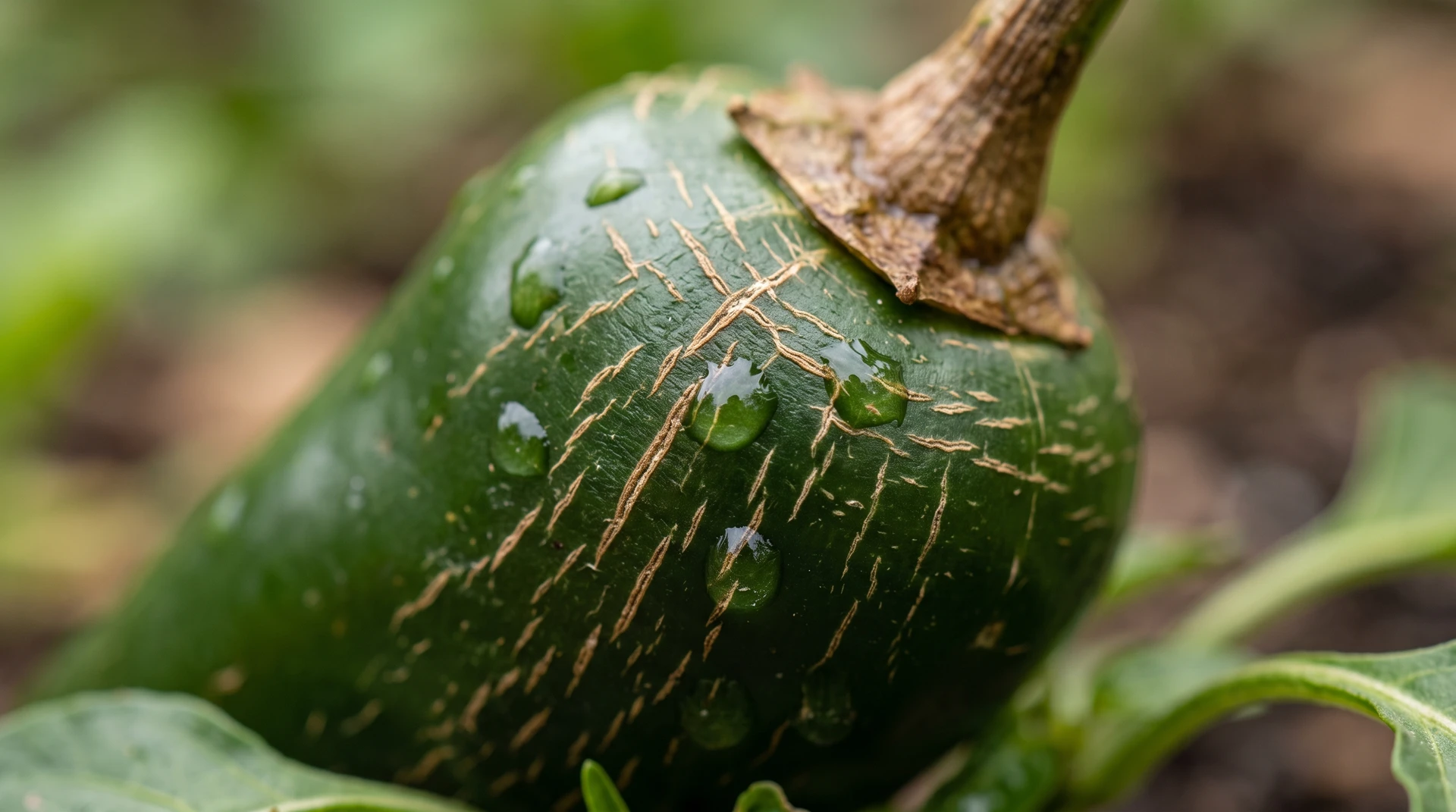
On heat, the best expert statement is from Danise Coon of the NMSU Chile Pepper Institute, quoted in Cook’s Illustrated, who called corking “merely a genetic trait with no bearing whatsoever on chile heat.” Cook’s own taste tests of corked and smooth jalapeños, tasting only and with no instrument measurement, came out “all over the map”: sometimes the corked ones tasted hotter, sometimes the smooth ones. That matches our reading of the evidence, which is that corking and heat have not been shown to be linked.
One correction on our own site is worth stating. Many jalapeño guides, including our jalapeño growing guide, describe corking as a sign the fruit has reached maximum capsaicin. The size-and-maturity half of that is reasonable, since older fruit on a mature plant tend to cork. The capsaicin half is the part we cannot support, and the sources above argue against it.
There is also a catch for anyone using stress watering. Corking follows swings in moisture, and a dry-down followed by a deep soak is a swing. A plant on a deliberate dry-and-drench schedule may well cork more, which would make the lines a sign of your watering pattern rather than of heat. That is our inference, not a tested result, but it is the opposite of treating the lines as a bonus. If you want fewer cracks, Iowa State recommends uniform moisture, mulch, watering through dry weather, and a crack-resistant cultivar such as Jalapeño Jalafuego.
How to grow the heat you want
Start with the cultivar and leave the dramatic interventions for last. The table below turns the evidence into actions, and says how firm each one is.
| Goal | What to do | Evidence behind it |
|---|---|---|
| Hotter fruit | Grow a cultivar with a hot record (Grande was recorded near 20,000 SHU) and read the seed packet’s heat claim before buying | NMSU: cultivar sets the range; ATK interview with NMSU’s Walker |
| Hotter fruit | Hold back extra nitrogen once plants are established | One jalapeño field trial: reduced N gave the highest SHU, higher N lowered it |
| Hotter fruit | Tag a few fruit to ripen red, then compare with green from the same plant | One jalapeño storage study says red is higher; 14-cultivar study says it varies |
| Milder fruit | Scrape out the white ribs and seeds before cooking | Colorado State: capsaicin is concentrated near the seeds |
| More peppers | Water evenly, mulch, and pick green fruit regularly | UC Marin Master Gardeners, Texas A&M, Iowa State |
| Avoid | Severe or prolonged water cut-offs, especially during flowering | Blossom and fruit drop; lower yield and SHU in the jalapeño trial |
Temperature plays a part too, though we found less on it. The Marin Master Gardeners note that in cooler climates “hot peppers won’t get as hot,” and Texas A&M puts the ideal at hot days of 85 to 95°F with cool nights of 65 to 70°F, adding that excessive heat reduces fruit size and causes bloom drop. NMSU’s guide also names temperature as an environmental factor that changes heat, so a cool summer can leave you with mild fruit that no watering plan will fix.
Why are my jalapeños mild? A diagnostic table
Mild jalapeños are far more often a cultivar or weather problem than a watering mistake. Work down this table from the top.
| What you see | Likely cause | What to try |
|---|---|---|
| Every fruit is mild, red ones included | A cultivar bred for low heat; NMSU says stress will not turn it hot | Check the tag; next year choose a cultivar with a hot record |
| Big, glossy fruit on a lush, heavily fed plant | Extra nitrogen; it lowered SHU in the jalapeño trial | Stop feeding high-nitrogen fertilizer once plants are established |
| Small green fruit picked early | Possibly lower capsaicin than fully red fruit, depending on cultivar | Let a few fruit colour and compare |
| Cool summer | Cooler growing conditions tend to give milder hot peppers (UC Marin) | Choose the warmest bed next year and start seedlings on time |
| Fruit with heavy corking tastes mild | Corking tracks moisture swings, not heat | Ignore the lines and even out watering |
| Hot one week, mild the next, same plant | Fruit-to-fruit and week-to-week variation; Scoville is “not precise” | Taste a sliver of rib (wear gloves) before cooking for guests |
| Flowers and small fruit dropping after you cut water | Water stress causes blossom and fruit drop (UC Marin) | Return to even watering and mulch the bed |
Frequently asked questions
Are red jalapeños hotter than green ones?
Sometimes. A storage study found more capsaicin in red jalapeños than in green ones ripened at 25°C, but in a 14-cultivar study of other peppers, capsaicin rose with ripeness in seven cultivars and fell in seven. Red jalapeños are the same variety, fully ripe; the extra ripening time costs you new fruit, because ripening stops the plant setting more.
Does stressing jalapeño plants make them hotter?
Not reliably. Water deficit raised capsaicin in one potted hot pepper cultivar and had little effect in two others, and the one jalapeño field trial we found showed lower SHU and lower yield after irrigation was cut off two weeks before harvest. NMSU says field stress raises heat in mild cultivars but cannot make a low-heat cultivar hot.
Does corking mean a jalapeño is hotter?
No evidence says so. The NMSU Chile Pepper Institute calls corking a genetic trait with no bearing on heat, and Iowa State links it to variations in moisture and temperature. Cook’s Illustrated tasting tests of corked and smooth jalapeños were inconclusive.
How hot is a jalapeño?
Colorado State University gives a commonly quoted range of 2,500 to 10,000 SHU. Cultivars vary more widely than that: TAM II has been recorded near 1,080 SHU and Grande near 20,000, so the cultivar matters more than any growing detail.
Can I make a mild jalapeño hotter?
Only a little. NMSU’s extension guide states that a plant that genetically produces low-heat fruit will not produce hot chile peppers even when grown in a stressed environment. For real heat, change the cultivar, or move up to a species like the habanero.
How do I make jalapeños less hot?
Remove the white ribs and seeds. Colorado State University reports that capsaicin is concentrated nearest the seeds, so scraping the interior takes out most of the heat before cooking. Wear gloves, because capsaicin stays on skin.
Sources
- New Mexico State University Cooperative Extension (Bosland and Walker). Measuring Chile Pepper Heat, Guide H-237. NMSU. pubs.nmsu.edu/_h/H237/
- Baameur, A. et al. Effect of Production Inputs On Jalapeño Pungency. Conference abstract, 2011 ASHS Annual Conference. American Society for Horticultural Science. ashs.confex.com/ashs/2011/webprogram/Paper6484.html
- Sung, Y., Chang, Y.-Y. and Ting, N.-L. Capsaicin biosynthesis in water-stressed hot pepper fruits. Botanical Bulletin of Academia Sinica 46:35-42 (2005)
- Jinagool, W. and Arom, P. Influence of Watering Regimes on Physiological Traits, Growth, Yield, and Capsaicin Content of Chilies. ASEAN Journal of Scientific and Technological Reports 26(1) (2023)
- Mendoza-Sánchez, L.G. et al. Physicochemical and antioxidant properties of jalapeño pepper (Capsicum annuum var. annuum) during storage. Revista Chapingo Serie Horticultura 21(3):229-241 (2015)
- Hamed, M., Kalita, D., Bartolo, M.E. and Jayanty, S.S. Capsaicinoids, Polyphenols and Antioxidant Activities of Capsicum annuum: Comparative Study of the Effect of Ripening Stage and Cooking Methods. Antioxidants 8(9):364 (2019). pmc.ncbi.nlm.nih.gov/articles/PMC6770197
- Iowa State University Extension and Outreach. Why do my peppers have brown lines on them? Yard and Garden
- Cook’s Illustrated. Gauging Chile Heat (quoting Danise Coon, NMSU Chile Pepper Institute). America’s Test Kitchen
- Hays, R. Have Jalapeños Lost Their Heat? (quoting Stephanie Walker, NMSU). America’s Test Kitchen, June 26, 2024. americastestkitchen.com/articles/8233-have-jalapenos-lost-their-heat
- Colorado State University College of Health and Human Sciences. Jalapeño Peppers. Food Source Information
- UC Marin Master Gardeners, University of California Agriculture and Natural Resources. Peppers
- Masabni, J. Jalapeño and Other Hot Peppers. Texas A&M AgriLife Extension (2011)