

How to Prune a Holly Bush: Cut Christmas Greens in December, Then Pick Between Early Summer and Late Winter (Extension Services Split)

How to prune a holly bush: cut Christmas greens in December, then pick early summer or late winter. Hat-racking limits and berry risk from extension sources.
In short
- To prune a holly bush, cut Christmas greens in December and save heavy cuts for late winter.
- Penn State says early summer for evergreen hollies; Maryland and NC State say late winter.
- Hat-racking removes one-half to three-fourths of branch length (Penn State).
- Checked against: Penn State, Delaware, Maryland, Clemson, NC State, Virginia Tech.
Penn State Extension tells gardeners to prune holly in December, and another Penn State Extension article says early summer is the best time to prune evergreen hollies. Both are right, because they answer different questions: December is for cutting greens for decoration, early summer is the window Penn State gives when berries are the concern, and late winter to early spring is where most other sources want the heavy cuts. This guide sorts the windows by what you want from the cut, shows where the sources disagree about which wood carries next year’s flower buds, and gives the hard-cut limits for each holly type.
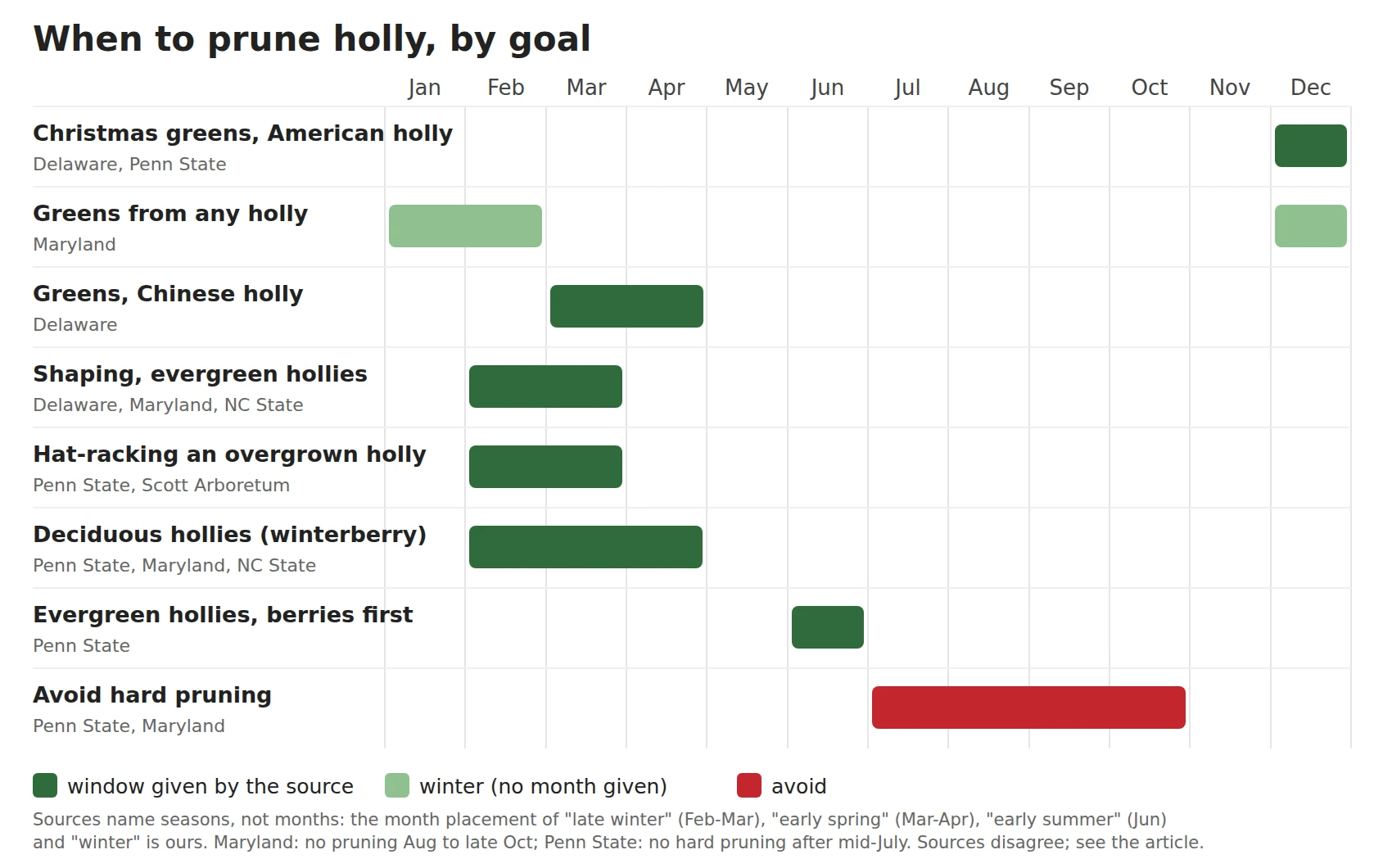
Which month to prune holly: the windows, by goal
Dead, diseased or wayward branches can come out at any time, and the rest depends on what you want from the cut. The table sets each goal beside the window the sources give; the right-hand column says who gives it, because the sources do not all agree.
| Goal | Window | Who says so |
|---|---|---|
| Christmas greens from American holly | December | Delaware: “American holly may be pruned in December for Christmas greens.” Penn State: “Prune holly during December.” |
| Greens from any holly | Winter | Maryland: trim hollies and other evergreens during the winter if the branches will be used for holiday decorations. |
| Greens from Chinese holly | Early spring | Delaware: Chinese holly “may be trimmed in the early spring.” |
| General shaping of evergreen hollies | Late winter to early spring, just before growth | Delaware (general evergreen rule); Maryland Ask Extension (roughly February into March); NC State (Chinese holly, late winter) |
| Shaping when berries matter | Early summer | Penn State: evergreen hollies “set flower buds the previous fall” |
| Deciduous hollies (winterberry) | Late winter or early spring, before growth; Maryland says before the end of April | Penn State, Maryland Ask Extension, NC State, Virginia Tech |
| Hat-racking an overgrown holly | Late winter; March | Penn State (late winter); Scott Arboretum (March) |
| Avoid | After mid-July, and from August to late October | Penn State: a hard pruning after mid-July can force growth that does not harden off before winter; Maryland: do not prune from August to late October |
The table’s biggest takeaway: December works for greens, late winter works for size, and only Penn State names early summer because of flower buds.

Three pre-planned garden beds, free
Stop staring at empty beds: printable plans with exact layouts, plant lists and planting calendars — yours free from the Garden Library.
Any of these assumes the plant has had time to settle. Illinois Extension says to prune hollies after they have been established for several years, because new plants resent pruning, and that mature plants can be kept to a manageable size and shape by pruning in late fall or early winter.
December: cut your Christmas greens
Cutting greens in December is real pruning, and Delaware and Penn State both recommend it for holly. Delaware’s fact sheet says many evergreens are pruned at Christmas by homeowners who want cut greens, and Illinois Extension adds that collecting the branches for holiday decorations is a bonus of pruning. Why the cuts matter: a heading cut removes the growing tip of a shoot, and the buds below it wake up (UGA), so the sprig you hang on the door is also the cut that thickens the shrub.
For American holly, Delaware gives one rule for the cut: “always make the cut at a node, just above a lateral bud,” and prune so as to maintain the natural shape of the tree. That is a heading cut (more on cuts below), so spread the cuts around the plant. Our suggestion, which none of these sources states: take a sprig from many branches rather than stripping one side, so no part of the shrub is left bare and the outline stays natural.
What to cut, and what to keep out of reach
- Cut it outdoors, use it outdoors. Penn State warns that holly leaves may drop off the stems indoors, so use the cuttings outdoors.
- Berried sprigs are the poisonous part. NC State Extension’s Plant Toolbox lists the fruits of American holly as the poisonous part and gives the toxic principle as illicin, possibly saponic glycosides, and triterpenoids; it lists contact dermatitis as “No.” Keep berried sprigs where children and pets cannot reach them.
- Know the species. The December advice is for American holly. Delaware puts Chinese holly in early spring instead. Our guide to yaupon holly covers the Southern hedge holly, which Clemson’s pruning fact sheet lists among the shrubs often pruned as tree forms.
- Know the history. The reason holly ends up on the door at all is its evergreen leaf; see the meaning of holly for the tradition.
Cutting a female holly in December means cutting berries too, and no page we read measures what that does to next year’s crop; Maryland says early trimming removes some flower buds of evergreen hollies, and Penn State ties early summer to buds set the previous fall. The sections below show why that question has no single answer.
Heading cut or thinning cut: which one a holly needs
The difference between the two cuts decides how a holly regrows, because they act on different parts of the plant. The University of Georgia defines heading as removing the terminal portion of a shoot or limb and thinning as removing an entire shoot or limb back to its point of origin. Heading stimulates regrowth near the cut, because removing the tip removes apical dominance (the tip’s suppression of the buds below it). Thinning is generally the least invigorating type of cut and gives a more natural growth form. For a deeper look at all the cuts, see our guide to pruning techniques.

Clemson Extension describes what that means for a shrub: when shrubs are headed back or sheared routinely, a lot of dense, thick new growth is produced near the outer canopy, whereas thinning “encourages new growth within the interior portions of a shrub, reduces size and provides a fuller, more attractive plant,” and is usually preferred. Delaware’s evergreen sheet agrees that shearing encourages additional lateral growth and a more dense habit of growth.
The two cuts suit different holly jobs, as the table shows.
| Job | Cut | What the sources say |
|---|---|---|
| Clipped hedge or topiary | Heading (clipping) | NC State: Japanese holly can be severely pruned to manage its size, so it works in small spaces and as topiary. Clemson: the dwarf inkberry ‘Compacta’ grows to 4 feet but can be sheared to make a 2-foot hedge. |
| Natural-shaped American holly | Heading at a node, spread around the plant | Delaware: cut at a node just above a lateral bud and maintain the natural shape. |
| Cutting the plant down in size | Thinning, over several years | Maryland Ask Extension: the preferred way to reduce size on evergreen shrubs is to thin them over a few years rather than in a single event. Clemson: cuts should be hidden inside the plant, where remaining leaves cover them. |
| Opening a dense, shaded interior | Thinning | Clemson: thinning encourages new growth within the interior of the shrub. |
Shearing makes a holly dense on the outside, and thinning opens the middle. If the leaves inside a sheared holly are dying or spotting, pruning will not fix every cause; check our holly diseases guide before you cut again.
How each holly type takes a cut
Holly species differ a lot in pruning tolerance, so identify yours before you pick a cut. The table gives what each source says for each type; a blank means we found no page for that type.
| Holly | What the sources say | Source |
|---|---|---|
| American (Ilex opaca) | December greens, cut at a node; keep the natural shape. Hat-racking is used on it. | Delaware; Scott Arboretum |
| Chinese (I. cornuta) | Greens in early spring (Delaware); prune in late winter to control size, remembering that next year’s blossoms and berries appear on new growth (NC State) | Delaware; NC State |
| Japanese (I. crenata) | Tolerates severe pruning (Clemson); can be severely pruned to manage size and used as topiary (NC State). Delaware: shrubby Chinese and Japanese hollies can be more severely pruned and may need some light pruning during the growing season. | Clemson; NC State |
| Inkberry (I. glabra) | Minimal pruning; if desired, prune in early spring just before new growth. Regrowth after drastic trimming is not always dense. | NC State; Maryland; Maryland Ask Extension |
| Winterberry (I. verticillata, deciduous) | Flowers appear on new growth (NC State). Prune in late winter, no more than one-third at a time (Penn State); early spring (Virginia Tech); early spring, before new growth (NC State ‘Winter Red’ page) | NC State; Virginia Tech; Penn State |
| Yaupon (I. vomitoria) | Listed among the shrubs often pruned as tree forms | Clemson, Pruning Shrubs |
Pick the cut to match the row, not the other way round: a Japanese holly forgives what an inkberry will not. Virginia Tech adds a size warning that matters for a foundation planting: a ‘Nellie R. Stevens’ holly that fits the corner of a house will be about 15 feet tall and 8 feet wide in ten years unless it is pruned annually.
Will pruning cost you berries? Where the sources disagree
Pruning can cost berries, but the sources disagree on which wood carries the flower buds, so the safest advice is the lightest cut, in the window that fits your goal. Only female hollies bear berries, and Penn State says the female needs a compatible male of the same or related species within about 40 to 100 feet, so a berryless holly is not always a pruning problem. Penn State lists “improper or heavy pruning” among the reasons female hollies fail to fruit, and the details differ by source. Our holly bush care guide covers the male, the distance and the cultivars that set fruit without one.
| Source | What it says about pruning and flowers | What it implies (our reading) |
|---|---|---|
| Penn State (berries article) | Evergreen hollies “set flower buds the previous fall”; early summer is the best time to prune them. Deciduous hollies bloom on new wood. | Late-winter cuts on an evergreen holly remove buds that are already set |
| Maryland (Ask Extension) | Early-season trimming of evergreen hollies can reduce berries because it removes some flower buds, but unless pruning is extensive, some berries will probably form on uncut twigs. | A light late-winter trim costs part of the crop, not all |
| NC State (Chinese holly) | Prune in late winter; next year’s blossoms and berries will appear on new growth. | Late winter is fine for flowers, on this species |
| NC State (winterberry) | Flowers appear on new growth (species page); shape in early spring before new growth (‘Winter Red’ page). | Fine for flowers, though Virginia Tech says a deliberate prune costs one crop |
| Virginia Tech (winterberry) | For increased fruiting, prune in early spring to increase branching. This pruning will decrease fruiting the following year but will pay dividends in future years. | Even a deliberate prune costs one crop |
The table’s biggest takeaway: no source we read puts a number on how much of an evergreen holly’s crop a late-winter trim removes, and the sources split on the bud question. Penn State and Maryland say pruning removes flower buds that are already set, while NC State says Chinese holly blossoms appear on new growth.
A common assumption is that holly berries are set on previous-year wood. That is Penn State’s position for evergreen hollies, and NC State’s position for Chinese holly and winterberry is the reverse, so treat it as one source’s view, not a settled fact. We found no page that reconciles the two.
A rule that holds under either view
- Keep the cut small. Maryland says unless the pruning is extensive, some berries will probably still form on uncut twigs.
- Prune deciduous hollies in the window their sources give. Late winter and no more than a third at a time (Penn State); Maryland, Virginia Tech and NC State’s ‘Winter Red’ page also give early spring.
- Stay out of late summer and fall. Penn State warns about hard pruning after mid-July; Maryland says not to prune from August to late October, because new growth will not harden off before winter.
- If berries matter more than shape, use Penn State’s early-summer window and keep the cut light.
Overgrown holly: how hard you can cut
An overgrown holly can usually be cut back hard, but the sources disagree on how hard, so match the cut to the holly and expect a thin look for a year. The numbers below are each source’s own.
| Source | How hard | When | Plants named |
|---|---|---|---|
| Penn State | Cut branches back by one-half to three-fourths (“hat rack”); the plant rebounds in two to three years | Late winter | Holly |
| Scott Arboretum | Reduced all branches by two-thirds on a hybrid holly; little sign of the cut by the end of the next growing season | March | Ilex aquifolium, I. opaca, ‘Doctor Kassab’ |
| Clemson (renovate) | Cut down to within 6 to 12 inches of the ground | Before spring growth | Azalea, glossy abelia, holly, Japanese cleyera |
| Clemson (renew) | Prune out a few shoots at a time over a period of three years | Dormant season (author’s preference) | Multi-stemmed shrubs (holly is named under “renovate”, not here) |
| Virginia Tech | Drastically prune to about one foot above ground; new stems in a short period | Preferably early spring | Evergreen hollies |
| Maryland (general rule) | “Do not cut evergreen branches into old wood”; once overgrown it is usually too late and they will need replacing | Severe pruning of evergreens in early spring | Evergreens (yews, junipers, hemlocks and a few conifers are exceptions) |
One-half to three-fourths of branch length is what Penn State says to remove when hat-racking an overgrown holly in late winter.
The Maryland rule is the outlier: it names evergreens such as yew and juniper as exceptions, not holly, and Penn State, Scott Arboretum, Clemson and Virginia Tech all describe holly regrowing from hard cuts. It is a general evergreen warning, and the holly-specific pages disagree with it.
Which route to pick
- Hat-racking in one year suits a tough holly you can live without looking at for a season: Scott Arboretum names English, American and a hybrid holly, and Clemson and NC State say Japanese holly tolerates severe pruning. The cost is one thin, open season (Scott Arboretum: the first growing season the tree will be fairly open).
- Thinning over several years suits a holly beside a window or on a hedge line. Maryland Ask Extension prefers thinning evergreen shrubs over a few years to a single cut, and Clemson’s three-year renewal works the same way for multi-stemmed shrubs; our suggestion is that spreading the cuts leaves the plant clothed throughout.
- Replacing it is Maryland Ask Extension’s worst-case option for an inkberry that stays sparse after a drastic trim; it suggests a dwarf cultivar suited to the space.
Whichever you pick, our reading is that a hard cut at this size is likely to cost the next crop of berries on a female plant. No source gives a berry recovery time, and Penn State’s two-to-three-year rebound is for the whole plant, not the fruit. For hedge plants that tolerate hard cutting, and those that do not, see our best hedge plants guide.
Sharp-leaf safety
Pruning a spiny holly needs gloves and long sleeves; Virginia Tech says that pruning hollies with spine-tipped leaves requires them. The same page notes that many holly cultivars have sharp spine-tipped leaves, which affects how close they sit to walkways. Our suggestion, which the sources do not state: wear eye protection too, and prune from the outside inward, so you are not reaching through spiny leaves toward the cut.
Which pruning plan should you choose?
- If you want Christmas greens from an established American holly, cut sprigs at a node in December (Delaware, Penn State); Illinois says to wait until the plant has been established for several years.
- If you want a smaller or tidier evergreen holly, thin in late winter, lightly (Delaware, Maryland).
- If berries matter most on a female evergreen holly, use Penn State’s early-summer window and keep the cut light.
- If your holly is overgrown, hat-rack it in late winter (Penn State; Scott Arboretum did it in March on English, American and a hybrid holly), or cut to 6 to 12 inches before spring growth (Clemson).
- If it is a winterberry, prune in late winter or early spring before growth, and no more than one-third at a time (Penn State).
Frequently asked questions
When is the best time to prune a holly bush?
It depends on the goal. December is the window for Christmas greens on American holly (Delaware, Penn State), late winter to early spring is the usual window for shaping (Delaware, Maryland), and Penn State names early summer as the best time to prune evergreen hollies when berries are the concern.
Can you prune holly in winter?
Yes. Maryland says to trim hollies during the winter if the branches will be used for holiday decorations, and to leave severe pruning of evergreens for early spring.
How far back can you cut a holly bush?
Penn State says one-half to three-fourths of the branch length for hat-racking, Scott Arboretum cut a hybrid holly back by two-thirds, and Clemson goes down to 6 to 12 inches and Virginia Tech to about one foot. Maryland’s general rule against cutting evergreens into old wood is the exception.
Will pruning stop my holly from making berries?
It can. Penn State lists improper or heavy pruning among the reasons female hollies fail to fruit, and Maryland says early-season trimming can reduce berries because it removes some flower buds. A light trim leaves part of the crop on uncut twigs.
Can I prune holly in summer?
Early summer is fine for evergreen hollies by Penn State’s account, but hard pruning after mid-July can force growth that will not harden off before winter, and Maryland says not to prune from August to late October.
Are holly cuttings safe to bring indoors?
The leaves are not listed as a contact-dermatitis problem for American holly, but NC State lists the fruits as the poisonous part, and Penn State says leaves may drop off the stems indoors.
Sources
- Penn State Extension. Why Doesn’t My Holly Have Berries? Penn State
- Penn State Extension. Mistletoe and Holly. Penn State
- University of Delaware Cooperative Extension. Pruning Evergreens. University of Delaware
- University of Illinois Extension. Growing Holly. Illinois Extension
- Ask Extension (University of Maryland Extension answer, February 2022). Pruning ilex. eXtension
- University of Maryland Extension. Pruning Shrubs and Hedges in the Home Garden. Home and Garden Information Center
- University of Maryland Extension. Inkberry Holly. Home and Garden Information Center
- Clemson Cooperative Extension. A Shrub Do-over Involves a Makeover (March 10, 2022). Home & Garden Information Center
- Clemson Cooperative Extension. Pruning Shrubs, HGIC 1053. Home & Garden Information Center
- Clemson Cooperative Extension. Holly. Home & Garden Information Center
- Virginia Cooperative Extension. Evergreen Hollies (Ilex spp.), publication 3010-1482. Virginia Tech
- Virginia Cooperative Extension. Winterberry, publication 2901-1077. Virginia Tech
- NC State Extension. Ilex opaca (American Holly). North Carolina Extension Gardener Plant Toolbox
- NC State Extension. Ilex cornuta (Chinese Holly). North Carolina Extension Gardener Plant Toolbox
- NC State Extension. Ilex crenata (Japanese Holly). North Carolina Extension Gardener Plant Toolbox
- NC State Extension. Ilex glabra (Inkberry). North Carolina Extension Gardener Plant Toolbox
- NC State Extension. Ilex verticillata (Winterberry). North Carolina Extension Gardener Plant Toolbox
- NC State Extension. Ilex verticillata ‘Winter Red’. North Carolina Extension Gardener Plant Toolbox
- University of Georgia Extension. Basic Principles of Pruning Woody Plants, Bulletin 949. UGA CAES
- Scott Arboretum of Swarthmore College. Hat Racking Hollies (April 7, 2008). Scott Arboretum & Gardens


